
Introduction
The dropdown runs 12 to 36 inches and never says which is yours. Or your box sits idle since it scraped your shin.
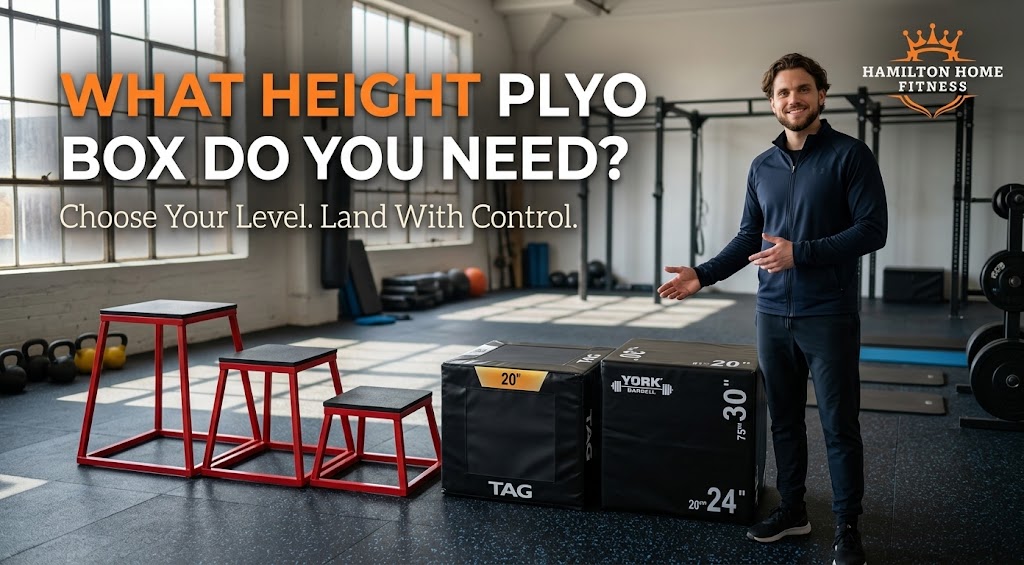
What height plyo box should I get? Start on 12 to 18 inches, move to 20 to 24 once landings are clean, and treat 30 as a skill you earn. The box tests your landing, not your jump.
Inside: a height-by-level table, a ceiling and floor check, a six-point readiness test, and why you always step down.
Coming back from a knee, ankle, or Achilles injury? Jumping waits for your doctor or physical therapist, so get cleared, then keep training around an injury.
What Box Height Fits Your Level?
Most beginners should start on a 12- to 18-inch box, intermediates on 20 to 24 inches, and experienced jumpers on 24 to 30. The right height is the one you land on in the same shallow squat you jumped from every rep, not the tallest box you can clear once.
Charts answer, "What height plyo box should I get?” differently: some size the box you clear once, others the landing you repeat.
How high should my plyo box be? Find your row; shorter lifters start at its low end.
Level | Jump box | Who it fits |
Beginner or returning | 12–18 in | New or rebuilding |
Intermediate | 20–24 in | Months of clean landings |
Advanced | 24–30 in | Years of jumping |
Specialist | 36 in | Tall athletes, high ceilings |
Why a Taller Box Isn’t Harder Work
A taller box doesn’t make your jump more powerful; it makes your landing harder and a miss more costly. The extra inches mostly test your knee tuck.
Small studies of 10 to 31 people found takeoff force and power barely change from low to high boxes. In one, elite handball players’ best box didn’t track their vertical jump.
Bored at your height? Try box drills that add challenge without more height.
Will Your Room Fit the Box You Want?
Check headroom and floor before you pick a height. You need your own height plus the box plus at least 6 inches to stand tall on top and a firm rubber surface that keeps both the box and your feet from sliding.
How Much Ceiling Do Box Jumps Need?
Add your height, the box height, and 6 inches; if the total beats your ceiling, that box is too tall for your room. Use the same check to plan a garage gym by square footage.
In an 8-foot room:
5'4" tall: up to 24 inches
5'10" tall: up to 20 inches
6'0" tall: up to 18 inches
A 30-inch box fits only if you’re 5'0" or shorter. The 6 inches is an estimate; arms overhead need more, and a 7-foot basement may fit step-ups only.
Studio, school, or team room? Book a gym design.
What Should the Box Sit On?
Put the box and your takeoff spot on the same firm, non-slip rubber surface, never carpet, tile, slick concrete, or finished hardwood. Light foam boxes slide most; equipment makers advise rubber under any plyo box.
Keep a clear floor behind the box for the step down. Then check how thick the rubber under a landing zone should be.
If ducts, beams or lights hang overhead, Gym Space Guide shows how to measure your real ceiling height to the lowest obstruction, minus flooring.
How Do You Size a Box for Step-Ups?
Size a step-up box to your legs, not your jump: with one foot on the box, your thigh should sit about level with the floor. For most adults that lands between 15 and 19 inches, so a 12- or 18-inch box often covers both jobs early on.
Jump boxes climb with skill; step-up boxes don’t.
Leg Length Sets the Step-Up Height
A thigh-level step-up box is roughly a quarter of your standing height. Estimates from typical body proportions, not a standard:
5'0" tall: about 15 inches
5'4" tall: about 16 inches
5'8" tall: about 17 inches
6'0" tall: about 18 inches
6'4" tall: about 19 inches
Older adults and rehab clients start near 12 inches and jump only with a coach’s or clinician’s OK. Pair that with balance work for older adults.
Box Jump or Step-Up: Which Fits Today?
Use step-ups to build single-leg strength you can load, and box jumps to train speed while your legs are fresh. Speed here means rate of force development: how fast you produce force.
On a sore-knee or nervous day, step up instead. Loaded step-ups? Add dumbbells, or see how heavy a weighted vest should be.
What Does a Safe Landing Look Like?
A safe landing puts both whole feet on the box in the same shallow squat you jumped from: hips back and above your knees, knees over your toes, almost no sound. Hold it for a beat, then stand tall.
When 23 adults landed from a drop, the cue “push your hips back” cut peak Achilles tendon force more than “bend your knees” or “land quietly.” Film one set from the side to check yours.
What a Bad Landing Warns You About
A loud, deep, or wobbly landing means the box is too tall for you today or you’re tired, so end the set there.
Loud slap: joints absorbing, not muscles
Knees caving in: lower the box, slow down
Deep squat or knees at chest: box too tall
Toes on the edge: box too high or too far
Ankle wobble: rebuild ankle control first
Wobbling since an old injury? First rebuild ankle stability after a sprain.
Of 205 female athletes, those who later tore an ACL had landed with about 8 degrees more knee cave-in; read it as a warning, not a forecast.
Why Step Down Instead of Jumping Down?
Step down after every box jump, one foot, then the other. Jumping back down turns the box into a drop landing, and landing force climbs fast as that drop grows, so the box jump’s real cost sits on the way down, not the way up.
In a lab study of 16 trained men, single-leg drop landings hit under 3 times body weight up to roughly 12 inches but about 5.3 times at roughly 30 inches. No trial has compared injury rates for stepping versus jumping down; the case rests on load and coaching experience.
Are Box Jumps Bad for Your Knees?
Box jumps aren’t bad for healthy knees at the right height, because landing on the box shortens your fall. The stress comes from jumping down, caving knees, and piling on reps, which can irritate the patellar tendon (jumper’s knee).
Knee pain, past surgery, or an ACL history? See a physical therapist before jumping. If jumping never sits well, try sled work for knee-friendly conditioning.
When Is Rebounding Acceptable?
Rebounding is acceptable in one form, the depth jump: you step, never jump, off a low box, and spring up the instant you land. It suits trained jumpers with clean landings and a certified coach (NSCA, NASM, or ACSM).
Start at 12 to 18 inches; most work stays under 24
Lower it if you rebound lower than a floor jump
Over 220 lb; many coaches cap it near 18 inches
That 220-pound cap rests on thin evidence. Touch-and-go rebounds in timed workouts trade control for speed; skip them.
How Many Box Jumps Should You Do?
For power, do 3 to 5 sets of 3 to 5 box jumps with 1 to 2 minutes of rest, once or twice a week, early in the workout. Stop a set the moment a landing gets loud or deep. Box jumps are never trained to failure.
Sample session: a warm-up that won’t blunt your jumps, then 4 sets of 4 on an 18-inch box.
3–5 sets of 3–5 jumps, full rest between
1–2 sessions a week, 48–72 hours apart
Jumps first, right after the warm-up
Session cap: 80–100 new contacts, 140 advanced
Count rope skipping toward that cap
Those contact caps, 80–100 new, 100–120 intermediate, and 120–140 advanced, count every landing in the session, so box jumps alone sit far below them. High-rep conditioning box jumps are a different goal: lower box, step down every rep.
Are You Ready for the Next Height?
You’re ready for the next height when every jump at your current one passes six checks across two separate sessions. Then move up one step, 2 to 4 inches or the next face of a 3-in-1, and try it fresh at the start of a workout.
On a 3-in-1, 24 to 30 is a 6-inch leap. Treat the test as a coaching rule of thumb, and check the first five on side-on video.
Same shallow squat on landing as takeoff
Whole feet on the box, near-silent
Knees over toes, no cave-in
No knee tuck needed to clear the edge
Controlled step-down every rep
No knee, shin, or Achilles pain the next day
One bad landing at the new height means dropping back a step.
Rebuilding Nerve After a Shin Scrape
Rebuild from contact, not courage: step-ups first, then low jumps, then a soft box one step below the height that caught you. A skin scrape only costs a nerve; bone pain that lingers needs a professional before any jumping.
Step-ups onto the box to retouch the edge
Jumps onto a low plate stack or 12-inch box
Soft box one step below your old height
Old height, first in a fresh session
Keep the bumper-plate stack low, wide, and flat on rubber flooring. Raise it only after 5 fearless reps; never stack plates on a box.
Which Box Fits Your Starting Height?
Buy the box for the height you’ll start on, not the one you hope to reach: a fixed 12- or 18-inch box for true beginners, a 3-in-1 foam box once you land 20 inches cleanly, and a fixed 30- or 36-inch box only for advanced jumpers with the ceiling for it.
Prices are as of October 2026. Whichever box you choose, set it on rubber flooring.
Starting at 12 or 18 inches
A single fixed box is the cheapest way to own your exact starting height. Apollo’s steel-framed Heavy Duty Plyo Box at 12 inches ($58.05) suits true beginners, nervous returners, shorter lifters and older adults’ step-ups.
The 18-inch version ($67.50) suits athletic beginners and step-ups for lifters near 6 feet. Both have a hard steel-frame edge that punishes a missed jump, and neither lists a weight capacity, so ask us before loaded step-ups.
Starting at 20 With Room to Grow
If you already land 20 inches cleanly, a 3-in-1 foam box gives you 20, 24 and 30 inches in one purchase. The budget pick, the York 3-in-1 Plyo Box (128.75),costslessthanfixed18-and24-inchboxestogether(147.15). It’s light, though, so it needs rubber underfoot, and it ships at standard rates.
The TAG Fitness 3-Way Plyo Box ($398.00) is ultra-dense foam under vinyl at 65 lb, so it stays planted, and it ships free. It suits shared gyms and anyone rebuilding after a shin scrape, for about three times the York’s price.
Both start at 20 inches, too tall for true beginners. Their 30-inch face is 6 inches up from 24 and has the smallest top, about 20 by 24 inches.
Training at 30 Inches and Above
Fixed 30- and 36-inch boxes suit advanced jumpers and tall athletes, if the ceiling allows. The 30-inch Heavy Duty box (89.10)andthe36-inch(101.25) are the low-cost route.
In an 8-foot room, standing tall on 30 inches works only at about 5'0" or shorter. The hard edge is also least forgiving at height. Own a 3-in-1 already? Its 30-inch face covers that height.
FAQ
Is a 24 inch box jump good?
Yes. A clean 24-inch box jump is a solid mark for most adults. It’s the men’s standard in CrossFit competition; women use 20 inches. It only counts if you land as shallow as you took off. The 24-inch box ($79.65) is a low-cost way to train it.
Can you build muscle with box jumps?
Some, mostly in the legs and mostly if you’re newer to training. A review of six head-to-head studies found jumping and lifting grew leg muscle about equally for up to 12 weeks in untrained or recreational adults. Evidence in trained lifters is thin, so loaded squats and step-ups stay the safer bet for size.
Final Thought
Start on the height you can land as shallow as you took off. Earn each step with the six checks, and step down every rep. With your number in mind, compare plyo boxes in every height.
The Hamilton Home Fitness team wrote this from published jump-training research and live product listings checked October 24, 2026, without testing any boxes.