
Introduction
Your ankle stopped hurting weeks ago. The swelling went down, you're cleared to load, and the injury feels finished. It isn't.
Ligaments heal on one timeline. Your ankle's sense of where it is in space runs well behind—and that gap is why so many athletes sprain the same ankle twice.
This guide covers the ankle sprain rehab exercises that close the gap: how to test what's missing, the four phases in order, which tool each needs, and what to clear before you play again. It doesn't diagnose, treat, or set your timeline—that call belongs to your physical therapist.
Why the same ankle keeps giving way
A sprain tears more than a ligament. The same tissue holds tiny sensors that tell your brain where the ankle sits, and when they're damaged, the muscles that would normally catch a roll fire too late. The joint feels fine standing still. It fails in the milliseconds that matter.
Those sensors are mechanoreceptors—nerve endings that report joint position. A lateral sprain overstretches the outer ankle ligaments and damages the receptors inside them.
The muscles on the outside of your ankle should pull the foot back before a roll goes too far. That reflex needs its signal on time. When it arrives late, the ankle keeps giving way—chronic ankle instability, which follows roughly one sprain in five.
How long recovery really takes
Ligament healing and balance recovery run on different clocks, and the second one is much slower. A mild sprain settles in one to three weeks; a moderate one usually takes three to six. Balance and position-sense deficits have been measured much later than that—in some athletes a year on. Your grade is a clinician's call. Pain leaving is not the signal to trust.
How to test your own position sense
Test it barefoot, on both sides, timed. Stand on your good leg with hands on hips, eyes open, and count how long you hold steady. Repeat on the injured side. Then run both again with your eyes closed. A clear gap between the two sides is your answer.
Most people don't fall. They compensate—and the compensations are the tell:
- Toes clawing at the floor
- Arms swinging out to catch you
- The standing foot skating around for grip
- The hip drifting to one side
Eyes closed is where the gap shows. Vision covers for a slow ankle, so taking it away strips that cover. If your good side holds thirty seconds and the injured side quits at eight, that's the deficit.
Keep a wall in reach. Match your rehab and recovery equipment to the phase you're in.
Rebuild strength before unstable surfaces
The muscles running down the outside of your shin—the peroneals—pull your foot outward when the ankle starts to roll inward. They can't produce that pull on a wobble board if they haven't been loaded on solid ground first. Strength comes before unstable surfaces, not alongside them.
Start on the floor. Double-leg calf raises, then single-leg once you can control them, then slow lowering—dropping the heel over three or four counts loads the calf harder than lifting it. Add band work for the ankle itself. None of this needs a board, and skipping it makes board work a test you fail.
Four-way band work for the ankle
Four-way band work trains the ankle in every direction it needs to control, and eversion is the direction that catches an inversion sprain. A set of light resistance bands for ankle work covers all four—that's the whole kit for this phase.
- Eversion—turn the foot outward. The protective one.
- Inversion—turn it inward, slowly.
- Dorsiflexion—pull the foot up.
- Plantarflexion—press it down.
The four-phase balance progression
Four phases, in order: two feet, one foot, eyes closed, unstable surface. Each one is entered on a criterion you can pass or fail today—not on a date. If you can't clear the threshold, you stay where you are. Advancing on the calendar instead of the test is how ankles get re-sprained.
Here's what each phase asks of you before the next one opens:
- Two feet → one foot: stand feet together, eyes closed, 60 seconds, no wobble
- One foot → eyes closed: single-leg stance, 30 seconds, hands off support, no pain
- Eyes closed → unstable surface: single-leg, eyes closed, 30 seconds, no hopping or grabbing
- Unstable surface → sport prep: steady on the surface, eyes open, 30 seconds
Test the injured side against the good one every time. Close is the goal.
When to close your eyes
Closing your eyes takes away the sense you have been quietly leaning on and forces the ankle to report for itself. Plenty of athletes hold a clean single-leg stance for a full minute, then last ten seconds without vision. That gap is the phase, and skipping it means arriving at the board with a deficit still hidden. Keep a wall within arm's reach.
Balance pad or wobble board first?
Soft foam isn't just the easy version. A thick pad compresses under your foot and blurs the detail your ankle is trying to read, pushing your brain toward vision and your inner ear instead. A firm board tilts without swallowing the signal. So a pad isn't simply step one.
That distinction changes the order for a cleared athlete. If the goal is retraining the ankle's own feedback, the firm tilting surface does that work more directly.
Surface | What it does to ankle feedback | When it fits |
Foam pad | Dampens it; the brain leans on vision. | Early loading, low confidence, poor tolerance |
Rocker board | Keeps it, one plane at a time | First firm surface after the eyes-closed phase |
Wobble board | Keeps it, all directions | Once rocker work is steady and pain-free |
A pad still earns its place when you're nervous, when standing on something that tilts feels like too much, or when a clinician has told you to keep the challenge low. This is a reasoned position, not settled science—the research on unstable surfaces is mixed. Worth knowing before you buy. You can compare balance board types once you've cleared the eyes-closed threshold.
Markers that say you can play again
Test against your other side, not against a feeling. Single-leg stance timed both ways. Reach as far as you can in three directions and compare distances. Repeated single-leg hops that stay pain-free. Then side-to-side hopping over a line, controlled, landing quiet. Both sides should be close before sport.
Run them in that order. If the reach test shows the injured side falling short, hopping isn't the next thing to try—the balance phases are.
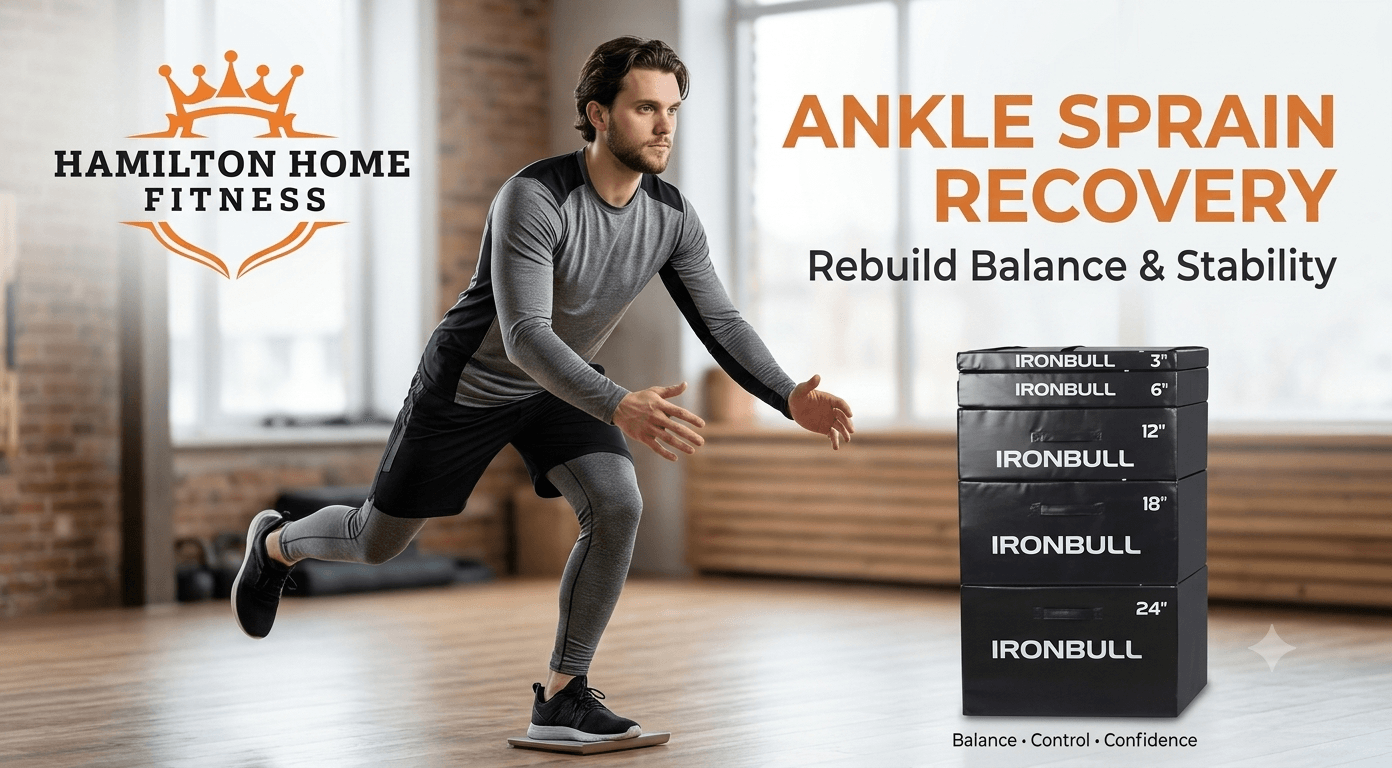
Watch the landings, not the count. An ankle that passes a hop test while the knee caves inward or the foot slaps down is passing on compensation. Film it on your phone if you're unsure; you'll see it immediately. Plyo boxes come in here once flat-ground hopping is clean and quiet.
Passing these isn't clearance. It's evidence to bring to the person who gives you clearance.
FAQ
Why does a sprained ankle keep re-spraining even after the pain and swelling stop?
Because symptoms clear faster than the reflex does. The ankle looks recovered and feels recovered, but its protective response is still slow—so the next awkward step catches it flat.
What is proprioception, and how do I know mine has not come back?
Proprioception is your sense of where a joint sits without looking at it. The marker is a clear gap between sides on a single-leg stance, and the gap widens with your eyes closed.
What is the correct progression from two feet to one foot to eyes closed to an unstable surface?
That order is correct—two feet, one foot, eyes closed, unstable surface. Each phase opens on a criterion you can pass today, not on a number of weeks since the injury.
When does a balance board become appropriate, and how do I know I'm ready?
When you can hold a single-leg stance on firm ground with your eyes closed for 30 seconds, hands off support, no pain. Before that, a board tests a deficit rather than training it.
How is a foam balance pad different from a wobble board, and which comes first?
Foam compresses and mutes what your ankle feels; a board tilts while keeping that feedback sharp. For a cleared athlete retraining position sense, the firm surface usually comes first.
What are the return-to-sport markers before I play again?
Timed single-leg stance, three-direction reach, pain-free repeated hops, and controlled side-to-side hopping—all close to your uninjured side. These support a clearance decision. They don't replace one.
Final Thought
The deficit is real, it's testable, and it responds to training. Earn each phase instead of guessing at it. The kit stays small—which piece you need depends entirely on where you're standing today. If you're not sure which that is, the Hamilton Home Fitness team can talk it through. Your clearance still comes from your clinician.