Introduction
You want conditioning that leaves you gasping and legs that drive harder—without the knee pain that running and jumping pile on. A sled does both. The hard part isn't the work. It's deciding whether you need a prowler, a drag sled, or a heavier power sled for your driveway, garage, or gym lane.
This guide settles that. You'll see how the three sled types differ, how to pick one by your floor and your goal, what weight to start with, and where sled work fits when your knees need a gentler way to train. Specific picks come at the end, once the tradeoffs are clear.
What sled training is and why it works
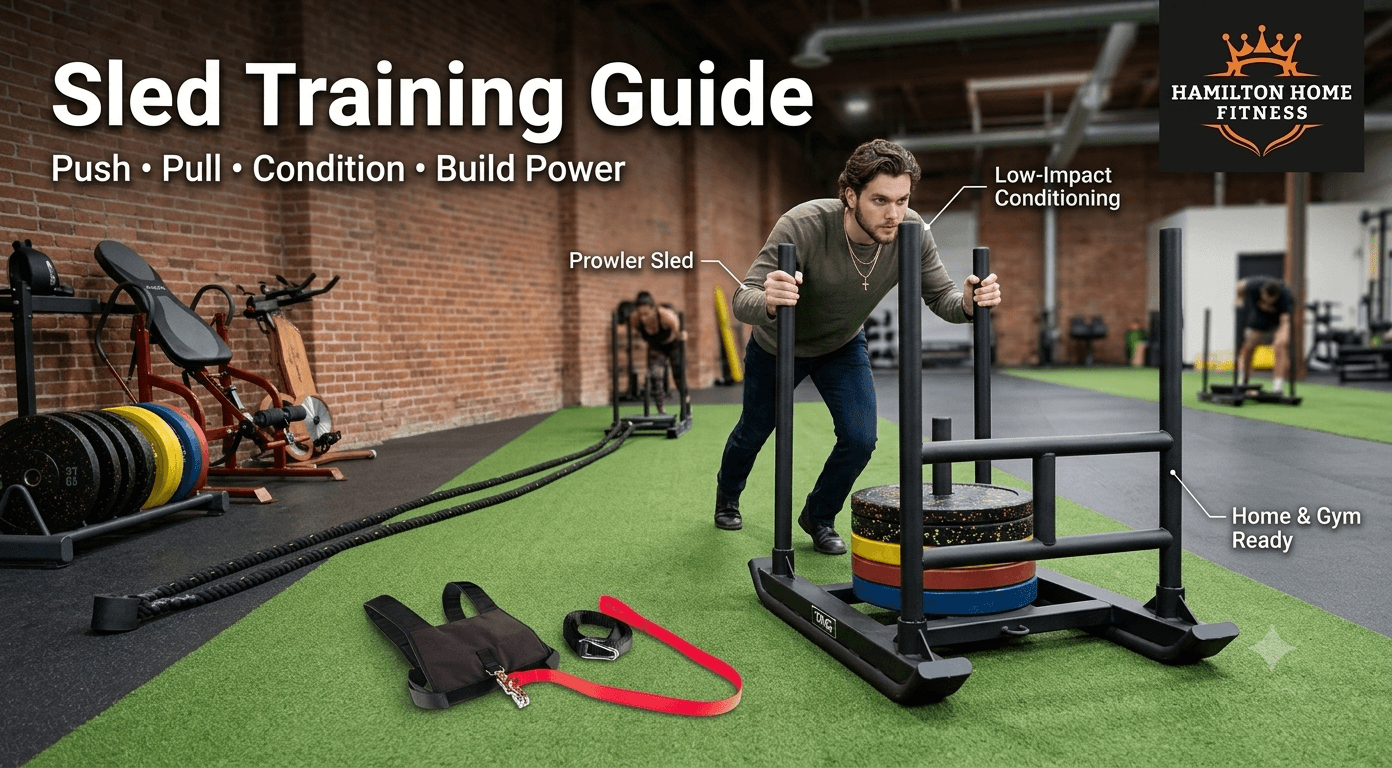
Sled push and pull training means loading a sled with weight and driving it across the ground for distance or time. You push it from behind or pull it with a strap or harness. It builds leg power and conditioning at once, and because the work is mostly concentric—muscles shortening, not absorbing impact—it stays easy on the joints.
That mix is what makes the sled rare. Few tools tax your legs and your lungs in the same set. Push a loaded sled 40 feet and you'll feel both at once: the burn in your quads and your lungs working hard, with not a single jarring landing.
Sled push vs sled pull—what each trains
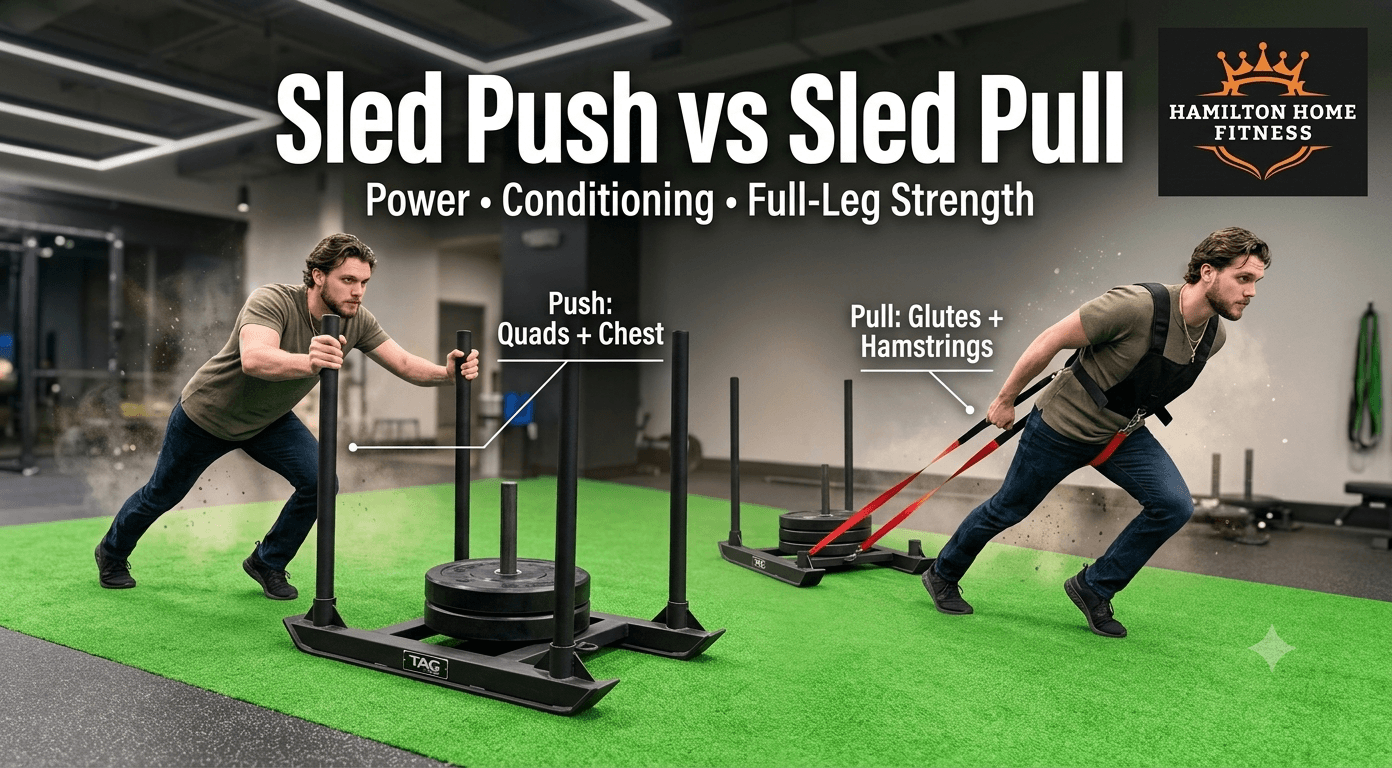
Pushing a sled leans on the quads and chest; pulling it leans on the hamstrings, glutes, and back. They train opposite sides, so they aren't interchangeable.
When you push, your body tips forward and your legs drive the load away from you. That hammers the quads and calves, with your chest and arms holding the bar and your core bracing to keep the sled tracking straight. This is the anterior side — the muscles on the front of your body.
When you pull—walking backward or dragging with a strap—the work flips to the back. Your hamstrings, glutes, and back take over, powering each step through hip extension. This is the posterior chain, and it's the side most lifters quietly under-train.
That's why a sled you can both push and pull earns its space. One tool covers the whole leg, front and back, and stacks up more work capacity than either direction alone.
Prowler vs drag sled vs power sled
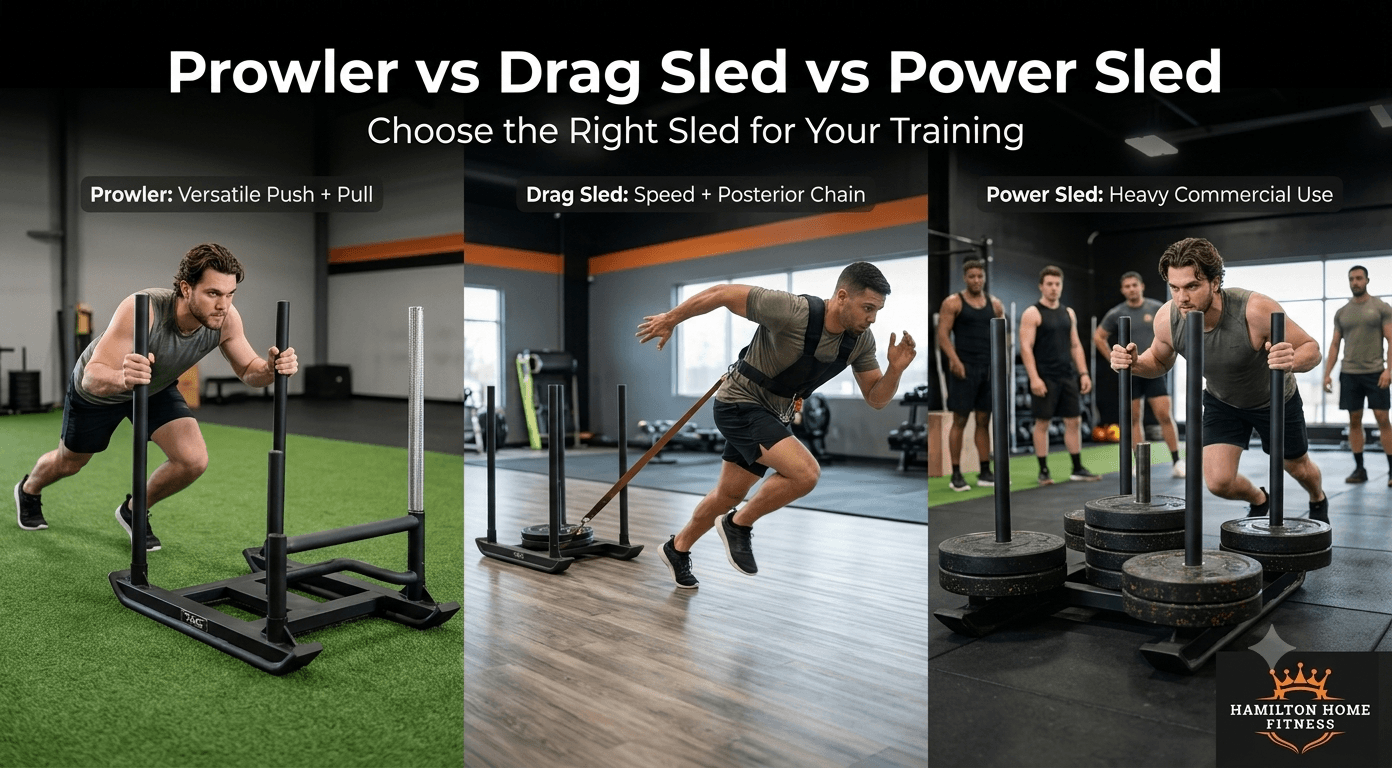
A prowler is an upright-post sled built for pushing at high and low angles. A drag sled is a low, simple frame you pull with a strap or rope, ideal for posterior-chain and sprint work. A power sled is a heavier, commercial-grade frame made for loaded pushes and hard team use.
Type | How it moves | Best surface | Best for | Who it suits |
Prowler | Pushed from upright posts (high or low); most also pull | Turf, asphalt, smooth concrete | Pushes at varied angles, all-round conditioning | Home buyers wanting one versatile sled |
Drag sled | Pulled by strap, rope, or harness; low frame | Turf or grass; works on concrete with more friction | Posterior-chain work, resisted sprints, drags | Athletes focused on pulling and speed; budget buyers |
Power sled | Heavy loaded pushes from posts take big weight | Turf or durable hard floor | Hard, heavy pushes and shared daily use | Teams, commercial gyms, and facilities |
The prowler is the do-everything choice. Its upright posts let you push high for an upright stance or low for a harder, more horizontal drive, and most also pull. If you want one sled for a home or garage setup, this is usually it.
The drag sled keeps it simple: a low frame you pull with a strap, rope, or harness. It shines for posterior chain work and resisted sprints, and it's often the lightest on your wallet. Pick it if your focus is pulling, speed, and dragging rather than loaded pushes.
The power sled is the heavy-duty option, built to take a big load and daily abuse. It's made for hard-loaded pushes and shared use, which is why you see it in teams and facilities. It's overkill for a casual home lifter, but right now several people will hammer it every day.
Pick a sled for your space and floor
Most home sled work needs a flat lane of roughly 30 to 50 feet of usable length. Concrete, asphalt, and a driveway all work fine. Turf slides smoother and runs quieter while protecting the floor. Indoors, a short turf strip over a hard floor is the common fix when distance is tight.
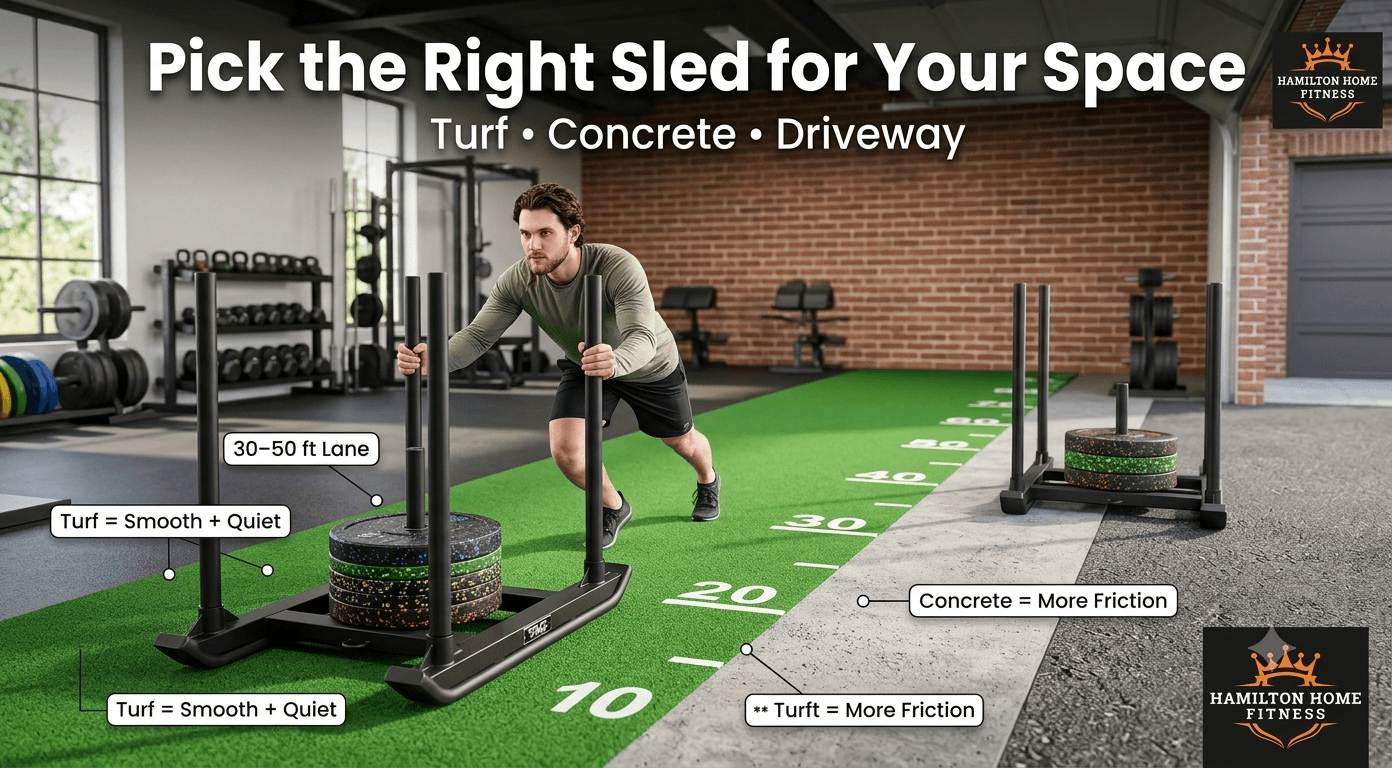
Match the sled to the space you actually have before you buy. The wrong call here means a sled that snags, wears out your floor, or has nowhere to run.
How long a lane do you need
Aim for at least 30 feet of straight, flat space. That covers short pushes and drags. Get closer to 50 feet and you can run real intervals without stopping every few seconds to reset.
Indoors, you rarely get that much room. A short turf strip — often 12, 15, or 20 feet — lets you push back and forth in a garage or basement when a full lane isn't possible. You trade distance for more turns, which still works for conditioning.
If you're outfitting a bigger space, plan the lane before you buy. Our guide to how a turf lane fits a gym layout shows where to place a sled lane so it doesn't cut across your lifting or cardio zones.
Concrete, turf, or driveway — what each does to the sled
Bare concrete and asphalt add friction and wear the skids faster. Turf slides smoother and protects the floor underneath.
Concrete and asphalt are the easiest surfaces to find—a driveway, a parking pad, an empty lot. They push back harder, so the sled feels heavier at the same load, and the skid pads wear sooner. Rough concrete chews them fastest.
Turf is the gentler ride. It lets the sled glide, cuts the grinding noise, and shields a garage or gym floor from skid marks. That's why most dedicated sled lanes use it.
A driveway is the practical default for home training. It's free, flat, and gives you real run-out distance. Just expect more friction and faster skid wear than on turf, and check that the surface is smooth enough that the sled won't snag mid-push.
How heavy is it to start and program
Start light enough to keep a steady, smooth pace—often the empty sled or one plate per side—over short 20- to 40-foot runs. Build distance and load before chasing speed. Most useful sessions run 15 to 25 minutes of work, not an hour.
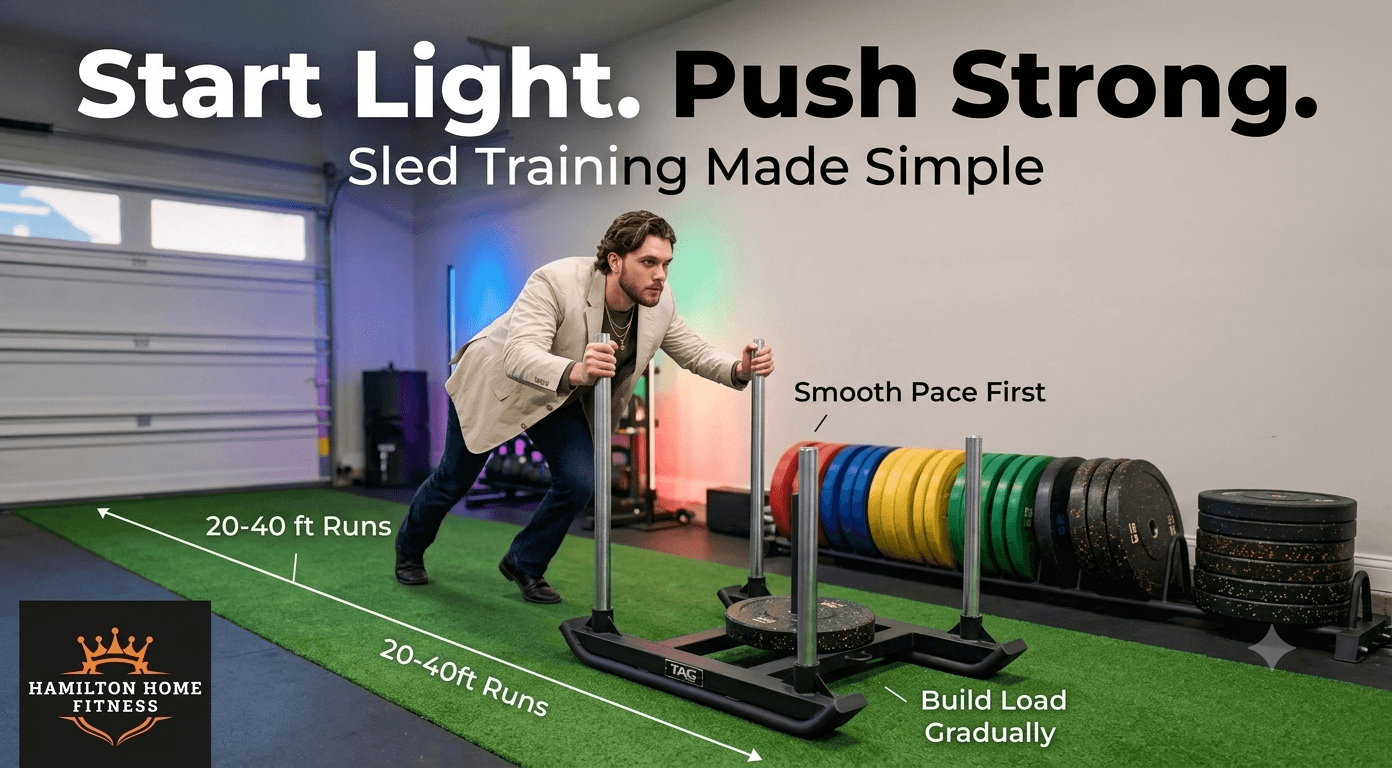
Going too heavy on day one is the most common mistake. A sled that grinds to a stall teaches nothing. One that moves smoothly builds real conditioning and strength.
Starting weights for beginners
Load light enough that the sled moves smoothly without you straining or stuttering. If your steps turn into a stuttering grind, take weight off.
For many beginners that means starting with the empty sled or one plate per side, then adding from there. The number on the sled matters less than the quality of the movement — smooth, steady steps with the sled tracking straight.
Build distance before load. Get comfortable pushing 40 feet cleanly before you stack on more plates. Add load before you add speed, and you'll skip the early injuries that come from rushing.
Sample sled workouts (intervals, EMOM, Tabata)
Pick a distance, push it hard, rest, and repeat—that simple loop is the core of every sled workout. From there, three formats cover most needs.
Straight intervals: push a set distance, walk back to recover, and repeat for 6 to 10 rounds. Easy to scale by changing distance, load, or rest.
EMOM (every minute on the minute): push your distance at the top of each minute, then rest whatever time is left before the next one starts. Heavier pushes leave less rest, which sets the difficulty.
Tabata-style: 20 seconds of hard pushing, 10 seconds rest, for 8 rounds with a lighter load. Short, brutal, and quick — better as a finisher than a full session.
You'll need Olympic plates to load the sled for any of these and a little more weight on hand than you think, since sled work scales fast.
Is sled training good for knees?
Sled pushes and drags are often gentle on the knees because the movement is mostly concentric and carries little impact or deep loading. That lets many people build leg strength and conditioning with less joint stress than running or jumping. It's widely used in return-to-training work, but it isn't a medical treatment, and it should follow professional guidance.
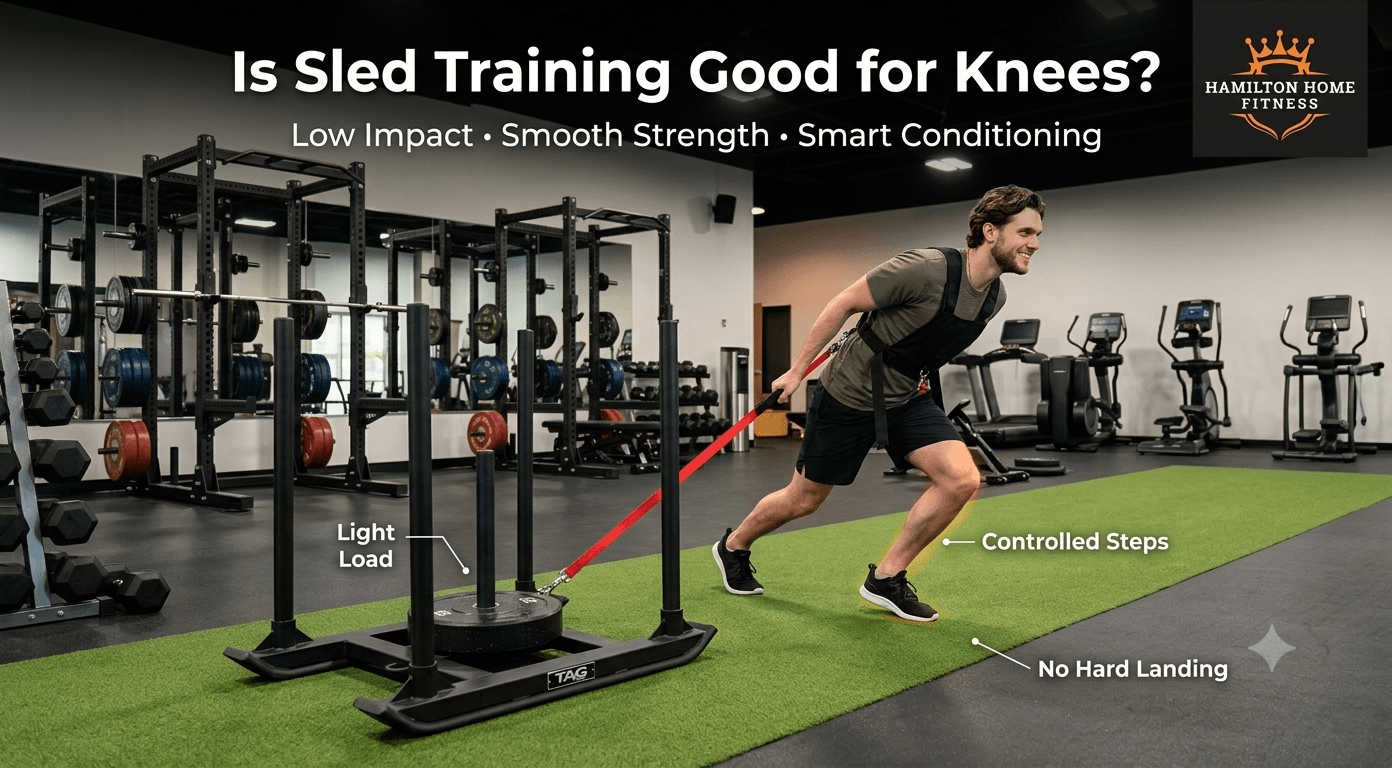
The reason is simple. There's no hard landing and no deep, loaded bend at the knee. You're driving the legs through a controlled range while the sled, not your joint, absorbs the resistance. For people who can't squat or run without pain, that's a way to keep training the legs.
Where the sled fits for knee rehab and runner's knee
Light, controlled sled drags let many people load the legs without the pounding that aggravates a sore knee. That's why you'll see them in rehab settings for issues like runner's knee or a post-surgery return to training.
The key word is light. Used carelessly or too heavy, any tool can set you back. The sled's value here comes from low load, smooth pace, and short distances—not from grinding through pain.
This isn't a substitute for a diagnosis or a rehab plan. If you're training around a knee injury, surgery, or ongoing pain, get clearance and direction from a physical therapist or doctor first. Within that plan, our rehab and recovery equipment can sit alongside sled work as part of a supervised return.
Sled accessories you actually need
For full sled work you mainly need a way to pull it. A body harness lets you drag and sprint hands-free. A strap or thick rope lets you pull hand over hand. Most pushing needs only the sled's own posts or handles. D-rings and clips are just the hardware that connects those attachments to the frame.
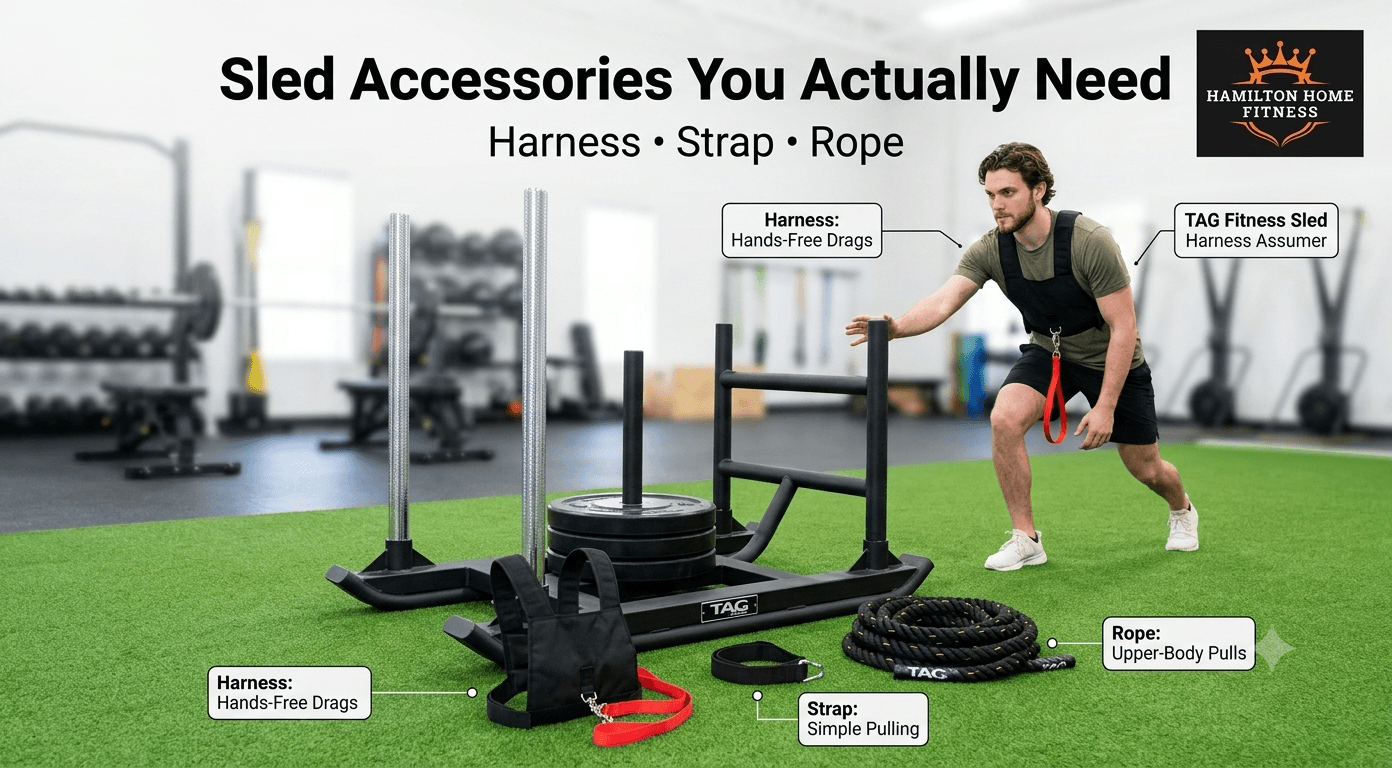
So the short list is small. A harness or a strap is the one must-have that unlocks pulling. Everything else—extra ropes, spare clips, plate storage—is nice-to-have, not essential to start.
Harness vs strap vs rope
A harness frees your hands for sprints and drags; a strap or rope is better for stationary, upper-body pulls. Pick by the work you actually plan to do.
A harness wraps your hips or shoulders and clips to the sled, so your hands stay empty. That's what you want for resisted sprints and long drags, where grip would give out before your legs do. If hands-free pulling is your goal, a body harness built for sled work is the piece to add.
A strap does a similar job more simply—a loop you hold or attach to a belt—and suits drags where you don't need full hands-free freedom.
A rope is for pulling toward you. Stand still, grip a thick training rope, and haul the sled in hand over hand. It hits the back, arms, and grip hard and adds an upper-body pull most sleds otherwise miss.
Choosing the right sled to buy
Choose a versatile push-pull sled if you want one tool for a home setup. Pick a simple weight sled if your focus is dragging and you sprint to work on a budget. Step up to a commercial power sled if a team or facility will load it hard daily. Consider a motorized smart sled only if you want app-based resistance without the floor space for a lane.
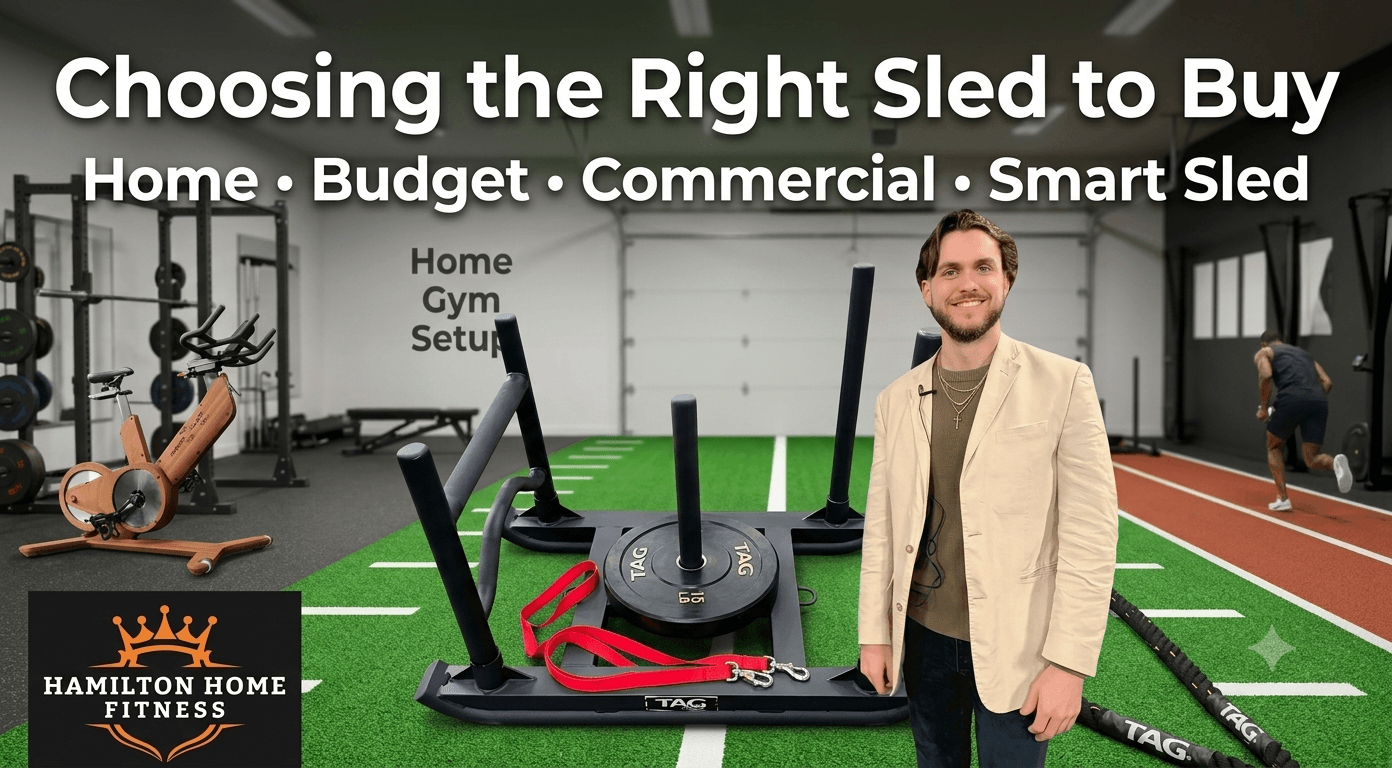
The earlier comparison told you how the types differ. This is the part where you match one to your space, your goals, and your budget—then buy with confidence instead of second-guessing.
Match a sled tier to your use
Most home buyers are best served by a do-both push-pull sled before they consider anything heavier. It covers pushes, pulls, and drags in one frame, which is all most people need.
For that entry tier, the Apollo Sled Rack fits the brief at $228.80: a push-pull frame with a 500 lb loading pole, harness hooks for hands-free work, and a compact 49 x 26 x 40 inch footprint. It suits a home or garage lifter who wants one sled to do everything, and it's enough sled for most people who aren't running a facility.
On a budget, or if your focus is dragging on sprint work rather than loaded pushes, a simpler, lighter sled does the job for less. You give up some pushing versatility, but you keep the posterior-chain and speed work that matters most for athletes.
For a team, gym, or facility, step up to a commercial-grade power sled built to take heavy loads and daily abuse from many users. It's overkill for a casual home lifter, but right when the sled won't get a day off.
A motorized smart sled — with app-based resistance and no need for a long lane — is a premium, niche choice, not a default. It's worth it only if floor space is tight and the budget is there.
When you're ready to weigh the exact options side by side, compare the full workout sled range and match a frame to your space and goal.
FAQ
Can a sled push replace running for hybrid and combat athletes?
It can replace a lot of running for conditioning, especially when your knees or shins need a break, because it spikes the heart rate hard with far less impact. But it doesn't replace the skill of running itself. Most athletes keep some true running for that and use the sled to add conditioning volume safely.
Why do sled pushes burn your lungs more than running?
A loaded push works large leg and trunk muscles in a near-constant, grinding effort with little coasting phase. Oxygen demand climbs fast, and there's almost no recovery between steps. That steady, high muscular demand is what makes your lungs feel it sooner than steady running does.
Is a workout sled worth it for a small home gym?
For most home gyms, yes—if you have at least a short flat lane indoors or a driveway. One sled covers strength, conditioning, and joint-friendly leg work in very little storage space. It's less worth it if you truly have no run-out distance and can't train outdoors.
Final thoughts
You came to choose a sled. Now you can. Match the type to your floor and your goal, start light enough to move clean, and build distance before you pile on load—that's the whole game, and it works whether you're chasing conditioning, posterior-chain strength, or a knee-friendly way to train hard.
The sled is one of the few tools that taxes your legs and your lungs in the same set, with none of the pounding that running and jumping bring. Pick the one that fits your space, and it'll earn its spot for years.
When you're ready, compare the full workout sled range and match a frame to your space and goal.