
Introduction
Your rack ships this week, the slab is bare, and the gym flooring thickness is the one spec you haven't settled. One page quotes 8 mm, the next quotes 3/8 inch, and both write as though those are the same number.
They aren't. Thickness follows what hits your floor and how it lands, not how many square feet you're covering.
Here's the thickness for each activity, the conversion nobody publishes, what changes over concrete, wood, or an upstairs room, and where thicker rubber stops helping—settle it before you order from the gym accessories range. Training above another dwelling? Check your floor structure and lease first; no flooring spec settles that.
What Thickness Each Activity Needs
Match thickness to what lands on the floor. Use 6mm for cardio and stretching, 8mm for general strength work and light free weights, around 1/2 inch where dumbbells and barbells get used regularly, and 3/4 inch anywhere loaded plates actually hit the ground.
The reason the same dumbbell shows up in two of those tiers is that thickness answers a question about impact, not about equipment. A treadmill presses a steady load into one spot for an hour. A 50 lb dumbbell arrives in a fraction of a second on one hex corner. Same room, same owner, completely different demand—which is why 6 mm interlocking tiles are enough under a bike and nowhere near enough under a rack.
Dropping vs. Lowering a Loaded Bar
8mm rubber handles deadlifts you lower under control. It does not handle deadlifts you drop, and that difference explains why the same floor gets rated for 75 pounds on one site and 315 pounds on another.
Guide the bar down, and the load arrives gradually, spread across two plate faces. Let it fall from the top of a pulley, and the same weight delivers its energy in milliseconds. The floor never sees your one-rep max—it sees how fast that weight stopped. What you load matters too: bumper plates versus iron plates changes what reaches the rubber, since rubber-clad plates absorb some of the impact before your floor has to.
Why Dumbbells Do More Damage
A dropped dumbbell concentrates its whole weight into a small hex corner, while a loaded barbell spreads across two wide plate faces, so the lighter object often does more damage per drop.
Picture 300 lb on bumper plates landing on roughly 36 square inches of rubber. Now picture a 50 lb hex head landing on maybe four. The barbell weighs six times more and puts far less pressure on any single point. That's why dumbbell shape changes your floor plan more than most buyers expect—round or flat-faced dumbbells spread the load, and hex corners punch it through.
What 8mm Actually Means in Inches
Convert before you compare. 6mm is about 1/4 inch, 8mm is about 5/16, 12mm is roughly 1/2, and 19mm is exactly 3/4. Notice what's missing from that list: 8mm is not 3/8 inch.
The gap is bigger than it looks. 8 mm measures 0.315 inch against 3/8 inch at 0.375—roughly 16% less material. Every other tier lands within about 6% of the imperial size it's sold beside. Suppliers' own guides explain the switch openly: 3/8 inch used to be the home gym standard, and the trade moved to 8 mm because it's lighter and cheaper to ship. So if you read a 3/8-inch recommendation and bought 8mm rubber rolls in six colorways, you bought a sixth less floor than the advice assumed.
Does Density Beat Thickness?
Density and thickness are not two grades of the same quality. Thickness absorbs an impact spike by deforming, density resists a steady load without denting, and the thicker product in a range is often the less dense one on purpose.
That trade-off is deliberate. A thick composite tile built for barbell drops can be measurably softer than a thin roll built for machines, because a drop needs somewhere to go and a static load needs something that won't compress. Under cardio equipment, dense and thin beats soft and thick every time. Worth knowing: few consumer flooring products publish a density figure at all, so in practice you're reading it off the format rather than the spec sheet.
Concrete, Wood Joists, or Upstairs
What sits under the rubber changes your number. Concrete is unforgiving and needs thickness to absorb impact. A wood floor flexes and needs the load spread across joists. An upstairs room needs both, plus a plan that no flooring product can supply on its own.
Each surface fails differently, which is what makes the choice real. Concrete chips and crumbles under repeated impact. Wood deflects, and the damage shows up as movement and loosened fasteners rather than cracks. An upstairs slab or joist system does neither—it transmits, sending the event into the rooms below. If your room sits in the second or third category, it's worth having someone plan the room before you order rather than guessing at a thickness.
Will Rubber Really Save Concrete?
Rubber flooring reduces concrete damage but does not eliminate it. Repeated drops onto the same square foot will chip and crumble a slab underneath thin rubber, and the damage stays hidden until the mat comes up.
The variable is repetition, not any single drop. Facilities that lift heavy things every day find damaged concrete under mats and even under platforms, because a hundred landings in one spot do what one landing never will. Lift a corner every few months and look. For a fixed landing area over concrete, 3/4-inch 4x6 mats for a drop area are the right buy—they're the wrong buy wall to wall, where you'd pay for protection the walkways and cardio corner never use.
Training Above Someone's Ceiling
Flooring reduces impact noise, the thud that travels through the structure, but does far less for airborne noise and cannot stop a dropped barbell being felt downstairs. Above another dwelling, the fix is not dropping, not more thickness.
Thicker rubber genuinely helps here, and it has a ceiling. Once the energy is in the joists, it travels, and no surface layer catches it after the fact. Lower the bar instead of releasing it, and the problem mostly disappears. If you're renting, puzzle mats that lift out when you move suit the room—though they're the wrong choice under a loaded rack, where tiles can shift and separate at the seams. Your building's floor structure and your lease terms are still the deciding factors, and neither is a flooring question.
One Thickness, or Zone, in the Room?
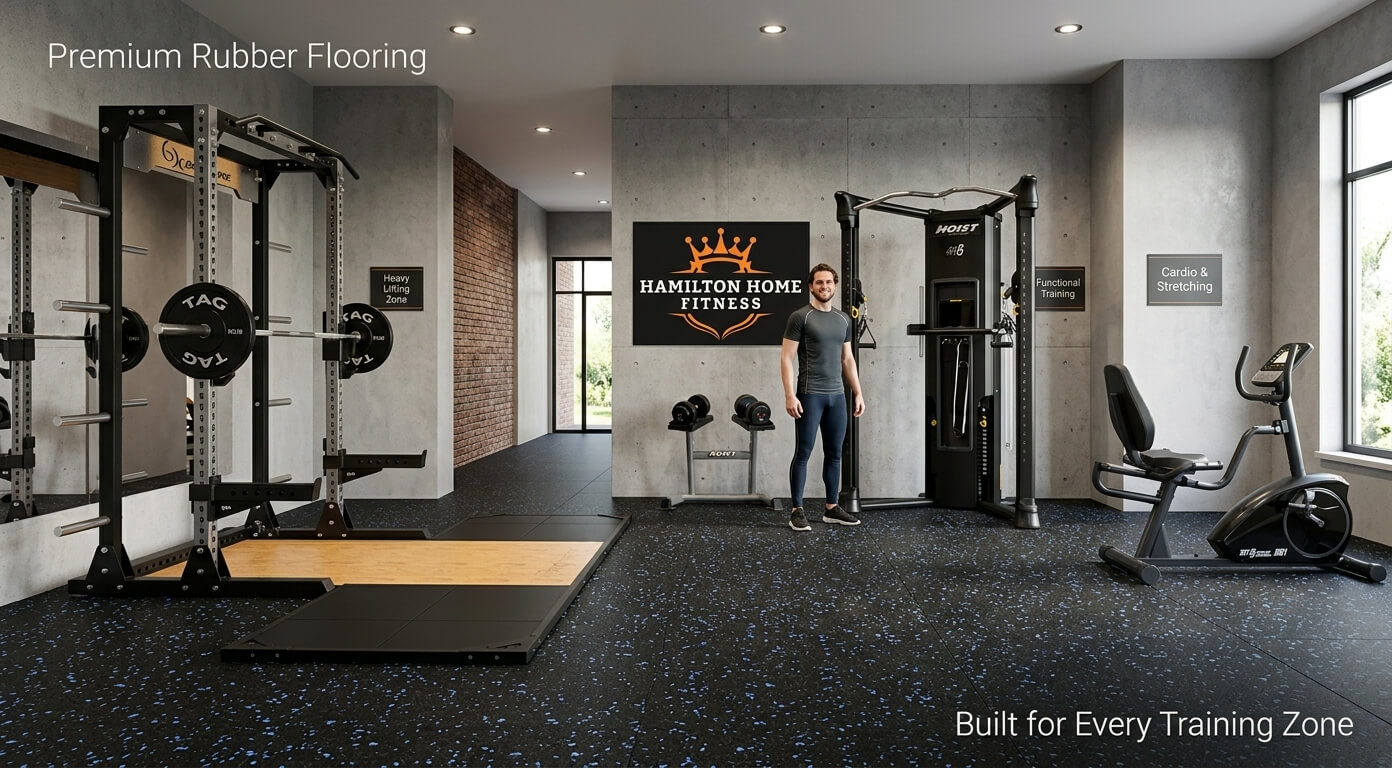
Most home gyms need two thicknesses, not one. A base layer covers the whole room, and a heavier drop area sits where plates land. Zoning costs less than flooring everything at your heaviest spec, and it protects better than flooring everything at your lightest.
Start from where the bar lands. A drop zone needs the full length of the bar plus room on either side and enough depth in front of the rack that a plate can land and roll without leaving the mat. Everything outside that footprint is walking, stretching, and machine space—and none of it needs the same floor.
Work through your room in this order:
- Base layer across the full floor
- Rack and bench footprint underneath
- Drop area sized to the bar
- Cardio corner, static load only
- Walkways and clear floor space
For the base layer, Vortex rolls cover the open floor with few seams, and Vortex flooring ships free. Where you want a firmer general-training surface underfoot, 12 mm Floorguard tiles fill the half-inch band tile by tile. Placement follows the rack, so settle that first—how a rack's footprint sets your lifting space decides where the drop zone has to go.
Thicker zones also cost headroom, and Gym Space Guide shows how much ceiling height flooring costs you, which matters in a low room.
When Thickness Stops Being Enough
Past 3/4 inch, buying thicker flooring stops being the efficient answer. Overhead drops and repeated heavy pulls need a different object at the landing point, not more rubber underfoot.
Your slab is marking under the mats. That's repetition in one spot, and another layer of rubber only delays it. Build a platform instead—plywood spreads the load across a wide area rather than absorbing it in place, and it sits naturally under power racks and cages where the pulls happen.
The neighbors have said something, or you're dropping from overhead. This is where thickness genuinely runs out. Barbell crash pads stand 6 inches tall at the landing point—roughly eight times a 3/4-inch mat—and they go exactly where the plates come down rather than everywhere. You cannot buy 6 inches of rubber flooring. You can put 6 inches of foam on the two square feet that need it.
The bar bounces unpredictably off stacked mats. Two layers of rubber move against each other and rebound at the seam, which is a purpose-built pad's whole advantage over a DIY stack. For a facility that wants this designed rather than assembled, GRYTFIT platforms and custom installs handle the layout end.
FAQ
Can you drop weights on 3/8-inch rubber?
Occasional controlled drops, yes. Repeated free-fall drops, no. Worth knowing that 3/8 inch sits between the two tiers most retailers stock, so you're really choosing 8 mm at 16% less material or 12 mm at slightly more.
What thickness goes under a treadmill?
Thin and dense beats thick and soft here. A treadmill is a static and rolling load, not an impact one, so a firm surface that won't compress does the job. A mat sized for a treadmill costs less than flooring the corner.
Can rubber flooring go over carpet?
Over low-pile, yes. Over plush, not without a rigid layer underneath. A compressible base lets a rack or bench rock under load, which is a stability problem before it's a flooring one.
What thickness do commercial gyms use?
Most run 8mm to 12mm in general areas and step to 3/4 inch or thicker in free-weight zones. Traffic volume drives that spec more than peak load does—plan cardio and lifting zones separately, and the thickness follows.
Does thicker rubber feel better underfoot?
Not always. Past about 1/2 inch, softer, thick rubber can feel unstable under a heavy squat or a loaded carry. That's a real reason not to floor an entire room at your maximum thickness.
Final Thought
The number follows the action, not the square footage. Work out what actually lands on your floor and how hard, and the thickness picks itself—usually two of them, a base layer plus a heavier drop area.
You have the spec now. Take it to the rubber flooring range, work out your coverage, and order once.