Introduction
Two weeks out, you catch your reflection and decide it's all going. It isn't. At two weeks, a trained lifter has lost little. Most of what looks gone is water and stored carbohydrate—both come back fast.
This page won't diagnose you. The plan for the injured joint comes from your doctor or physical therapist. What follows is how to train around an injury everywhere else: what you can still load, how little it takes to hold what you built, and how to come back without going straight back out.
What You Can Still Train Right Now
An injured joint rules out a set of movements, not a body. Most people keep the opposite limb, the opposite half of the body, the trunk, and low-impact conditioning. The job in front of you is subtraction—remove the movements that load the injury, then train what's left.
A wrist injury is the clearest case. It removes barbell pressing and anything that puts weight through the hand, but it leaves leg training, hip work, and cable rows pulled with a strap around the forearm. Same body, three-quarters of it still available.
Conditioning is the first thing most people drop and usually the first thing they could have kept. An upper-body injury leaves most low-impact cardio equipment available. A knee or ankle problem narrows it to seated and non-weight-bearing options, but rarely to nothing.
One test covers most of it: if a movement doesn't load, compress, or stretch the injured area, and it doesn't hurt, it stays in until your clinician says otherwise.
How Fast You Actually Lose Strength
Measurable muscle loss generally doesn't begin until roughly two to three weeks of complete cessation in trained lifters. Strength holds longer than size. The change you see in the mirror during week one is mostly glycogen and the water bound to it, and it returns within days of training again.
Immobilization is a different case, and most articles blur the two. A limb in a cast or sling loses faster and more locally than a limb belonging to someone who simply stopped going to the gym. Across roughly three to four weeks of upper-limb immobilisation, reported maximum strength losses sit in the region of ten to twenty percent, with muscle thickness changing far less than that.
The number worth holding onto is how little it takes to keep what you have. Reduced-volume research has found that a small fraction of previous training volume — a fraction, not a majority — was enough to maintain strength and size over long periods, with older lifters needing more of it to hold size than younger lifters did.
One honest caveat: most of this research studied healthy people who were detrained or artificially immobilised, not injured people. Treat these as ranges, not promises.
Why Training the Good Side Counts
Training the uninjured limb produces measurable strength carryover to the side you can't train. The effect is neural—your nervous system gets better at driving both limbs, so the untrained side gets stronger without getting meaningfully bigger. It's real, it's partial, and it's the highest-leverage thing available to you right now.
Researchers call it cross-education: strength gained on one side showing up on the other. Typical carryover is modest—around half the strength gain seen in the trained limb, in the region of several percent. Pooled evidence suggests it shows up most clearly in upper-limb muscles closer to the trunk.
Frame it correctly and it stays useful. This is damage limitation, not a workaround. It slows how much the sidelined limb gives up while you wait; it doesn't replace the rehabilitation work that comes after clearance.
In practice it looks unremarkable. A lifter in a sling still rows, presses, and curls single-arm on the free side, using dumbbells and kettlebells rather than a bar. Train that side properly—real load, real effort—because a token effort produces a token carryover.
Where Low-Load Tools Really Help
Low-load tools earn their place when heavy loading is off the table. Light work taken close to failure can maintain muscle size surprisingly well. Maximum strength is the part that responds better to heavy loading, and it comes back as load comes back—so treat light work as holding ground, not building it.
That's the honest version of a claim you'll see oversold everywhere. Light loads taken near failure produce muscle-size gains comparable to heavy loads. Maximum strength gains still favor heavy work. Both halves are true, and most pages only print the first one.
There's a second caveat nobody mentions: low-load-to-failure sets are genuinely unpleasant, and it's harder to judge how close to failure you actually are when a set runs past twenty reps. That's an adherence problem, not a footnote. Plan for it.
Isometric holds are the underrated option here. Because you choose the joint angle, you can often work around a painful range rather than through it. Whether that applies to your injured joint is your clinician's call, not this page's.
You'll have seen blood flow restriction mentioned. It comes up because it lets very light loads produce a heavier-feeling stimulus, and it belongs under supervision—cuff pressure is the reason, and getting it wrong is the risk. Without a clinician guiding it, a light load taken close to failure is the version you can do safely on your own.
The rehab and recovery equipment range covers most of what follows, sorted by recovery stage.
Bands, Balls, and Vibration Plates
Each of these does one job well, and none of them replaces the load.
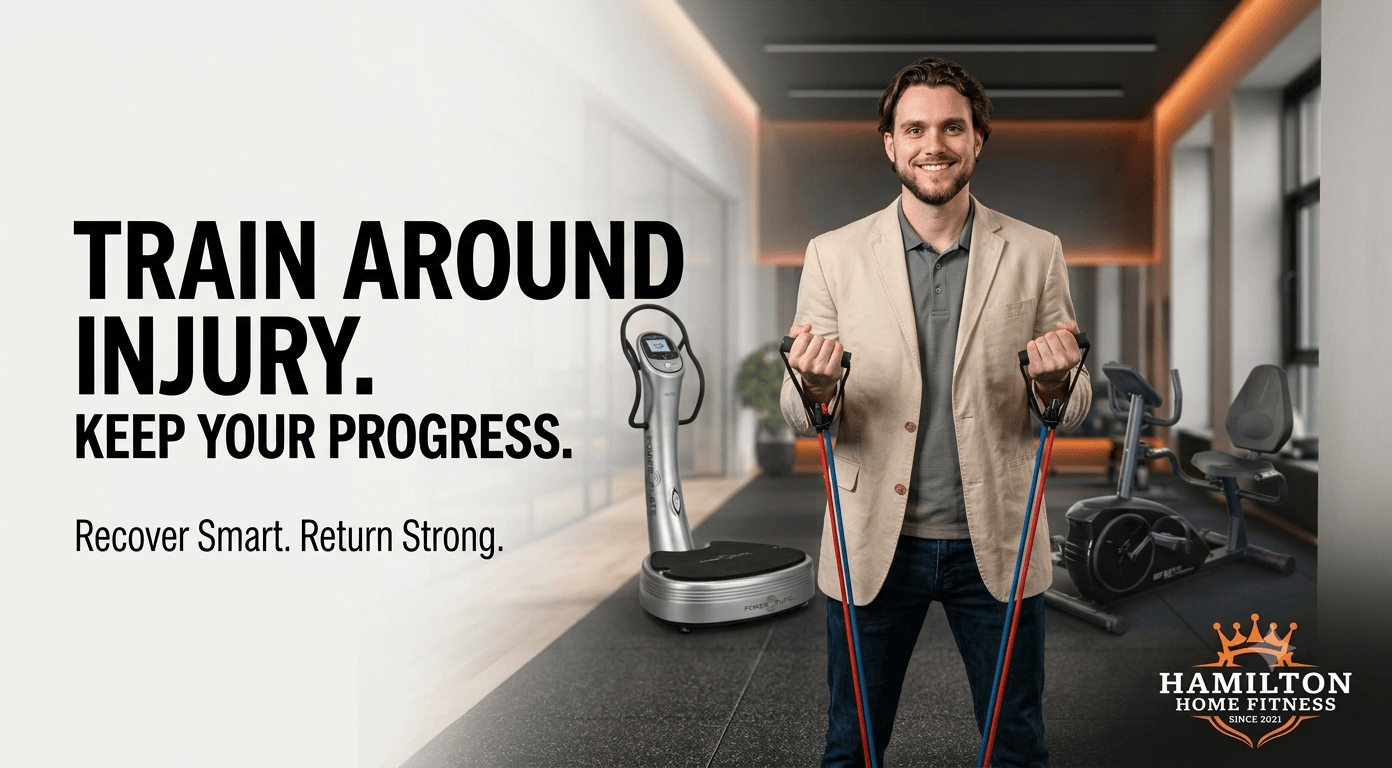
Bands give you light, scalable resistance and a joint angle you can adjust mid-set. They're the most useful of the three for maintaining muscle, and the least useful once you need real load—a band that felt hard in week two feels like nothing by week eight.
A stability ball does core control and supported seated work. It's genuinely helpful when standing or floor positions are off the table. It is not a strength tool, and buying one expecting muscle maintenance will disappoint you.
Vibration platforms activate muscle at low external load, which is the point when heavy loading isn't available to you. They're the wrong choice if you already have access to bands and can train the uninjured side properly—that combination does more for less.
What to Buy and What to Skip
The test is simple: will you still use it after you're cleared?
Bands, a foam roller, and a ball pass that test. They cost little, they store in a drawer, and athletes keep using them for injury prevention long after rehabilitation ends. Those are the small buys that survive recovery, and workout bands are the ones most people should own regardless.
A large single-purpose machine bought in week two usually fails it. Panic buying during a layoff is how a piece of equipment ends up holding laundry—you bought it for a six-week problem, and it doesn't fit the training you'll return to.
Buying nothing is a legitimate answer. If you have a healthy side, some weight, and a floor, you already have what maintenance requires.
Soreness You Can Train Through
Clinicians commonly use a three-part test rather than a feeling. Discomfort stays low during the session, doesn't climb sharply afterwards, and has settled back to baseline by the next morning. Pass all three, and the load was tolerable. Fail all three, and it was too much.
Low during. Sources differ on where the ceiling sits—commonly cited somewhere between three and five on a ten-point scale. They disagree, so don't treat any single number as settled.
No sharp climb after. Discomfort that builds over the hours following a session is a different signal from discomfort during it.
Back to baseline by morning. This is the one people skip, and it's the most informative of the three.
Worth knowing where this comes from: it emerged in tendon rehabilitation research and is applied under clinical guidance. It's a framework to raise with your therapist, not a license to self-manage the injured joint.
Some signals override the test entirely. Sharp or tightly localized pain. Swelling that increases after you train. Limping, or altering your form to dodge a painful position—compensating is how a second injury starts somewhere else.
Ordinary training soreness is dull, spread across a muscle belly, and worst a day or two after unfamiliar work. Injury pain is sharper, sits closer to a joint, and doesn't follow that pattern.
Your First Four Weeks Back
Clearance means your risk is now acceptable, not that your body is ready for your old numbers. A conservative reload starts near half of your pre-injury volume and intensity, then climbs in small weekly increments—and only one variable changes at a time.
Week one should feel too easy. Every returning lifter wants to ignore that, and ignoring it is the most common way people go straight back out.
The staged approach behind this is standard in return-to-training guidance: rebuild in planned percentages rather than jumping back to where you left off. Around half of pre-injury volume and intensity is a common starting point, with roughly ten to fifteen percent weekly progression from there.
Change one thing per week. Add load, or add volume, or add frequency—not two together. Stacking them is the classic re-injury pattern, and it's what makes week three feel fine and week four feel like starting over.
For the limb that was out, clinical frameworks often want it within roughly eighty-five to ninety percent of the other side before full loading resumes. That's measured, not estimated by feel, and it's your therapist's assessment to make.
Machines that hold a fixed path suit this phase well. Controlled loading matters more than free-weight stabilization while you're rebuilding, and a guided bar path lets you train hard without the joint managing balance at the same time.
FAQ
How long before I can lift after an injury?
There's no honest universal timeline—it depends on the tissue and on clearance. Muscle strains, tendon problems, and post-surgical recovery run on very different clocks, and tendon and ligament healing is slower than muscle. The date comes from the person examining you.
Can I train before I've seen a doctor or therapist?
Generally yes, for the parts of your body that aren't involved and aren't painful. What you shouldn't do is design a plan for the injured area or test it to see how it feels before someone has examined it.
Is it safe to load the injured joint with very little weight?
That decision belongs to your clinician, not to a website. Light loading is part of many rehabilitation plans, but "light" depends on the diagnosis, the tissue, and the stage—the same weight can be appropriate in week six and harmful in week one.
Does cardio stop muscle loss while I'm injured?
On its own, no. Muscle responds to resistance, not endurance work. Low-impact conditioning is still worth keeping for cardiovascular fitness, circulation, and routine—just don't expect it to hold the muscle you built lifting.
What should I track while I'm out?
Log what you did, what hurt, and how it felt the next morning. Those three lines turn a vague "it's still sore" into information your therapist can actually use at your next appointment.
Final Thought
You've lost less than the mirror suggests, and holding onto it takes less work than you assume.
Your clinician writes the plan. Equipment executes it. Hamilton Home Fitness is an authorized dealer for over 40 brands, shipping to all 50 states from Tennessee—when you have your plan, talk to our team about your setup, and we'll match the gear to what you've actually been told to do.