Introduction
Someone reached for the stair rail, and it held. That near-miss is what sends most people looking at balance equipment for seniors—for themselves, or for a parent.
Search it, and two answers come back. Health sites say you need no equipment. Retailers say buy a board. Both are partly right; which one applies depends on how steady the person is right now.
This guide settles the order: what to start with, which safety features matter, and how often the work has to happen.
One caveat up front. Equipment doesn't lower fall risk on its own—the training does. Have a physician or physical therapist clear the plan before the first session.
What Actually Lowers Fall Risk
Balance and strength training is what the evidence behind fall reduction points to. No board, ball, or platform carries that effect on its own. Equipment earns its place differently—by letting an older adult train more often, at a difficulty they control, without someone standing by every time.
Staying upright runs on three inputs: what the feet and joints read from the floor, what the inner ear registers as tilt, and what the eyes take in. The first is proprioception—your sense of where your body is without looking. Age erodes all three, and leg strength with them. Muscle mass declines steadily after midlife, so ankles and hips stop catching small errors as quickly as they used to.
Training rebuilds the recovery, not just the hold. Standing on one leg is one skill. Catching yourself mid-stride on a wet step is another—and it's the second that keeps walking speed up and fear of falling down.
Which Balance Tool Should You Start With?
Start below the ability you already have. If you can walk unaided but feel unsteady, a foam pad next to a kitchen counter is the sensible first buy. If you're already using furniture to get around the house, stay on the counter itself and add a seated stability ball. Boards wait.
Tool | How it challenges balance | Starting difficulty | Supervision needed | Who it suits | Who should wait? |
Chair or counter | Support you remove a finger at a time. | Lowest | Once steady, none | Anyone starting from zero | Nobody |
Foam pad or cushion | Soft surfaces muffle floor feedback. | Low | First few sessions | Most first-time buyers | Anyone unsafe standing unaided |
Stability ball (seated) | Unstable seat trains trunk control | Low-seated | First few sessions | Weak core, limited standing tolerance | Never stand on it. |
Adjustable step | Controlled height to step up and down | Low to moderate | Until the height feels dull | Stair anxiety, weak legs | Can't clear the lowest setting |
Rocker or wobble board | Moving platform on a small base | Moderate to high | Every session at first | Already steady, unsupported | Recent falls, dizziness, vertigo |
Vibration platform | Powered activation, not balance work | Low physically | Handhold recommended | Leg work when standing training is limited. | Anyone not cleared by a clinician |
Entry pieces here start around twenty dollars, so the first decision costs far less than the last one. You can browse the balance boards and stability trainers currently stocked and check them against the safety criteria in the next section before committing.
Which row you belong in has little to do with age. Someone who walks to the mailbox without thinking about it sits several rows lower than someone who runs a hand along the wall between rooms—and the two can be the same age, in the same house. Judge by the support being used now, not the birth year.
Two rules keep the order honest. Buy the tool you can use safely this month, not the one you're working toward. And add one piece at a time—TAG Fitness stability balls are inexpensive enough that starting seated costs little if the step turns out to be unnecessary.
What is the best exercise equipment for seniors' balance? There isn't a single answer, and any page offering one hasn't asked how steady you are. The useful question is which tool matches the support you need today.
Safety Features That Actually Matter
Rank them by how much they change real risk. Grip on the floor comes first, step-on height and base width second, handhold access third, and rated weight capacity fourth. A tool that slides or sits too high isn't rescued by a good handle—the first two decide whether it's usable at all.
- Floor grip—a non-slip base that won't creep on tile or hardwood.
- Step-on height—the lower the deck, the less there is to fall from.
- Base width—a wide base tips slowly; a narrow one tips before you react.
- Handhold access—something solid to grab on both sides, within reach.
- Weight capacity—rated comfortably above the user's weight, with margin.
The same low, wide platform is safe on hardwood and hazardous on a rug, because the rug slides and the platform can't stop it. Stiff ankles undercut all five criteria, so a 36-inch foam roller is a cheap way to loosen calves before standing on anything unstable.
Are balance boards safe for the elderly? For someone already steady without support, yes, with a counter alongside. For someone holding furniture between rooms, no. The risk sits in the tool, not the age.
What Stays Within Arm's Reach?
Before the first session, put something solid within arm's reach on both sides—a counter edge, a sturdy chair back, or a doorframe—and keep it there until standing on the tool feels boring.
- Clear six feet of floor in every direction.
- Turn the lights up; dim rooms make the eyes work harder.
- Wear shoes with grip, or go barefoot on a firm floor—never socks.
- Have someone else in the house for the first few weeks.
Stability Ball vs. Balance Board
They train different things, so this isn't a better-or-worse choice. The ball train's trunk control is on a soft, forgiving surface and works while seated—usable on day one. The board trains ankle and foot correction on a small base while standing, which puts it later in the sequence for most older adults.
Sit on a ball, and the hips make constant small corrections to stay centered. That's core and posture work, and it happens without ever leaving a seated position. Sitting to standing on a ball, or a chair squat beside one, extends the same pattern into the movement that gets someone off the sofa.
Stand on a board, and the work drops to the ankles. The base is narrow, the correction is fast, and the margin for error is small. Useful—but only once unsupported standing is already comfortable.
One practical note: the ball is bought to the user's height, not picked by color. Sizing guidance sits on the stability balls sized by height page. Get it wrong and the knees ride above the hips, which turns a stable seat into an awkward one.
Where a Vibration Platform Fits
A vibration platform is a low-load activation tool, not a balance trainer—the vibration prompts muscles to contract and relax without heavy weight on the joints. The research signal is strongest for lower-body strength and sit-to-stand performance. For balance scores and fall rates specifically, results are mixed. It belongs alongside standing balance work, not instead of it.
Where it earns a place is when standing training is limited. Sore knees, low tolerance for time on the feet, and a body that's stopped responding to gentle floor work—those are the situations where a platform adds leg stimulus that nothing else in this list provides at that effort level.
Where the evidence shines is the claim buyers most want. Several trials show better strength and easier transfers out of a chair after regular sessions. Trials looking directly at balance scores and fall rates have come back inconsistent, some finding no difference at all. Treat improved steadiness as possible, not expected.
Cost sits at the other end of the range from everything else here. A platform runs into the hundreds at minimum, and clinical-grade units into the thousands, against roughly twenty dollars for a ball. Specs and price ranges are on the whole body vibration platforms page.
One firm limit: vibration training isn't appropriate for everyone. Pregnancy, certain implants, cardiovascular conditions, acute injuries, and bone concerns are all common reasons to check first. Ask a physician or physical therapist before ordering, not after.
Do vibration plates help with balance in older adults? Possibly, and indirectly. Stronger legs and easier sit-to-stand support steadiness. Direct evidence that plates reduce falls is weaker than the marketing suggests.
How Often and How Long to Train
Three sessions a week, ten to fifteen minutes each, is the pattern to start on. Short and consistent beats long and occasional—balance is a skill, and skills respond to frequency. Expect the first noticeable change in weeks, not days, and expect it to show up as confidence on stairs before it shows up anywhere measurable.
The rule that governs everything below: you progress by removing support, not by adding time.
- Two feet on the floor, both hands on the counter
- Two feet, fingertips only
- Two feet, no hands
- Feet together
- Tandem stance—one foot directly in front of the other
- Single-leg stance
- Any of the above with head turns or eyes closed, supervised only
Move up a rung when the current one feels dull, not when a calendar says so. Most people spend longer on rungs three and four than they expect, and that's the work doing its job.
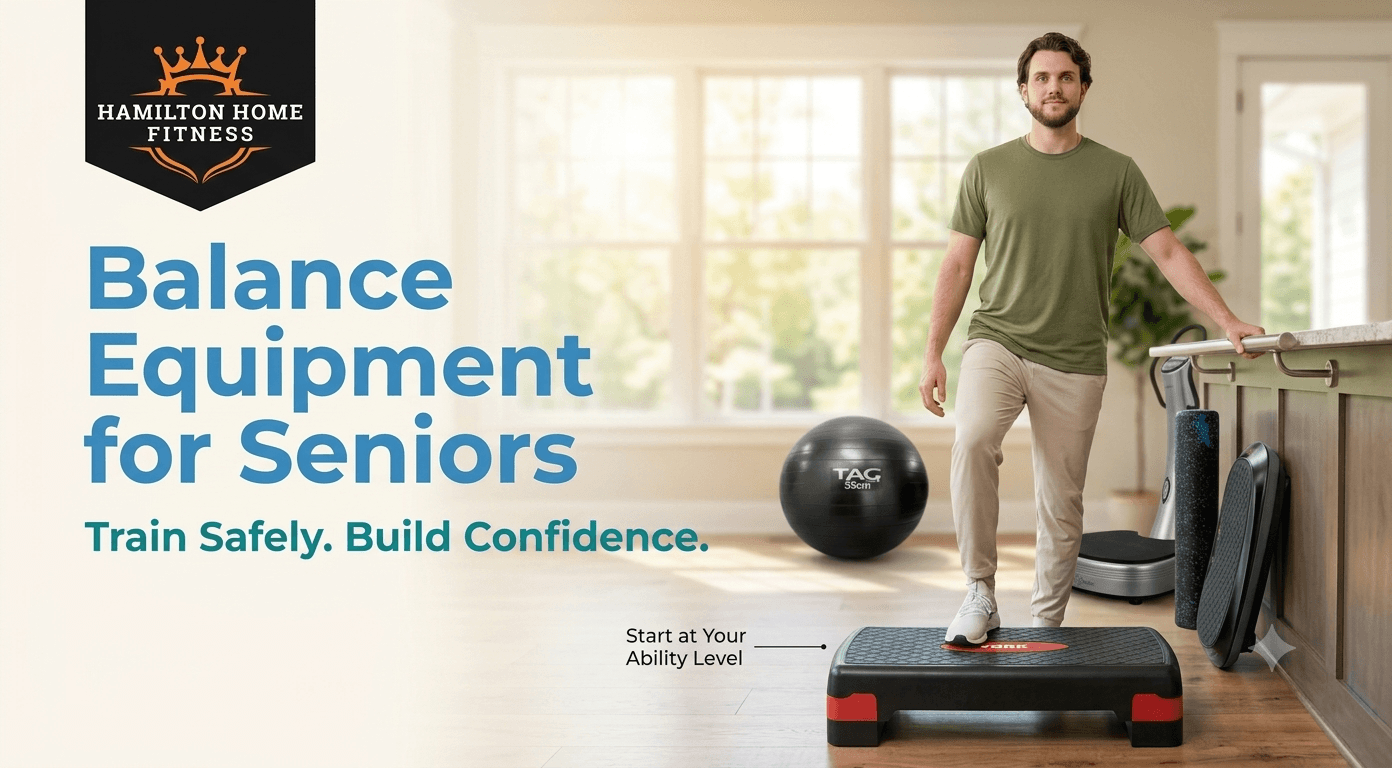
Add loaded movement alongside the holds. Sit-to-stands from a dining chair, calf raises at the counter, and side steps along a hallway. An York Aerobic Adjustable Step fits here because the height rises in stages, which lets step-ups get harder without getting riskier.
How long does it take to improve balance? Several weeks of consistent practice before the change is obvious, longer if you're starting from significant unsteadiness. Stopping resets it, so the schedule matters more than any single session.
FAQ
Can you improve balance after 70?
Yes. Balance responds to training well into later decades, and the starting point matters more than the number. Someone beginning at 78 with a counter and ten minutes a session will out-improve someone at 68 who buys a board and never uses it.
What equipment prevents falls at home?
No equipment prevents falls on its own, and two different categories get confused here. Training tools—pads, balls, steps—build the balance. Home modifications—brighter lighting, secured rugs, and grab rails by the bath and stairs—remove the hazards. Most households need both.
Do you need equipment for balance training at all?
No. The first few weeks can happen at a kitchen counter with nothing bought. What equipment adds is controlled difficulty you can raise a notch at a time, plus something physically in the room that makes the habit harder to skip.
What about osteoporosis or a recent joint replacement?
The sequence comes from the treating clinician, not an article. Unstable-surface work is commonly deferred in both cases, sometimes for months. Take the specific tool you're considering to the next appointment and ask where it fits, rather than guessing from a general guide.
Final Thought
You now know which row you sit in, and that's the whole decision. One rule carries the rest: start below your current ability, progress by removing support rather than adding time, and keep something solid within reach until the tool feels dull.
Get the plan cleared by a physician or physical therapist first, and train with someone in the house until steady. That order matters more than any product on this page.
When you know what you need, the rehab and recovery equipment range covers all four tool types in one place. Outfitting a room rather than a household—a senior living community, a clinic, a shared fitness space—is worth a book, a gym design consultation, instead of a single purchase.
Still can't place yourself in a row? Talk to the team before you order. Buying the wrong tool is the expensive mistake here—buying nothing is the common one.