Introduction
Your warm-up is five minutes on the roller, a few toe touches, then straight under the bar. And somewhere you heard the toe touches are costing you strength.
They aren't—not at the length you hold them. Foam rolling vs. stretching was never a contest for the same slot. What decides whether stretching costs you is how long you hold it, not whether you do it.
Below is a ten-minute sequence with a reason behind every step and the mobility and recovery equipment each one needs. This is healthy training, not rehab—pain or a joint that gives way belongs with a physical therapist.
What Each Tool Actually Does
Foam rolling and stretching change different things on different timescales. Rolling briefly changes how a muscle feels and how far it moves, and the effect fades within about half an hour. Stretching, repeated over weeks, changes how much range you actually own. Neither replaces the other.
Rolling is self-myofascial release: pressure on your own muscle using body weight. It lifts local blood flow, quiets tenderness, and buys a little range of motion. That's what a firm roller actually changes. Your hamstrings feel looser walking off it—and it's usually gone by your second working set.
Stretching runs on a slower clock. One session mostly shifts stretch tolerance—how much lengthening you'll accept before discomfort stops you—not the muscle. For the past four weeks, the range has been yours.
One finding rarely reaches warm-up advice. Across roughly 38 trials, neither rolling nor stretching beat other warming activities on the acute range of motion—walking, cycling, and bodyweight work landed in the same place. Certainty is moderate for range and low for stiffness. Rolling is convenience, not necessity. What it doesn't do is blunt force the way a long static hold can.
Is Static Stretching Bad Before Lifting?
Not at the durations most lifters actually use. Hold a static stretch for 60 seconds or less per muscle group, and the cost to strength and power is around one percent—nobody feels that. Push past 60 seconds and it climbs to roughly four to seven percent, which is real.
One percent on a heavy triple is not a missed rep. It is not anything. The numbers only get interesting at the top end: a single 60-second hold cut vertical jump height by 3.4% and peak power by 2%, while a 30-second hold was indistinguishable from doing nothing.
So the rule is duration, not abstinence. Keep any pre-lift hold near 30 seconds, and the question stops mattering. Save the long holds—the ones that actually build range—for after training, on a mat where you can settle in. That's what mats and floor props are for.
Which raises the obvious question. If short holds cost nothing, why does the research everyone quotes sound so much worse?
Why the Lab Result Misleads You
The studies behind the warning stretched cold muscle for minutes, then tested a maximum effort immediately after—which is nothing like a warm-up.
Put short stretching inside a real sequence, and it disappears. Trained athletes ran a full warm-up, added either five-second holds, thirty-second holds, dynamic work, or nothing at all, then ramped up to full intensity. Sprint and jump results came out identical. The athletes predicted otherwise—eighteen of twenty backed the dynamic version, and their predictions had no relationship to their scores.
Roll First, Stretch First, or neither?
Roll first, if you're rolling at all. It's a low-effort way to warm tissue before you ask it for range. But the order carries less weight than the internet suggests—the sequence you'll actually finish beats the theoretically perfect one you skip three days a week.
Nearly every page on this question gives the same reason: rolling breaks up fascia so the stretch reaches deeper. That mechanism has never held up. Rolling warms tissue and dulls the pull-back reflex—which a few minutes on a bike also does.
One real exception. If your upper back is stiff—desk job, bench day—a few passes along the thoracic spine before you press reach what a leg swing can't, and a stability ball for chest and thoracic openers works the same area from the other side.
So the rule is simple. Roll only where you're stiff, keep it under two minutes, then spend the rest moving—dynamic work through the hips and ankles you're about to load. Leave ballistic and PNF work to people with a coach watching.
A Ten-Minute Warm-Up for Heavy Days
Ten minutes, four phases: raise, mobilise, activate, and ramp. Spend the first two minutes getting warm, three moving through range, two switching on the muscles you're about to load, and the last three on the lift itself at building weights. The ramp is the part most people skip.
Minutes 0–2 — Raise. Bike, row, or walk until you're breathing harder. Warm tissue moves further than cold, which is most of what mobility work does.
Minutes 2–5—Mobilize. Leg swings, hip circles, and ankle rocks through the ranges the lift demands. This is movement preparation, so keep every hold short.
Minutes 5–7 — Activate. Band pull-aparts and glute bridges, twelve slow reps each. Light resistance bands for warm-up sets let you load the pattern without fatiguing it.
Minutes 7–10 — Ramp. Empty bar, then ramp-up sets at 40, 60, and 80 percent of your working barbell squat. This is why the short holds cost you nothing—you rebuild output on the way up.
No bands on hand? Air squats and slow bodyweight bridges do the same job, and the wider resistance range holds other options if you'd rather load it properly.
What Each Step Needs
You can run this whole sequence with a floor and ten minutes. The equipment makes two of the four steps easier, not possible.
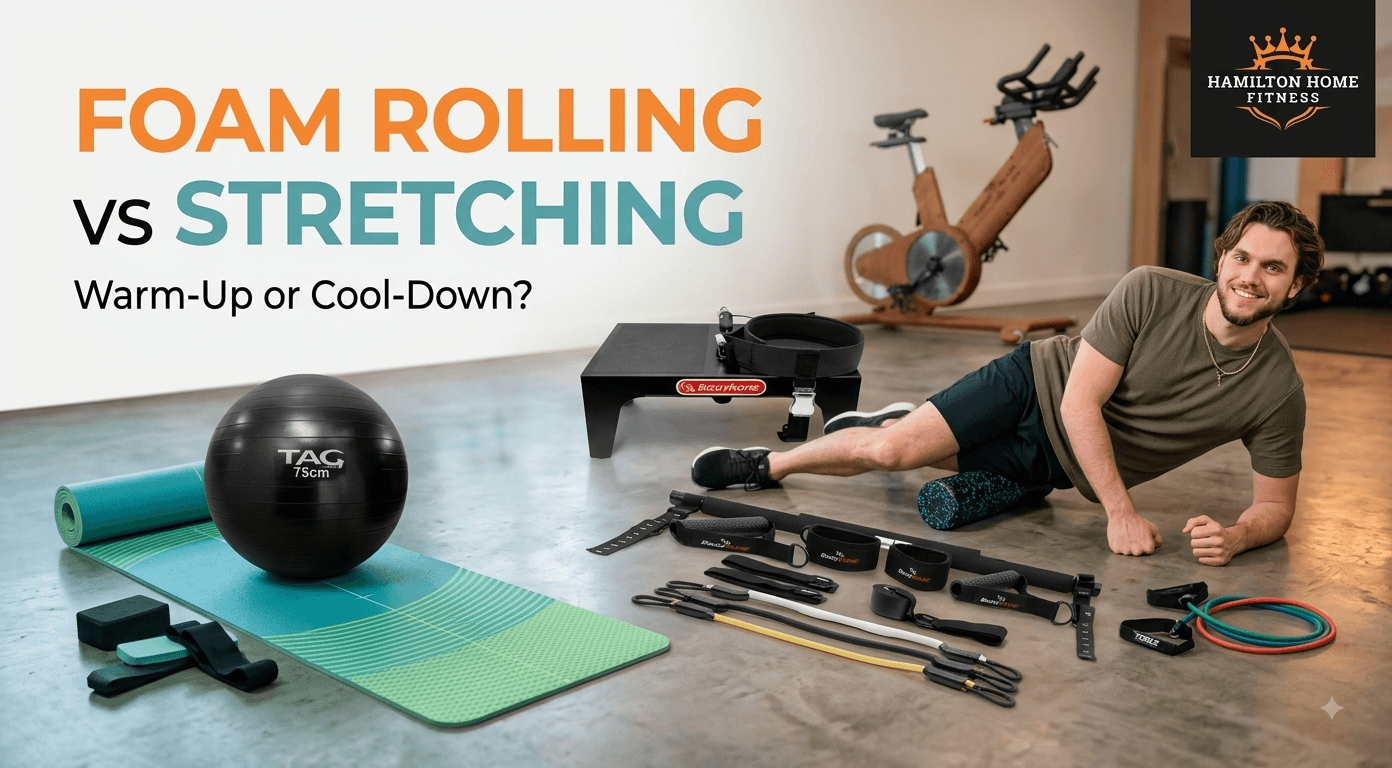
- Roller—minute 2, only where you're stiff
- Mat—minutes 2–5, so floor work isn't a carpet negotiation
- Light band—minute 5, for pull-aparts and bridges
- Stability ball—chest and thoracic openers
A band and tube kit covers the loading steps in one purchase.
Bought through Hamilton Home Fitness, the four make a compact home warm-up kit for someone without a rack of options. Skip it if your gym already has all four on the floor.
What Belongs After the Last Set
Stretching after a workout is where long static holds belong. The tissue is already warm, nothing is being tested afterward, and the flexibility that takes weeks to build gets built here—not in the eight minutes before a squat. Sixty seconds and up, on whatever actually limits you.
Pick two or three, not twelve. Hips and shoulders limit most lifters, and stretch tolerance climbs fastest where you train it consistently. Five minutes of honest work beats twenty minutes done twice a month.
One caveat, stated plainly. Almost all stretching research puts the work in the warm-up—roughly 85 percent of some 300 trials—so the post-training slot is thinly studied. The reasoning is sound; the direct evidence is thinner than the warm-up literature.
Rolling belongs in the cool-down too, for soreness rather than range. And if you're outfitting a studio or a garage where this happens daily, it's worth planning a dedicated mobility corner rather than working around a rack.
FAQ
When is static stretching the right tool, and when is dynamic movement better?
Dynamic before, static after. Dynamic work warms tissue while moving through the ranges you're about to load. Static holds work best when nothing is being tested afterward. Before a session, keep any hold near 30 seconds.
Does rolling after training do anything for next-day soreness?
Modestly. Post-training rolling reduces how sore a muscle feels and slightly improves how sprint and strength measures recover—around three to four percent. It doesn't speed the underlying repair. Comfort with a small edge, not a fix.
Does stretching prevent injury?
Not on its own. Stretching doesn't lower all-cause injury rates. Pooled evidence does show fewer muscle injuries specifically, and short static work inside a full warm-up may help in high-intensity sport. The whole warm-up matters more than the stretch.
Where do stability balls, bands, and mobility tools fit into the sequence?
Bands go in the activation step for light patterning. A stability ball suits chest and thoracic openers on the floor. A mat makes anything on the ground tolerable. All three are convenience, not requirement—we can help match a kit to your setup.
Final Thought
Your warm-up was never the problem. A few toe touches held for half a minute cost you nothing—the missing piece was the three minutes of ramp-up sets at the end.
Ten minutes: raise, mobilize, activate, ramp. Long holds after, not before.
If you want the four pieces that make it easier—roller, mat, band, and ball—they ship to all 50 states from Tennessee.