Introduction
You've got a one-car garage, a half-basement, a shed, or a two-car bay you share with the car—and a real worry that a rack, bench, barbell, conditioning piece, and storage won't all fit without giving up safe lifting distance or pull-up clearance. They fit. A working garage gym goes into 100, 200, or 400 square feet when smart layout, vertical storage, and folding gear do the heavy lifting.
This is a garage gym layout by square footage: the smallest footprint that actually trains you, the ceiling height each lift needs, a piece-by-piece plan for all three sizes, and how to keep your steel from rusting. Where it helps, you'll see how to source the space-saving gear and get a layout sized to your exact room—but the plan comes first.
How Small a Garage Gym Can Really Be
The smallest gym that still trains you is about 100 sq ft for conditioning and bodyweight work, and roughly 150 sq ft once you add a barbell and bench with a safe range of motion. Plan at least 2 ft of clearance around equipment and about 4 ft in front of a lifting station.
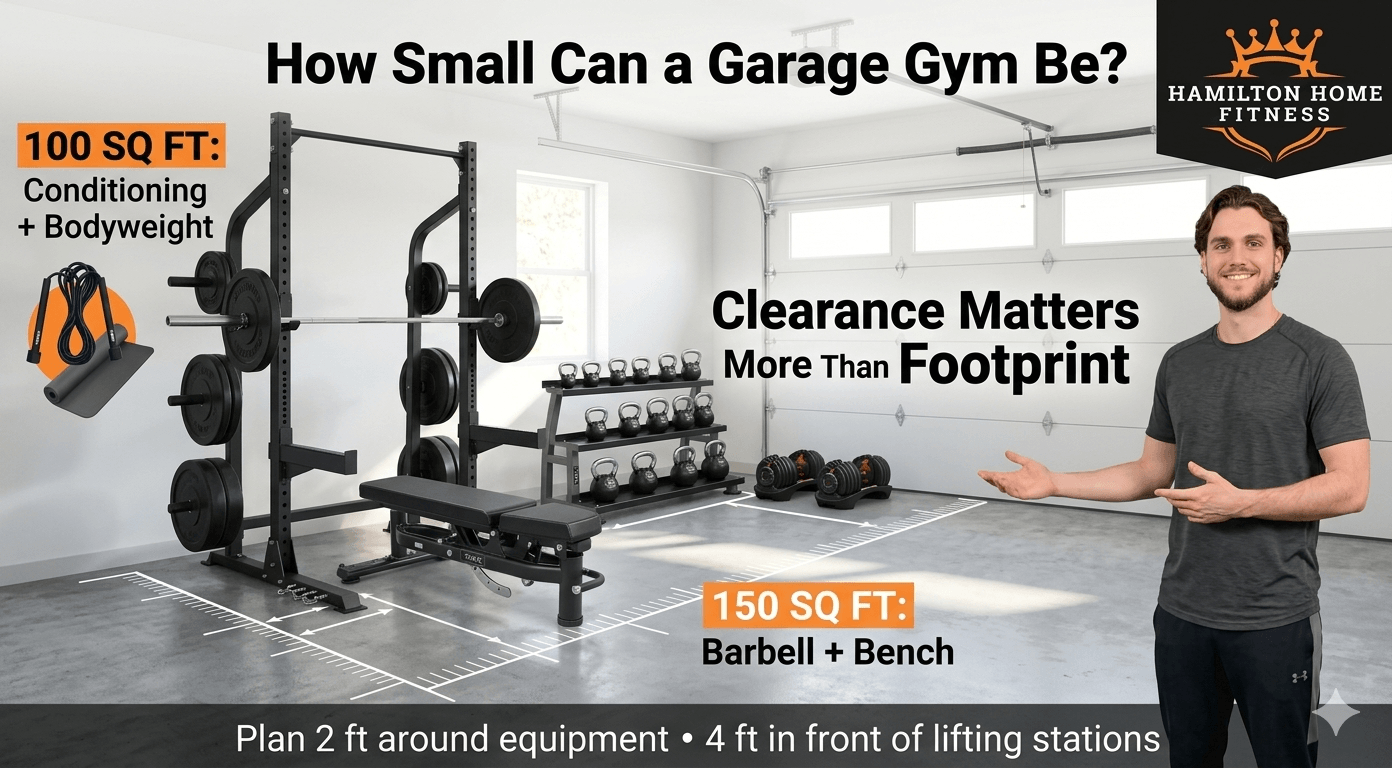
The number that catches people out isn't the equipment footprint — it's the clearance around it and the width of the bar. A loaded Olympic barbell is about 7.2 ft wide, so your usable width is set by the bar's sweep, not the rack frame. Measure the gear, then add the empty room a lift actually needs: a step back to walk out of a squat, a body length to lie out for a bench, and a clear path to load plates from both ends.
Footprint | What realistically fits | Clearance to plan |
~50–80 sq ft | Adjustable dumbbells or kettlebells, a folding bench, bodyweight work, a wall-mounted pull-up bar | ~2 ft around the bench and weights |
~100 sq ft | The above, plus a folding wall rack or compact half rack and a barbell for the basics | ~2 ft on the sides, ~3–4 ft to walk the bar out |
~150 sq ft | A half rack, barbell and bumper plates, a bench, and one small conditioning piece | ~2 ft sides, ~4 ft in front to load and lie out the bench |
Treat those clearances as planning minimums, not hard lines. Add a foot if you're tall, lift heavy, or share the floor with a training partner—the goal is room to fail a rep safely, not just room to stand.
Ceiling Height and Overhead Clearance
Most floor-based training works fine under an 8 ft ceiling, but standing overhead press and pull-ups get comfortable closer to 9 or 10 ft. The rule that protects you: measure your true clearance — ceiling height minus flooring, minus any platform, minus the bar's travel — at the lowest point in the room, then pick a rack about 6 to 12 inches shorter than that.
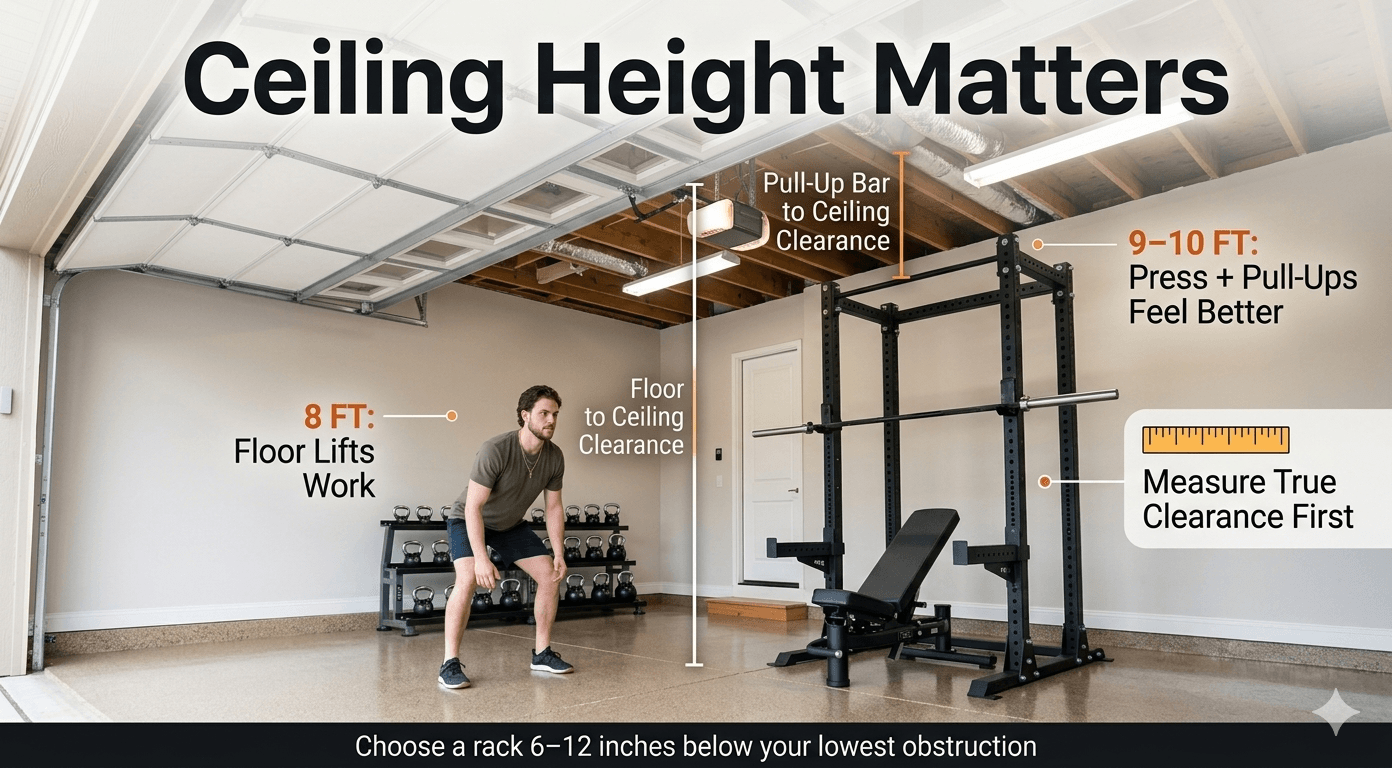
"At the lowest point" matters more than the number on a tape measure held to the drywall. A garage-door track, a duct run, a support beam, or a light fixture sets your real ceiling, not the space between them. Measure to the lowest obstruction directly over your lifting spot. And remember, a pull-up bar wants roughly 18 inches of clearance above it for a full dead hang—you can shave that to 12–14 inches, but you'll lose the taller pull-up variations.
Tiered ceiling reality
Here's what each common ceiling realistically allows and how to train around a low one.
Ceiling height | Rack height that fits | What you can do |
7 ft (84 in) | Short rack only (~70–72") | Floor lifts and seated work; standing press and full-hang pull-ups usually out—lean on a lat pulldown and bent-knee pull-ups |
8 ft (96") | ~70–80" rack | All floor lifts; standing presses, and pull-ups are tight for taller lifters, so bend the knees on the bar |
9 ft (108") | Up to ~83–90" rack | Standing overhead press and pull-ups work for most lifters with room to spare |
10 ft (120") | Any standard rack height | Full overhead press, dropped and kipping pull-ups for nearly everyone |
A short ceiling doesn't end barbell training — it just swaps the two movements that need the most headroom. Trade a standing press for a seated barbell or dumbbell press, and trade full-hang pull-ups for bent-knee pull-ups, a lat pulldown, or cable rows. The bigger decision is the rack itself: in a low garage, a shorter frame keeps the integrated pull-up bar usable instead of jammed against the ceiling. Match the rack to your true clearance first, then choose from power racks and cages sized to your ceiling rather than buying on height alone.
Layouts for 100, 200, and 400 Sq Ft
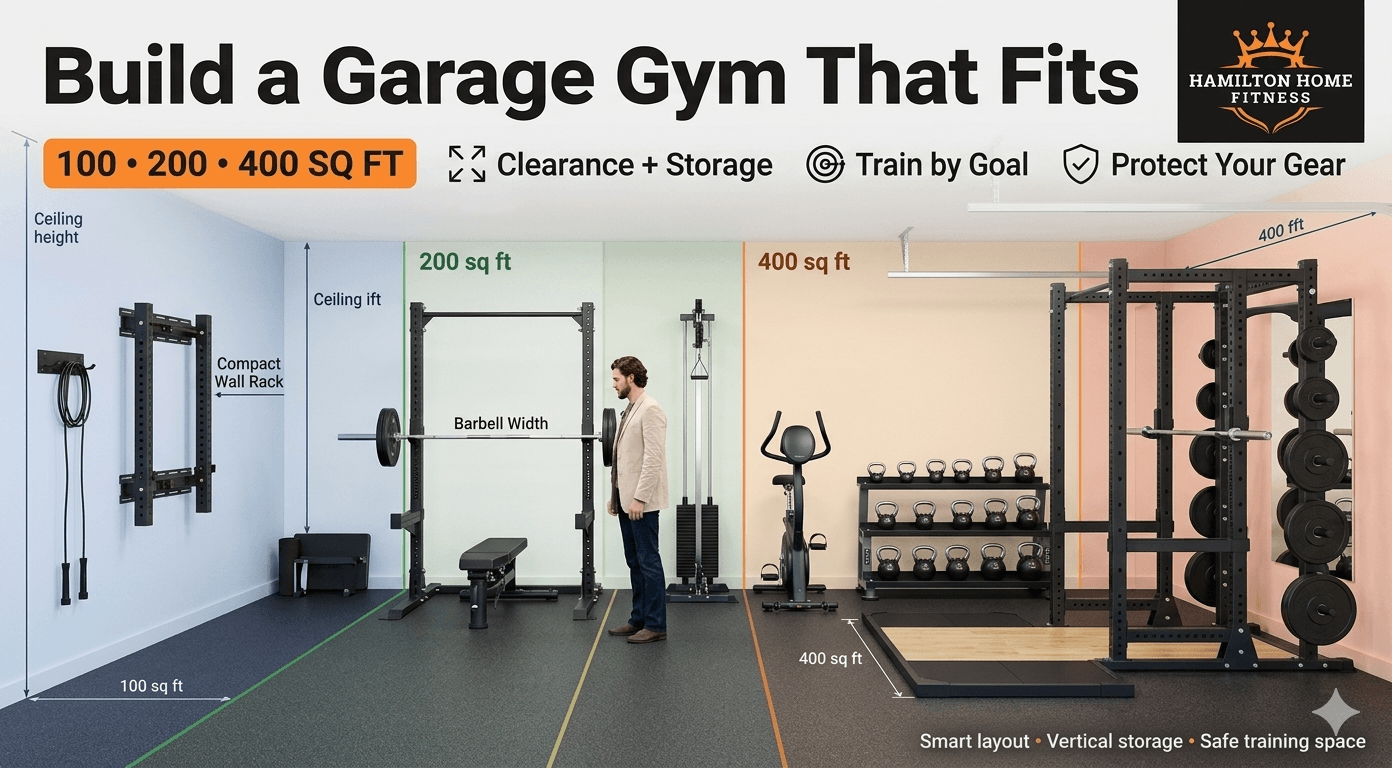
At 100 sq ft, build around a folding wall rack or compact half rack, a folding bench, and adjustable dumbbells. At 200 sq ft, a half rack, a barbell and bumpers, a bench, and one conditioning piece fit comfortably. At 400 sq ft, a full rack and platform, a complete weight set, cardio, and a storage wall coexist with room for a second person to train.
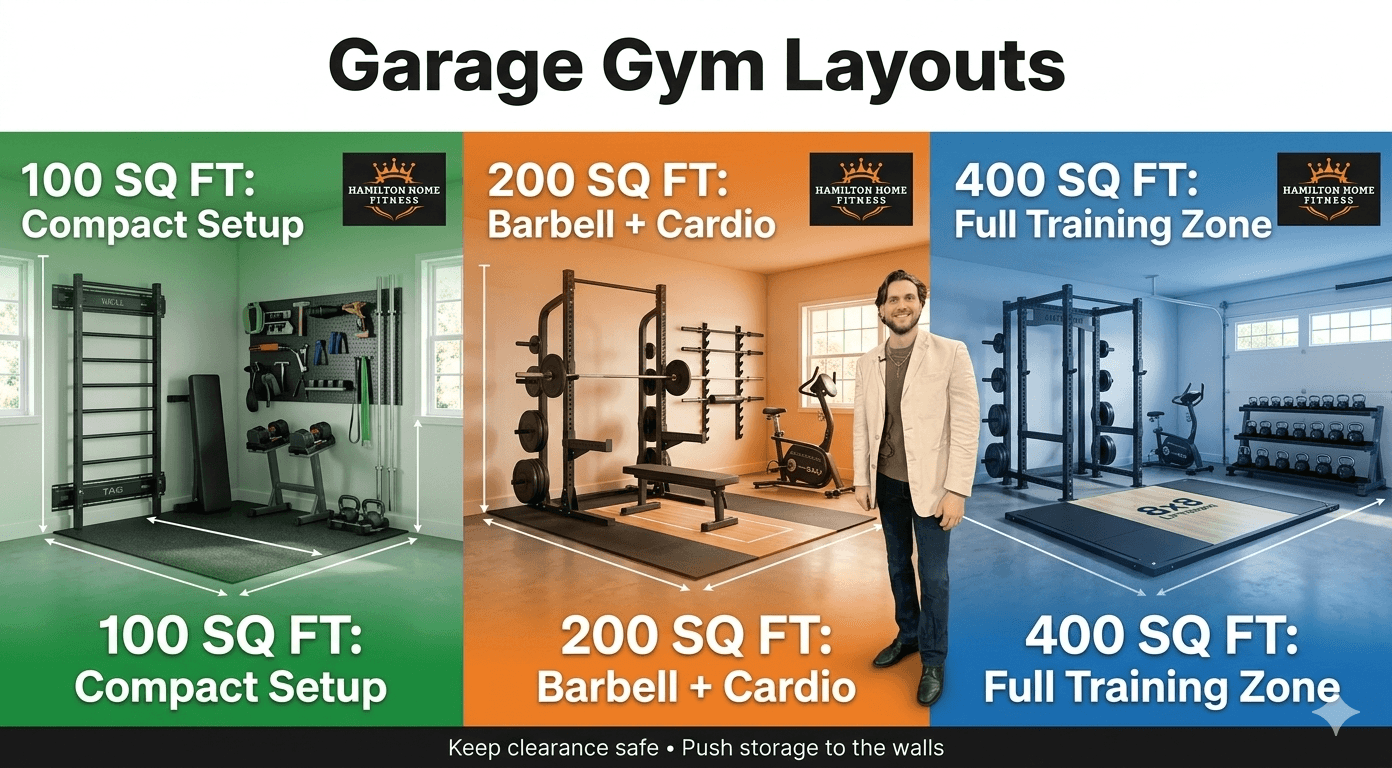
The footprints below assume a clear strip for the bar's roughly 7.2 ft sweep, about 2 ft on each side of the rack, and 3–4 ft in front to walk out a lift and lay out a bench. Hold those clearances and the layout stays safe; everything else is about pushing storage onto the walls.
100 Sq Ft: One-Car Corner or Shed
In 100 sq ft, vertical and folding gear is the difference between a gym and a storage closet. Picture a 10-by-10 corner of a garage, a shed conversion, or a spare bedroom: one wall does the lifting, and the floor stays open.
Mount a fold-flat wall rack or compact half rack on the strongest wall—it tucks to within inches when folded and sits under a foot deep in use, with a wall-mounted pull-up bar built in. Drop a folding bench in front of it for presses, then fold and lean it against the wall when you're done. Keep a 7-by-8 ft clear zone directly in front of the rack as your working strip.
For the rest, go vertical and adjustable. One pair of adjustable dumbbells that collapses into a single set replaces six or eight pairs and a dumbbell rack, which is the single biggest floor-saver at this size. A barbell and a modest plate set on wall horns round it out. It's tight, but you can squat, press, pull, and do pull-ups in a space most people write off.
[Floor plan — alt: "100 sq ft one-car corner garage gym layout with folding wall rack, folding bench, and adjustable dumbbells"]
200 Sq Ft: One-Car Garage or Basement
200 sq ft is where a half rack and a barbell setup stop competing for floor space. This is the sweet spot for a one-car garage gym layout or a half basement—think a 10-by-20 strip or a 14-by-14 room.
Anchor the back third with a half rack: it gives you squats, bench, overhead press, rack pulls, and an integrated pull-up bar in a smaller footprint than a full cage. Run a flat or adjustable bench in and out of the rack, and reserve a 6-by-8 ft open patch beside it as a deadlift zone with bumper plates. That leaves the front third for one conditioning piece — an air bike, rower, or walking pad — without anyone feeling boxed in.
Storage climbs the walls and the rack uprights so the floor stays trainable. A half rack also leaves room to add a cable or landmine attachment later, which is why it tends to outlast a fixed squat stand. Browse the space-saving half racks and rack packages that fit this footprint, then size the bench and bar to the room.
[Floor plan — alt: "200 sq ft one-car garage gym layout with half rack, barbell, bench, and cardio piece"]
400 Sq Ft: Two-Car Bay or Full Room
At 400 sq ft, you stop subtracting equipment and start planning zones. A 20-by-20 two-car bay or a full spare room has room for everything the smaller builds make you choose between.
Center the lifting zone on a full power rack over an 8-by-8 deadlift platform—a 4-by-4 rack inside that platform creates a natural training island you face into, with clear walkout on all sides. Put a dedicated bench station to one side and run a storage wall down the other: plate trees, a dumbbell saddle rack, a barbell holder, and kettlebell shelves all off the floor. That keeps a clean 5-ft traffic lane around the platform so two people can train at once—the reason this size works for couples and families.
The leftover footprint, usually the front bay near the door, becomes a conditioning zone. With this much room you can keep a full-size piece parked permanently instead of folding it away, so pick from the compact cardio and conditioning machines—an air bike, rower, treadmill, or stepmill—that match how you train.
[Floor plan — alt: "400 sq ft two-car garage gym layout with full power rack, deadlift platform, storage wall, and cardio zone"]
Training in a Shared Two-Car Garage
Share a bay by claiming one wall or corner with a folding or mobile setup: a wall-mounted or fold-flat rack, a folding bench, casters on the heavy pieces, and floor-taped zones so the car returns to the same spot every time. Most lifters need only a 7–8 ft wide working strip once the car is parked.
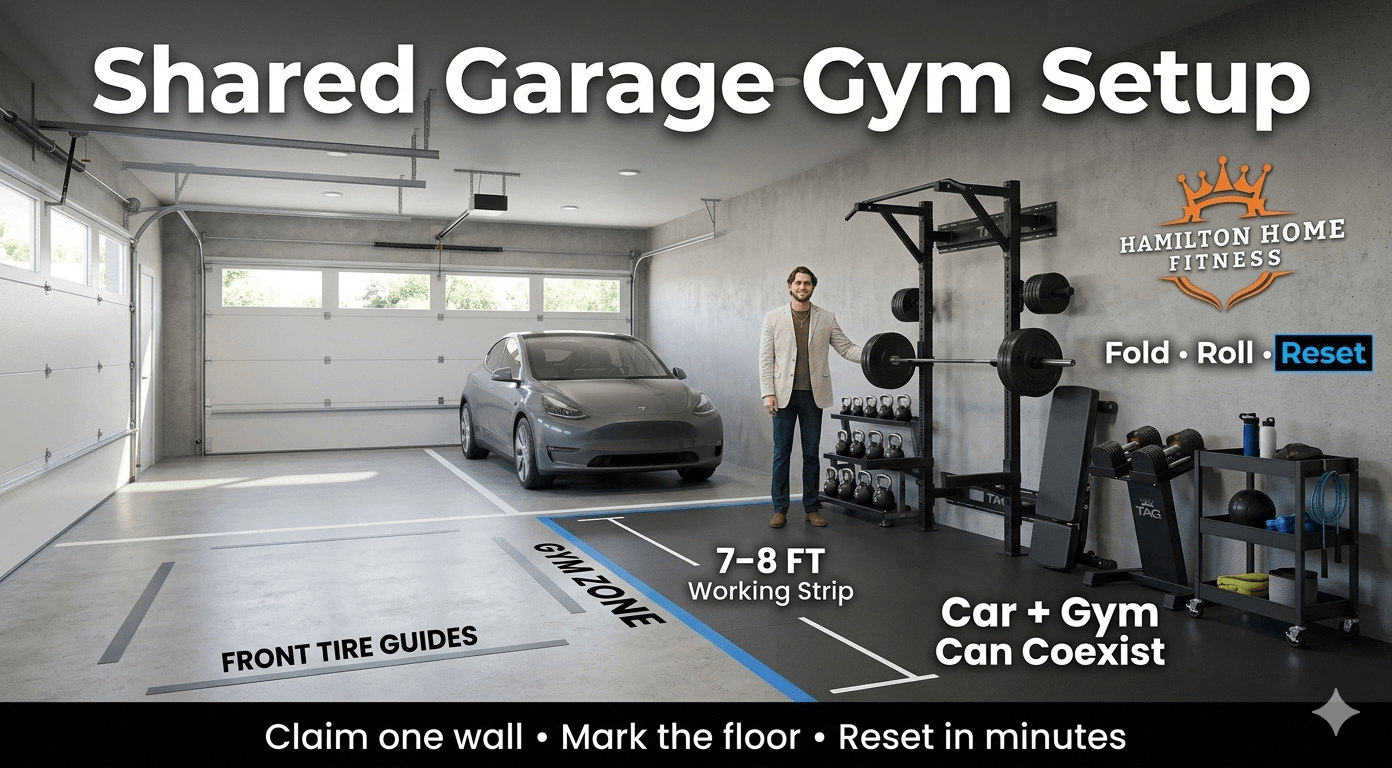
The trick isn't fitting the gym around the car—it's making the swap between "parking" and "training" fast enough that you'll actually do it daily. The car owns the floor; the gym owns the wall and the ceiling. A fold-flat rack against the strongest wall and a pull-up bar overhead take up zero usable floor when the car is in and then open into a full lifting station the moment it pulls out.
The daily reset system
A shared bay works when resetting it takes under two minutes. Build the routine around four moves: claim, fold, roll, and mark.
Claim one wall and the air above it. Wall-mount the rack and pull-up bar so the car can park right up to them.
Fold anything that doesn't need the floor. A folding or adjustable bench stores flat against the wall between sessions and drops back into place in seconds.
Roll the heavy pieces. Put casters or a loadable mover under a plate tree, a single dumbbell, or a conditioning piece so it slides clear instead of being dragged.
Mark the floor with tape — two strips for the front tires, one for the working strip's edge. The car lands in the same place every night, and your 7–8 ft training lane stays protected.
Two recurring problems trip people up. If the door track or opener motor hangs into your overhead space, mount the pull-up bar forward of it or set a barbell in the J-cups for presses instead. And if the slab slopes toward the door for drainage, level the rack and bench with thin shims so you're not lifting on a tilt. Solve those two, and one bay genuinely serves the car and a daily training habit at the same time.
Vertical Storage That Clears the Floor
Keep the floor clear by storing weight vertically: plate horns or a plate tree for bumpers and iron, a barbell wall or fishbone holder for bars, a saddle rack for dumbbells, and a wall shelf for kettlebells and accessories. Rack-mounted weight horns add storage without adding a single square foot of footprint.
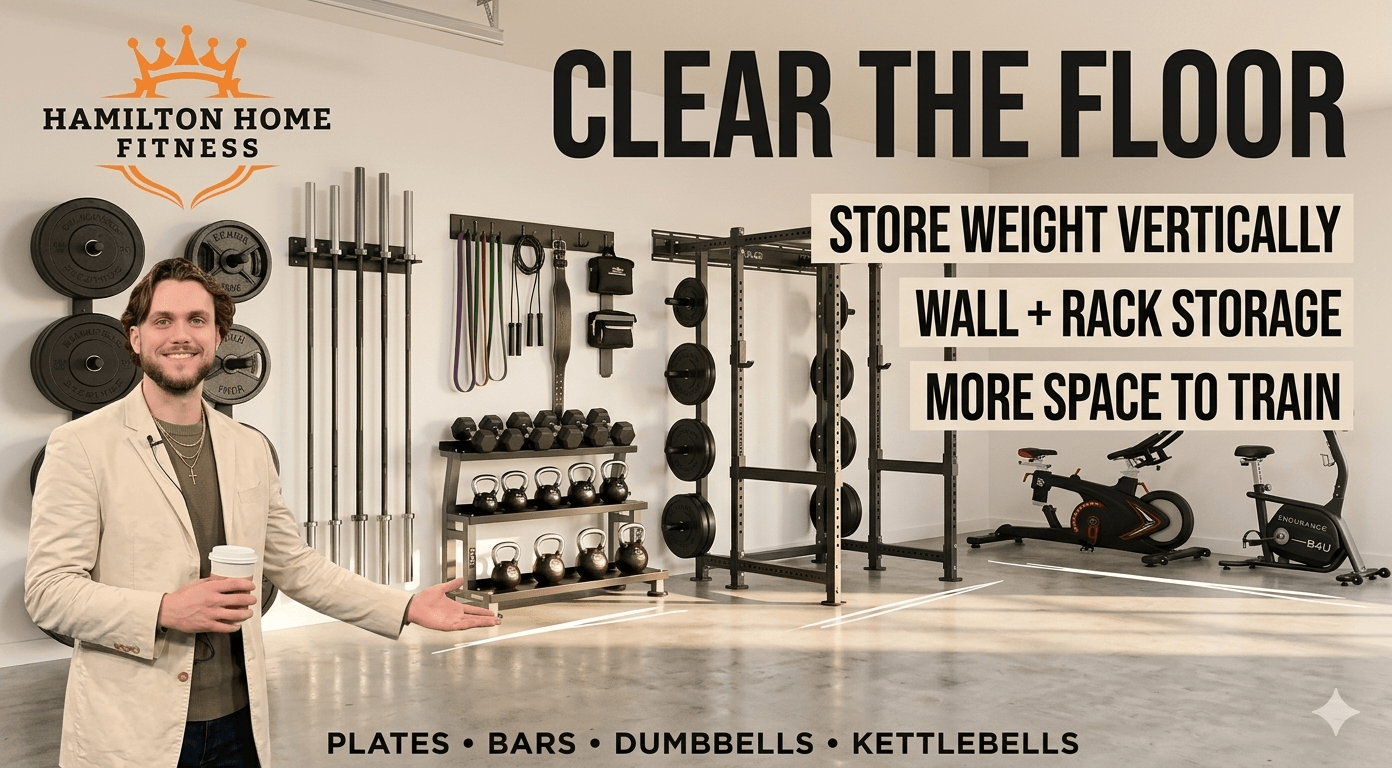
In a small gym, storage isn't an afterthought—it's what decides whether the floor is trainable or buried. Every plate leaning against a wall and every dumbbell parked on the ground steals from the clear zone a lift needs. The fix is to send weight up the walls and onto the rack uprights, where it's organized, off the slab, and out of your walking path.
Storage that doubles as footprint savings
Every pound on a wall is a square foot back on your floor. Match each item to the holder built for it:
Bumpers and iron plates → plate horns mounted on the rack or wall, or a freestanding plate tree if you have a corner to spare. Rack-mounted horns are the space winner because they use a frame you've already paid for.
Barbells → a vertical bar holder or a fishbone holder that stands bars on end, or a horizontal barbell wall holder. Keep 7-ft bars out of the traffic lane instead of rolling underfoot.
Dumbbells → a dumbbell saddle rack on the wall, which cradles pairs in a tight vertical stack instead of a long floor rack. Adjustable dumbbells shrink this to a single small shelf.
Kettlebells, accessories, and small gear → a wall shelf or a row of hooks for kettlebells, bands, a jump rope, sleeves, and a belt.
The pattern is the same at every footprint: weight lives on the wall, and the floor stays open for movement. When you're choosing holders, the gym storage racks and wall-mount accessories cover plate horns, bar holders, saddle racks, and shelving so you can clear the floor in one pass rather than piece by piece.
Airflow, Climate, and Rust Prevention
Rust comes from trapped humidity, so control moisture first: add airflow with a fan or vent, run a dehumidifier in humid months, and consider a mini split for heat and cold. Wipe bars down after chalky sessions, keep a light film of oil on bare steel, and store plates and bars off a damp slab.
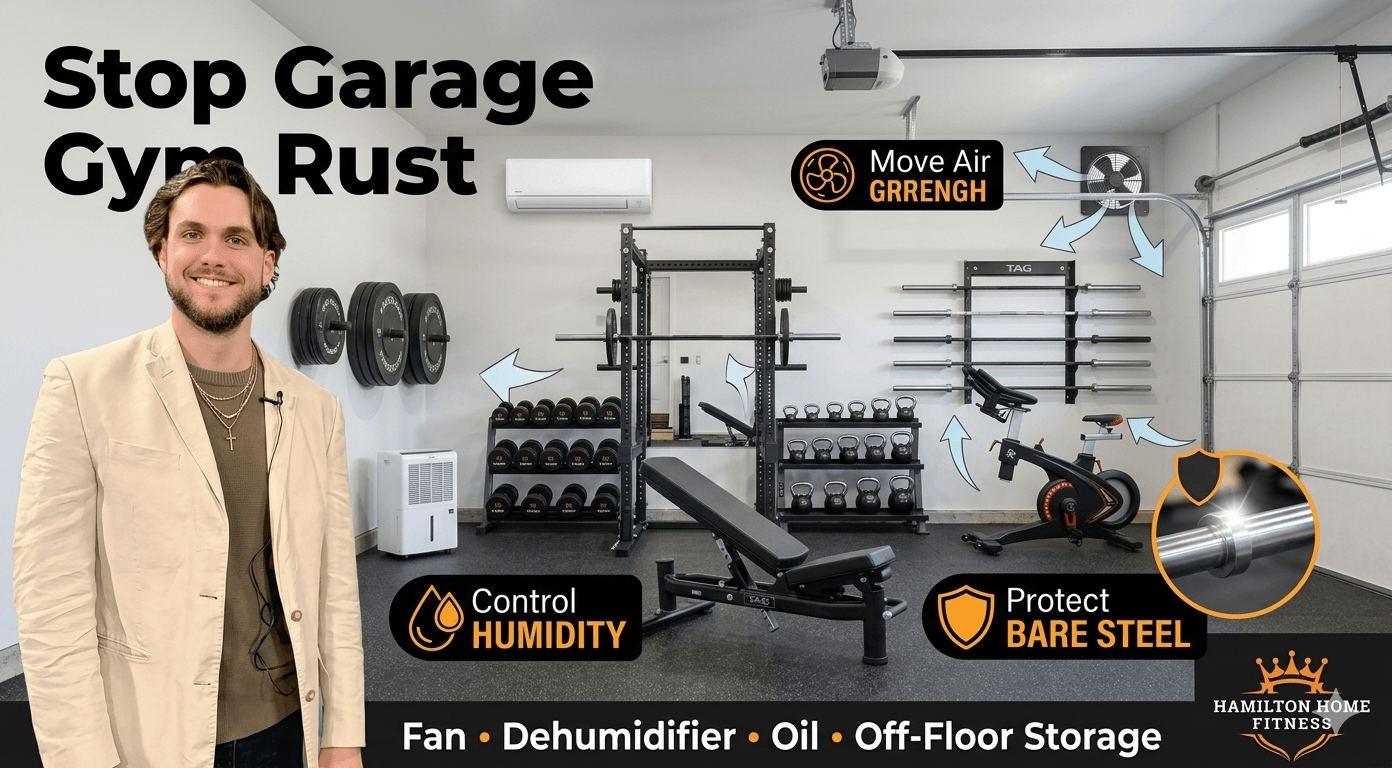
A garage swings between extremes that a finished room never does—summer heat, winter cold, and the moisture that condenses on cold steel when warm, humid air hits it. That condensation is what pits a barbell's knurling and freckles your plates with orange. Beat it by moving air and pulling moisture out before it settles, then by giving bare metal a thin barrier so the humidity that does linger has nothing to bite into.
Climate control—keep the room usable year-round:
Airflow: a fan or a powered wall/ceiling vent keeps air moving so moisture can't sit on cold metal. This is the cheapest, highest-return step.
Humidity: run a dehumidifier through humid months and empty or plumb it regularly; this does more for rust than anything else in a damp climate.
Temperature: a mini split handles both heat and cold and runs efficiently; an infrared or propane heater warms the space faster in cold-only garages.
Envelope: insulating the walls and garage door steadies the temperature and cuts the condensation cycle that drives rust in the first place.
Rust prevention — protect the steel:
Wipe bars and bare-metal contact points after every chalky or sweaty session.
Keep a light coat of 3-in-1 or honing oil on bare steel; brush the knurling with a nylon or brass brush periodically.
Store bars on a holder and plates on horns or a tree—off the slab, where ground moisture wicks up.
Re-oil more often in spring and fall, when day-to-night temperature swings produce the most condensation.
Two notes worth respecting. Climate needs differ by region—a humid Southeast garage leans hard on the dehumidifier, while a northern garage prioritizes heat and insulation—so weight your spending toward your actual problem. And treat the power side as real work: a mini split and most high-output heaters draw enough current that a licensed electrician or HVAC pro should handle the install and the circuit, both for safety and to keep any warranty intact.
Build Your Equipment List by Goal
Pick equipment by how you train, not by the trend. Powerlifting prioritizes a sturdy rack, a solid bench, and calibrated iron plates. Olympic lifting needs bumper plates and a platform. CrossFit and hybrid training want a rig, a conditioning piece, and an open floor; hypertrophy leans on adjustable dumbbells and a cable option. Then set the bar and rack height for the lifter.
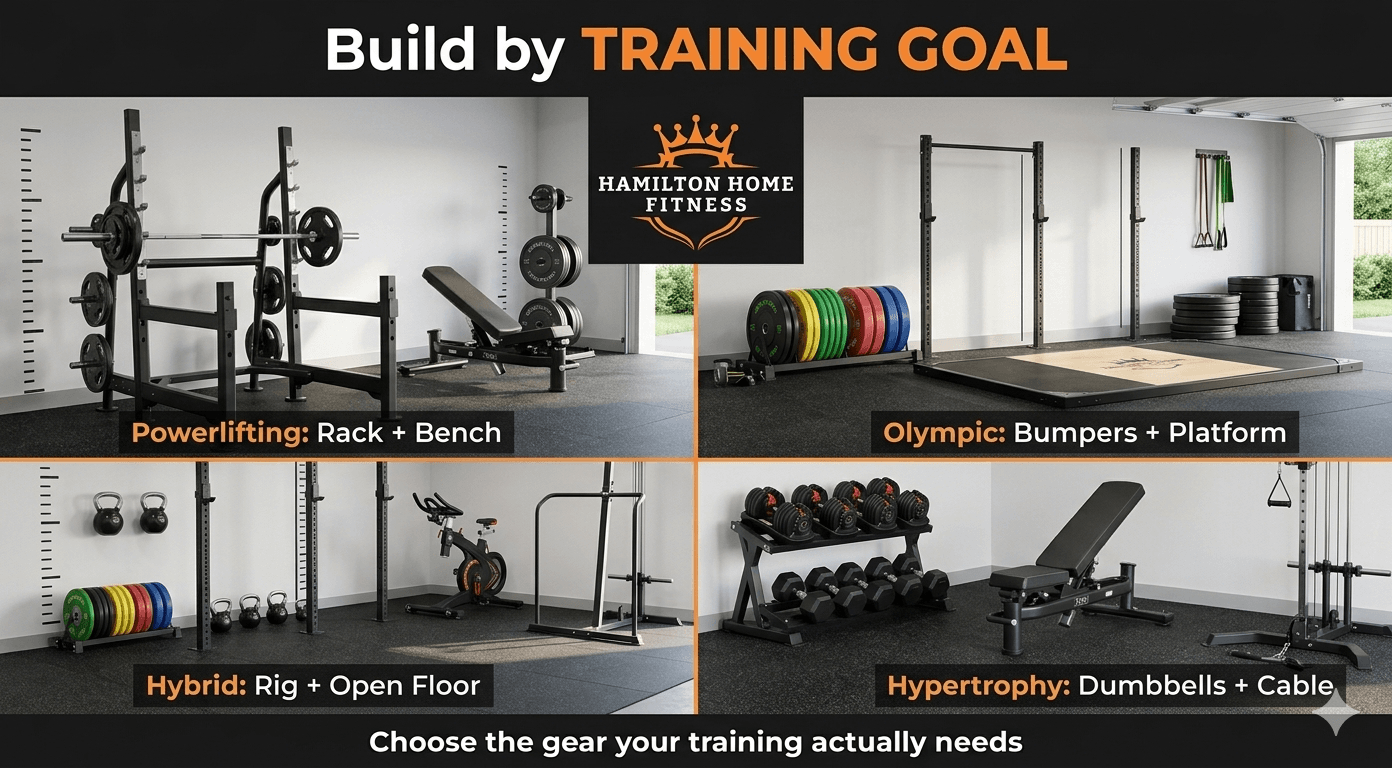
The layout tells you what fits; your training tells you what to actually buy. The fastest way to waste a small footprint is to fill it with single-use machines before you own the basics that cover most of your work. Start from the style you train, get those pieces right, and add specialty gear only when a real need shows up.
Match equipment to your training
Start from how you train, then buy only what that style rewards.
Training style | Core pieces to prioritize |
Powerlifting | A heavy-duty rack with reliable safeties, a rigid flat or FID bench, an Olympic power bar, and calibrated or iron plates for precise loading |
Olympic lifting | Bumper plates you can drop, a lifting platform, and a women's or men's Olympic bar with good spin |
CrossFit / hybrid | A rig or rack with a pull-up bar, bumpers, a conditioning piece, kettlebells, and a clear floor for WODs |
Hypertrophy | Adjustable dumbbells, an adjustable bench, and a cable or landmine attachment for angles and isolation |
A few pieces pull double duty across all of them—a quality rack, an adjustable bench, and a barbell are the backbone of nearly every garage setup, which is where most of your budget should land first. Specialty bars (trap, safety squat, EZ curl) and extra plates are easy to add later once the core is in. When you're ready to fill in the bar and plates, the Olympic barbells, plates, and free weights cover the loading side of any of these builds.
Sizing for body type and training age
The same room fits different bodies once you set bar and rack heights to the lifter. A 5'4" lifter and a 6'4" lifter can share a 200 sq ft plan—they just need different J-cup and safety positions and slightly different clearance.
Tall lifters need the most attention to overhead and walkout space: confirm pull-up clearance for a longer body, set J-cups higher, and give an extra foot in front of the rack for a longer squat walkout. Female lifters often train better with a 25 mm women's bar, which fits smaller hands and loads the same plates. Master lifters and anyone managing joints benefit from joint-friendly swaps—a trap bar for deadlifts, a safety squat bar that's easier on the shoulders, and seated press options when standing overhead work bothers a shoulder. Set storage and bar heights so nothing requires an awkward overhead reach to rack or load.
If you'd rather not solve the geometry yourself, you can book a custom gym design sized to your exact room and the people training in it.
FAQ
Are foldable wall racks safe?
Yes — when they're mounted correctly. A folding wall rack has to bolt into wall studs or a reinforced backing that's rated for the loads you'll lift, with the hardware and folding pins checked periodically. Mounted that way, a quality folding rack handles heavy barbell work. The failure point is almost never the rack itself; it's a weak wall or a missed bolt. Confirm the wall structure and the rack's weight rating before you load it, and treat this as general guidance rather than a safety guarantee for your specific wall.
How much clearance do I need around a power rack and bench?
Plan about 2 ft of clearance on each side of the rack and roughly 3–4 ft of walkout and loading space in front and behind, plus enough room to lie out flat for a bench. These are widely used planning minimums, not hard limits—add margin if you're tall, lift heavy, or share the floor with a training partner. The clearance protects your range of motion and gives you room to fail a rep safely, which matters far more than squeezing the footprint down to the frame.
Can my garage floor handle a loaded power rack?
A standard concrete garage slab handles a loaded rack with no trouble. The real risk shows up in basements and on upper floors, where a loaded rack and dropped weights can far exceed a wood floor's design load. In those spaces, map the rack legs over structural joists rather than mid-span, and consult a structural engineer before installing heavy equipment. On a slab you're fine; off a slab, verify the structure first.
Final Thought
A genuinely functional garage gym fits in 100, 200, or 400 square feet—the space was never the real limit. Smart layout, vertical storage, and folding gear are what make a rack, bench, barbell, conditioning piece, and storage coexist without giving up safe lifting distance or pull-up clearance.
The order that gets you there: Start from your true square footage and ceiling height; choose the rack type that fits the room; send your weight up the walls instead of across the floor; and protect your steel from the moisture that drives rust. Get those four right and the build comes together at any size.
When you're ready to turn the plan into gear, contact the Tennessee team for a personalized equipment list sized to your space—and to confirm free-shipping eligibility on STEPR, Spirit Fitness, TAG Fitness, Body-Solid, and Vortex.