Introduction
You’ve passed suspension straps for years on gym racks, clinic frames, and hotel doors, so what do they do that dumbbells don’t?
Most suspension training benefits come from leverage: your body becomes the weight, and a step of your feet changes the load. Straps can take bodyweight off a squat, which no dumbbell can, but hit a ceiling near bodyweight.
Wary beginner, joint-conscious lifter, or clinic buyer? Expect load by angle, where instability helps, how to pass the ceiling, straps versus bands, rings and dumbbells, and who gains most.
This page explains equipment, not treatment; training around an injury starts with a physical therapist.
How Does Foot Position Change the Load?
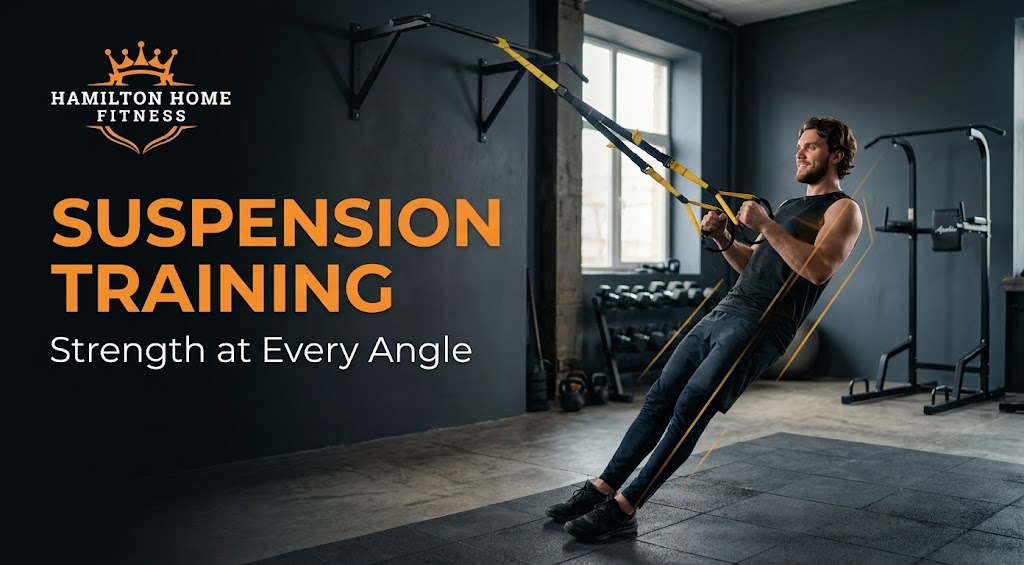
Walk your feet toward the anchor, and the straps take more of your bodyweight; move them away, and your feet carry it. One step changes the load, a finer move than the fixed jumps along a rack of dumbbells. That is foot position scaling, often called vector resistance. The same leverage can also take bodyweight off.
How Much Load Does Each Angle Add?
In the hardest suspended push-up setup measured with load cells in the straps, 50.4% of bodyweight went through the handles with arms straight and 75.3% at the bottom of the rep. The test used 28 young male university students, so treat these figures as a guide, not a rule.
For a 180 lb person, the hardest setup means about 91 lb at lockout and 136 lb at the bottom. Easier suspension push-up angles put less on the straps and more on your feet. Two steps apart, the same push-up feels like a different exercise.
Why Straps Can Take Bodyweight Off
Hold the handles and lean back, and your arms share a squat or lunge with your legs; pull harder on a tough rep, ease off on an easy one. A sit-to-stand that’s too hard alone becomes doable with a light pull on the handles.
That is bodyweight leverage training in reverse; a dumbbell can only add load. Rated assist bands help too, but the band you picked sets that help, not how the rep feels.
What Does Strap Instability Add?
Straps put your hands or feet on a support that moves, so your trunk works to hold a straight line. That extra work is real on some moves and close to absent on others, so treat the wobble as a tool to place, not a bonus on every rep.
Your hands stay on a support while your body moves, a closed chain exercise, yet push-up handles drift apart unless you hold them.
Does TRX Work Your Core?
Yes: across 18 muscle-activity studies, suspended push-ups, planks, and hamstring curls worked the core and upper body harder than the same moves on a stable floor. Skin sensors measured this instability core activation from moderate, 21% to 40% of a maximal contraction, to above 60%, mostly in small studies.
Core moves make you stop your lower back from sagging, called anti-extension, or your hips from twisting, called anti-rotation. Body saws and fallouts rank among the toughest.
Where Instability Adds Little
Suspended rows work the back about as hard as an ordinary inverted row, and in muscle-activity research, pulling on straps changes activation far less than pushing does. So use the row for TRX row progression: a pull with no bar, scaled by a step, then single-arm reps.
Pushes carry the cost: more trunk work can mean more spine load. If a strap plank or fallout makes your lower back ache, shorten the lever until the arch that hurts on an ab wheel disappears.
Can Suspension Training Build Real Strength?
Yes, for people new to strength work: in trials of seven to twelve weeks, suspension programs built strength about as well as traditional training in untrained, middle-aged, and older adults. Untrained muscle responds to almost any progressive overload. Most of that suspension training research was small and short.
Experienced lifters gain less, as the method’s own coaching texts concede.
Where Bodyweight Scaling Runs Out
Scaling resistance without plates ends at your own bodyweight: once the steepest angle and the single-limb version are easy, the straps have nothing left to add. In the 28-student push-up test, the hardest setup peaked at 75.3% of bodyweight; legs top out at single-leg bodyweight.
Heavy squats and hinges need a barbell in a power rack, loaded in heavy, measured jumps. A common rule of thumb: add load at 12 to 15 clean reps in the hardest setup.
How to Keep Progressing Past It
To make TRX harder, use the free levers first, in this order, and add outside load only when the last one is easy.
Steepen the angle.
Switch to single-arm or single-leg work.
Slow the lowering to three or four seconds.
Pause at the hardest point.
Move your feet into the foot cradles.
Adding a weighted vest to TRX comes next, the same way pull-ups and dips get loaded.
Adjustable weighted vests step up in small increments; start near 5% of bodyweight. Heavy leg work still needs a barbell. Body-Solid vests ship free as of October 10, 2026.
Straps vs. Bands, Rings, and Dumbbells
Each tool changes the load a different way: dumbbells by swapping to the next weight, bands by stretch, and straps and rings by body angle. Straps and rings let your arms take bodyweight off a move on demand; a band’s help is fixed, and a dumbbell only adds.
Tool | How load changes | Can it take the load off? | Load ceiling | Best job |
Suspension straps | Body angle and foot position | Yes, arms assist on demand. | Near bodyweight (75.3% on the hardest push tested) | Scaling bodyweight moves, unloading, travel |
Resistance bands | Stretch, rising toward lockout | Fixed assist set by the band | The heaviest band owned | Isolation, warm-ups, sideways and rotational lines |
Dumbbells | Swap to the next weight. | No | As heavy as the rack goes | Measured strength and size work |
Gymnastic rings | Body angle | Yes, arms assist on demand. | Near bodyweight | Dips, support holds, gymnastic skills |
Are Gymnastic Rings Better Than TRX?
Rings are better for dips, support holds, and gymnastic skills; straps are better for leg and core work, because the foot cradles make hamstring curls, pikes, and atomic push-ups easier to set up and hold.
In TRX vs gymnastic rings, straps need one anchor point, not two, and change length faster. If dips are your real priority, a dip station covers them.
TRX vs. Resistance Bands: Two Load Curves
Bands and straps load a rep from opposite ends: a band is lightest at the start and heaviest at lockout, while a suspended push-up is heaviest at the bottom. That rising pull is called accommodating resistance.
In TRX vs. resistance bands, bands win isolation and sideways or rotational lines; straps win compound bodyweight moves. Whether you pick loops, tubes, or stretch cords, owning both is often the honest answer.
What Is Suspension Training? Good For?
The clearest suspension training benefits are jobs, not adjectives:
Scaling bodyweight moves by a step, no plates
Taking bodyweight off squats, lunges, and sit-to-stands
Core work that resists sagging and twisting
Travel and small rooms: one bag, one anchor
Joint-friendly accessory volume for lifters
Is TRX Good for Beginners?
Yes, you can start almost upright, where the straps carry little load, and move to a steeper angle as strength comes, without buying heavier equipment. A suspension trainer for beginners has one trap: letting your hips sag.
Compare the two TRX strap setups, TRX Bands at $144.99 and the TRX Club 4 System at $300.00 (October 10, 2026); shipping is calculated at checkout, and neither lists a weight capacity.
Why PT Clinics Rely on Suspension
Rehab plans come from a physical therapist; this page doesn’t treat injuries. Clinics use suspension because a patient can work with part of their bodyweight removed in steps small enough to match recovery, while the therapist’s hands stay free to guide. A suspension trainer for rehab fits among other rehab equipment.
Sling exercise dates to a 1927 lecture to British physiotherapists. Fitting out a clinic or studio? Start with commercial fitness equipment.
A Joint-Friendly Tool for Lifters
For lifters, straps earn a place as joint-friendly accessory work: the handles move freely, so wrists and shoulders find their own path on rows, presses and Y and T raises. This joint-friendly resistance suits most healthy shoulders and wrists; it won’t fix an injured one. Hang them from a rig crossmember for warm-ups between barbell days.
Shared gyms can step up to the TRX Club 4 System, listed as club-grade; heavy users should ask the team about capacity.
FAQ
Can you build muscle with a suspension trainer?
Yes, TRX is enough to build muscle while each set stays hard: muscle grows from sets near failure at many loads. Once the hardest setup is easy, see how heavy a weighted vest should be.
Is suspension training good for seniors?
Often, yes, with supervision at first: in small 12-week trials, a suspension trainer for seniors matched or beat bands and weights on strength and balance. Ask a doctor first, and see balance equipment for older adults.
Can one suspension trainer train your whole body?
Yes, one tool covers the full body: push, pull, squat, lunge, hinge and core. Legs hit the ceiling first; heavy leg work needs a barbell. For hotel rooms, a band kit for travel packs smaller.
How often should you do suspension training?
Two or three TRX sessions a week suits most people, in line with adult guidance for strength work on two or more days. Rest a day between hard sessions for the same muscles.
Final Thought
Straps scale bodyweight moves both ways by a step. Start at the angle you can control, and add load only when the steepest one stops being hard. Hamilton Home Fitness ships to all 50 states from Tennessee.
Planning a clinic or studio? Book a gym design consultation.