
Introduction
Six weeks, same sticking point. In the powerlifting gym, bands run from rack to bar. How do they anchor? How hard should they pull?
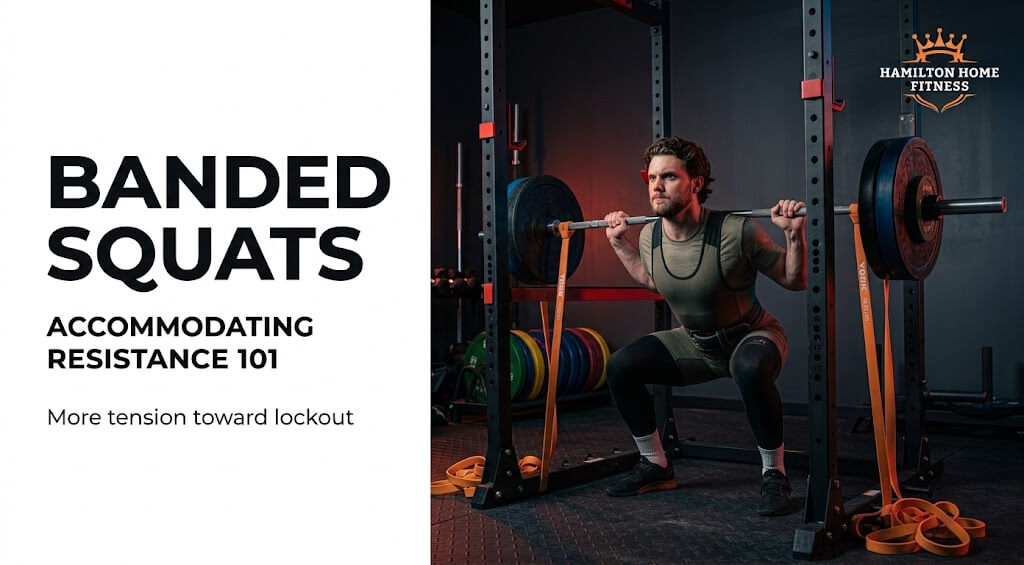
Banded squats use accommodating resistance: the band adds load as you stand, so the top, where you're strongest, gets heavier. Run about a fifth of your max at lockout, measured on your rack.
Intermediate or advanced? Here's whether bands fit your stall, which matched pair to buy, and how to anchor it safely. Still adding weight most weeks? Bands add nothing yet.
A stall isn't pain. If the lift hurts, see a doctor or physical therapist, and read how to keep training around an injury.
Why a Barbell Fights Your Strength Curve
Accommodating resistance is a load that rises as a lift gets easier. On the squat and bench, you're strongest near lockout, so a straight bar is hardest at the bottom and too light at the top. A band adds tension as it stretches, which evens that out.
Lifters call this an ascending strength curve: the closer you get to standing, the more force you produce. A plate weighs the same at every depth.
[Image: line graph of squat strength by depth against band tension by depth. Alt text: squat strength curve compared with band tension rising toward lockout]
Picture a 300 lb squat: it grinds just above parallel, then floats. Past that sticking point, you slow the bar and coast, so the top half barely trains.
A band stays slack at the bottom and pulls hardest near the lockout. Chains do the same with steel.
The bands here are 41-inch flat loops. Here's why flat loops, not tubes, belong on a bar.
Do Banded Squats Actually Help?
Banded squats with accommodating resistance aren't reliably better than straight weight for raising your max. Reviews range from no edge to a small one, seen when bands supply a fifth of the load or less. They clearly help acceleration: bar speed and jump height.
An early pooled analysis many gear sites cite was withdrawn over errors.
Where Bands Earn Their Place
Bands earn their place on speed work, lifts that die near lockout, and athletes who need full-rep speed.
On a conjugate dynamic effort day, the rising pull forces acceleration all the way up. The faster band-driven drop may help too; that's plausible, not proven.
In one eight-week trial, squat jump rose 21.4% with bands against 12.9% without; max and sprint gains matched.
When Bands Are Just a Distraction
Skip bands if you fail low, still add weight most weeks, or lose position near lockout. A band fixes none of those.
Fail in the hole? Bands barely load it
Adding weight weekly? You haven't stalled
Losing position up top? Groove it first
No anchor you trust? Not yet
Until you stall, plates and bars for straight-weight work beat any band.
How Much Band Tension Should You Use?
Set total band tension at about 20% of your one-rep max, measured at lockout, which sits inside the 10–25% range most coaching uses. Once bands supply more than about 37% of the total load, bar speed and power drop off.
Read the number at lockout, where the band stretches most. At the bottom it pulls far less, often under half.
Split the total across two bands. These examples aren't prescriptions:
Lift | Example max | 20% at lockout | Per band |
Squat | 300 lb | 60 lb | 30 lb |
Bench press | 225 lb | 45 lb | About 23 lb |
Deadlift | 400 lb | 80 lb | 40 lb |
Speed days in the conjugate method run the bar at 50, 55, and 60% of your max across a three-week wave, with about 25% band tension at lockout. If the bar slows, drop weight.
Which Bands to Buy for Barbell Work
Barbell work needs two identical 41-inch flat loop bands, one per side, so the bar pulls evenly. A medium-width loop covers most intermediate squats, a heavy loop covers deadlifts and bigger squats, and a light loop, often doubled, covers most bench presses.
TAG Fitness Strength Resistance Bands are 41-inch flat loops, 4.5 mm thick, stepping from light to heavy, and they ship free. Order two Medium (42.00) for squats, two Heavy (54.00) for pulls and bigger squats, or two Light ($29.50, 1-1/8 inches wide) for bench. The catch: TAG lists levels, not pounds.
Want a number first? York bands with printed pound ranges come in eight levels, sold individually: 45–115 lb (13.98), 60–140 lb (19.05), and 70–150 lb ($24.13). They ship at standard rates.
How to Attach Bands to a Power Rack
Loop each band around a low peg or the rack's base, then over the sleeve beside the collar, with the same hole on each side. Choke it for more tension. Attach both before heavy plates go on, or with a partner, so one can't yank the bar off the hooks.
No low holes? Compare power racks and cages.
Can Bands Lift Your Rack?
Yes. Band tension pulls up on its anchor, so an unbolted, lightly loaded rack can shift or tip.
The Sunny SF-XF9925 power cage ($439.99, October 2026) must be bolted down first.
The Sunny SF-XF9931 squat stand ($389.99, 83 lb) needs full plate storage.
Follow the manual, never anchor to J-hooks or safety straps, and see a professional about pain.
No Band Pegs? Safe Anchor Options
Without pegs, anchor bands to something heavy or fixed below the bar, never the hooks or straps.
Two heavy dumbbells side by side
A bolted rack's base crossmember
Your feet, for deadlifts
Add-on pegs sized to your holes
Pegs can be an add-on: see the Body-Solid GPR400 with optional band pegs ($840.00). Hole sizes differ across brands.
Ask whether pegs fit your rack before ordering.
How to Measure Band Tension
Band tension is the scale reading at lockout minus your bodyweight and the bar's weight. Charts assume one setup; your pegs change the number.
Set bands exactly as you'll train
Read a bathroom scale at lockout height (luggage scale for bench)
Subtract bodyweight and bar weight
Log peg hole and choke; re-check if either changes
Setting Up Squat, Bench, and Deadlift
Every lift anchors low and loops the sleeve, but the band path changes. Squat bands run straight up from low pegs, bench bands are choked or doubled under the bench, and deadlift bands anchor at floor level.
Banded Squat and Box Squat
For a banded squat, run each band straight up from a low peg to the sleeve so it pulls vertically. A box at parallel keeps depth identical while the band is lightest.
An angled band drags your bar path. Seat each band against a tight lockjaw and spring barbell collar, off the knurling.
Can You Bench Press With Bands?
Yes. Choke or double a light band around a low anchor under your shoulders and loop it over each sleeve. Expect the bar to drift forward as you unrack.
Unrack slowly or take a handoff, and check the bench fits between the safeties; compare flat and adjustable weight benches.
Banded Deadlift Setup
Anchor deadlift bands at floor level, under heavy dumbbells or to platform pegs, or stand on one band across the bar at midfoot. Pull fast, since the band adds most at lockout. Standing on it suits a lighter band, so tension stays manageable underfoot.
Reverse Bands and Chains
Reverse bands hang from the top and help you out of the bottom; chains add steady weight as links leave the floor. Neither pulls the bar down like straight bands.
How Reverse Bands Differ
Reverse bands hang above the bar and lift weight off at the bottom, fading to almost nothing at lockout, so you can handle above-max loads up top.
A higher anchor helps more in the hole.
Hang them from full cages and half racks; they won't fix a weak bottom.
Are Chains Better Than Bands?
Neither wins overall, and research splits: chains are easier to start with, while bands load the lockout harder for less money.
Load shape: chains linear, bands curved
Downward pull: bands only
Cost per pound of top load: bands lower
A 22 lb pair of lifting chains (5 ft, $200.00, October 2026) suits a bench start; for 60 lb or more at lockout, bands cost less.
FAQ
Are banded squats harder than regular squats?
Harder at the top, easier at the bottom. With a lighter bar and bands adding load as you stand, lockout and bar speed feel hardest, while the hole feels lighter than a straight squat with the same top load.
Do banded squats build more muscle?
Not more than straight weight. Bands lighten the bottom, where muscles work under stretch, so keep straight-weight sets for size and use bands for speed. Direct evidence on bands and growth is thin.
When should I replace bands I use on a barbell?
At the first nick, a whitened patch or separating layer. On a barbell, bands are worn at the sleeve, collar edge, and peg, so check those spots each session. Here's how to inspect and retire a worn band.
Final Thought
Bands train lockout and speed; they don't fix a weak bottom. Run about a fifth of your max at lockout, measure it on your own rack, and anchor it to a frame that can't move.
When your scale check points to a level, pick matched pairs in the Workout Bands range.
Hamilton Home Fitness ships bands and racks to all 50 states from Tennessee.