Introduction
You rolled all the way out on day one and got back somehow. Your lower back has ached ever since.
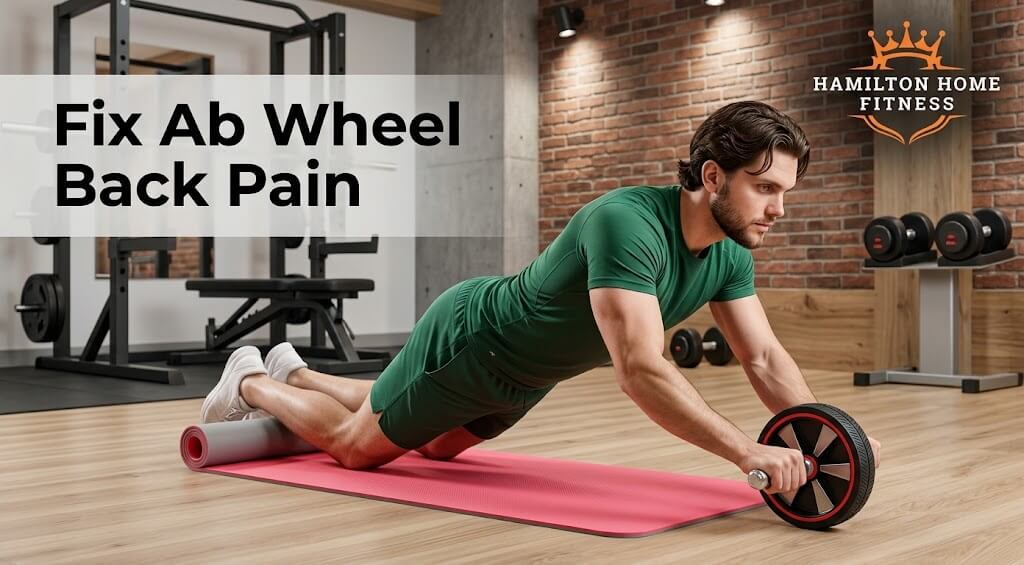
It's rarely the wheel or a weak back. With a wheel rollout, lower back pain usually starts when your trunk arches past what your abs can hold, loading your lower spine instead.
If your back aches at rest, keeps flaring up, or has a known disc issue, read the triage section before your next set. This page can't diagnose you.
Otherwise, keep the wheel: make three position fixes, run a depth test, and use easier versions until a full rollout holds.
Why Your Lower Back Takes the Load
A wheel rollout (not a crunch-frame "ab roller") is anti-extension core training: your abs hold your trunk straight while the wheel pulls it long. Roll past what they can hold, as on day one, and your lower back arches, handing the load to the joints at the back of your spine.
That shift, not a weak back, drives most ab wheel rollout lower back pain. In small lab studies, lower-back muscles stayed under 10% of maximum effort during controlled rollouts.
What an Arched Rollout Does to Your Spine
When your lower back arches at the far end of a rollout, more load travels through your facet joints, the small joints at the back of your spine, instead of your abdominal wall.
In lab tests on donor spines under sustained load, a slight arch sent 16% of the load through those joints, while slight rounding sent none. Joint pressure also climbs as the arch deepens.
So a lumbar arch during a rollout is a position fault, not a strength problem. Known disc or back condition? Read the next section first.
Sore, Strained, or Time for a PT?
Sore abs for a day or two after rollouts is normal. A lower back that still aches at rest, keeps flaring up, or brings leg symptoms is a reason to stop rolling and get assessed.
Sore abs: carry on.
Back ached only during the set: shorten the range.
Aching at rest: pause rollouts until it settles.
Lingering or recurring ache, or a known disc issue: physical therapist clearance first.
Get same-day care if back pain comes with leg weakness or numbness, loss of bladder or bowel control, fever, unexplained weight loss, a recent fall or blow, or a history of cancer.
Most new back pain settles within four to six weeks; meanwhile, keep training the rest of your body. As of July 2025, every US state allows a physical therapist evaluation without a referral, though visit limits vary by state.
Set Your Position to Stop the Arch
Stop the arch before the wheel moves: ribs down, glutes squeezed, pelvis slightly tucked, midsection braced. Then pull back with your abs, not your hips. Hip sag on an ab wheel is that arch seen from the side; it starts when you set position after the roll begins.
Ribs Down, Glutes Tight, Slight Tuck
Before you roll, pull your ribs toward your hips and squeeze your glutes until your lower back stops arching. That slight tuck is all the posterior pelvic tilt a rollout needs.
Stop short of rounding your back, since loaded rounding bothers backs that dislike bending. This is the same tuck-first fix used on AB machines.
Brace the Whole Trunk, Don't Suck In
Stiffen your whole midsection, front, sides, and back, instead of sucking your belly in. Lab comparisons found a full brace steadies the spine better than hollowing.
It's the same brace a lifting belt gives your abs to push against.
For ab wheel breathing and bracing, brace before each rep and exhale on the return without losing it. Managing blood pressure? Skip long breath-holds and check with your clinician.
Pull Back With Abs, Not Hips
Start the return by pulling the wheel toward your knees, trunk still stiff. If your hips move back first, your hip flexors take over and your lower back bends.
In controlled lab rollouts, hip flexors worked at just 6 to 10% of maximum. Burning hip flexors means you did hip work, the job of hanging knee raises on a power tower.
Tempo keeps a roller form honest: two to three seconds out, a pause, then a controlled pull back, never a yank.
How Far Should You Roll Out?
The way back sets your limit, not the way out: roll out only as far as you can pull back from with the flat trunk you started with. On day one, that's well short of full extension for most people. Lab recordings show an activation climbing with reach, so rollout depth control is your difficulty dial.
Set a Wall Stop, Then Move It Out
A wall stop turns rollout depth into a physical limit instead of a judgment call: kneel a short way from a wall and roll until the wheel touches it.
[Photo or diagram: wall-stop setup. Alt text: "Kneeling on a wheel rollout stopped by a wall a short distance in front of the wheel."
Pad your knees with a folded exercise mat, then:
Kneel an arm's length from a wall, wheel on bare floor.
Set ribs down and glutes tight, then brace.
Roll until the wheel touches the wall.
Pull back with your abs; your hips follow.
Step farther from the wall only after a session with no arch.
End each partial range rollout set at the first rep that arches or starts with the hips. No wall? Use a floor tape line.
Feeling It in Your Arms, Not Your Abs?
The ab wheel mainly works your rectus abdominis and obliques, which stop your trunk from sagging. Your chest, lats, and triceps control the wheel; in lab tests, no other ab exercise loaded them more. Tired arms are normal. Not feeling the ab wheel in your abs means the rep changed: bent elbows, hips moving first, or too little range.
Why Bent Elbows Feel Easier
Bending your elbows pulls the wheel closer to your body, which shortens the lever your abs have to resist. The rep feels easier because your triceps and shoulders take work your abs should be doing.
That elbow bend cheating fakes depth, too. Keep your arms straight, not hyperextended, and if that stops you sooner, the shorter reach is your honest range.
When Your Shoulders Ache at Full Reach
Ab wheel shoulder pain usually shows up at full reach, where your arms are close to overhead. Start with your shoulders stacked over the wheel, and stop short of the range where the shoulder pinches.
Keep your shoulder blades drawn down so your lats help control the wheel.
Sharp or lingering shoulder pain gets assessed, not trained through. If your overhead range is tight, try mobility drills for overhead reach instead of forcing the rollout.
Easier Ways to Earn a Full Rollout
Beginners can use an ab wheel, kneeling and over a short, controlled range, once they pass three checks; standing rollouts come later. Until then, a stability ball, loop band, or round-plated barbell takes part of the load while you train the same pattern.
Three Checks Before Your Next Set
You're ready for kneeling rollouts when you pass three checks:
A ribs-down plank with no hip sag.
A dead bug with your lower back flat.
Slow stability-ball rollouts with no arch.
Fail the first two? Stability balls for forearm rollouts are gentler, since your forearms rest on the ball. TAG balls run $19 to $23 by size (September 2026); move on once kneeling rollouts feel controlled.
For the plank prerequisite, coaches quote 30 to 60 seconds; no sag matters more than the clock.
Band-Assisted Rollouts: Anchor Behind
A band-assisted rollout works only when the band pulls the wheel back toward you, easing the hardest part of the rep. Loop one of the loop bands made for assisted reps around the wheel and anchor it low behind your knees to something that can't slide or tip; anchored in front, it resists instead.
[Diagram: band anchored low behind the kneeling lifter and looped around the wheel. Alt text: "Kneeling on a wheel rollout with a loop band anchored low behind the lifter and looped around the wheel."
TAG strength loop bands are flat, continuous loops in four levels at $21 to $54 (September 2026), suited to anyone solid at short range but not full reach. Too heavy a band does the work, so start at the lightest level that gets you to your stop and check it for nicks before each use.
Barbell Rollouts Need Round Plates
A barbell rollout with full-size round plates is usually easier than a small wheel: the tall plates keep your hands higher and shorten how far your trunk extends. Use the bar you own, or an Olympic bar from the free weights range.
Smaller plates make it harder, and 12-sided plates won't roll smoothly. Full-size round bumper plates suit a home gym that already has a bar; if rollouts are your only goal, a wheel costs far less.
FAQ
Are AB wheel rollouts bad for your back?
No, not for most healthy backs, if you stop before your trunk sags into an arch. They don't treat existing back pain, though; a physical therapist does.
Do AB rollouts actually work?
Yes. In lab recordings, rollouts rank among the top exercises for the rectus abdominis and obliques; a stability-ball version hit 63% of maximum upper-ab activity. They train resisting a sag; for curling, add floor crunches or a supported ab machine.
Is a dual-wheel ab roller easier than a single wheel?
Yes for balance, not for your back. A double wheel cuts side-to-side wobble, making Sunny's double-wheel ab roller (No. 003, $14.99 in September 2026) a steadier first wheel. Depth and position still decide the pain.
Why do my wrists hurt on an ab roller?
Usually because your wrists bend back under load. Grip the handles, knuckles forward, wrists straight in line with your forearms. Pain that lingers, tingles, or spreads into your hand needs checking, not more reps.
Final Thought
The ache came from the arch, not the wheel or a weak back. Fix position, then depth, and use an easier version until both hold.
Keep your wheel; run the wall-stop test next session. If it wobbles, compare the ab rollers we carry.
Wheel or mat questions? Ask our team which wheel fits your floor; ongoing pain goes to a physical therapist first.