Introduction
Fifteen strict pull-ups, twenty-five dips, a home bar, no plates, and a month that added nothing.
More reps won't fix it. After 12 to 15 strict reps, the next one builds endurance, not strength.
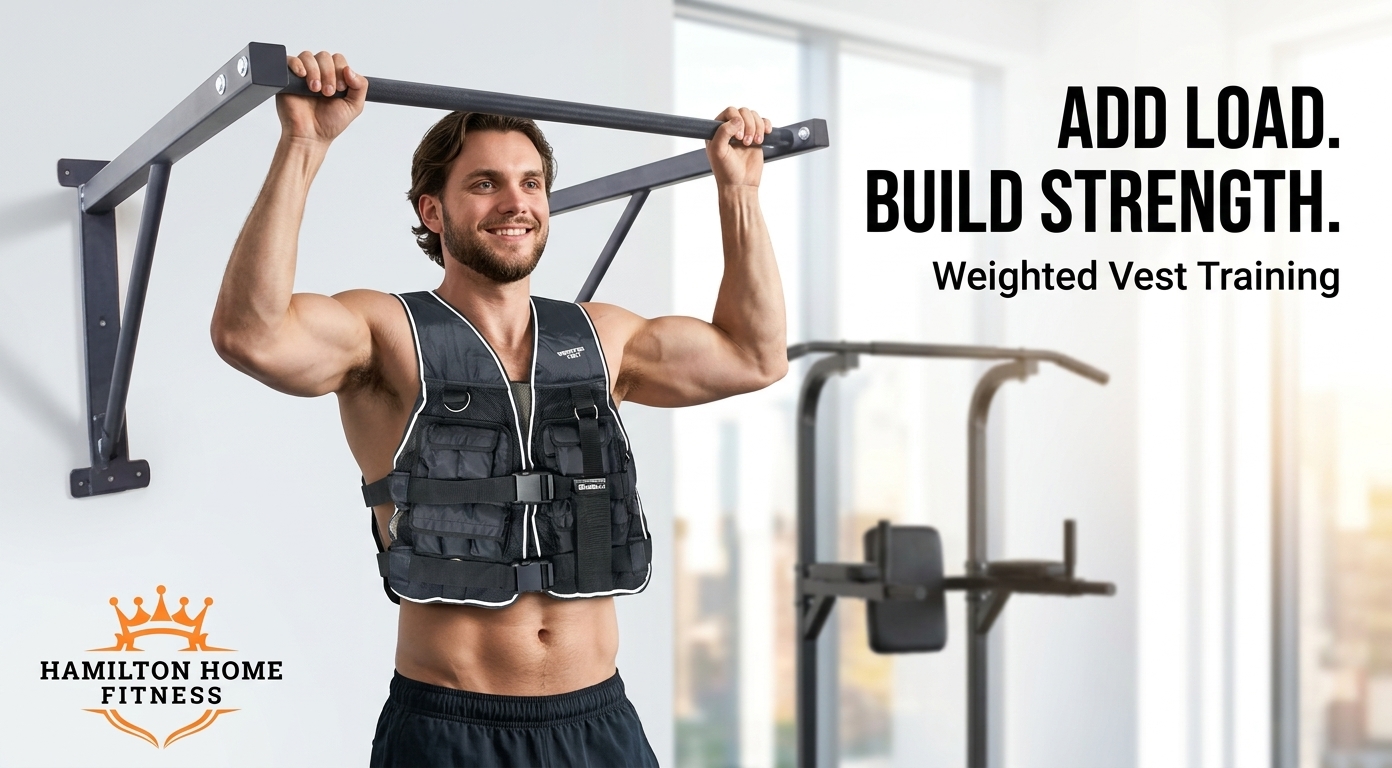
A vest will. Start near 5% of your total body mass, about 9 lb if you weigh 180. Reps earn each next step. Past the vest's limit, a dip belt takes over.
This guide covers weighted vest pull-ups, chin-ups, dips, and push-ups, plus a note on legs and core. For walks, see how much a walking vest should weigh.
It's for healthy, trained lifters. Get current shoulder, elbow, or wrist pain assessed before adding load.
When to Add Load, and What Has to Hold It
Add load once strict sets pass about 12 to 15 reps, the point where bodyweight is too easy and extra reps mostly build endurance. Before your first weighted set, confirm your bar or tower is rated for your bodyweight plus the vest, or compare power towers and wall racks if you still need one.
How Many Strict Reps Before Adding Weight
Coaches set the line between 5 and 15 strict reps, but past 12 to 15, extra reps train endurance more than strength. Across 21 studies, heavier loads built more maximal strength, with similar muscle growth when sets reached failure.
One large lifting log averages 13 pull-ups for men and 6 for women, so your 15 puts you ahead. Weighted calisthenics strength standards are community-set, not official.
A rep counts only if it:
Starts from a dead hang
Ends with your chin over the bar
Uses no kip or swing
Check the Bar's Rating Before the Vest
A bar that holds you may not hold you plus 40 lb, so check its rated capacity before loading. An 180 lb lifter in a 40 lb vest puts 220 lb on it. The Apollo Power Tower handles pull-ups and dips in a small footprint but lists no user capacity, so ask our team to confirm it first.
Skip doorway bars for loaded work. A wall-mounted pull-up rack suits it better once its fixings and rating are confirmed.
How Much Weight to Add First
Your first weighted pull-up set should use about 5% of your total body mass, roughly 9 lb if you weigh 180. After that, add weight only when you beat your target reps by one or two in two straight sessions.
Count Your Whole Body, Not the Vest
A 10 lb vest on a 180 lb lifter adds about 5.6% to the load, which sits inside the normal progression step. Progressive overload on bodyweight follows the usual 2 to 10% rule. One-rep-max calculators won't help, since rep-based formulas fail past 10 to 12 reps.
Start with two to four sets of about eight reps. A 40 lb vest that loads in one-pound bags makes a 9 lb start exact at $61.98. Its 6-month home-use warranty is short for facility traffic, and it doesn't ship free.
Add the Next Step After Two Clean Sessions
Add weight when you beat your rep target by one or two reps in two straight sessions, keeping each jump inside 2 to 10% of total mass. The conservative version, the 2-for-2 rule, waits for two extra reps in two sessions running.
In weighted calisthenics progression, step size depends on the vest. A one-pound bag adds about half a percent to a 190 lb lifter-plus-vest. 3.5 lb vest plates add under 2% at $25 each, but fit plate vests only, not sandbag-packet vests.
What a Vest Does to Each Movement
Adding load to bodyweight training with a vest puts its full weight into pull-ups and dips, since your whole body leaves the ground. On push-ups, only part reaches your hands because your feet stay planted, and the vest can hit the floor first.
Pull-Ups and Chin-Ups: You Lift It All
On weighted vest pull-ups and chin-ups, every pound of vest travels the full range, so you lift all of it. Keep reps strict: a kip swings the load, and a loose vest shifts, so snug the straps first.
The added weight drives the bar into your palms and tires your grip sooner. Padded lifting gloves cushion it, unless you prefer a bare-hand bar feel.
Dips: Guard the Bottom Position
With a vest on, stop each dip where your shoulders stay set, and end the set at the first front-shoulder pain. Lingering shoulder or elbow pain needs a clinician.
Weighted dips programming starts with setup:
Shoulders pressed down first
A slow, controlled descent
Depth your shoulders can hold
A chin-up and dip station rated for commercial use, like the $735 Body-Solid FCD, fits loaded dips, but its page lists no user capacity, so confirm it.
Push-Ups: Clear the Floor Under the Vest
Weighted push-ups can lose depth before they lose reps, because the vest's front panel reaches the floor first. A push-up already puts about 64% of bodyweight on your hands, and the vest's share is likely higher, as it sits nearer your hands.
Raise your hands on a pair of push-up bars ($11.90) to restore depth, unless neutral-grip wrist pain rules them out. Elevating your feet also adds load, pushing your hands' share to 70–74% of bodyweight.
Weighted Vest or Dip Belt?
Use a vest while working sets need 40 lb or less, and you want one tool for pull-ups, dips, push-ups, and legs. Switch to a dip belt once pull-ups and dips outgrow the vest, or its bulk blocks your range.
Weighted vest | Dip belt | |
Where the load sits | Torso | Below hips |
Practical ceiling | 40 lb (sandbag vests) | Belt and plates |
Movements loaded | Pull-ups, dips, push-ups, legs | Pull-ups, chin-ups, dips |
Needs plates | No | Yes, or kettlebell. |
Bulk at the bar | The front can touch the bar. | The chest stays clear |
Which feels harder at equal weight, dip belt vs. weighted vest, is still disputed.
Where a Vest Is the Better Tool
Yes: adjustable weighted vests for calisthenics suit pull-ups up to about 40 lb added, and load push-ups and planks, which a belt can't. For ring work, a vest likely stays steadier than a swinging plate.
Body-Solid's vest range, which ships free, suits anyone training under 40 lb, not past it.
Does Vest Bulk Get in the Way?
Vest bulk on pull-ups matters most when your chest meets the bar, and rigid plates hold their shape where sandbag packets flatten. A sandbag-packet vest like the BSTWVP40 ($150) sits close but takes no add-on plates.
A plate-loaded vest ($199) loads firmly but adds the most front bulk and lists no capacity.
The Load Where a Belt Takes Over
Once your working sets on pull-ups or dips need more than 40 lb, a dip belt carries the load below your hips, clear of your chest. An 180 lb lifter at a community benchmark of 1.25 times bodyweight in total already needs 45 lb added.
Any standard dip belt with a chain works, but it loads only hanging moves and needs kettlebells and plates to hang from a belt.
How to Mix Weighted and Bodyweight Sets
Run weighted sets first while you're fresh, in the 3-to-6-rep strength range with long rests. Then finish with bodyweight sets for volume in the hypertrophy range. For trained lifters, the standard guidance leans on heavy sets of 1 to 6 reps with 3 to 5 minutes of rest.
Order mixed weighted and bodyweight sets like this:
Bodyweight warm-up sets
Weighted work sets
Bodyweight back-off sets short of failure
Optional cluster or EMOM finisher
A pull day might run 5x5 weighted pull-ups, resting three minutes, then two bodyweight sets stopped a rep or two short of failure. Sweaty hands slip on that back-off volume, so a chalk-free grip enhancer helps.
A cluster set splits one hard set into mini-sets with short pauses. EMOM means a few reps every minute, on the minute.
FAQ
Do weighted push-ups build muscle?
Yes, when sets run close to failure. In an eight-week trial at matched load, push-ups grew the chest about as much as bench press, 18.3% against 19.4%. Added load mainly builds strength and keeps rep counts out of the 30s.
Can you do muscle-ups with a weighted vest?
Yes, a vest for muscle-ups works once bodyweight reps are clean and repeatable. Start at your vest's smallest step, and expect its front panel to meet the bar in the transition. You also need room above the bar, so compare pull-up bars with overhead room.
Which lower-body and core moves suit a vest?
Pistol squats, lunges, step-ups, and planks. The vest's load rides your torso rather than your limbs, so weighted vest lunges and squats move naturally. See why torso load beats ankle weights on your feet.
Final Thought
Load against your whole body, let two clean sessions earn each step, and switch to a belt once the work passes 40 lb. Hamilton Home Fitness is an authorized dealer shipping from Tennessee to all 50 states.
Pick the vest whose smallest step matches your first increment. Training clients or running a studio? Plan a calisthenics corner with our design team.