
Introduction
You searched "resistance bands" and got an $11.98 stretch cord, a $30.00 tube kit, a $54.00 loop and $300.00 suspension straps, all called bands (September 2026 prices).
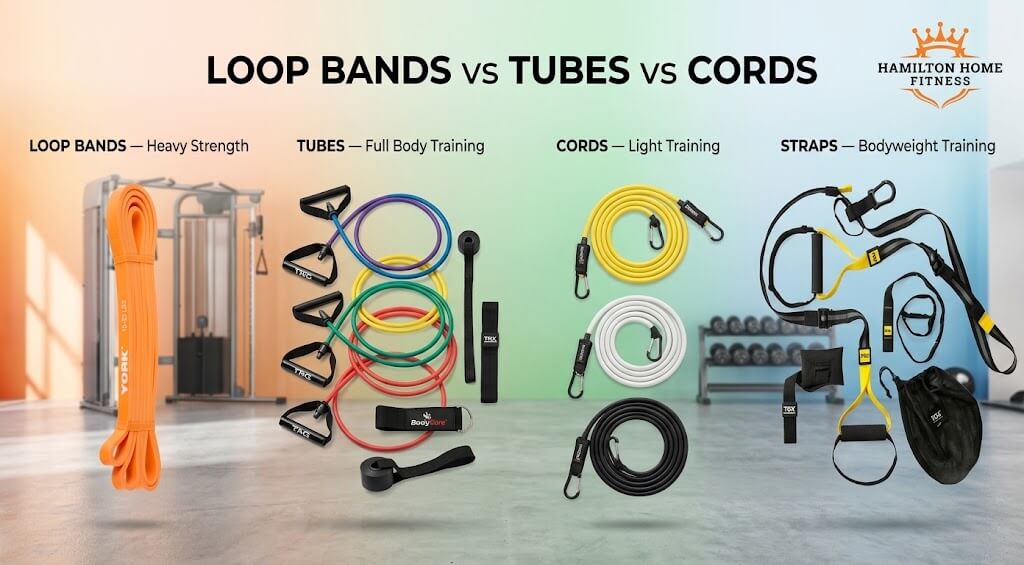
In resistance bands vs tubes vs loops, the choice follows the job. Loops carry heavy and barbell work. Tube kits carry handled full-body training. Cords suit light toning and rehab. Straps give bodyweight leverage and don't stretch. Each ends in a pick from the resistance bands, tubes and straps in one range, limits included.
Following a therapist's band list? Match their band and level first. This guide compares equipment and doesn't prescribe rehab or training around an injury.
What Sets the Four Formats Apart?
In resistance bands vs tubes vs loops, shape comes first. A loop band is a flat, continuous ring you stand on, wrap or anchor. A tube is a hollow cord with handles, sold singly or in kits whose tubes clip to shared handles. A stretch cord is a light, single-level tube. Suspension straps are non-stretch webbing loaded by your bodyweight.
What Is a Stretch Cord, Really?
A stretch cord is a single light-resistance tube with a handle on each end, used for toning, rehab exercises and swimmers' dryland pulls.
It also sells as a toning tube, and swimmers use the name for surgical tubing.
The five-level XERTONE cord set runs 44 to 53 inches, one color-coded level per cord, with plastic handles. Heavier means a new cord, while a kit's tubes share one pair of handles.
Why Suspension Straps Don't Stretch
Suspension straps don't stretch. Load is the share of bodyweight your arms or legs hold, and it rises as your body nears horizontal.
Lean back further on a row and it gets harder, with nothing added.
At the bottom of a push-up, strap load in one small group of young male sports students rose from 36.8% to 75.3% of bodyweight between a 45-degree lean and horizontal, a guide, not a rule.
That caps straps at your bodyweight, a ceiling to weigh as you browse suspension trainers in the TRX range.
Which Format Handles Heavy Strength Work?
Rated loop bands handle the heaviest work, with York's line running up to 70–150 lb per band. Tube kits suit moderate full-body strength, stretch cords suit light toning and rehab, and suspension straps are capped by your own bodyweight.
How Much Load Does Each Format Give?
Only York's rated loops and tube kit publish pound ranges; TAG lists levels, and straps load a share of bodyweight.
Format | Example | Published load | Load rises as |
Rated loop | York Fitness Band | 10–35 to 70–150 lb, 8 levels | It stretches |
Tube kit | York 11pc Resistance Tube Set | 5–10 to 35–50 lb per tube | It stretches |
Stretch cord | TAG XERTONE | 5 levels, no lb rating | It stretches |
Suspension straps | TRX Club 4 | Share of bodyweight | You lean lower |
Ratings are ranges because tension climbs with stretch; wider York bands carry heavier ones. Pick York bands with printed pound ratings by number, not color.
TAG's four-level strength bands list levels, not pounds.
Do Bands on a Barbell Build Strength?
Loop-band tension on a barbell can help trained lifters build maximal strength, though evidence is mixed, and only rated loops fit: toning tubes and cords are built for handles, not bar sleeves.
Called accommodating resistance, it adds load as you stand up. Pooled trials favor it, mainly in trained lifters near their max, but a later squat trial found no long-term edge: promising, not settled.
Bar tension needs a printed number, which York Barbell's rated band line gives.
How Does Each Format Anchor and Grip?
Loops anchor to feet, posts, racks or bars. Tube kits that include a door anchor clip to a closed door. Cords need a door, pole or partner. Straps need an overhead point that holds your bodyweight. Handles make tubes and cords easiest to grip.
What Each Anchor Point Limits
Your anchor sets your exercise menu: a door anchor gives high, middle and low pulls and presses, but no bar or pull-up work.
Loop bands: feet, band pegs or a rack for pulls
Tube kits: one door at three heights, nothing else
Stretch cords: a door, pole or partner; light loads only
Suspension straps: a beam or wall anchor overhead, nothing less
A door-only apartment or hotel room suits a tube kit, whose handles and ankle cuffs clip on by carabiner. For straps, ask what anchor ships with the Club 4; its page doesn't say.
Which Is Easiest on Your Hands?
Tube kits with foam handles are the easiest on your hands. Bare loops dig in on presses and rows because you grip the band itself, though they spread pressure better underfoot.
XERTONE cords sit in between, with plastic handles. If hand fatigue comes early or your hands sweat, choose handles and compare loops and handled cords side by side.
Which Format Lasts Longest?
No format wins on durability by name. Each wears at a predictable point: loops at surface nicks and sun-damaged spots, tube kits and cords where the tube meets a clip or handle, and straps at the webbing, stitching and anchor. Store all four away from heat and sunlight.
Loops: feel for nicks, whitened spots or separating layers
Tube kits and cords: look for cracks at clips and handles
Straps: check for frayed webbing and pulled stitching
Storage: cool and dark, as sunlight's UV dries latex
Inspect new bands on arrival. The 30-day return terms cover only unused, undamaged gear in original packaging.
How to Stop a Band Snapping Back
Snap-back injuries happen when a band slips off a foot or anchor or a worn band tears, so check both before every session.
Eye clinics have documented band recoil injuries, some with lasting vision loss. If a band hits your eye, get checked the same day; serious injuries don't always show at first.
Check for nicks, cracks or whitened spots
Retire damaged bands; never tape them
Test the anchor with a firm pull
Keep the pull line away from your face
Consider protective glasses for heavy banded lifts
Which Format Should You Buy First?
Door only? A handled tube kit covers the most for its price. Own a bar or rack? Rated loops cover more. Cords suit light rehab; straps need a solid overhead anchor. TAG Fitness loops and cords ship free.
Lifting and Warm-Ups: Rated Loops
A lifter should buy rated loops for bar tension, pull-up help and warm-up pull-aparts or face pulls. Printed pounds make those loads plannable, as with band-assisted pull-ups on a power tower. Without a garage-gym rack or bar, a tube kit suits presses and rows better.
New to Training: A Handled Tube Kit
Beginners and travelers do best with a handled tube kit: familiar handles, a door anchor, five tubes. York's 11-piece tube set, $30.00 as of September 2026, adds ankle straps and a carry bag, shipping at standard rates. Outgrow its 35–50 lb tube and it's done.
Rehab or Toning: Light Stretch Cords
For light toning or a prescribed rehab list, stretch cords give low, steady resistance in five steps, with handles. XERTONE cords by single level cost $11.98 to $17.98 as of September 2026.
They suit light band work after an ankle sprain, but match your physical therapist's band and color; TAG lists no pounds.
Bodyweight Strength: Suspension Straps
Training bodyweight with a solid overhead anchor? Straps fit, scaling every row, push-up and lunge by body angle. The TRX Club 4 suspension trainer, $300.00 as of September 2026, suits a home or studio with a beam, rack or ceiling mount. It can't load past bodyweight; a $144.99 option sits in the TRX range.
FAQ
Are loop bands better than tube bands?
Loops win for heavy work, pull-up help and lower-body moves; tube kits win for handled presses, rows and sore hands. Choose by your main exercise, or cover the range with a four-level TAG strength band set.
Can resistance bands replace weights?
For building strength, largely yes: pooled trials found elastic tubes and bands built strength on par with machines and dumbbells. Their limits are a lower ceiling and less exact loading.
Is TRX better than resistance bands?
Neither is better overall. Straps win for bodyweight strength when you have an overhead anchor; bands win for load past bodyweight, packability and single-muscle work. Once straps feel easy, consider adding load with a weighted vest.
Are fabric bands better than latex bands?
For short hip-circle work, yes: fabric won't roll or pinch but stretches less, so latex covers long loops and tubes. Many fabric bands contain latex threads, so allergic buyers should check labels and skip the all-latex York 5-piece loop set.
Final Thought
Choose the format by where its load comes from and what you can anchor it to. Then choose the level. The four routes above each end in a real product with its limits stated. Match yours to your door, rack or overhead beam, then open that range at Hamilton Home Fitness.