
Introduction
Twelve athletes hit the sled in a commercial gym’s functional training zone. One pushes, two load plates, and nine stand still while two battle ropes sit unused.
That’s a counting problem, not a quality problem. Workout format sets the count before headcount does.
You run a studio, box, hotel, apartment, or office gym. You know your floor, class size, and budget, not your rope, sled, and box numbers. With dozens of users per piece, wrong counts stall classes, and wrong specs cost replacements.
Next come counting, space, rig choice, surface, and wear budget, with our commercial gym equipment range as examples, limits included.
What Goes in a Functional Training Zone?
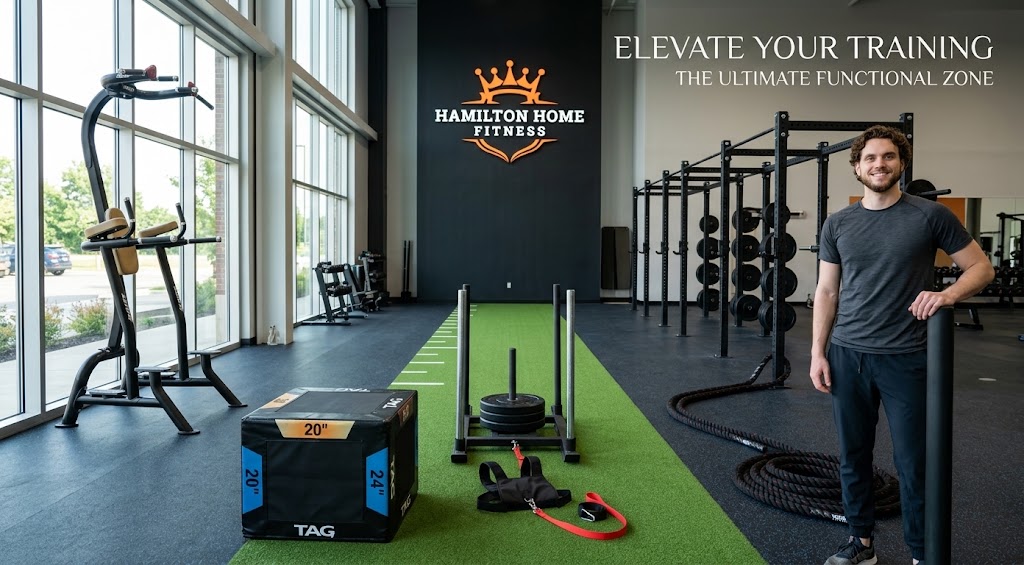
Every functional zone runs on five pieces, from a small studio equipment list to a full box. Facility type changes the version, not the list:
Battle ropes sized to your floor
A sled with a straight lane
Plyo boxes at your class heights
Pull-up and dip stations
A sled-friendly surface, usually turf
Boutique and small group studios
A boutique studio fit-out runs soft plyo boxes, 30-foot ropes, and one sled lane, since mixed-ability classes miss jumps and tight floors rarely fit two lanes. A foam-core 3-way plyo box covers 20, 24, and 30 inches in one forgiving 65 lb unit, but it’s the wrong pick for a whole class jumping at once.
CrossFit boxes and affiliates
In a CrossFit box, the rig is the center of the functional zone, so functional fitness rig planning comes first, and ropes, the sled lane, and box sets fit around it. Custom rig design for a box size of a 7-gauge steel frame to your room.
Hotel, apartment, and office gyms
A hotel gym functional zone stays small and safe to use unsupervised: one soft box, a 20-foot rope needing about 15 feet of floor, and a pull-up or dip station only where the ceiling clears it. Skip the sled without a turf runner. Our guide to planning a hotel gym guests actually use covers the rest.
Apartment and office rooms work the same way; apartment clubhouse gym planning adds peak-user sizing.
How Many Ropes, Sleds, and Boxes per Class?
Group training equipment is counted by workout format first, headcount second. Whole-class movements need one piece per athlete, station rotations need one per athlete at that station, and partner work halves rope and sled counts.
Count by workout format, not headcount.
Class-based equipment ratios depend on format. Twelve athletes doing box jumps together need twelve boxes. Rotating through four stations, they need three. Partners alternating on ropes halve the rope count.
Count the piece your programming hands everyone at once. If that’s the whole-class box jumps, price commercial plyo boxes in foam, wood, and steel at one per athlete.
Starting counts for classes of 10 to 20
Equipment per class size in a four-station rotation, with partners on ropes and sleds, starts at about 2 ropes, 2 sleds, 3 boxes, and 3 pull-up stations for 12 athletes.
Item | 10 athletes | 12 athletes | 20 athletes | 12, whole class |
Ropes | 2 | 2 | 3 | 6 |
Sleds | 2 | 2 | 3 | Run in heats. |
Boxes | 3 | 3 | 5 | 12 |
Pull-up stations | 3 | 3 | 5 | 12 |
Each extra sled needs its own lane, so 20 athletes need three. The TAG Fitness commercial power sled ($550 in October 2026, free shipping) suits turf lanes, not rubber-only rooms. Confirm its load rating and skid details before ordering.
Add a sled harness for every drag station.
How Much Floor and Lane Space to Plan
Group functional classes commonly plan 100 to 150 square feet per athlete. For a class of 12, that’s 1,200 to 1,800 square feet, plus a straight lane for each sled. A whole box is a bigger build, covered in our CrossFit box equipment list by class size.
Each piece also needs clear space around it, and ropes are the easiest to misjudge, so size them with our rope length and clear-space guide. Mark these on your functional zone floor plan:
Sled lane: 30 to 60 feet, straight
Rope clearance: half the rope length plus 5 feet
Walkways: about 3 feet wide
Station gaps: 2 to 3 feet
Ceiling: 8 to 9 feet for pull-ups, 12 to 14 for rope climbs
Add those clearances up, and a functional training zone in a commercial gym seldom fits a leftover corner. Place it using zoning and traffic flow for a gym floor, then check ceiling height, which settles the rig question next.
Rig or Freestanding Stations?
A rig earns its cost when several people need pull-up or squat stations at once and the floor can take anchors. Freestanding stations win when one or two people train at a time, ceilings are low, or you can’t drill. The functional training rig vs. freestanding choice comes down to demand and room, not quality. Freestanding here means separate pieces, such as a power tower, not a rig set off the wall.
Is a rig worth it? For classes that run pull-ups most days, usually yes: one frame serves several athletes and holds storage. Check steel gauge, anchoring and clearance on our functional fitness rigs before you commit floor to one.
In a hotel, apartment, or office room, the Hoist Fitness Tree power tower covers pull-ups, dips, and knee raises on one 243 lb frame, at $1,572 by private invoice (October 2026). It stands 97.75 inches tall, taller than an 8-foot ceiling before any head clearance. It also can’t serve a class needing four pull-up stations at once.
What Surface Do Indoor Sleds Need?
Sleds work indoors on a turf lane. Steel skids dragged across rubber flooring create heavy friction that wears both the floor and the sled, so most facilities lay turf for sled work and keep rubber under racks and free weights. With the lane settled, choose from sleds matched to your floor.
A 50 by 60 foot lane covers 300 square feet. In an October 2026 price check, indoor gym turf ran about $4.50 to $9 per square foot for material, so that lane costs roughly $1,350 to $2,700 before installation.
Around the lane, our rubber rolls and tiles for the rest of the floor include an 8 mm, 4 by 15 foot roll at $225, about 3.75persquarefoot.Noroomforanylane?AmagneticsledsuchastheBodyKoreSmartSledPro(4,499) is built for a compact footprint.
What Wears Out First, and What You Re-Buy
Commercial rope and sled durability comes down to contact points, which wear out long before frames: rope ends and anchor loops, sled skids and straps, box covers and tops, and station grips and pads.
Ropes fail at the ends and the anchor.
No reliable lifespan figure holds across facilities, because rope life depends on floor surface and weekly use. Retire multi-user conditioning gear like ropes when the ends unravel past their caps or the core shows.
Our battle ropes from 20 to 50 feet ($100 to $320 in October 2026) pair a PolyDacron blend, rated at a 1,500 lb average breaking strength, with heat-shrink ends. Lacking a sleeve, they suit rubber or turf, not rough concrete.
Sleds and boxes wear at contact points.
High-traffic conditioning equipment wears where it touches people or the floor: sled skids and straps, vinyl seams on soft boxes, and the tops and rated loads of steel boxes.
Our steel frame plyo box set of seven covers 6 to 42 inches and ships free at $1,443 (October 2026). Mind its 300 lb rating on loaded step-ups; its hard edges also punish beginners’ missed jumps.
Consumables vs. capital equipment
Budget consumables as a yearly operating line, and keep frames, rigs, and steel boxes in the capital budget. The consumables are:
Battle ropes
Harnesses and straps
Sled skids
Soft-box covers
Turf lane
Grips and upholstery
To spot a worn part, read the warranty. Hoist’s commercial warranty schedule covers frames for 10 years but finishes, cables, upholstery, and accessories for just 1 year.
FAQ
How big should a functional training class be?
Most coached classes cap between 8 and 15 athletes per coach. Past about 15, coaching attention and equipment counts both thin out, so add a coach or a heat before adding the kit.
Which brands ship free, and which need a quote?
TAG Fitness and Body-Solid ship free nationwide from Tennessee. Hoist and Hudson Steel are private-invoice brands, so request a facility equipment quote for those brands before you lock the budget.
Is assembly and installation available?
Yes. Steel box sets ship disassembled, and our equipment moving and installation crews move, reassemble and level commercial pieces. Written quotes are free, so labor sits in the budget from day one.
Final Thought
Count from the workout format, let the lanes and ceiling height shape the room, pick a rig or freestanding stations by how many people train at once, and budget ropes, straps, and skids every year.
Then book a gym design with your class size and floor plan, plus your workout format and ceiling height, and we’ll turn the counts into a layout you can price.