Introduction
The fitness center is one of the few hotel amenities a guest will praise or pan by name in a review — and the one most operators still equip by guesswork. If you run a property as a GM, asset manager, or brand-standards director or own a boutique hotel, you're solving three problems at once: a room that moves your review scores, a line item in your brand book, and an ADA-regulated space that runs unsupervised around the clock.
This guide shows how to size, zone, equip, and service a hotel gym that clears brand and ADA review, survives heavy daily use, and earns recommendations instead of complaints. Good hotel gym equipment planning is less about how many machines you can fit and more about which ones keep working, stay safe to use alone, and read as premium the moment a guest walks in.
A gym guest actually uses daily beats, ones that only photograph well. Get the equipment mix, durability, and compliance right, and the layout and budget fall into place, which is exactly where we land by the end.
Hotel Gym Brand Standards, Decoded
Major hotel brands don't publish their fitness specs publicly — they enforce them through approved-supplier programs and confidential design standards in your franchise portal. Marriott and Hilton properties typically run recognizable commercial brands like Life Fitness, Hammer Strength, and Precor, with equipment, flooring, signage, and paint all tied to the brand and tier.
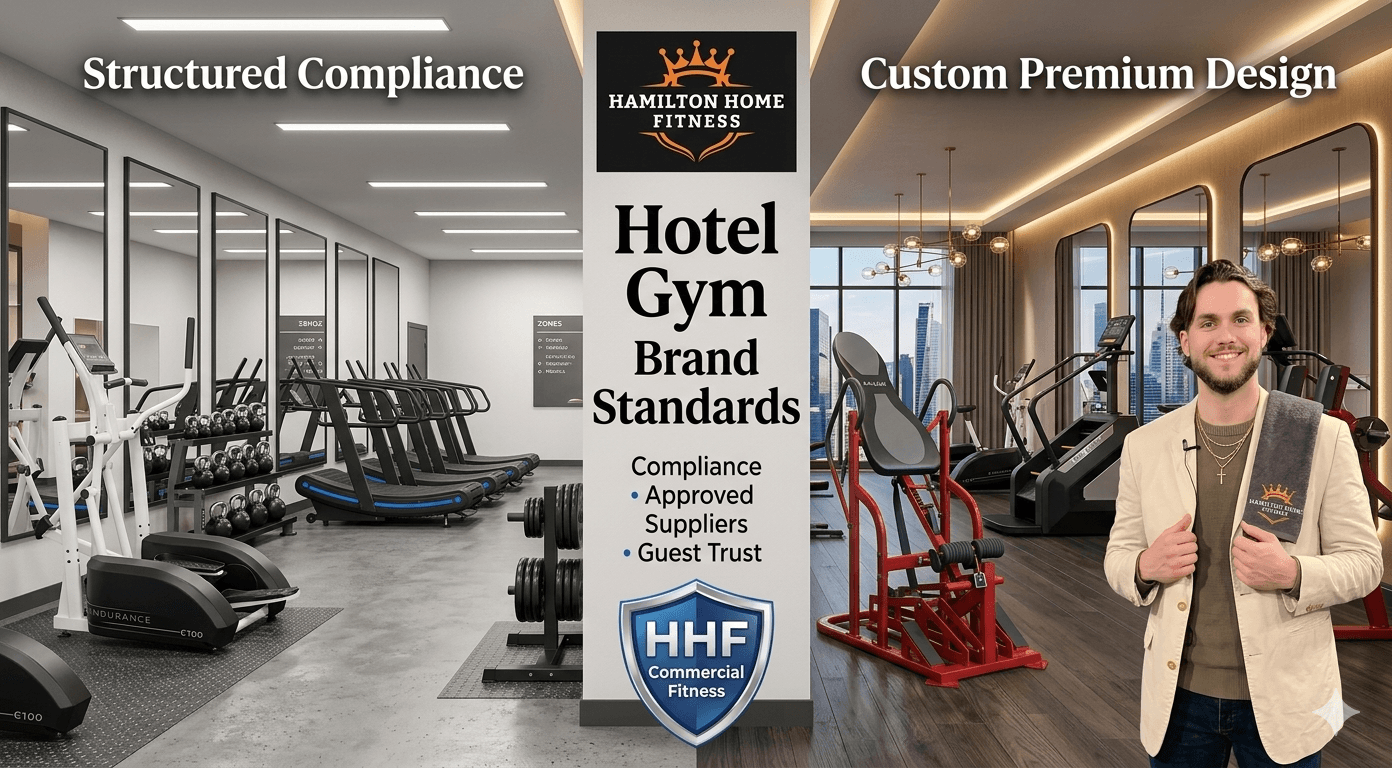
What that compliance looks like depends on where you sit. Select-service brands hand you a prescriptive, standardized package — less choice, fewer surprises. Premium and luxury brands leave more room to tailor the space. Either way, the details that pass inspection come from the brand, not from a blog post.
Marriott, Hilton, and Hyatt Specs
Treat any specific square-footage or machine-count "requirement" you read online as unverified. The authoritative numbers live in your brand's design-and-construction resources and approved-supplier list—and they change over time.
Here's what's actually visible from the outside. Marriott flagship fitness centers have featured Life Fitness and Hammer Strength equipment, and Marriott requires FF&E to come from approved suppliers who can document brand compliance. Hilton runs a formal fitness program with brand-specific guidebooks and named supply partners — Precor, Life Fitness, and Matrix — and has long standardized full-service fitness around Precor, often building larger centers in phases where equipment, flooring, signage, and paint come first. Hyatt and the other major flags follow the same pattern: an approved-supplier list and brand-specific standards rather than a one-size spec.
The throughline is simple. The same commercial names recur because brands want equipment guests recognize and trust, and that holds up under constant unsupervised use. Westin built an entire amenity around that idea with its long-running WestinWORKOUT positioning.
So start by pulling your brand's current fitness standard and approved-supplier list—that document, not this guide, is the one that passes inspection. Once you have it, a hospitality-focused supplier like HHF Commercial Fitness can help match equipment to that list and ship it nationwide from Tennessee. The approved list itself always comes from your brand first.
Boutique and Independent Freedom
Without a brand mandate, boutique and independent hotels set their own bar — which means the fitness center can become a genuine differentiator instead of a compliance checkbox.
That freedom cuts both ways. A small lifestyle hotel often gets more review value from a tight, design-forward room—two quiet premium cardio pieces, one functional trainer, a clean free-weight nook, strong lighting, and a mirror wall—than from a bigger, blander space crammed with machines. But no brand book also means no guardrails. The durability, ADA, and unattended-use rules in the rest of this guide still apply. Spend on impact, not imitation—and don't let "no mandate" turn into "under-built."
How Big a Hotel Gym Needs to Be
Plan roughly 300 sq ft as a practical floor for a small select-service property, 500–800 sq ft for a typical 100–300 room hotel, and 1,000+ sq ft for a full-service or resort fitness center. But size is the second question. A well-zoned 300 sq ft room beats a cramped, badly planned 500 sq ft one every time.
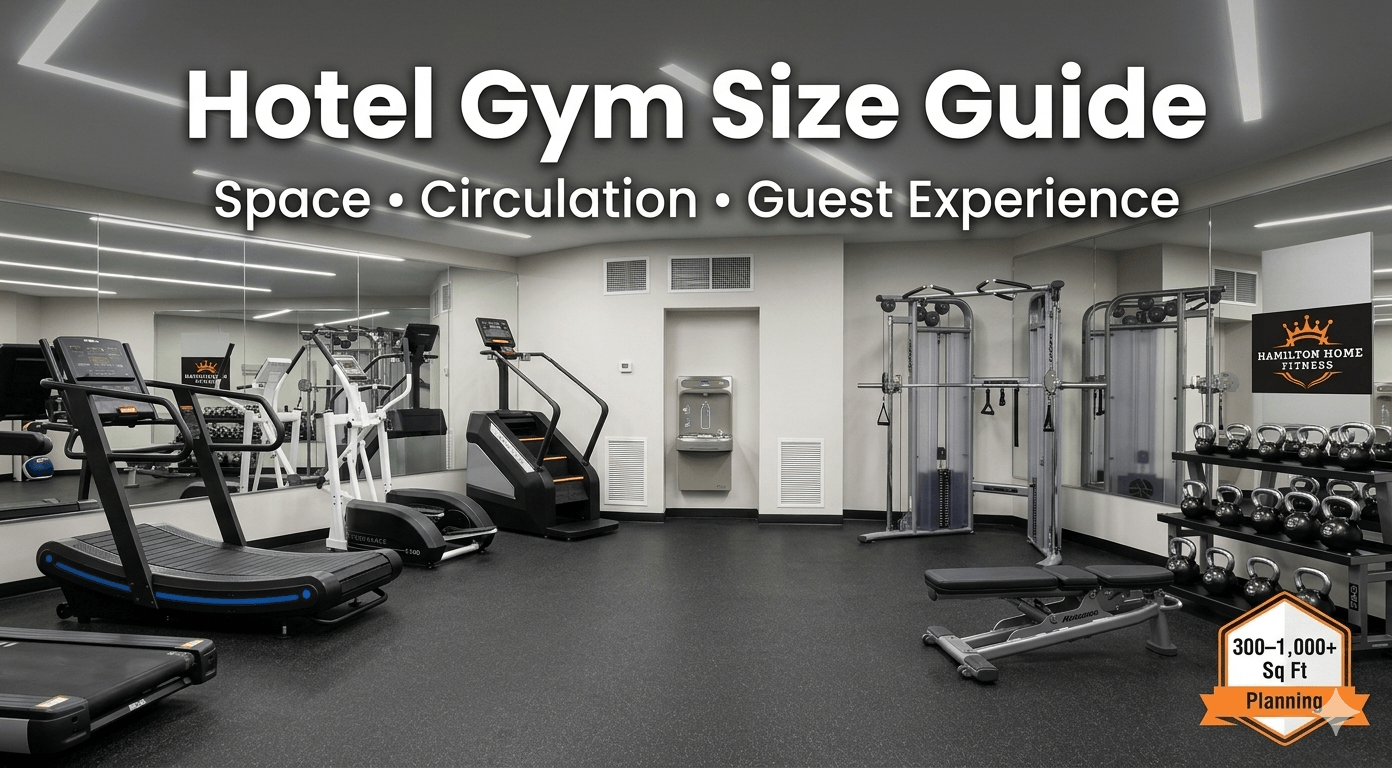
Use the tiers below as a starting point, then pressure-test them against your room count, service level, and — most of all — circulation.
Square Footage by Room Count
Size the room to your room count and service tier, then protect circulation before you count machines.
Room size | Best-fit property | Typical equipment capacity |
~300 sq ft | Small select-service, extended-stay | 2–3 cardio pieces, one functional trainer or compact selectorized unit, a small dumbbell set |
~500 sq ft | Select-service, ~100–150 rooms | 3–4 cardio pieces, 1–2 strength machines or a cable/functional trainer, dumbbells plus a bench |
~800 sq ft | Upscale / full-service, ~150–300 rooms | 5–6 cardio pieces, a selectorized line or functional trainer, a fuller free-weight area, a stretching space |
1,000+ sq ft | Full-service resort | 8+ cardio pieces, multi-station strength, full free weights, a functional/stretching zone, room for recovery |
These are planning ranges, not hard caps—the real limit is clearance. As a rule of thumb, allow roughly 20–30 sq ft for each cardio machine and 30–50 sq ft for each strength station once you include the space around it. Keep about 6 ft between pieces, hold walkways to at least 36 in, and leave open space behind every treadmill belt. Fit equipment to those clearances first; whatever's left over is your true capacity, regardless of what the floor plan claims to hold.
The Room: Floors, Mirrors, Air
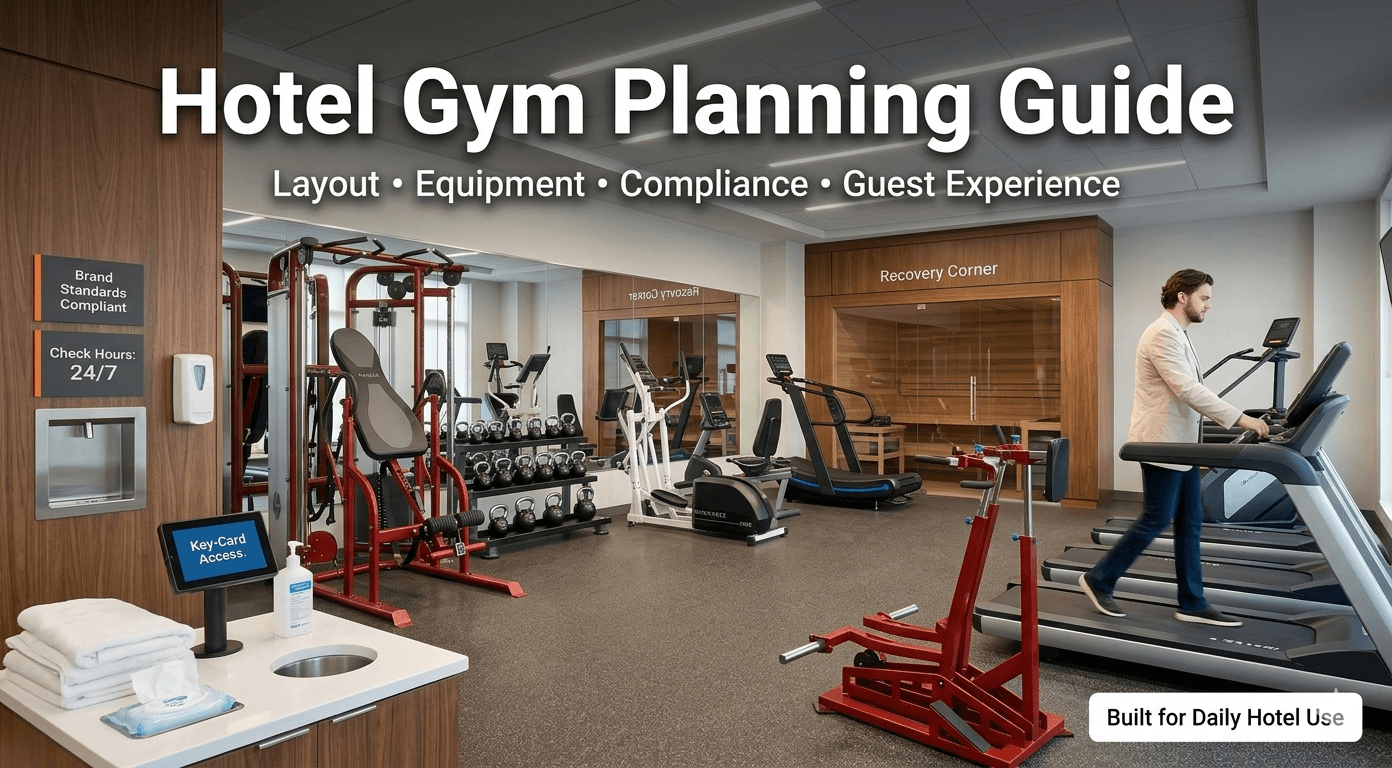
Rubber flooring, a mirror wall, bright even lighting, dedicated ventilation, and sound isolation matter as much as the machines do—because guest rooms usually sit on the other side of that wall.
Build the room around this short list:
Flooring: Commercial rubber roll or rubber tile to absorb impact, protect the slab, and cut noise. It also reads as "real gym" the moment a guest steps in.
Mirrors: A mirror wall makes a small room feel larger, helps guests check form, and brightens the space without adding fixtures.
Lighting: Bright, even LED lighting. Dim rooms are one of the most common complaints in fitness reviews.
Air: Dedicated ventilation — a mini-split or properly sized HVAC zone, not borrowed corridor air. A stuffy gym empties fast and draws bad write-ups.
Noise control: Plan acoustics early. Use drop-protection mats under free weights, buffer equipment away from shared walls, and account for vibration transfer before a guest above files a complaint at 6 a.m.
Hydration: A bottle filler or water fountain inside the room. It's a small spend guests notice and mention.
Get these wrong and no equipment list saves the room. Two issues — stuffy air and noise transfer — drive most fitness complaints in shared buildings, and both are cheaper to design in than to retrofit. For the deeper mechanics of zoning, traffic flow, and where each zone belongs, Hamilton Home Fitness lays it out in its in-depth commercial gym layout guide; here, the takeaway is simpler — the shell carries as much of the guest experience as the machines do.
The Right Cardio and Strength Mix
For a typical 100–300 room hotel, weight the mix toward cardio: roughly 50–60% cardio, 25–30% guided strength, and 15–20% free weights. Then shift toward strength as the property scales up, tracking the 2026 move toward strength-first training.
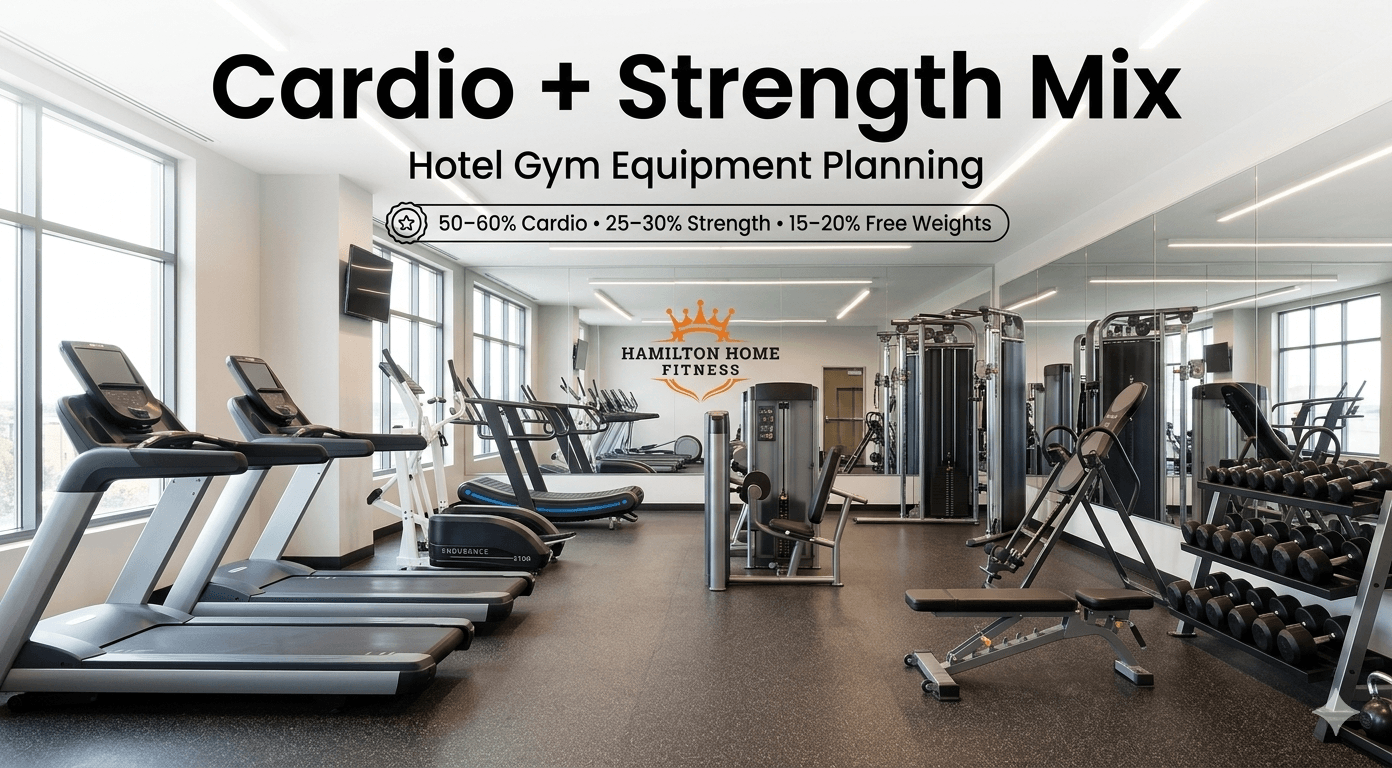
Those percentages are a starting frame, not a formula—adjust them to your guest profile and the grade of property you run.
Property type | Cardio | Strength | Free weights |
Select-service / extended-stay | ~60% | ~25% | ~15% |
Upscale / full-service | ~50% | ~30% | ~20% |
Resort / lifestyle | ~45% | ~30% | ~25% |
The pattern is consistent: smaller, business-leaning properties skew cardio-heavy because guests want a quick treadmill session before a meeting, while resorts and lifestyle hotels earn more from strength and functional space as stays lengthen and travelers train more seriously. Whatever the split, every piece has to survive unsupervised daily use — so the what matters as much as the how much.
Cardio That Runs All Day
Lead with treadmills, then add an elliptical, a recumbent bike, an upright or spin bike, and a rower—chosen for quiet drives, smooth belts, and high-duty cycles.
A reliable hotel cardio lineup usually looks like this:
Treadmills—the most-used machines in any hotel gym, so buy them first and buy them durable. Leave open space behind every belt for a safe step-off.
Elliptical — low-impact, joint-friendly, and approachable for guests of every age and fitness level.
Recumbent or upright bike — easy on the body and intuitive; a recumbent with a swivel seat also doubles as an accessible option (more on that next section).
Rower or stair climber — adds variety in larger rooms without much footprint.
The deciding traits are quiet operation and duty rating. In a room sharing walls with guests, look for enclosed drive systems, balanced flywheels, and smooth belt tracking—the difference between a machine guests enjoy and a 6 a.m. noise complaint. When you're ready to compare specs side by side, browse cardio machines built for daily hotel traffic and match the duty rating to your real volume.
Strength Without a Spotter
In a staff-free room, prioritize selectorized machines, a functional trainer or cable column, and at most a Smith machine—guided motion is safe to use alone, unlike loose barbell work.
This is where hotel gyms differ most from commercial clubs. With no trainer on the floor, heavy free-barbell setups invite injury and liability. Guided, pin-loaded equipment lets guests train alone without a spotter, and a single functional trainer covers dozens of movements in one compact footprint — ideal when space is tight. Pair that with clear instructional signage on each station, and you have a strength offering that's safe to leave unattended around the clock.
For a premium guided-motion option that holds up under constant use, Hoist is a strong fit for hospitality buyers and is available via private invoice.
Right-Sizing Free Weights
Keep free weights tight: a fixed hex dumbbell set (commonly 5–50 lb), one or two adjustable benches, and a small kettlebell set—secured, rubber-coated, and racked to control noise and walk-off.
Free weights satisfy serious guests, but more is not better here. A compact, well-organized set delivers the value without the downsides: rubber-coated hex dumbbells on a proper rack stay quiet and orderly, fixed weights Resist the walk-off that loose plates invite, and one or two benches are plenty for a room this size. Skip the heavy barbell-and-plate platform unless you're a lifestyle or athletic-leaning property with the space and the floor for it.
Match the dumbbell range and rack to your footprint with a compact free-weight selection built for shared, unsupervised rooms.
Meeting ADA in a Small Gym Room
ADA doesn't require every machine to be accessible. Under the 2010 Standards, at least one of each type of equipment needs clear floor space of 30" × 48"—36" × 48" if enclosed on three sides—positioned for transfer or seated use and served by an accessible route. Clear spaces are allowed to overlap.
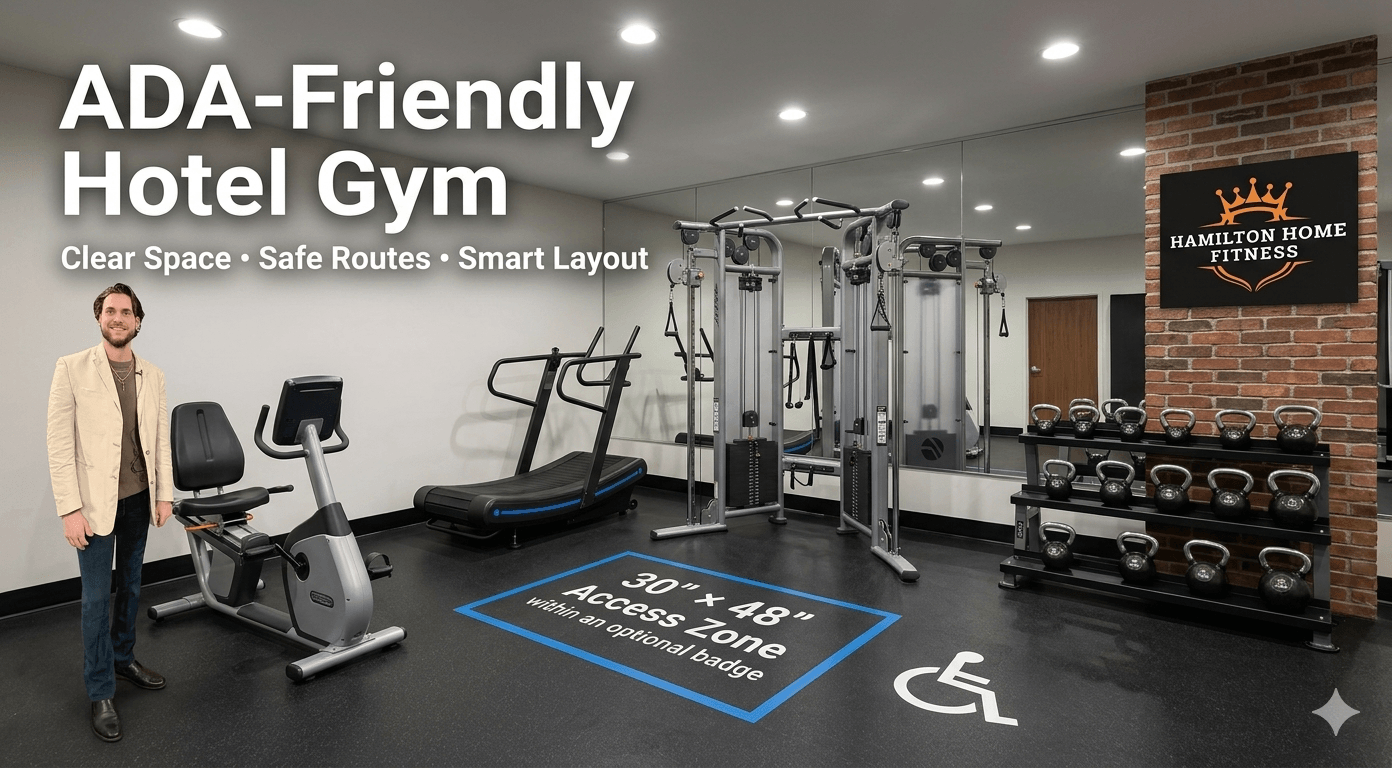
That one rule does most of the work in a small room. The mistake operators make isn't missing the dimensions—it's misreading what "one of each type" means and treating accessibility as the last item instead of the first.
What ADA Actually Requires
A treadmill, a bike, a rower, and a stair climber each count as a different cardio "type," and a curl machine differs from a press machine—so one accessible unit per type, on an accessible route, is the minimum.
In practice, that breaks down like this:
Count by type, not by machine. Each kind of cardio is its own type; most strength machines are separate types from one another. Where you offer both free weights and a machine that trains the same muscle, both need accessible, clear floor space.
One per type, not one per room. If you have three identical treadmills, only one needs the compliant clear floor space. Two of the same machine from different manufacturers still count as one type.
Clear floor space: 30" × 48" at the accessible unit, or 36" × 48" if it's boxed in on three sides by walls or equipment. Position it for transfer or for use while seated.
Accessible route: A path must connect to those spaces—and here's the space-saver: clear floor spaces may overlap and be shared between two pieces, and the route can run through them. Line equipment up thoughtfully, and a single aisle can serve several machines.
The machines themselves are exempt from the rules on controls and operating parts. You don't need special consoles—you need the space and route around the unit.
One design move pays off twice: choose at least one piece usable from a wheelchair, like a recumbent bike with a swivel seat or an upper-body cardio machine. It satisfies the intent of the standard and genuinely serves more guests, including the low-impact and rehab-friendly equipment that active-aging travelers look for.
Plan all of this at the layout stage. Retrofitting clearances into a finished room almost always costs more than designing them in.
One important limit: this is general guidance, not legal advice. An ADA application varies with new construction versus alterations and with local code, so confirm your specific room with a licensed accessibility professional or your local code official before you build.
Equipment Grade and 24-Hour Upkeep
Match grade to traffic: full commercial for branded, high-traffic, and 24-hour properties; light commercial only for low-traffic boutique rooms; and hospitality-grade lines where a brand or budget calls for it. Then lock in full commercial warranties, a preventive-maintenance contract, and a service-technician network before you buy.
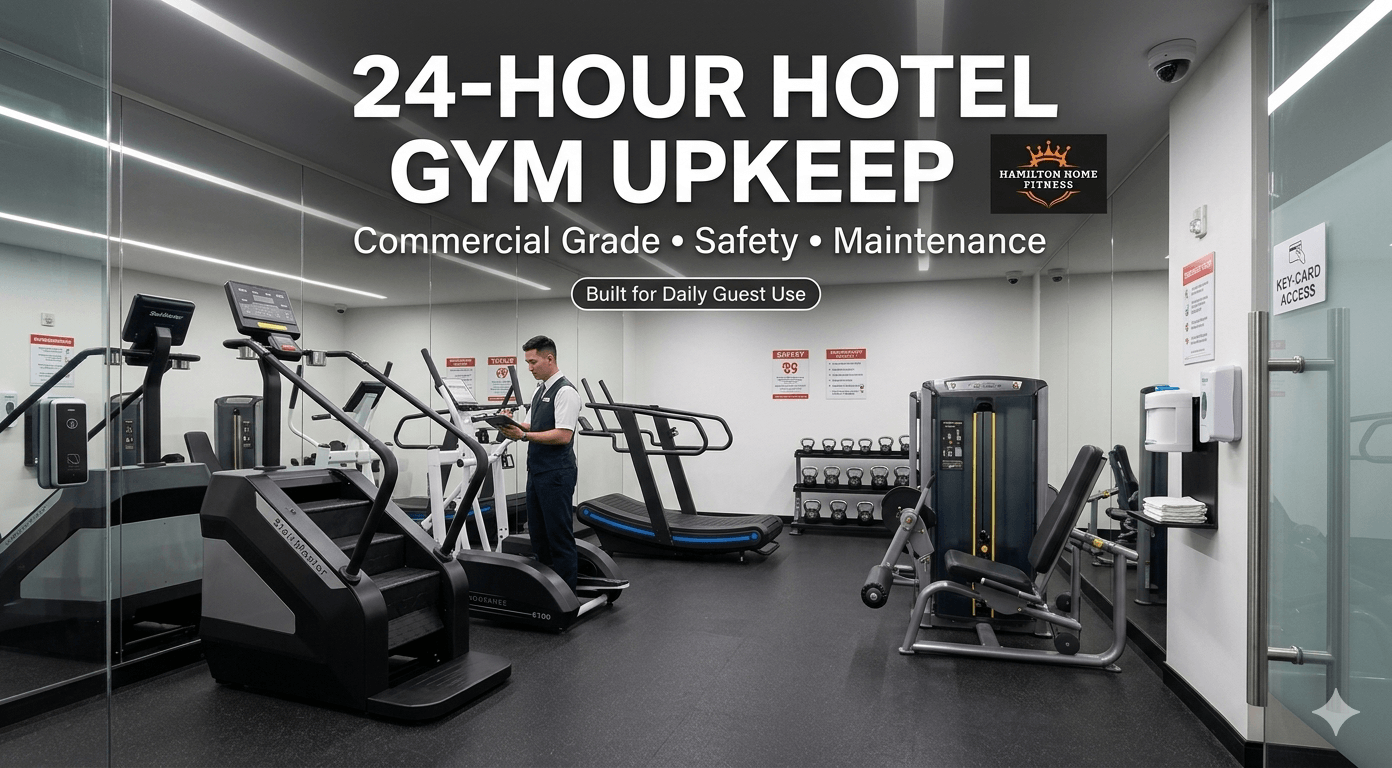
Grade and service are the same decision viewed from two angles. The grade you choose sets how often the equipment breaks; the service plan you sign sets how fast it's fixed when it does. In an unattended room, both show up directly in your reviews.
Commercial vs Hospitality Grade
The cheapest path is rarely the lowest cost—undergrading a 24-hour gym means premature failure, downtime, and the bad reviews that follow.
Grade | Best-fit property | Duty cycle | Warranty expectation |
Full commercial | Branded, high-traffic, 24-hour | Built for continuous daily use | Longest frame and parts coverage; strong service network |
Hospitality-grade | Brand-specified or budget-driven hotels | Heavy, hotel-rated use | Solid coverage tailored to hospitality duty |
Light commercial | Low-traffic boutique or extended-stay rooms | Moderate, lower-volume use | Shorter coverage; verify the duty rating fits your traffic |
The trap is reading the price tag instead of the total cost of ownership. A light-commercial treadmill in a 24-hour room may cost less up front and then fail inside its first year, leaving you with downtime, a replacement bill, and a string of "the treadmill was broken" reviews. Buy the grade your real traffic demands, and confirm three things before purchase: warranty length, frame and motor duty rating, and how quickly the manufacturer can get parts and a technician to your property.
To weigh the tiers in detail, work through the commercial gym equipment buyer's guide. For high-traffic or brand-specified properties, premium full-commercial cardio and strength are worth considering and are available via private invoice.
Unattended Access and Safety
An unattended gym needs key-card or room-key access, a security camera, posted rules and emergency-contact signage, equipment stop buttons, and self-service towel, wipe, and water stations.
Because no staff member is watching the floor, the operational layer carries the safety and the guest experience. Cover it with this checklist:
Access control: Key-card or room-key entry, ideally logged, so only registered guests use the room around the clock.
Security camera: A visible camera protects guests and the property and discourages misuse.
Signage: Brand-approved rules, hours, an age-restriction notice where required, and a clearly posted emergency contact. Treadmills and other motorized equipment should have accessible stop buttons.
Self-service stations: A towel station, a sanitizing wipe dispenser, and hand sanitizer — placed so guests can clean equipment without crossing the room — plus the in-room water source from earlier.
Maintenance rhythm: A preventive-maintenance contract and a named technician network turn breakdowns from multi-week outages into quick fixes. In a 24-hour room, a fast repair path is the difference between one bad day and one bad review.
Set this layer up once, and the room largely runs itself—safely, cleanly, and without a dedicated attendant.
Details Guests' Rewards in Reviews
Guests reward three things in reviews: equipment that works, brands they recognize, and a space that feels clean and bright. Working, recognizable machines plus visible cleanliness and good lighting do more for your fitness rating than adding equipment to an already crowded room.
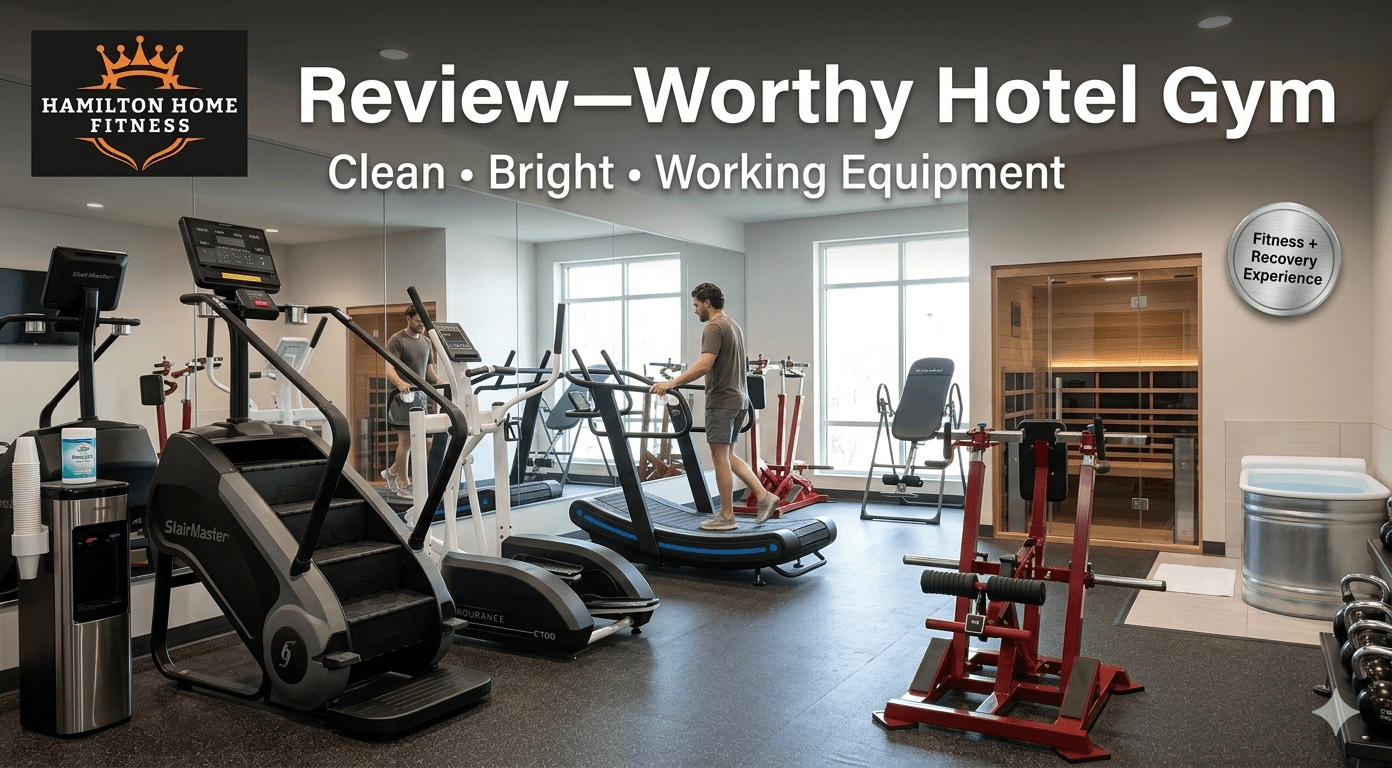
This is the payoff for every decision so far. A guest doesn't review your duty cycle or your clearance math — they review how the room felt for twenty minutes before checkout. Get the controllable details right, and the rating follows.
Why Guests Rate Your Gym
Broken machines and dim, stuffy rooms generate the harshest fitness reviews; recognizable commercial brands and a clean, well-lit space generate the warmest.
Picture the two-line review that actually gets written. The bad one: "Treadmill out of order; room was hot and cramped." The good one: "Clean, bright gym with real Life Fitness equipment—better than I expected." Almost everything separating those two outcomes is within your control: equipment that's working and well-maintained, a space that's visibly clean, lighting and airflow that feel good, and machine brands guests already trust from their home club.
That last point is why grade and brand selection pay off twice—once in durability and once in perception. When a guest sees recognizable, well-built machines, they read the whole property as more premium. Stocking recognizable, well-built commercial machines is one of the clearest ways to move a fitness rating without enlarging the room.
Recovery as a Differentiator
Adding a sauna or cold plunge turns a fitness room into a wellness amenity guests photograph and mention by name—a growing differentiator for resorts and lifestyle properties.
Recovery is where a hotel can pull ahead in 2026. A sauna or cold plunge gives guests a reason to talk about your property specifically, and it photographs well enough to earn the Instagram tags and "the cold plunge was a highlight" reviews that generic gyms never get. Match the format to the property: a cold plunge suits active, wellness-leaning, and resort guests; a traditional or infrared sauna fits a broad audience and reads as relaxation; a small space can start with one rather than both.
This is a targeted upgrade, not an impulse buy—weigh it against your guest profile and budget. When it fits, pair a Plunge Zero cold plunge with a Golden Designs sauna to round out the recovery experience.
What It Costs to Equip a Hotel Gym
As a 2026 planning guide, budget roughly $50–$75 per square foot for equipment, then add flooring, mirrors, screens, signage, freight, and installation on top. Final cost depends on equipment grade, brand mix, property size, and recovery add-ons — so treat any single number as a starting estimate, not a quote.
Run the per-square-foot figure first, then layer the build costs the equipment number leaves out. A 500 sq ft select-service room and a 1,000 sq ft resort center sit in very different brackets, and the same footprint can swing widely once grade and brand enter the math.
The variables that move your number most:
Equipment grade—full commercial costs more up front than light commercial, but as the upkeep section showed, under-grading a 24-hour room usually costs more over its lifetime.
Brand mix—premium and brand-specified lines carry higher price tags than entry-level commercial equipment.
Property size — more square footage means more machines and more flooring, mirrors, and screens to cover it.
Recovery add-ons — a sauna or cold plunge is a separate line item, not part of the per-square-foot equipment figure.
Freight and installation—hospitality-grade equipment ships heavy and often needs white-glove delivery and installation, especially above the ground floor.
So size your room, pick your grade, and price the build layers separately—that gives you a realistic budget rather than a misleading round number. The most accurate figure comes from a quote built around your actual footprint, brand requirements, and traffic, not a published average.
FAQ
Do hotel guests actually use the gym?
Yes. Fitness facilities rank among the hotel features travelers say matter most, and a well-maintained gym measurably lifts guest satisfaction. Surveys have repeatedly found that a large share of travelers will pay more for, or specifically book, a property with a quality fitness center — which makes the gym a booking and review driver, not just a cost.
Does a hotel gym need an attendant?
Most don't. With guided-motion strength machines, quiet self-explanatory cardio, clear instructional signage, and a security camera, a hotel gym can run safely unsupervised 24 hours a day. The trade-off is buying durable, intuitive equipment that's safe to use alone—which is exactly why grade and equipment-type decisions matter more in a staff-free room.
How often should hotel gym equipment be replaced?
Plan replacement around your capex cycle and the equipment's duty rating. Full commercial machines in a 24-hour hotel typically last several years before a refresh, while under-graded units fail far sooner. That gap is the real argument for choosing the right grade and warranty up front: the cheaper machine often costs more once you count early replacement and downtime.
Final Thought
A hotel gym wins on flow, the right grade, and brand-plus-ADA compliance — not on how many machines you can fit in the room. Get the fundamentals right and the rest falls into place: equipment that works, in a clean and accessible space, is what guests recommend and what brand inspections pass.
That's the whole job. Size the room to your property and protect circulation first. Pull your brand's approved-supplier list before you spec anything. Build the mix toward cardio for business-leaning hotels and toward strength as you scale, using guided-motion equipment that's safe to leave unattended. Meet ADA at the layout stage, match grade to real traffic, and back it with a service plan that turns breakdowns into quick fixes. Then let the details guests actually feel—cleanliness, light, air, recognizable brands, and recovery—do the work in your reviews.
If you'd rather not piece that together alone, the next step is simple: book a hotel gym design consultation with the Hamilton Home Fitness team. You'll turn your square footage into a compliant, durable, review-ready plan—with the right equipment, sourced to your brand's spec and shipped nationwide, from day one.