Introduction
Planning a fitness amenity for a 50- to 400-unit community means more than buying machines — it means building a room residents actually use, one that survives unattended 24-hour access and holds up to accessibility and liability scrutiny. Renters now expect a credible gym, and a weak one quietly costs you on leasing tours and at renewal.
This multifamily apartment gym equipment guide takes developers, asset managers, leasing directors, HOA boards, and build-to-rent operators through sizing, zoning, equipment, ADA accessibility, durability, service, and budget—in the order you'll decide on them. When you're ready to turn the plan into a finished, cross-brand buildout, a gym-design partner can take it from there.
Why a Clubhouse Gym Pays Off
A fitness center is one of the amenities renters most consistently want, so a good one strengthens leasing and retention — but its return shows up in occupancy and renewals far more than in a large standalone rent premium.
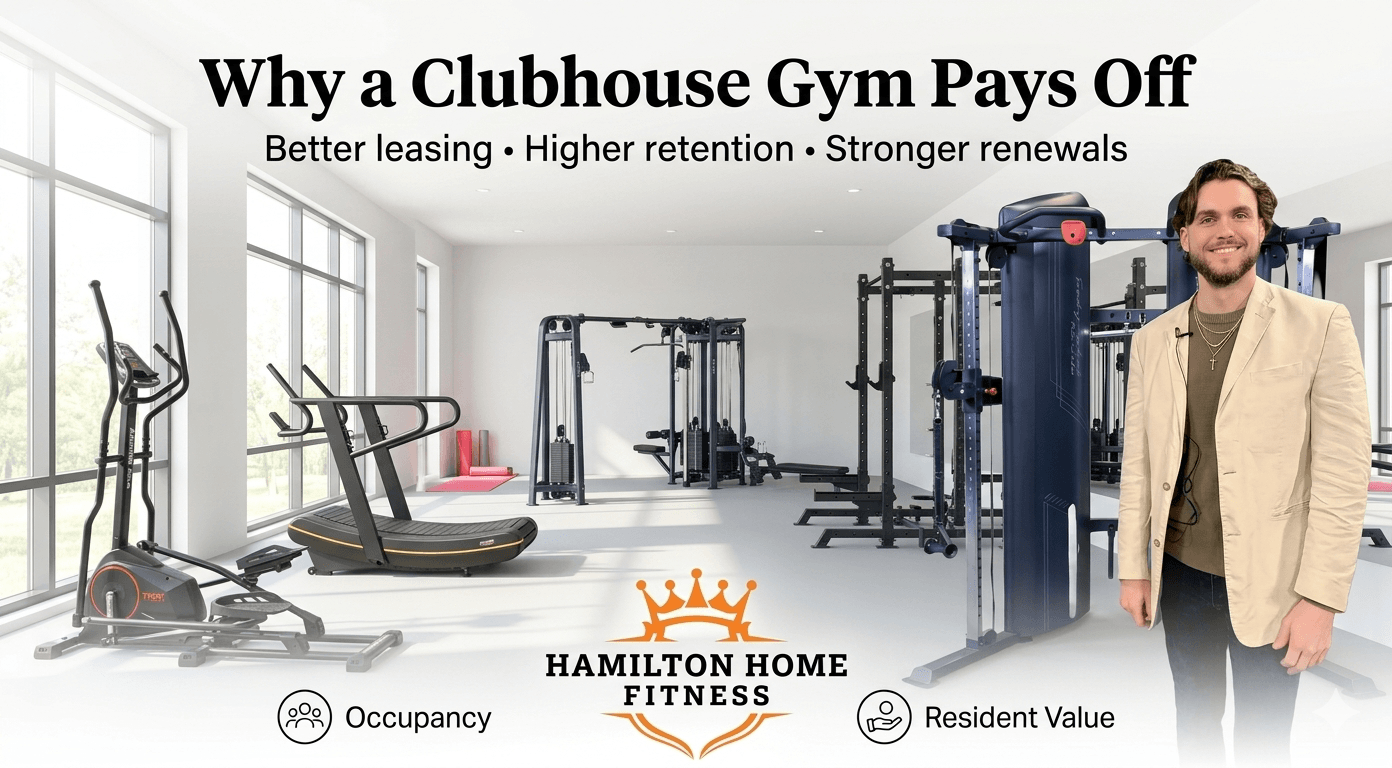
The NMHC/Grace Hill Renter Preferences Survey has consistently ranked an on-site fitness center among the most-wanted community amenities, with roughly 70% of renters saying they're interested in one or wouldn't rent without it. In a competitive market, that makes a credible gym close to table stakes. What it rarely does is earn a big rent line item on its own—renters tend to pay more for in-unit features or services like childcare before they pay a premium for the gym. So the honest way to value a multifamily gym is as a competitiveness and retention lever: it helps fill units faster, hold occupancy, and win renewals, which is where the money actually is.
Interest vs. actual usage
More residents value having a gym than use one every week, so the real target is a room that turns interest into habit — not a showpiece that photographs well and sits empty.
The communities that get steady use tend to get four things right:
Equipment mix—approachable cardio and guided strength residents will use unsupervised, not niche pieces that intimidate or gather dust.
Sightlines and layout—an open, well-lit room where people can read at a glance feels safe and inviting, especially for first-timers and off-hours users.
Uptime — gear that works every time; one broken treadmill teaches residents to stop checking.
Accessibility — routes and equipment that work for older, recovering, and less-experienced residents, who are often your most loyal renewers.
You can see how these drivers come together in the fitness centers we've outfitted for communities. Get them right, and the same budget buys far more usage—the difference between an amenity that drives renewals and one that just fills a floor plan.
How Big Should the Gym Be?
There's no mandated size, but a reliable starting point is roughly 12–15 square feet per apartment unit. Then sanity-check that against how many residents will actually train at once—plan about 35–45 square feet per person and 40–60 square feet per cardio machine—and build according to whichever method gives the more realistic room.
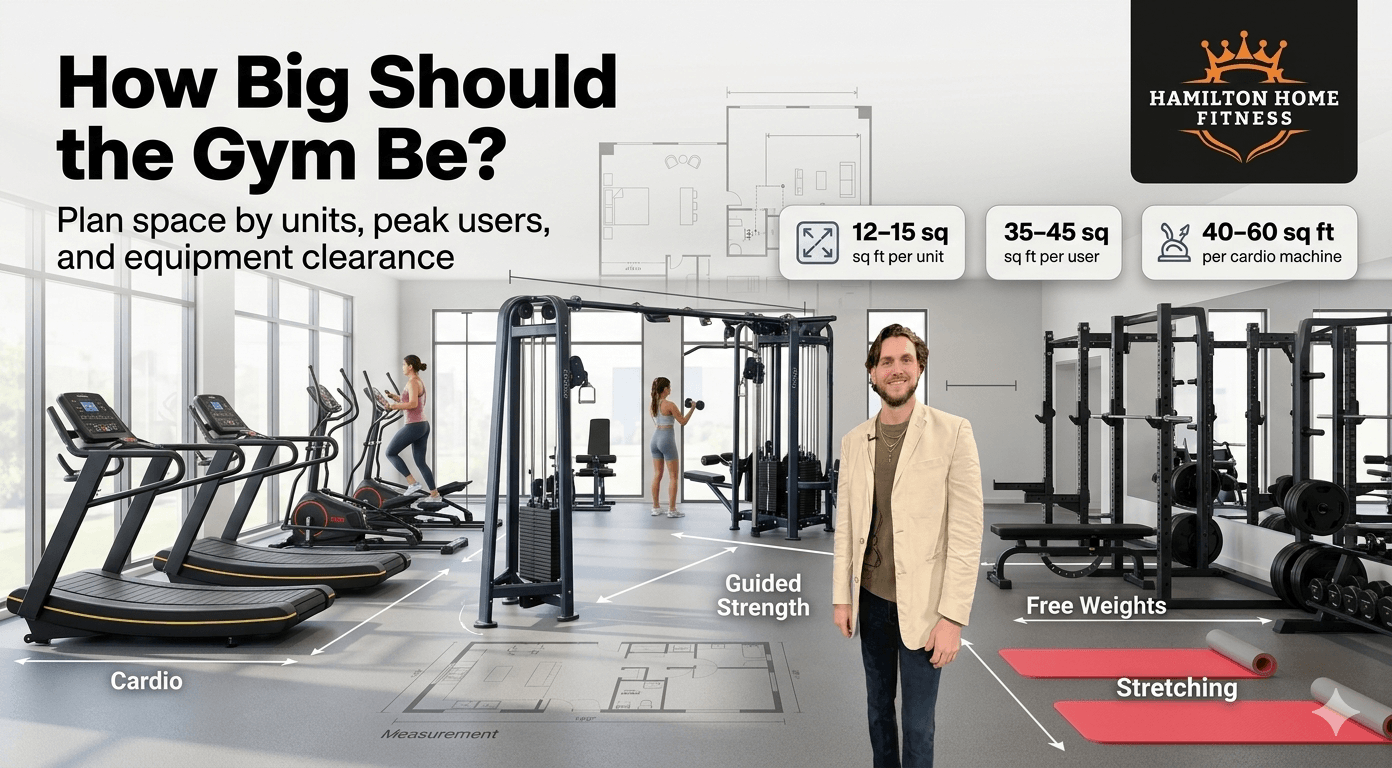
Use the per-unit figure to set a target footprint and the peak-user figure to confirm it. When the two disagree, trust the larger number.
Sizing by unit count (50–400)
Multiply your unit count by a per-unit allowance to get a target footprint, then confirm it against peak usage. At 12–15 square feet per unit, that works out to:
Units | Typical footprint | What fits |
50 | ~600–750 sq ft | One compact zone each: cardio, guided strength, and a small free-weight/stretch corner |
100 | ~1,200–1,500 sq ft | Distinct zones plus a few cardio pieces and a rack |
200 | ~2,400–3,000 sq ft | Full zoning with a recovery/stretch area and room for functional training |
400 | ~4,800–6,000 sq ft | Multi-room potential: separate cardio, strength, and a studio or recovery space |
Run much leaner than this, and the room feels cramped at peak hours. Communities chasing a Class A or amenity-rich position often push higher to fit a recovery, stretch, or small group-fitness studio.
Sizing by peak users
Plan for peak concurrent users, not total residents, because crowding and wait times are what drive complaints and idle equipment. Only a small share of residents are in the gym at any one moment, but that share spikes in the early morning and the evening.
Take a 200-unit community. A typical peak might be eight to twelve people training at once. At roughly 35–45 square feet each—plus 40–60 square feet around every cardio machine for safe mounting, dismounting, and walk-behind space—that points to a 2,400–3,000 square-foot room, which lines up with the per-unit estimate above.
Whatever the total, protect circulation. Keep clear corridors between zones and enough clearance around each machine that residents aren't stepping over equipment. The American College of Sports Medicine's common planning figure — about 40–60 square feet per piece — exists for exactly this reason. A room that hits its square-footage target but ignores clearance still feels crowded and unsafe.
Layout, Zones, and Room Essentials
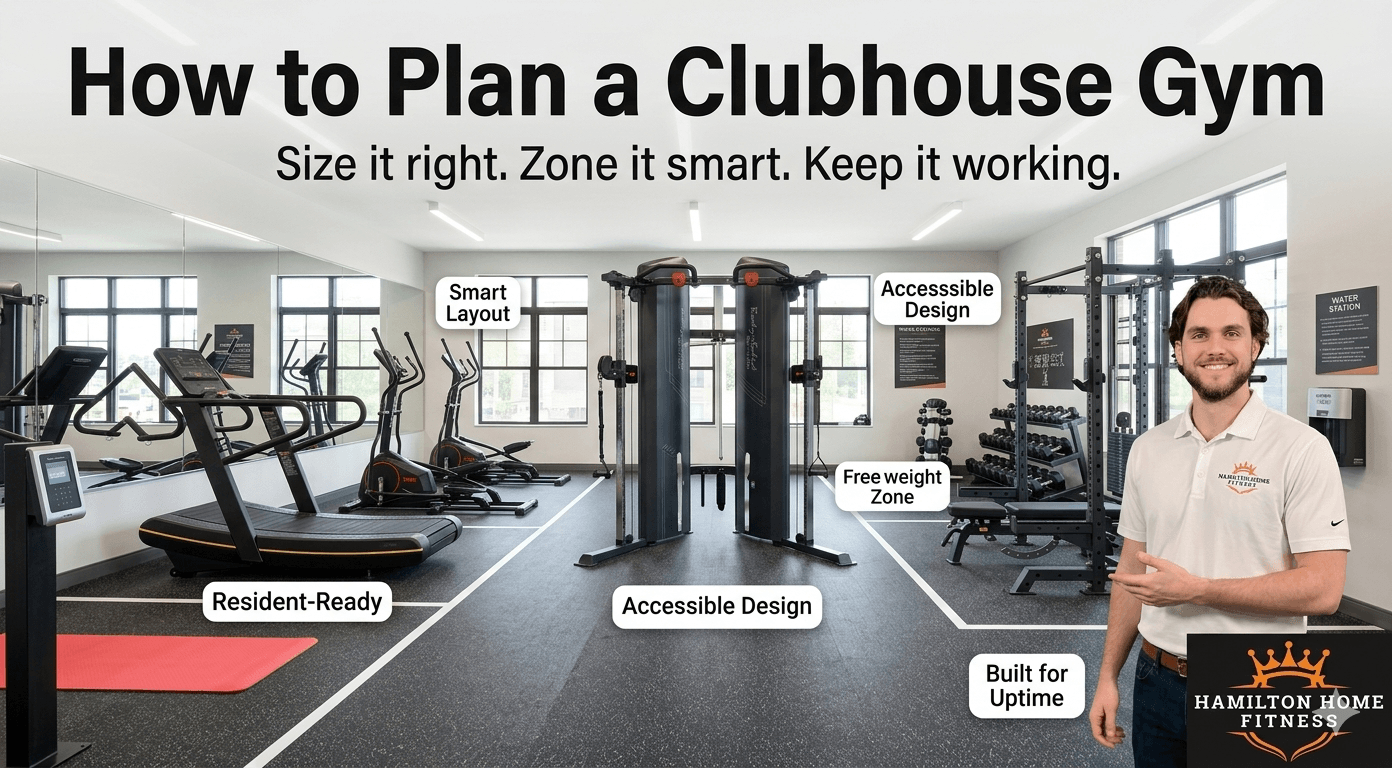
Divide the room into clear zones — cardio, strength machines, a free-weight/functional area, and a small recovery or stretch corner — connected by wide, unobstructed corridors and accessible routes. Zoning keeps similar equipment together, separates loud or high-traffic gear from quiet areas, and lets residents read the room at a glance.
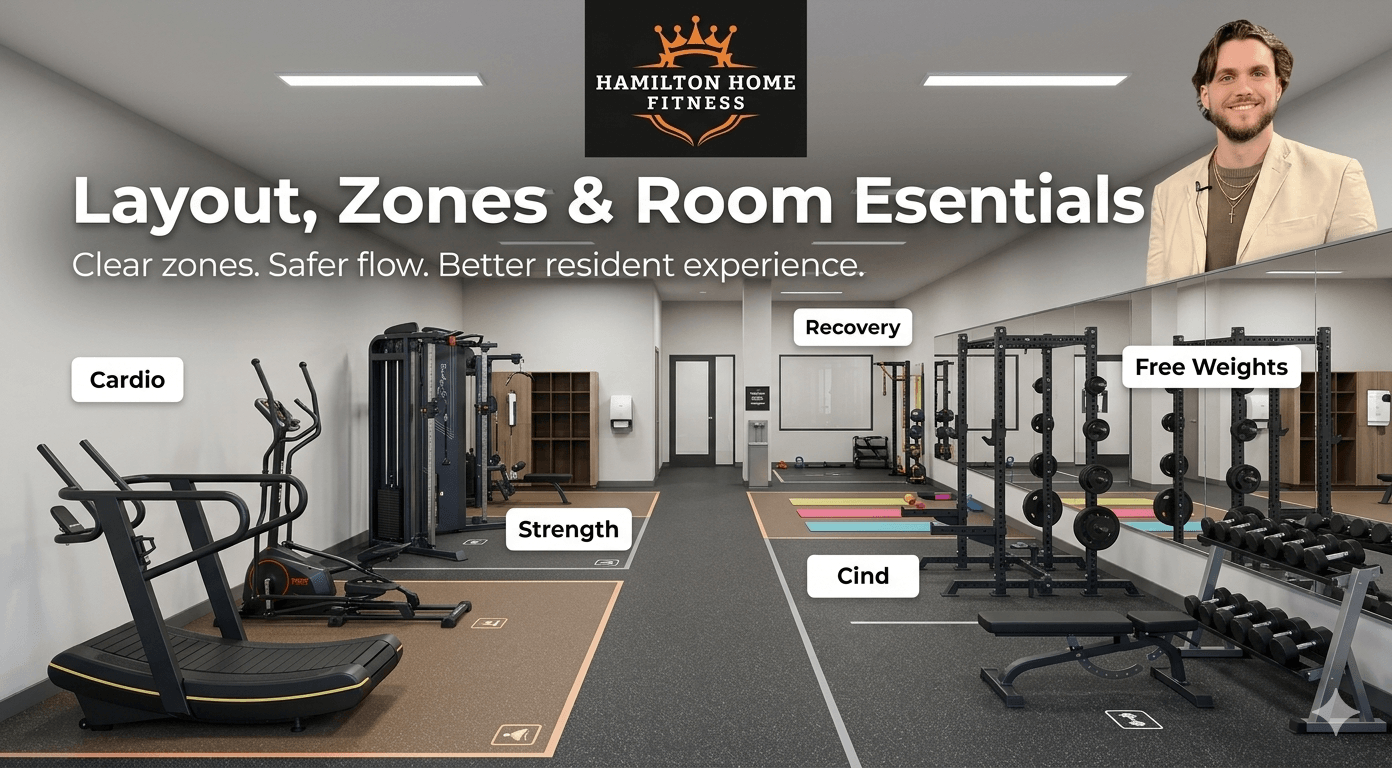
Lock these layout basics before equipment arrives:
Anchor heavy machines along perimeter walls to open up the floor and keep sightlines clear.
Group by zone so cardio, strength, and free weights don't bleed into each other.
Keep a clear path through the room and around every machine — no stepping over equipment.
Put the free-weight zone on the most durable flooring and away from cardio screens and mirrors.
Leave an accessible route to and within each zone (covered in the ADA section).
Plan for swaps — leave a little open space so you can change the mix as usage data comes in.
Flooring, mirrors, lighting, HVAC
Get flooring, ventilation, mirrors, and lighting right first—they decide durability, noise, and how the room feels long before anyone touches a machine.
Flooring: Commercial rubber over the slab. Rolled rubber gives a seamless surface for cardio and general areas; interlocking rubber tiles add thickness and impact protection under free weights and drops.
Mirrors: A mirror wall along the strength and free-weight zones for form checks; it also makes a tight room feel larger. A mirrored corner pairs well with yoga and stretching gear for the stretch and mat area.
Lighting: Bright, even LED lighting with no dark corners — it reads as clean and safe, which matters most for early-morning and late-night users.
HVAC and ventilation: Size cooling for a room full of working bodies and machines, not an empty space. A dedicated mini-split and good air exchange prevent the stuffy, humid feel that empties a gym.
Sound and AV: Hard surfaces echo, so add acoustic treatment where you can, and plan wall-mounted TVs or a sound source if the amenity tier calls for it.
Sanitation, water, and access control
Plan sanitation, hydration, and secure access from day one, since no staff will be on site to manage any of it.
Sanitation: Wipe dispensers and hand-sanitizer stations at the entrance and within each zone, with a visible spot for residents to clean equipment after use.
Hydration: A bottle-filling station or water fountain — ideally both — placed where it won't crowd a workout zone.
Towels and storage: Cubbies or hooks for belongings; a towel station if the tier warrants it (most resident gyms skip full towel service).
Access control: Key-fob or app-based entry that limits the room to residents and creates an access record — the foundation of safe 24-hour, unattended use.
Security: Cameras covering entries and the main floor, plus clear posted rules and hours.
Signage: Equipment-use basics, a cleanup reminder, and an easy way to report a broken machine.
What Equipment Residents Actually Use
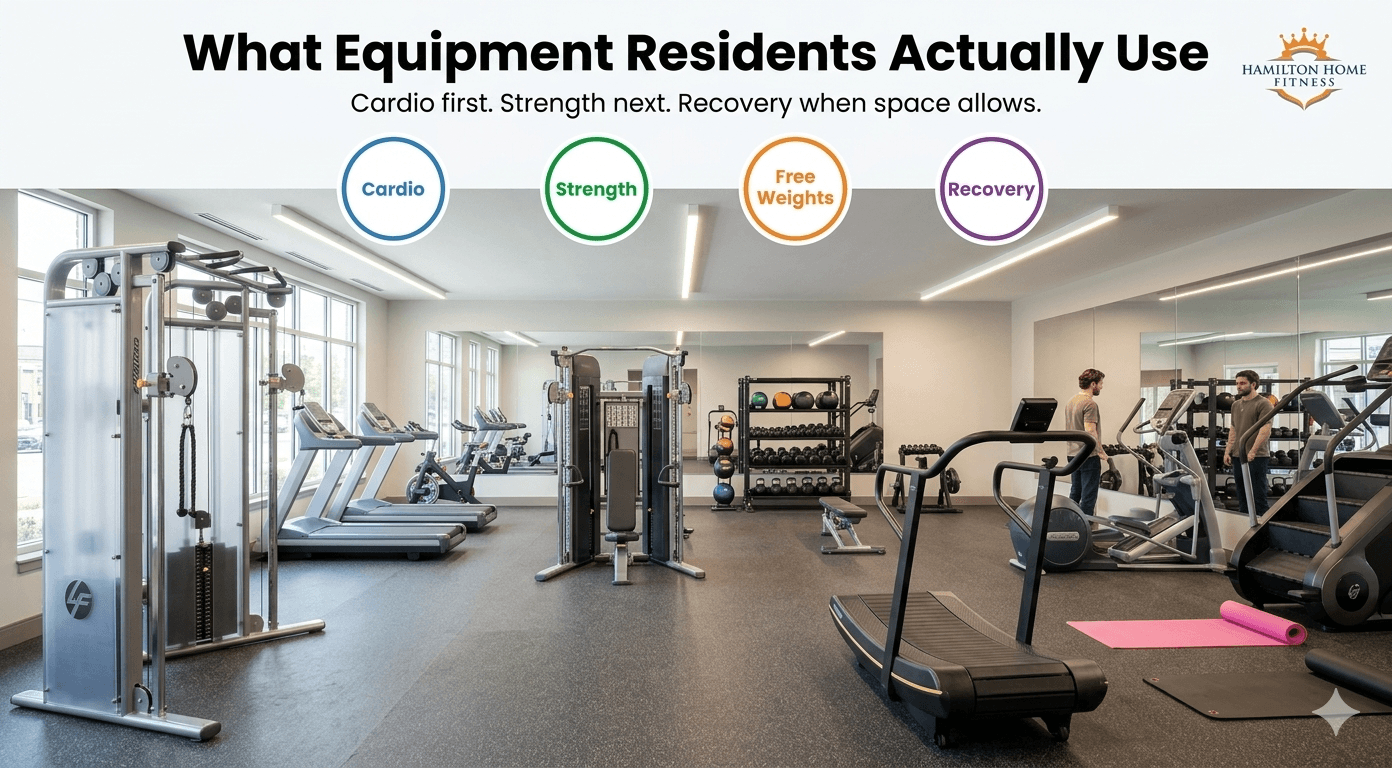
Lead with approachable cardio and versatile, low-skill strength first; add free weights next, then recovery and premium pieces as space and budget allow. The goal isn't to fit every machine — it's to fill the room with gear that residents will use confidently, on their own, at any hour.
Cardio that earns its footprint
Lead with treadmills and low-impact cardio—they get the most use per square foot in a residential gym. A practical mix balances footprint, impact, and how much maintenance each piece demands under unattended traffic.
Piece | Footprint | Impact | Maintenance |
Treadmill | Larger | Higher | Higher—motor and belt, the most-used and most-serviced piece |
Elliptical | Larger | Low | Moderate |
Recumbent bike | Moderate | Very low | Low — strong for older and recovering residents |
Upright / spin bike | Smaller | Low | Low |
Rower | Long but narrow; stores upright | Low | Low |
Stair climber | Compact footprint, tall | Moderate | Moderate |
For most communities, start with treadmills, add a recumbent or upright bike for low-impact options, and include a rower or stair climber as space allows. Representative options worth considering include Spirit Fitness cardio (which ships free), Concept2 rowers, and STEPR stair climbers, with Matrix, Horizon, or Vision available when you want full-commercial cardio for higher traffic. You can browse the full range of commercial cardio machines to match pieces to your footprint and resident base.
Strength machines and racks
Selectorized machines and a rack with proper safeties cover most residents safely, without a spotter—which is exactly what an unsupervised room needs. Match the equipment to skill level:
Selectorized (pin-loaded) machines — the default for resident gyms. Guided movement paths make them safe and intuitive for beginners training alone.
Plate-loaded machines — more loading capacity for experienced lifters, but a step up in skill; add them once the basics are covered.
Rack or Smith machine with safeties — gives confident lifters a way to squat and press solo; spotter arms and catches are essential for unattended use.
Functional trainer / cable column — one compact station covers dozens of movements for all levels, making it one of the most space-efficient strength buys.
Representative lines that suit multifamily use include Body-Solid Pro ClubLine selectorized equipment, Hoist functional trainers, BodyKore, and Tag Fitness racks and Smith machines (several premium lines are quoted by private invoice). For the guided, solo-friendly core of the room, start with power racks and cages and a functional trainer.
Free weights and functional zone
A compact dumbbell set, a couple of benches, and a small functional area cover the widest range of residents in the least space. Keep this zone tight and durable:
Dumbbells — a fixed urethane or rubber-hex set is the workhorse; adjustable dumbbells save space in smaller rooms.
Benches — one or two adjustable flat/incline/decline benches multiply what the dumbbells can do.
Kettlebells and medicine balls — a few of each add variety with almost no footprint.
Functional extras—plyo boxes and a small turf strip or open floor area support bodyweight and mobility work.
Representative options include Tag Fitness, Body-Solid, and York Barbell, plus space-saving adjustable dumbbells. Build the zone around a durable set of free weights and the right benches before adding accessories.
Recovery and premium add-ons
Recovery and premium pieces set a community apart once the core room is solid—they're tier-up options, not foundations. Add them when space and budget allow and the amenity position calls for it.
Sauna — an infrared sauna (such as Golden Designs) is a strong differentiator for wellness-focused and active-adult communities.
Cold plunge—increasingly expected in Class A and luxury buildings; Plunge Zero cold plunges and similar units give residents a recovery draw few competitors offer.
Vibration plates — a Power Plate adds warm-up, mobility, and recovery value in a small footprint.
Premium cardio—a marquee piece like a STEPR stair climber signals a high-end amenity at a glance.
These are what residents point to when they tour — the difference between a competent gym and one that helps close a lease.
Full vs. Light Commercial Equipment
Light commercial equipment is fine for smaller, lower-traffic rooms, but unattended 24-hour access pushes your high-use pieces—treadmills especially and high-use strength equipment—toward full commercial. The reason isn't prestige: duty cycle, warranty validity, and liability all hinge on matching the equipment to how the room is actually used.
One rule clears up most of the decision. Residential-grade equipment doesn't belong in any shared amenity — placing it in a multifamily gym voids the manufacturer's warranty and shifts the liability for a failure onto the property. That leaves two real tiers:
Light commercial | Full commercial | |
Built for | Moderate daily use — hotels, small studios, apartment rooms | Continuous, high-frequency use across many users |
Daily hours | Roughly under 8 hours | Extended hours, heavy back-to-back traffic |
Frame & motor | Commercial components, lighter build | Heavier frames, higher-output motors and bearings |
Weight capacity | Lower | Higher |
Warranty | Shorter commercial coverage | Longer coverage rated for high-traffic settings |
Best multifamily fit | Smaller communities, low-traffic pieces | High-use cardio and strength under 24-hour access |
The practical call: in a smaller community, light commercial can carry the room. As unit count, peak traffic, and around-the-clock access climb, move the pieces that take the most punishment—treadmills first, then your busiest strength stations—to full commercial, and keep light commercial for lower-traffic gear. Whichever tier you choose, confirm that each model's commercial warranty explicitly covers unattended multifamily placement; coverage and duty-cycle ratings vary by manufacturer and model, and a voided warranty erases the value of the spec. You can compare full-commercial equipment built for this kind of continuous, unsupervised use when you're ready to match the tier to the traffic.
ADA and Accessibility Requirements
It depends on who can use the room. A resident-only gym behind a key fob is generally governed by the Fair Housing Act's accessible-common-area design rules—not ADA Title III, which applies when a space is open to the public, most clearly your leasing office or any amenity non-residents can use. On top of both, state and local building codes set their own accessibility requirements.
That distinction matters because most equipment guides tell you to "just follow ADA," which is often the wrong frame for a private, resident-only amenity. The Fair Housing Act applies to common areas in covered multifamily buildings first occupied after March 13, 1991, and treats fitness rooms as common-use space that must be accessible to and usable by residents with disabilities. The ADA enters the picture when the room — or the path to it — is open to people beyond residents and their guests. In practice, many developers design the whole amenity to ADA standards anyway because it's a clear, well-documented benchmark and it future-proofs the space. Either way, accessibility isn't only a compliance line; older, recovering, and less-experienced residents are often your most loyal renewers, and a room they can actually use protects retention.
What this looks like on the floor:
Accessible routes and clearances into the room and to each zone, with enough turning and maneuvering space around equipment.
Accessible cardio — recumbent bikes with swivel or step-through seats and low step-on treadmills are far easier to use for residents with limited mobility.
Accessible strength — a functional trainer or cable column with reachable adjustments works for a wide range of abilities from a seated or standing position.
Reachable controls and clear floor space at each accessible machine.
Accessible, low-impact pieces — including accessible, rehab-friendly cardio — do double duty: they meet accessibility goals and serve the older and recovering residents who use the gym most consistently.
This is general information, not legal advice. Accessibility obligations vary with how the amenity is used and where it's built, so confirm the specific requirements for your project with your architect or an accessibility specialist and your local code authority before you finalize the layout and equipment.
Maintenance, Uptime, and Budget
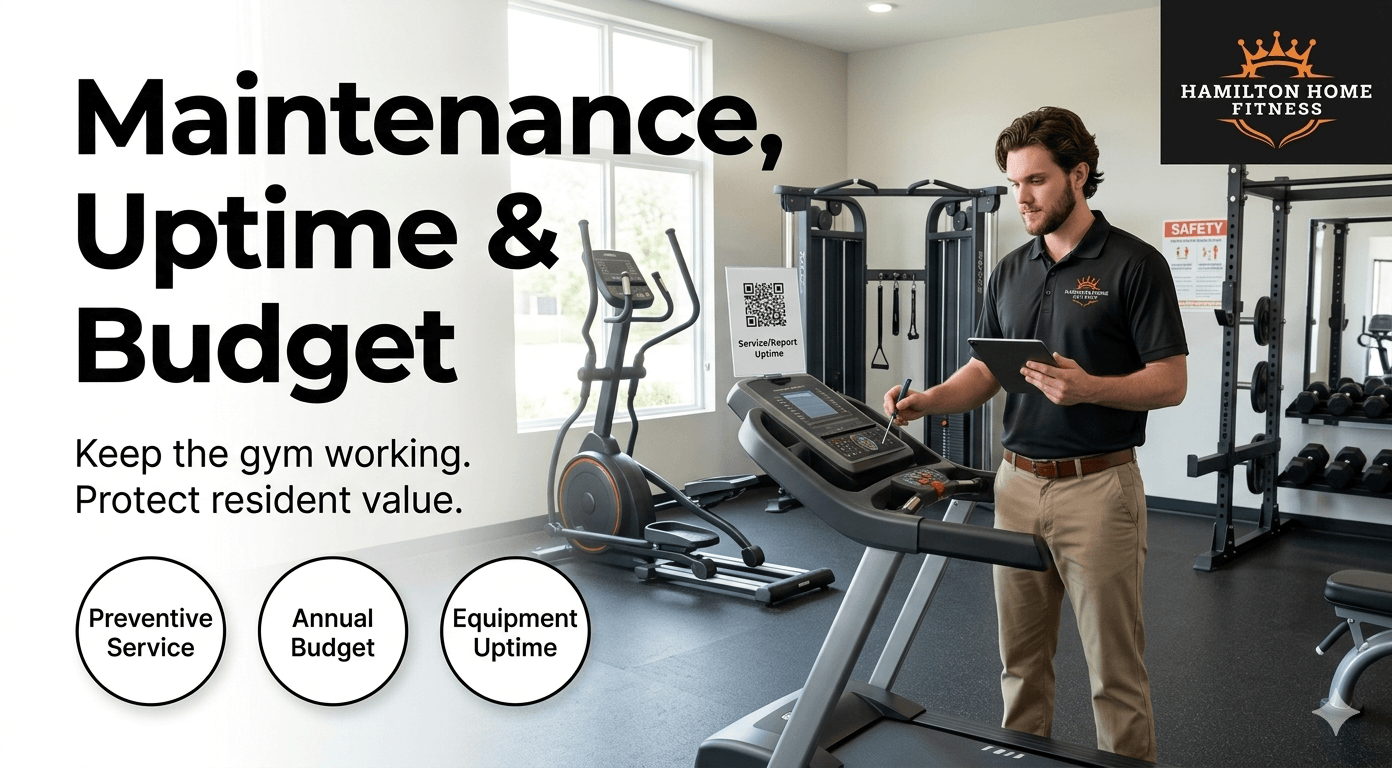
Protect uptime with a preventive-maintenance contract and a few unattended-room safeguards, and budget the project in three separate buckets: equipment, flooring and installation, and annual service. A gym is only an amenity when it works — a room full of out-of-service machines does more damage to renewals than no gym at all.
Prevent downtime in a 24-hour gym
Uptime in an unattended gym comes from a service contract plus a few simple on-site safeguards — there's no front-desk staff to catch a problem, so the system has to catch it for you.
Preventive-maintenance contract — scheduled technician visits to inspect, lubricate, calibrate, and replace wear parts before they fail. Skipped maintenance is the main driver of downtime and expensive emergency repairs.
Spare-parts access—confirm parts availability and turnaround for your specific models before you buy, especially for treadmills.
Remote monitoring — where equipment supports it, error alerts flag a failing machine before residents do.
Easy reporting — a posted QR code or number so residents can report a broken machine in seconds.
Cameras and signage — deter misuse and document incidents in a room no one supervises.
Emergency basics — consider an emergency phone and an AED, and post clear hours and rules.
Correct setup prevents a surprising share of early failures, so plan professional delivery and installation—proper assembly, leveling, and operational testing—rather than treating installation as an afterthought.
Annual service and PM budget
Budget an annual preventive-maintenance line scaled to room size and equipment count. As a planning range, a small resident gym might run a few hundred to a couple thousand dollars a year, while larger facilities with more machines cost more; treat these as estimates that vary by market, equipment mix, and visit frequency.
Most multifamily rooms do well on monthly-to-quarterly visits. The case for it is simple: regular service extends equipment life by years and prevents the bigger, unplanned repair bills that come from running machines until they break. The annual contract is the cheaper path.
What a full buildout costs
Budget in three buckets—equipment, flooring and installation, and annual service—rather than chasing a single all-in number, because scope drives the total.
Equipment—the largest bucket and entirely scope-dependent. Commercial cardio and strength run roughly $1,500 to $10,000+ per piece depending on tier and type, so the count and grade of machines set the figure. Treat any range as a starting estimate that varies by model.
Flooring and installation—commercial rubber plus professional installation; budget per square foot and confirm with quotes for your room.
Annual service — the recurring PM line above.
For larger or full-commercial buildouts, the cleaner route is a configured, quoted package. Premium lines like Matrix Fitness (private invoice) and cross-brand buildouts are handled by Matrix Fitness (private invoice) requests rather than online checkout, which also gets you a single coordinated order across cardio, strength, recovery, and flooring. Financing and leasing can keep upfront capital focused on construction. Exact figures vary with scope, so use ranges to frame the pro forma and confirm with a real quote.
FAQ
How much square footage should I dedicate per number of units?
Plan for roughly 12–15 square feet per apartment unit, then cross-check against peak users at about 35–45 square feet each. That points to ~600–750 sq ft for 50 units, ~1,200–1,500 for 100, ~2,400–3,000 for 200, and ~4,800–6,000 for 400. Use the larger of the two methods.
Which cardio and strength pieces drive the most resident usage?
Treadmills and low-impact cardio (recumbent and upright bikes) see the heaviest unsupervised use, alongside guided selectorized strength machines and a functional trainer. These work for beginners training alone, which is most of your residents.
What ADA requirements apply to amenity fitness centers?
It depends on access. A resident-only, key-fob gym is generally governed by the Fair Housing Act's accessible-common-area rules; ADA Title III applies to public-facing spaces like the leasing office or an amenity open to non-residents. State and local codes also apply—confirm specifics with your architect and local authority.
How do I prevent equipment downtime in an unattended 24-hour gym?
Put a preventive-maintenance contract in place and add on-site safeguards: spare-parts access, remote error alerts where available, cameras, clear signage, and an easy way for residents to report a broken machine. Scheduled service prevents most failures before they happen.
Should multifamily gyms use full or light commercial equipment?
Light commercial works for smaller, lower-traffic rooms. Move high-use pieces—treadmills first, then your busiest strength stations—to full commercial once unit count, peak traffic, and 24-hour access climb. Residential-grade gear voids warranties and raises liability, so it doesn't belong in a shared room.
What service and preventive-maintenance plan should I budget annually?
Budget an annual PM line scaled to room size and equipment count, with visits typically monthly to quarterly. Costs vary by market and equipment mix; regular service extends equipment life and avoids the larger emergency-repair bills that come from skipping it.
Do unattended apartment gyms need staffing or special insurance?
Most run unstaffed, using key-fob access, cameras, and posted rules instead of on-site staff. Liability is usually carried under the property's existing policy, but unattended 24-hour access raises liability considerations worth reviewing with your insurer before opening.
Final Thought
A clubhouse gym pays back when it's sized to the building, zoned for flow, equipped for real usage, accessible, hardened for unattended 24-hour use, and backed by a service plan that keeps it running smoothly. The spend is far easier to defend when each of those decisions is made on purpose instead of by default—that's the difference between an amenity that drives renewals and a room that just fills a floor plan.
When your plan is ready to build, the cleaner path is a configured, quoted package across cardio, strength, recovery, and flooring rather than piecing it together one machine at a time. Book a gym design consultation with Hamilton Home Fitness to turn your unit count and footprint into a finished, cross-brand buildout sized for your residents and your budget.