Introduction
A working CrossFit box for 10 to 25 athletes per hour runs on the same core kit: a pull-up-capable rig, men's and women's barbells, full bumper plate sets, a dumbbell range, a kettlebell ladder, rowers, air bikes, wall balls, plyo boxes, and proper flooring. Equipping one costs roughly $25,000 with used gear to $90,000 or more fully new in 2026, separate from your CrossFit Level 1 certificate and affiliate fees.
CrossFit sets no equipment mandate, so every choice and every dollar is yours — and matching the right counts to your class size is what keeps a session flowing instead of stalling at the rig. This guide scales the list to 10, 15, 20, and 25 athletes, walks the rig, bar, plate, and conditioning calls that drive most of the spend, breaks down a dated budget across new, used, and phased buying, and lays out a floor plan to fit it all.
What You Actually Need to Open
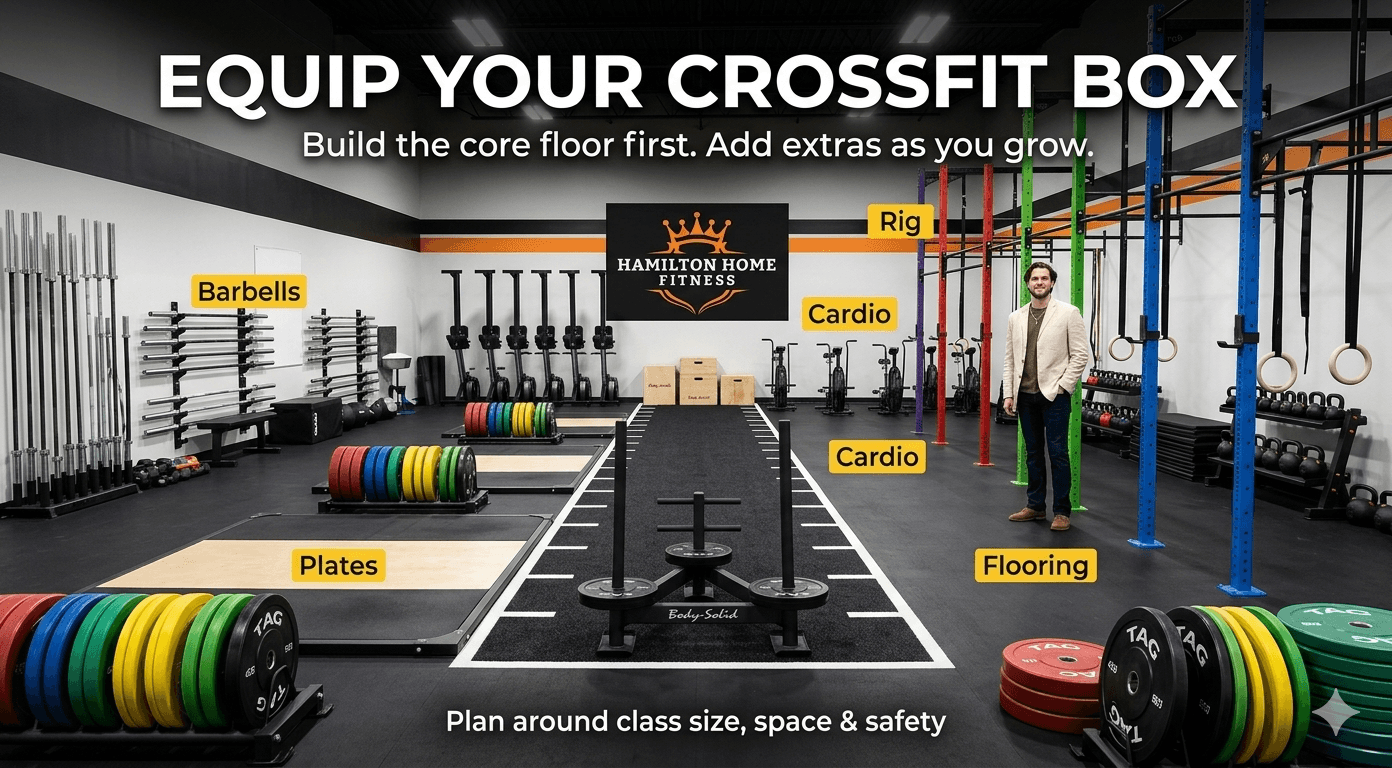
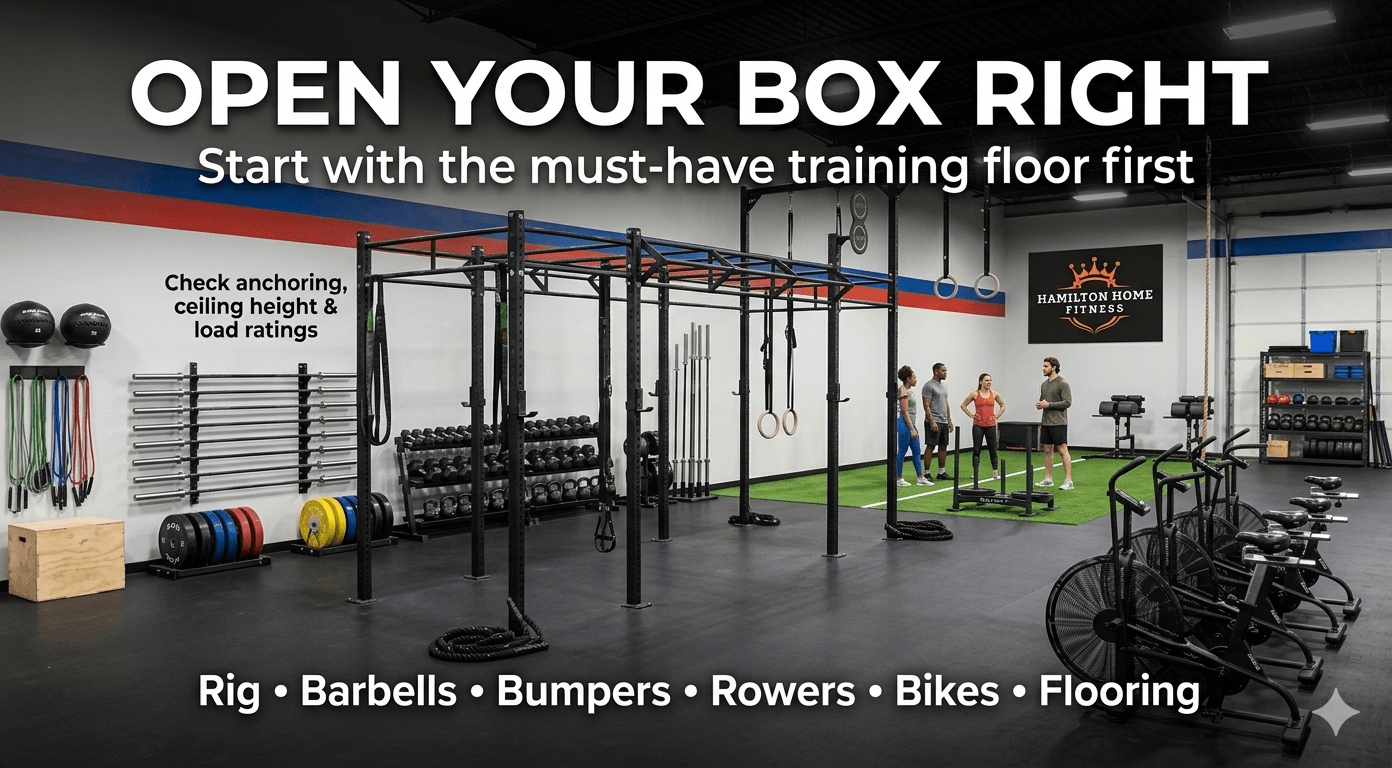
A working box needs a pull-up-capable rig, men's and women's barbells, full bumper plate sets, a dumbbell range, a kettlebell ladder, rowers, air bikes, wall balls, plyo boxes, jump ropes, and rubber flooring. GHDs, reverse hypers, sleds, and rope climbs add real range, but they can phase in after the core floor is covered.
The split below is your buying order. Cover every must-have first; pull from the nice-to-haves once the essentials are in and the budget allows. Most of these sit in the cross-training gear category alongside plyo boxes, pull-up bars, and dip stations.
Must-have to run class on day one
Rig with multi-grip pull-up bars and room for kipping
Barbells — men's 20 kg and women's 15 kg
Bumper plate sets, color-coded, plus change and fractional plates
Dumbbells, roughly 10–70 lb in pairs
Kettlebells, an 8–32 kg ladder
Rowers and air bikes for conditioning
Wall balls (14 lb and 20 lb) and a few slam balls
Plyo boxes, soft or 3-in-1
Jump ropes, gymnastic rings, abmats, and a chalk station
Rubber flooring rated for dropped loads
Nice-to-have you phased in
Sleds and a turf strip
GHD and reverse hyper
Rope climb station—pairs naturally with the rig, using Pacific Fibre climbing ropes
Jerk blocks and dedicated lifting platforms
Parallettes, D-balls, and extra storage racks
One caveat before you buy: a rig and rope climb are safety-critical. Confirm anchoring, ceiling height, and load ratings, and have them installed professionally.
Equipment Counts by Class Size
Plan for roughly one barbell and one rig or platform spot per athlete at peak, then scale plates, dumbbells, and accessories so a full class can split into stations without waiting on gear. Treat these as planning recommendations, not CrossFit rules—adjust them to your programming and the "rule of three" rotation many boxes lean on.
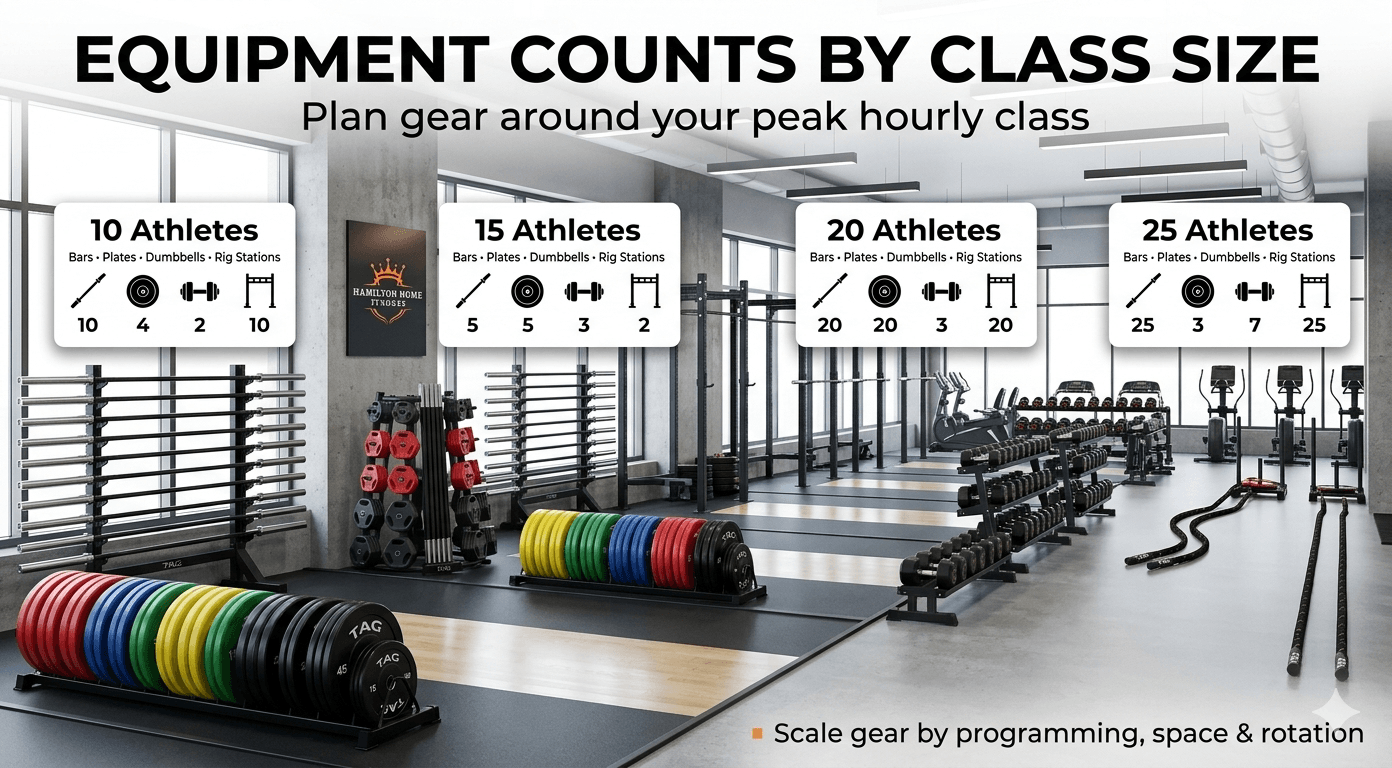
The table below sizes the core kit to your largest hourly class. Bars follow a roughly 60/40 men's-to-women's split; plates and dumbbells are stocked across a range, not in identical pairs.
Equipment (per peak class) | 10 | 15 | 20 | 25 |
Men's bars (20 kg) | 6 | 9 | 12 | 15 |
Women's bars (15 kg) | 4 | 6 | 8 | 10 |
Bumper plate sets | 2 | 3 | 3–4 | 4–5 |
Dumbbell pairs (across range) | 10–12 | 14–18 | 18–24 | 24–30 |
Rig pull-up stations | 6–8 | 8–12 | 10–14 | 12–16 |
Two adjustments to keep in mind: plate counts scale with the loads you actually program, so heavy-barbell cycles may need an extra set or two, and rotating a class into groups lets you trim rig stations if floor space or budget is tight.
Rig, Barbells & Bumper Plates
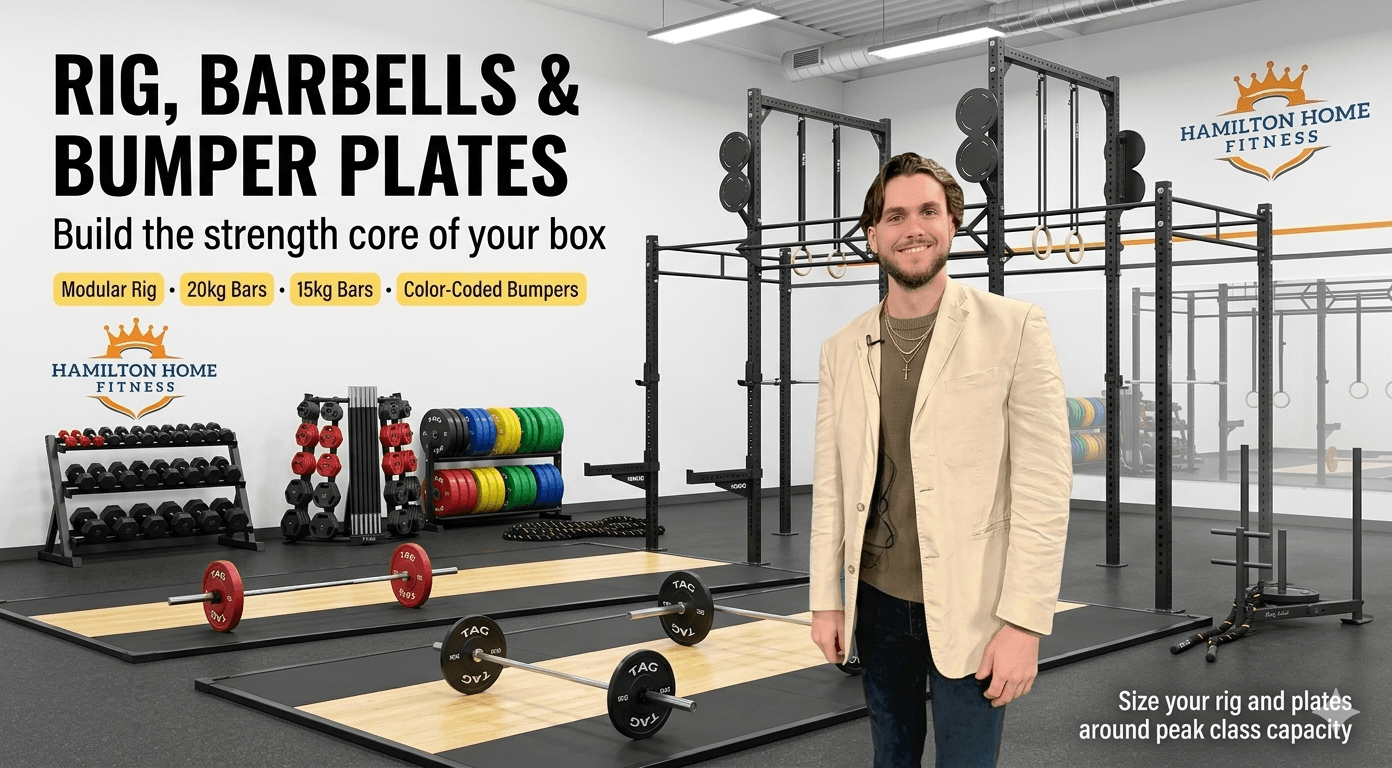
The strength core of your box comes down to three purchases: a modular rig sized to your biggest class, men's (20 kg) and women's (15 kg) bars in roughly a 60/40 split, and enough color-coded bumper sets that two or three barbell movements can run at once without anyone hunting for plates. These three lines also absorb most of your equipment budget, so size them deliberately.
Picking the right rig
Your rig is the spine of the box, so size it to your largest class and the movements you program. The post count sets your capacity: more uprights and bays mean more squat and pull-up stations running at the same time. A 4-post unit suits a class of 10, a 6-post fits around 15, and an 8-post or connected modular rig is what carries 20 to 25 athletes.
Rig setup | Squat/pull-up stations | Best for |
4-post | ~2–4 | Classes of 10 |
6-post | ~4–6 | Classes of 15 |
8-post+ connected | 8+ | Classes of 20–25 |
Beyond size, decide on type and attachments. Wall-mounted rigs save floor space; free-standing rigs move with you; and outdoor rigs open up a second training zone—and your ceiling height dictates whether rope climbs and high pull-up bars even fit. Add multi-grip and kipping bars, gymnastic rings, dip bars, and a peg board to match your menu. For affiliate-scale builds, Beaver Fit modular rigs are worth considering and are available by quote.
Men's & women's barbells
Stock men's 20 kg (28 mm) and women's 15 kg (25 mm) bars, plus a few training bars for on-ramp athletes. Use the roughly 60/40 split from the counts above, so a mixed class never waits on a bar. The spec difference matters: the thinner A 25 mm women's shaft is built for smaller hands, and a hook-grip-friendly knurl with reliable sleeve spin makes Olympic lifts cleaner for everyone.
You don't need competition bars to open. A solid affiliate-grade Olympic barbell handles daily metcons and lifting cycles, and lighter multi-purpose or technique bars let newer athletes drill movement before they load up.
Bumper plate sets
Plan two to four bumper sets per class in color-coded 230/260/300 lb configurations, plus change and fractional plates. Picture a 20-athlete metcon with barbells loaded around 95–135 lb: a dozen bars are pulled from your plate stock at once, and without enough sets, someone is stripping a neighbor's bar mid-round.
Color-coding speeds loading and resets between heats, change plates let athletes make small jumps, and fractional plates matter for anyone chasing a lift PR. Match plate volume to the loads you actually program—heavy barbell cycles may justify an extra set. Buy bumper plate sets rated for repeated drops, since this is gear that takes daily abuse.
Dumbbells, Kettlebells & Balls
Stock dumbbells from 10 to 70 lb in pairs, a kettlebell ladder from 8 to 32 kg, and balls to match common WODs—14 lb and 20 lb wall balls plus a few slam balls. These implements carry the bulk of metcon volume, so the rule is the same as bars and plates: buy enough that a class isn't fighting over one weight.
Dumbbell range to stock
A 10–70 lb dumbbell range in pairs covers most CrossFit programming; extend to 100 lb for hybrid strength work. Stock in 5 lb increments through the middle of the range, where most reps live, and thin out the heaviest pairs. Rubber hex dumbbells handle daily drops and cost less, while urethane heads survive abuse and look cleaner on a commercial floor. Add a storage rack so the set stays organized between classes—browse the commercial dumbbell range to match increments to your budget.
Essential kettlebell ladder
Stock an 8–32 kg ladder—heavier on 16/20/24 kg—to cover swings, snatches, and Turkish get-ups across abilities. Treat the counts below as a planning guide for a class of around 20, scaling down for 10 and up for 25.
Kettlebell | Typical use | Stock (~20 athletes) |
8 kg | Scaling, technique | 3–4 |
12 kg | Lighter scaling, accessory | 4–5 |
16 kg | Women's Rx swings/snatches | 5–6 |
20 kg | Mixed Rx | 5–6 |
24 kg | Men's Rx swings/snatches | 5–6 |
28 kg | Heavier work | 3–4 |
32 kg | Heavy carries, get-ups | 2–3 |
Cast-iron kettlebells are the durable, budget-friendly default; competition kettlebells hold a uniform size across weights, which helps athletes who train cleans and snatches at volume. Cover the workhorse middle first—see the kettlebells' range—and add the extremes as your roster grows.
Conditioning & Class Flow
For 15 to 20 athletes, plan around 8–12 rowers, 6–10 air bikes, and 4–6 ski ergs, scaling down for 10 and up for 25; then add sleds, plyo boxes, and balls to round out metcons. These are planning recommendations, not CrossFit rules, but get the ratios wrong, and athletes stand idle waiting for a machine mid-workout. Match your commercial cardio equipment to your largest class, and store it vertically to reclaim floor space.
Rowers, bikes & ski ergs
Concept2 rowers, air bikes, and ski ergs are the conditioning backbone of most boxes—plan one machine per two to three athletes at peak. Mix the modalities so a single piece never becomes the bottleneck, and stagger heats when your class outnumbers your machines.
Cardio (per peak class) | 10 | 15 | 20 | 25 |
Rowers | 6–8 | 8–10 | 10–12 | 12–15 |
Air bikes | 4–6 | 6–8 | 8–10 | 10–12 |
Ski ergs | 2–4 | 4–5 | 4–6 | 6–8 |
Rowers do the most programming work, so weight your spend there first; air bikes carry sprint intervals and "buy-in" calories; ski ergs round out the menu and mount on a wall to save space. Concept2 rowers are the common standard for durability and consistent splits, though they aren't required — air bikes, magnetic rowers, and curved treadmills all have a place.
Sleds, boxes & accessories
Round out the floor with a sled, soft and 3-in-1 plyo boxes, jump ropes, and a chalk station. Picture a chipper: 20 wall-ball shots, 15 box jumps, a 50-foot sled push, then double-unders. Every station in that workout needs gear stocked deep enough for a full class to rotate through without a traffic jam.
A sled and turf strip turn one lane into pushes, drags, and bear crawls; soft plyo boxes lower the injury risk on jumps, while 3-in-1 boxes give three heights from one unit; and speed ropes, ab mats, and a shared chalk bowl finish the essentials. Workout sleds and turf are also where a center lane earns its footprint. GHDs and reverse hypers extend your accessory work, but they can wait until the core conditioning floor is covered.
Space, Layout & Floor Plan
Most affiliates run well in 3,000–5,000 sq ft, planning roughly 100–150 sq ft of usable floor per athlete at peak. Build in clear ceilings — at least 12 feet, ideally 14 or more — so rope climbs, wall balls, and overhead lifts have room. What matters more than total square footage is how you divide it.
Think in zones, not a single open box:
Lifting zone: rig, platforms, bars, and plate storage along a wall, so dropped loads stay contained and athletes aren't lifting in traffic.
Conditioning zone: rowers, bikes, and ski ergs stored against the wall, opening into a clear floor for the metcon.
Center lane: a turf strip down the middle for sled pushes, drags, and carries.
Mobility and warm-up: a quieter corner for rollers, bands, and coaching the on-ramp.
The decision rule is to under-furnish on purpose. Leave open floor for movement, keep walkways clear between stations, and resist filling every gap with equipment—a class of 20 needs room to spread out, not more machines crammed in. Build in a 10–25% buffer beyond your current need so a growing roster and new gear don't force a move in year one. And measure your ceiling before you commit to a space; it quietly decides whether rope climbs and tall rigs fit at all.
Budget & Smart Sourcing
As of 2026, equipping a box commonly runs roughly $25,000–$45,000 used to $40,000–$90,000 or more new—separate from CrossFit's affiliate costs. Per CrossFit's published Open a Gym information, expect a one-time application fee around $1,000 and an annual affiliate fee in the range of about $2,500–$4,500 depending on location, billed monthly. Those are program fees for branding and support, not equipment, so keep them in a separate line from your buildout.
The sourcing strategy matters as much as the total. Spend where wear and safety count, save where they don't, and phase in the extras once classes are running.
What a full buildout costs
A 20-athlete box typically needs a mid-five-figure equipment budget in 2026, with the rig, bars, plates, and cardio as the biggest line items. The ranges below are dated planning bands, not quotes—prices and freight shift, and high-ticket items like rigs and machines often ship by freight or white-glove delivery, which adds cost and lead time.
Category | New (approx.) | Used / phased (approx.) |
Rig + storage | $6,000–$15,000+ | $3,000–$8,000 |
Bars + bumper sets | $6,000–$14,000 | $3,500–$8,000 |
Dumbbells + kettlebells | $4,000–$9,000 | $2,500–$5,500 |
Cardio (rowers, bikes, skis) | $12,000–$30,000+ | $7,000–$15,000 |
Boxes, balls, sleds, accessories | $3,000–$8,000 | $1,500–$4,000 |
One real lever: free shipping on eligible STEPR, Spirit Fitness, TAG Fitness, Body-Solid, and Vortex lines can trim freight on a large order. For a scaled, multi-brand quote across the floor, the commercial gym equipment catalog is the place to start, and add a 10% contingency for delivery delays and surprises.
New, used or phased
Buy new where safety and wear matter—rig, bars, and cardio—and consider used or phased purchases for plates, boxes, and storage. Plates, sleds, and racks are nearly indestructible, so lightly used commercial finds carry little risk; rigs and machines, by contrast, are where condition and warranty earn their cost.
Phasing protects opening cash flow. Open with the must-have floor, then add a GHD, reverse hyper, jerk blocks, or extra cardio as revenue stabilizes. Closing affiliates and resellers are a steady source of used commercial equipment, and lead time often matters more than the gear itself—order the long-freight items first so a delayed rig doesn't push your opening date.
FAQ
Are Concept2 rowers required at CrossFit affiliates?
No. CrossFit doesn't require any brand. Concept2 rowers are the de-facto standard because they're durable and widely used in testing, but alternatives like APE assault runners and air bikes are common and fully workable for daily programming.
Does CrossFit set an equipment requirement for affiliates?
No official equipment list exists. Affiliation requires the owner's Level 1 certificate plus the affiliate fees and adherence to CrossFit's standards—but the gear, brands, and layout are entirely your call.
Do I need a GHD or reverse hyper to open?
No. Both are valuable accessory pieces, but they're nice-to-haves you can phase in after the rig, bars, plates, dumbbells, kettlebells, and cardio are covered.
How long does it take to equip and open a box?
Plan several weeks to a few months once you've ordered. Freight and white-glove delivery on rigs and cardio drive the timeline more than choosing the gear, so order the long-lead items first.
Final Thought
You now have what most buildout guides skip: an equipment list scaled to your real class size, dated 2026 numbers, and a sourcing plan that spends where it counts and saves where it doesn't. Buy in that order—core floor first, extras as revenue grows—and you open with a box that flows instead of one that drains your opening budget.
The fastest way to turn this into a real floor plan and a multi-brand quote is to book a gym design consultation—bring your space and class size and walk away with a buildout matched to both.