Introduction
Most gym spaces share a common problem: too many machines doing one job each and never enough floor space left over. A commercial functional trainer solves this differently—two independently adjustable cable columns, resistance from any angle, and full-body training capability within a footprint most single-stack machines cannot match.
One machine covers lat pulldowns, cable rows, chest flies, triceps pressdowns, bicep curls, face pulls, core rotations, and hip exercises. That range makes it useful across commercial gyms, hotel fitness rooms, apartment amenity spaces, personal training studios, rehab clinics, and home gyms — without requiring a dedicated cable zone for every movement pattern.
This guide covers the main machine formats, the specs that affect training feel and facility fit, how to match a functional trainer to your specific space and user base, and how it compares to a cable crossover station. By the end, you will have a clear framework for choosing the right machine before you buy.
If you are planning a larger facility and need to evaluate your full equipment mix, the Commercial Gym Equipment Buying Guide is a useful starting point for the broader planning process.
What Is a Commercial Functional Trainer?
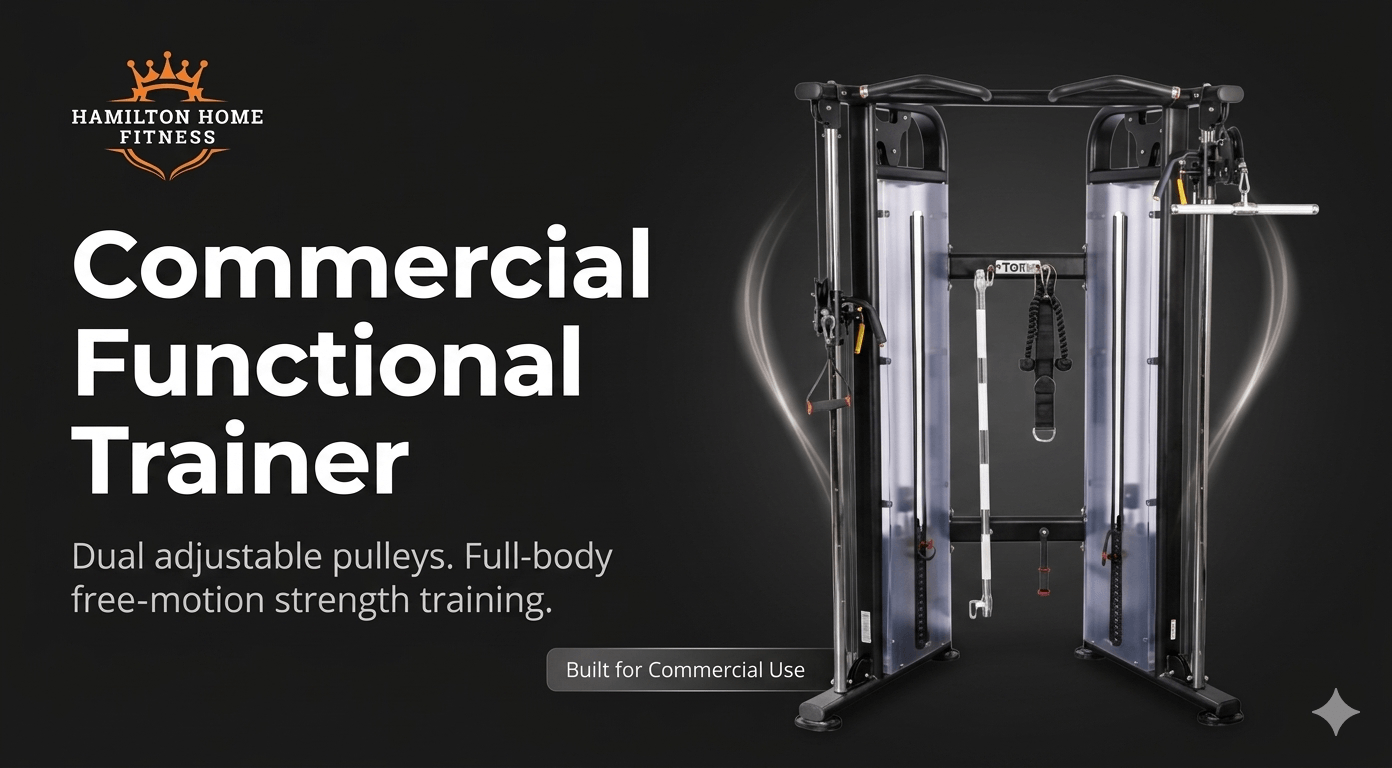
A commercial functional trainer is a dual-cable strength machine with two independently height-adjustable pulley arms built into a single steel frame. Each arm can be set at a different height — from floor level to overhead — and repositioned between sets without changing machines. That combination of independent adjustment and full-height range is what separates a functional trainer from other cable machines.
The word "functional" refers to the type of movement it supports. Instead of locking the body into a fixed path like most selectorized machines, a functional trainer allows free-motion resistance at any angle. That means users can train in the same movement patterns the body uses in real activity — pushing, pulling, rotating, hinging, and stabilizing — rather than isolating a single joint on a single plane.
For commercial environments specifically, the machine needs to handle repeated daily use across a wide range of users, fitness levels, and training goals. A commercial-rated functional trainer is built to meet that demand: a heavier-gauge steel frame, commercial-grade cables, enclosed or shrouded weight stacks, and a warranty structure designed for shared-use facilities rather than residential ones.
Dual Adjustable Pulley Explained
A dual adjustable pulley (DAP) system is the defining feature of a functional trainer. It consists of two cable arms—one on each side of the frame—each mounted on a vertical track with multiple height positions, typically 15 to 20 stops per side. Each arm moves independently, so the left and right sides can be set at completely different heights at the same time.
Most quality commercial models also include 360-degree swiveling pulleys at the attachment point. This swivel allows the cable to track naturally with the user's movement rather than pulling at an angle, which improves resistance feel and reduces stress on the cable and carabiner over time.
The practical result is a machine that supports unilateral training, bilateral training, and rotational training from a single setup. Setting the left arm at hip height and the right arm at shoulder height, for example, enables a rotational pull—a wood chop, a Pallof press variation, or a sport-specific diagonal movement—that no fixed-pulley machine can replicate without repositioning entirely.
That range of motion is why functional trainers appear in personal training studios, rehab clinics, hotel fitness rooms, and serious home gyms alike. The machine adapts to the exercise rather than the other way around.
For buyers comparing functional trainers against other commercial strength formats, the Commercial Strength Machines The Selectorized & Plate-Loaded Guide covers how cable machines fit within the broader selectorized and plate-loaded equipment categories.
Cable Machine vs. Functional Trainer
These two terms are often used interchangeably, but they are not the same thing. A cable machine is any resistance machine that uses a pulley system and weighted cable to create a load. A functional trainer is a specific type of cable machine—one with dual, independently height-adjustable columns and full-range pulley positions.
All functional trainers are cable machines. Not all cable machines are functional trainers.
The distinction matters when buying for a commercial space because the category includes several formats that look similar but behave differently:
A single cable column — often called a lat pulldown machine or low-row station — has one fixed or limited-adjustment pulley. It handles a narrow range of exercises and is not a functional trainer.
A cable crossover station has two weighted columns and adjustable pulleys, but the columns are spaced wide apart, and the pulleys typically offer only two or three height positions per side—high, mid, and low. It handles more exercises than a single column but lacks the full-height continuous adjustment of a true functional trainer.
A functional trainer has two independently adjustable cable arms with 15 or more height positions per side, typically on a compact frame, with a weight stack or plate-loaded system on each column.
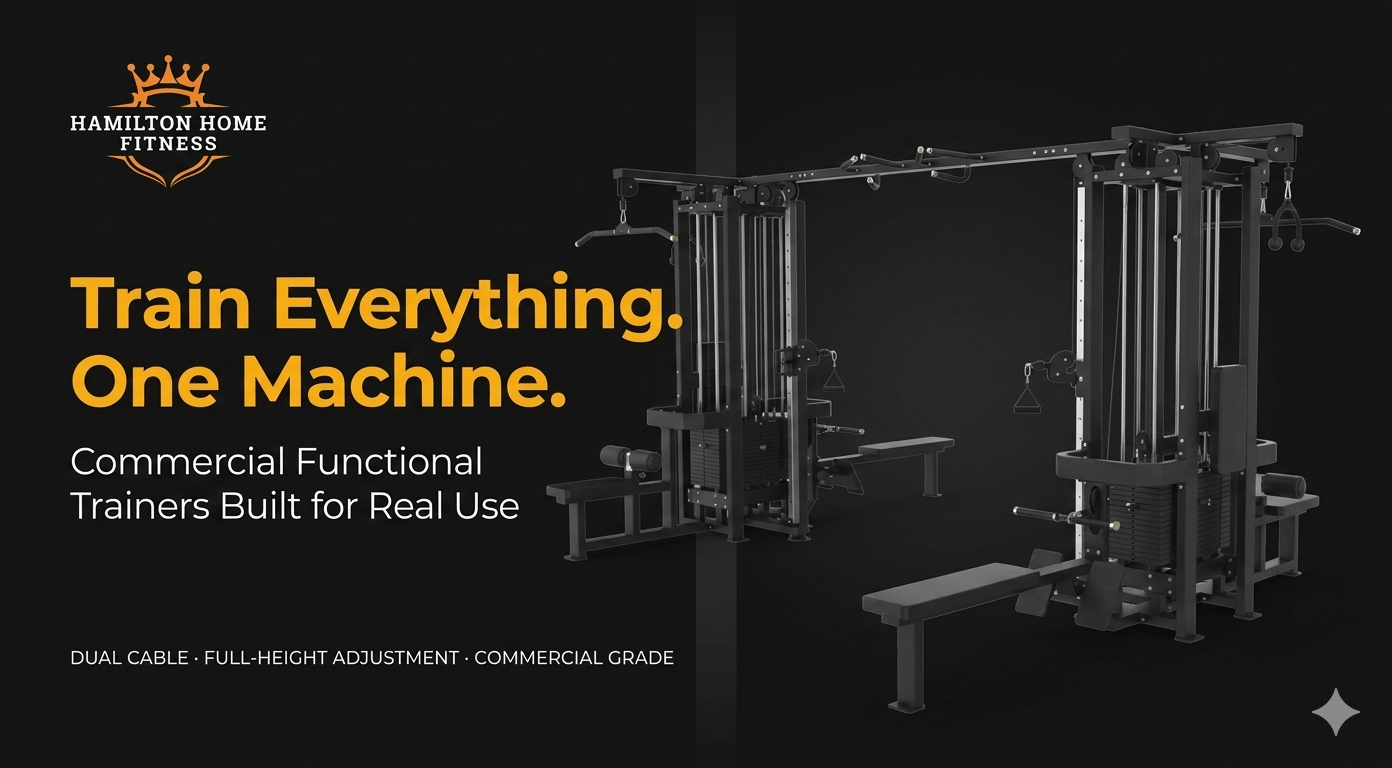
A multi-station cable machine combines two or more cable columns with additional integrated features—pull-up bars, landmine attachments, or even a Smith machine—into a larger frame designed for higher-volume or multi-user environments.
Understanding which format you are evaluating makes it easier to compare machines accurately and avoid buying a single-column cable station when a full dual adjustable pulley system is what the facility actually needs.
Types of Cable Machines for Gyms
Commercial cable machines come in four main formats: full dual cable columns, compact functional trainers, wall-mounted units, and multi-station cable systems. The right format depends on three things—floor space, daily user volume, and how the machine fits into the broader equipment layout of the facility.
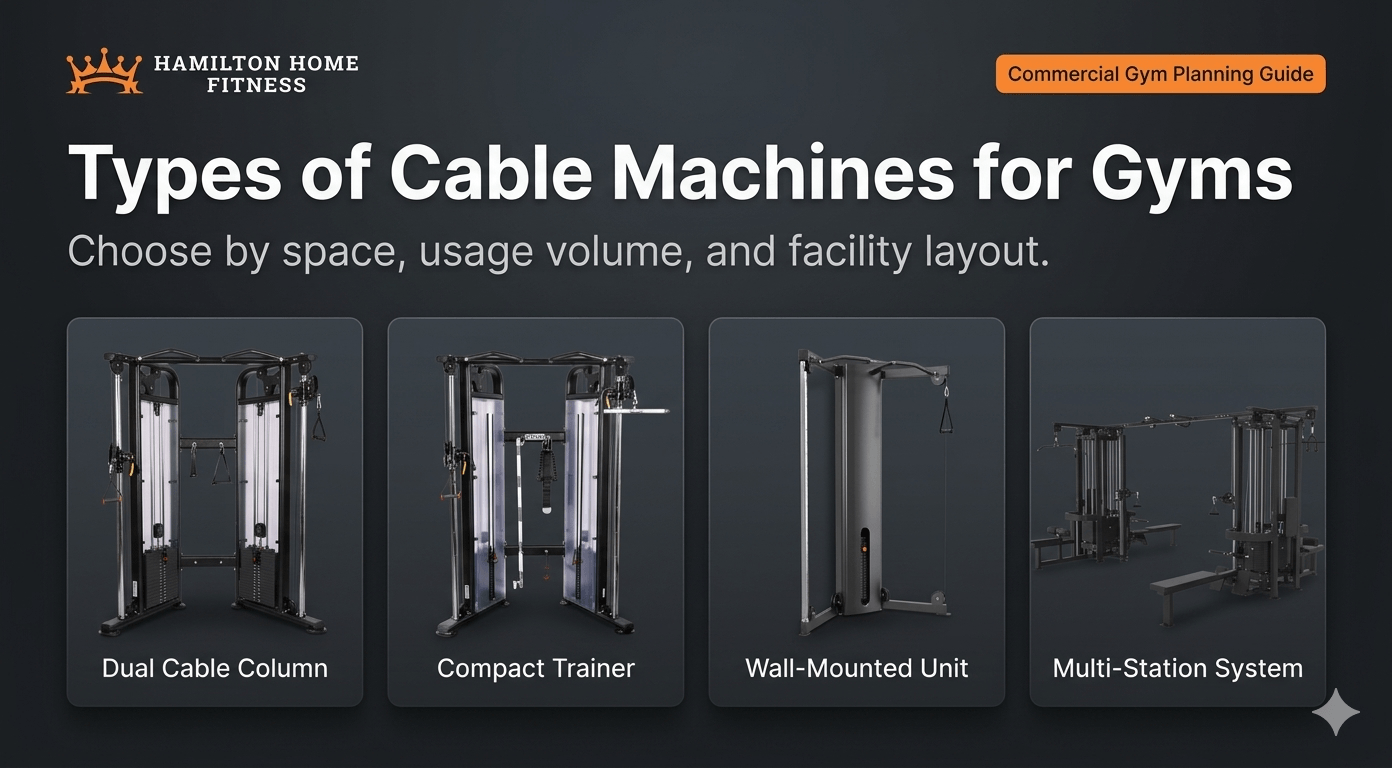
Choosing the wrong format is one of the most common and costly mistakes in commercial gym planning. A machine that is too large leaves no usable training space around it. A machine that is too light for the facility's daily usage volume wears out faster and frustrates experienced users. Matching the format to the facility first makes every other buying decision easier.
Full Commercial Dual Cable Column
A full commercial dual cable column is the standard format found in most dedicated training facilities, fitness studios, and well-equipped commercial gyms. It stands 82 to 90 inches tall and typically carries a frame footprint of roughly 64 inches wide by 44 inches deep. Each column houses an independent weight stack—usually 150 to 200 lbs per side—with 15 to 20 height positions per arm and commercial-grade shrouded weight stacks built to withstand high daily usage.
This format offers the broadest exercise range, the highest stack capacities, and the most durable build specifications of any standalone functional trainer. It is designed for facilities where the machine will see consistent use throughout the day across a range of users — from beginners working at low resistance up to advanced clients and athletes using near-maximum loads.
Ceiling height is an important pre-purchase check. Most full commercial models require a minimum of 84 to 90 inches of ceiling clearance, and taller models need more. The active training space—the clearance required around the machine for safe cable travel and full movement range—should be at least 36 inches on all sides where users will be positioned.
This is the right format for personal training studios, boutique fitness facilities, full commercial gyms, and any space where the cable machine will serve as a primary training station rather than a supplementary one. Facilities planning a broader commercial equipment setup can use the commercial gym equipment for facilities & gyms as a resource to evaluate how a full cable column fits alongside other strength and cardio equipment categories.
Compact and Wall-Mounted Trainers
Compact freestanding and wall-mounted functional trainers are designed for spaces where floor area is limited but training versatility still matters. A compact freestanding model typically measures under 50 inches wide and carries lighter stack options—often 100 to 160 lbs per side—while maintaining independent height adjustment and full cable functionality on a smaller frame.
Wall-mounted functional trainers take this further. They extend only 8 to 12 inches from the wall when not in use and require no significant floor footprint beyond the immediate training zone. The trade-off is installation: wall-mounted units must be anchored into structural wall studs or a reinforced mounting surface. A standard drywall surface is not sufficient. This is a firm requirement that facilities need to verify before ordering.
Both compact and wall-mounted formats are well-suited for hotel fitness rooms, apartment amenity gyms, corporate wellness spaces, and smaller boutique studios where a full commercial dual-column machine is not proportionate to the room size or user volume. They are also a practical option for home gyms with low ceiling clearance, where a full 90-inch-tall column would not fit safely.
The key limitation to communicating honestly: compact models with smaller stacks may not satisfy advanced lifters or high-volume performance programming. For facilities serving a broad fitness population that includes experienced athletes, the full commercial format is usually the more appropriate long-term investment.
Hamilton Home Fitness ships commercial fitness equipment nationwide from its Tennessee base. Buyers across the United States can explore compact and full commercial cable machine options, request layout guidance, and get quote support through the commercial gym equipment supplier in Tennessee page.
Multi-Station Cable Machines
A multi-station cable machine combines two or more cable columns with additional integrated features—pull-up bars, landmine attachments, low-row stations, or, in some configurations, a Smith machine—into a single larger frame. These systems range from dual cable crossover stations with fixed high and low pulley positions to full jungle gym setups with five or more cable attachment points.
The primary advantage is user throughput. A multi-station system allows two or more users to train simultaneously on different cable angles without competing for the same machine. For a high-traffic commercial gym floor during peak hours, that capacity difference is meaningful.
The primary trade-off is footprint and cost. A multi-station cable system typically requires significantly more floor space than a standalone functional trainer — often 100 square feet or more when active training clearance is included on all sides. Installation is more involved, and the cost is proportionally higher.
This format is best suited for full-scale commercial gyms with a dedicated strength zone, athletic performance facilities with high daily user volume, and any space where multiple trainers are running simultaneous sessions. It is generally not the right choice for hotel gyms, apartment fitness rooms, or boutique studios where a compact or full-format standalone trainer handles the space and usage requirements more efficiently.
For facilities considering a multi-station setup that incorporates barbell training, squatting, or pressing alongside cable work, combining a dual cable column with a separate power rack is often a more flexible and cost-effective approach than a single all-in-one system. The Commercial Power Racks & Squat Cages: The Gym Buyer's Guide covers that equipment category in detail.
Specs That Determine the Right Machine
The four specs that matter most for a commercial cable machine are weight stack size, cable ratio, pulley height positions, and machine footprint. Each one affects training feel, exercise range, and facility fit in a different way—and getting any one of them wrong creates problems that are difficult to fix after the machine is installed.
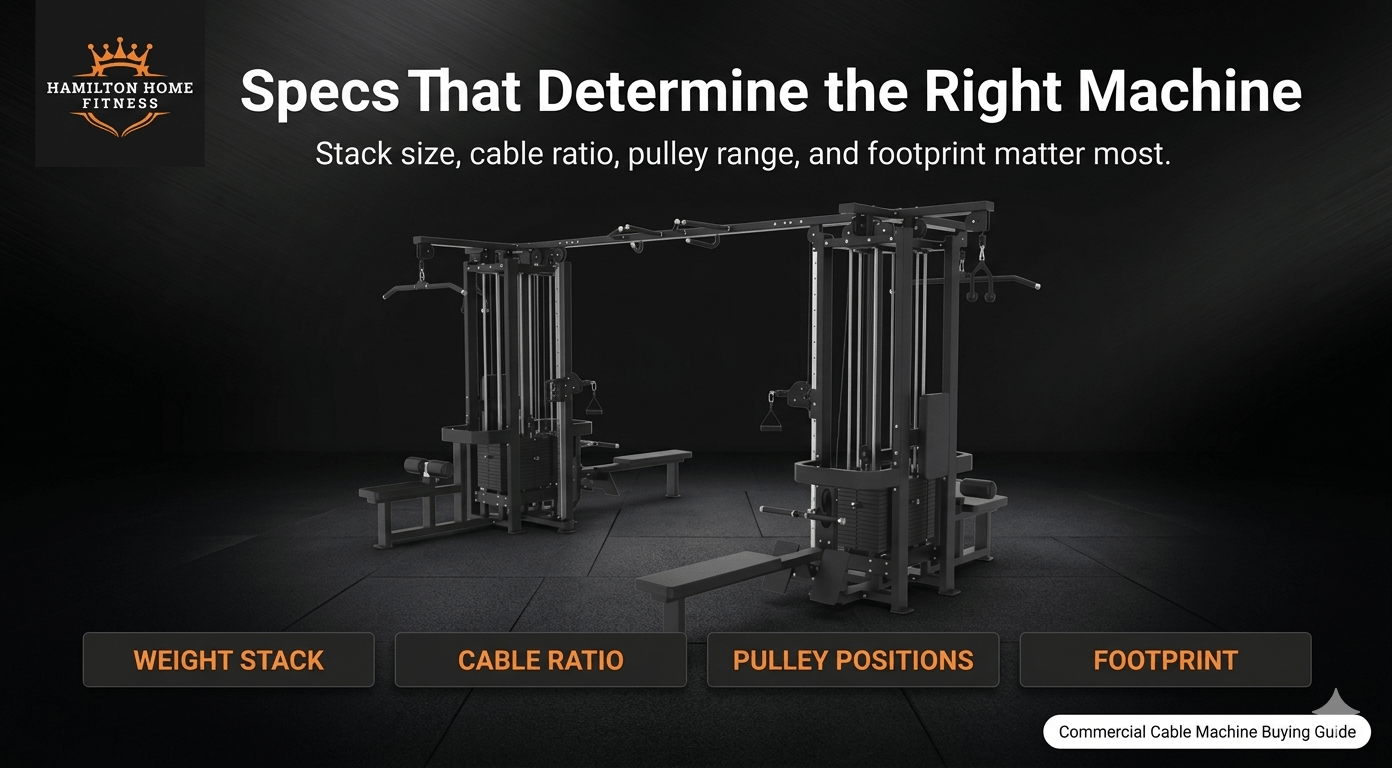
Most buying mistakes in this category come from focusing on a single number — usually the weight stack — without understanding how that number interacts with the cable ratio. Understanding all four specs together makes it much easier to compare machines accurately and choose the right fit for the facility and the users it serves.
Weight Stack Size and Increments
For most commercial functional trainers, dual stacks of 150 to 200 lbs per side provide enough resistance range to serve the majority of user populations—from rehab clients and beginners working at 10 to 20 lbs effective resistance up to advanced lifters using 80 to 100 lbs or more, depending on the cable ratio of the machine.
Weight stack increment size matters just as much as the total stack weight, particularly in facilities that serve a wide range of fitness levels. A machine with 10-lb increments between stops is standard for most commercial models and works well for strength-focused training. Facilities serving rehab clients, seniors, or beginner populations benefit from machines with 5-lb increments, which allow more gradual resistance progression and reduce the jump between settings that less experienced users often find difficult to manage.
Stack capacities also differ by facility type:
Rehab clinics and senior fitness spaces—100 to 150 lbs per side is typically sufficient; small increments matter more than maximum weight
Hotel, apartment, and corporate gyms—150 to 175 lbs per side covers most guest and resident populations comfortably
Personal training studios and boutique facilities—150 to 200 lbs per side handles general fitness clients and most performance programming
High-performance and athletic training facilities—200 lbs or more per side may be warranted when the user base regularly trains at maximum loads
One important point: the weight shown on the stack selector is not always the weight the user is moving. That depends directly on the cable ratio, which is covered in the next section.
Cable Ratio: 1:1 vs. 2:1
The cable ratio is one of the most misunderstood specs in the functional trainer category, and it directly affects how the weight stack number should be interpreted.
A 1:1 cable ratio means the resistance the user feels equals the weight selected on the stack. Selecting 100 lbs delivers 100 lbs of working load at the handle. The feel is heavier, and cable travel — the distance the cable moves through a full range of motion — is shorter.
A 2:1 cable ratio means the effective resistance at the handle is approximately half the selected stack weight. Selecting 100 lbs on a 2:1 machine delivers roughly 50 lbs of working load. The feel is lighter per pound selected, but cable travel is nearly doubled—allowing longer, fuller movement ranges that benefit exercises like cable flies, wood chops, and full-extension pulls.
Neither ratio is objectively better. They represent different design priorities:
1:1 machines are a stronger fit when users regularly train at heavier loads and prefer a direct relationship between the number on the stack and the weight they are moving
2:1 machines are a stronger fit for full-range functional exercises, rehabilitation movement patterns, and facilities that need accessible resistance levels across a wide user range
The practical implication for buyers: if you are comparing two machines—one with a 150 lb stack on a 1:1 ratio and one with a 200 lb stack on a 2:1 ratio—the first machine delivers more maximum working load despite having a smaller stack number. Understanding the ratio before comparing stacks prevents a common and costly misread when evaluating competing products.
Footprint, Frame, and Build Quality
Space planning for a commercial functional trainer involves three separate measurements that are easy to confuse: the machine footprint, the active training zone, and the ceiling clearance requirement.
The machine footprint is the floor space the frame itself occupies—typically 64 inches wide by 44 inches deep for a full commercial dual cable column. Compact models run narrower, often under 50 inches wide, with a shallower depth.
The active training zone is the additional clear space needed around the machine for safe cable travel and full movement range. A minimum of 36 inches of clearance on all sides where users will be positioned is the practical baseline. This is not negotiable from a safety standpoint—users performing cable flies, lunges, rotational movements, or full-extension pulls need that clearance to move without contacting walls, other equipment, or other users.
The ceiling clearance requirement for most full commercial models is 84 to 90 inches minimum. Some taller configurations require more. Compact models designed for lower-ceiling spaces are typically available in shorter frame heights—worth confirming before ordering for basement home gyms, older hotel fitness rooms, or any facility with a drop ceiling.
On frame construction, commercial-rated functional trainers should use a minimum of 11-gauge steel on the main structural frame. Lighter-gauge steel—14-gauge or above—is common in residential-grade machines and is not appropriate for shared commercial use. A wide, bolt-down-capable base improves stability during heavy lateral cable pulls, which place asymmetric loads on the frame.
Cables are wear items on any cable machine. Commercial-grade cables are typically coated steel with a service life of several years under normal use. Regular visual inspection for fraying, kinking, or sheath wear is the most important maintenance habit. Replacement cables for commercial models should be available directly from the supplier—this is worth confirming at the point of purchase.
Before ordering, use this checklist against your actual space:
Machine footprint fits within the planned equipment zone
36 inches of active clearance available on all user-facing sides
Ceiling height meets or exceeds the model's minimum requirement
The wall behind or beside the machine is clear of obstructions for cable travel
The floor is rated for the machine's installed weight
Bolt-down or floor anchor option available if needed for the frame
Once the spec evaluation is complete and the format decision is made, the next step is browsing the available options. Shop quality fitness gear and equipment at Hamilton Home Fitness to compare commercial functional trainers by footprint, stack size, and facility type.
Which Facilities Benefit Most
A commercial functional trainer is useful across more facility types than almost any other single piece of strength equipment. But the right model, stack size, and footprint vary significantly depending on who uses the space, how often, and what kind of training they need.
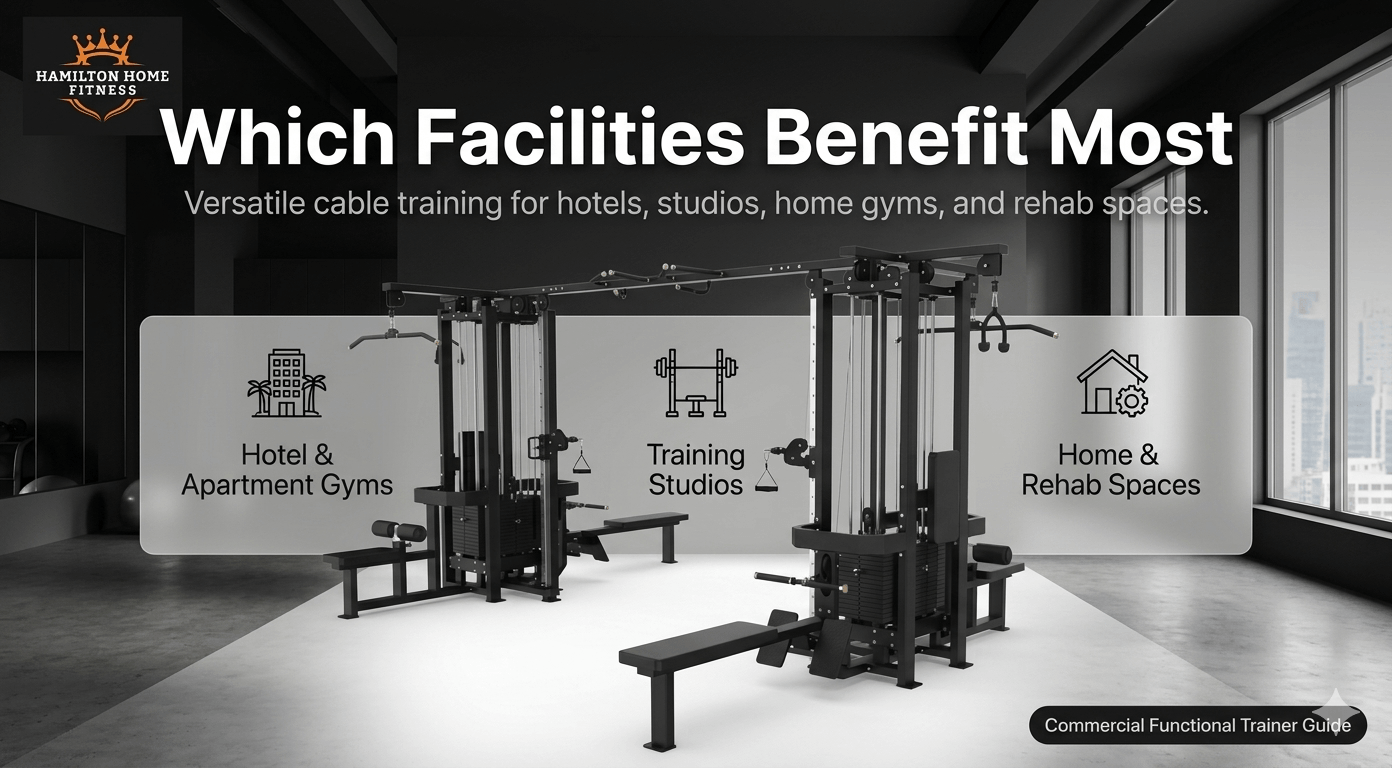
The three facility categories below cover the most common buyer situations in this market. Each one has different space constraints, user populations, and programming demands — and each points toward a different machine specification range.
Hotel, Apartment, and Corporate Gyms
Space-constrained commercial facilities — hotel fitness rooms, apartment amenity gyms, and corporate wellness spaces — share a common challenge: they need to serve a wide range of users with limited floor area and, in most cases, no on-site fitness staff to guide machine use.
A compact functional trainer with dual 150- to 175-lb stacks, 15 or more height positions per side, and a frame footprint under 50 inches wide is the strongest fit for these environments. It delivers full-body training capability in a fraction of the floor space that a comparable multi-machine layout would require—freeing the rest of the room for cardio equipment and an open training area.
The ease-of-use factor matters specifically in uncoached spaces. A selectorized functional trainer with clearly labeled height positions and intuitive attachment points requires minimal orientation for a hotel guest or apartment resident who has never used the machine before. That reduces frustration, increases utilization, and makes the machine a genuine amenity rather than an underused floor anchor.
From a planning standpoint, the functional trainer typically works best when paired with a compact cardio selection and a dumbbell rack. That combination covers the full spectrum of what most hotel guests, apartment residents, and office employees need from a fitness space without overcrowding the floor. For cardio equipment that complements this setup, choose the best commercial cardio equipment; the commercial options are worth considering. Buyers outfitting a complete facility can also review commercial cardio equipment for fitness facilities for a deeper look at pairing strength and cardio in commercial spaces.
One practical note on maintenance: in facilities without a dedicated fitness manager, cable machines should be added to a routine inspection schedule. Monthly visual checks on cables, pulleys, and carabiner attachments — and a quarterly wipe-down of the frame and weight stack guides — extend machine life significantly and reduce the likelihood of service calls.
Training Studios and Performance Spaces
Personal training studios, boutique fitness facilities, and athletic performance centers have different demands than hospitality or residential gyms. The machine will be used under coached programming, often for multiple sessions per day, with users spanning a wide fitness range—from general health clients to competitive athletes.
For these environments, a full commercial dual-cable column with 150 to 200 lbs per side, a 2:1 cable ratio, and 15 to 20 height positions per arm is the appropriate specification baseline. The broader stack range, more precise height adjustment, and commercial-grade build quality support the kind of varied, high-frequency programming that personal trainers and performance coaches rely on.
The exercise range available on a full commercial functional trainer maps directly to the needs of coached training. A trainer working through a single session might use the low pulley for cable Romanian deadlifts and hip abduction, the mid position for rows and Pallof press variations, and the high pulley for face pulls, lat pulldowns, and triceps pressdowns—all without changing machines or adjusting a single weight plate. That efficiency matters in a studio where time between exercises affects session quality and client experience.
For performance-focused spaces that incorporate conditioning work, sled training, or CrossFit-style programming alongside cable training, the CrossFit Gym Equipment Guide outlines the broader equipment considerations for functional training environments.
Attachment compatibility is worth evaluating carefully in studio environments. A machine used for coached programming should accept a full range of standard attachments—rope handle, ankle strap, D-handle, short bar, long bar, and single grip—without adapter hardware. Confirm attachment compatibility at the point of purchase, particularly if the facility plans to expand its attachment library over time.
Home Gyms and Rehab Spaces
Home gym buyers and rehabilitation-focused facilities share a common requirement that differs from most commercial environments: controlled, low-impact resistance at precise, accessible load increments.
For home gym setups, a compact functional trainer with a 2:1 cable ratio and 5-lb weight increments covers most training needs within a practical footprint. The 2:1 ratio keeps effective resistance accessible across the full stack range — useful for a home gym user training alone without a spotter — while the compact frame fits a garage, basement, or dedicated room without dominating the space.
For rehabilitation clinics, physical therapy practices, and senior fitness spaces, the cable machine's mechanical properties make it one of the most appropriate strength tools available. The cable system provides constant tension throughout the full range of motion, including the often-neglected eccentric phase. Resistance is controlled, the movement path is guided without being fully fixed, and the user can release the handle safely without injury risk if a movement becomes uncomfortable—an important consideration for post-surgical or injury-recovering clients.
Specific movement patterns commonly used in rehabilitation — shoulder external rotation, hip abduction, terminal knee extension, seated cable row for postural correction, and low-load Pallof press for core stability — are all achievable on a functional trainer at load levels that most selectorized rehab machines also support. The height adjustability is particularly valuable here, as rehab exercises often require precise cable angles that a fixed-pulley machine cannot replicate.
A note of professional transparency: while a functional trainer is a useful tool in rehabilitation-supportive environments, exercise programming for injury recovery or post-surgical clients should always be designed and supervised by a qualified physical therapist or licensed medical professional. Equipment capability does not replace clinical judgment.
For facilities pairing cable training with free weights—which applies to most serious home gyms and many rehab spaces that also incorporate light resistance work—the Commercial Free Weights Buying Guide covers dumbbell and free weight selection for commercial and home gym environments.
Functional Trainer vs. Cable Crossover
Both machines use cable columns, weight stacks, and adjustable pulleys. Both build strength across the full body. But they are designed around different priorities — and choosing the wrong one for a facility's space and user base is a mistake that is expensive to reverse.
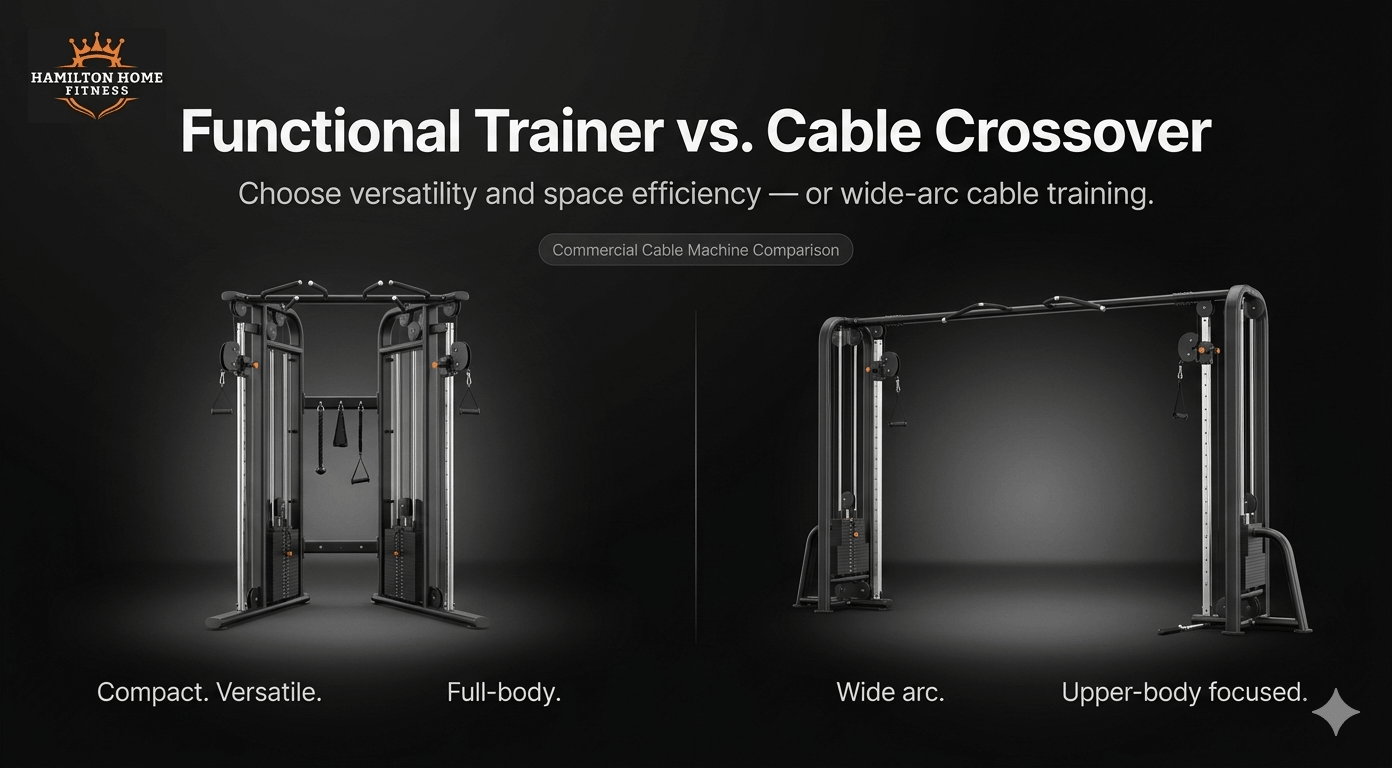
The core difference is this: a functional trainer is a generalist built for exercise variety and space efficiency. A cable crossover is a specialist built for wide-arc movements, particularly chest cable work, in facilities where floor space is not a constraint.
Spec | Functional Trainer | Cable Crossover |
Frame width | Typically 48–66 inches | Typically 82–118 inches |
Floor footprint | Compact — fits most rooms | Large—requires dedicated floor zone |
Height positions | 15–20 per side, continuously adjustable | 2–3 per side (high, mid, low) |
Exercise range | Full body — 100+ movements across all planes | Strong for upper body; limited for lower body and rotation |
Wide-arc chest fly | Possible but narrower arc | Superior — wide column spacing enables true full-arc fly |
Rotational training | Excellent—independent arm adjustment enables diagonal and rotational patterns | Limited by fixed column spacing |
Rehab and low-load use | Strong fit — fine-grain height adjustment and low increments | Limited—fewer height positions reduce angle precision |
Simultaneous users | Typically one user at a time | Two users can train independently at the same time |
Best facility fit | Hotel gym, apartment gym, studio, home gym, rehab space | Large commercial gym with a dedicated cable zone |
Typical stack range | 100–250 lbs per side | 150–300 lbs per side |
Cable ratio | Commonly 2:1 | Commonly 1:1 |
The exercise overlap between the two machines is significant. Most movements performed on a cable crossover can also be performed on a functional trainer. The reverse is less true — the rotational exercises, diagonal pull patterns, and rehab-specific cable angles that a functional trainer handles at any height are not replicable on a crossover with only three pulley positions.
The one area where a cable crossover has a genuine mechanical advantage is the wide-arc cable chest fly. The wide column spacing of a cable crossover creates a longer cable pull arc from a fully extended starting position—a feel that a narrower functional trainer frame cannot fully replicate. For bodybuilders and hypertrophy-focused lifters who prioritize chest development, that difference is real and worth acknowledging.
For most other facilities — hotel fitness rooms, apartment gyms, personal training studios, boutique spaces, rehab clinics, and home gyms — the functional trainer is the stronger choice. It offers more exercise variety, requires less floor space, provides finer height adjustment, and adapts to a wider user population without the cable crossover's footprint demands.
For large commercial gyms with an existing full equipment floor and a dedicated cable zone, both machines can coexist productively. In that context, the functional trainer handles general and multiplanar training while the cable crossover serves users who specifically prioritize chest cable work and bilateral upper-body isolation.
The decision rule is straightforward: if floor space is limited or the facility serves a mixed user population with varied training needs, choose the functional trainer. If the facility already has a full equipment layout, serves a high volume of bodybuilding-oriented members, and has the floor space to accommodate both, adding a cable crossover alongside a functional trainer expands the training range further.
Cable machine brand selection is a separate but related decision. For facilities comparing commercial cable equipment across major brands, the Spirit Fitness vs. Hoist vs. TAG Fitness Brand Comparison provides a side-by-side look at how leading commercial cable and strength brands differ in build quality, warranty structure, and facility fit.
How to Buy the Right Cable Machine
Buying the right commercial functional trainer comes down to five decisions: machine format, weight stack size, cable ratio, floor footprint, and support after delivery. Getting these five right before ordering avoids the most common buyer regrets—a machine that fits the room but leaves no usable training space, a stack that is too light for the facility's user base, or a compact model purchased for a high-volume studio that will wear out under the demand placed on it.
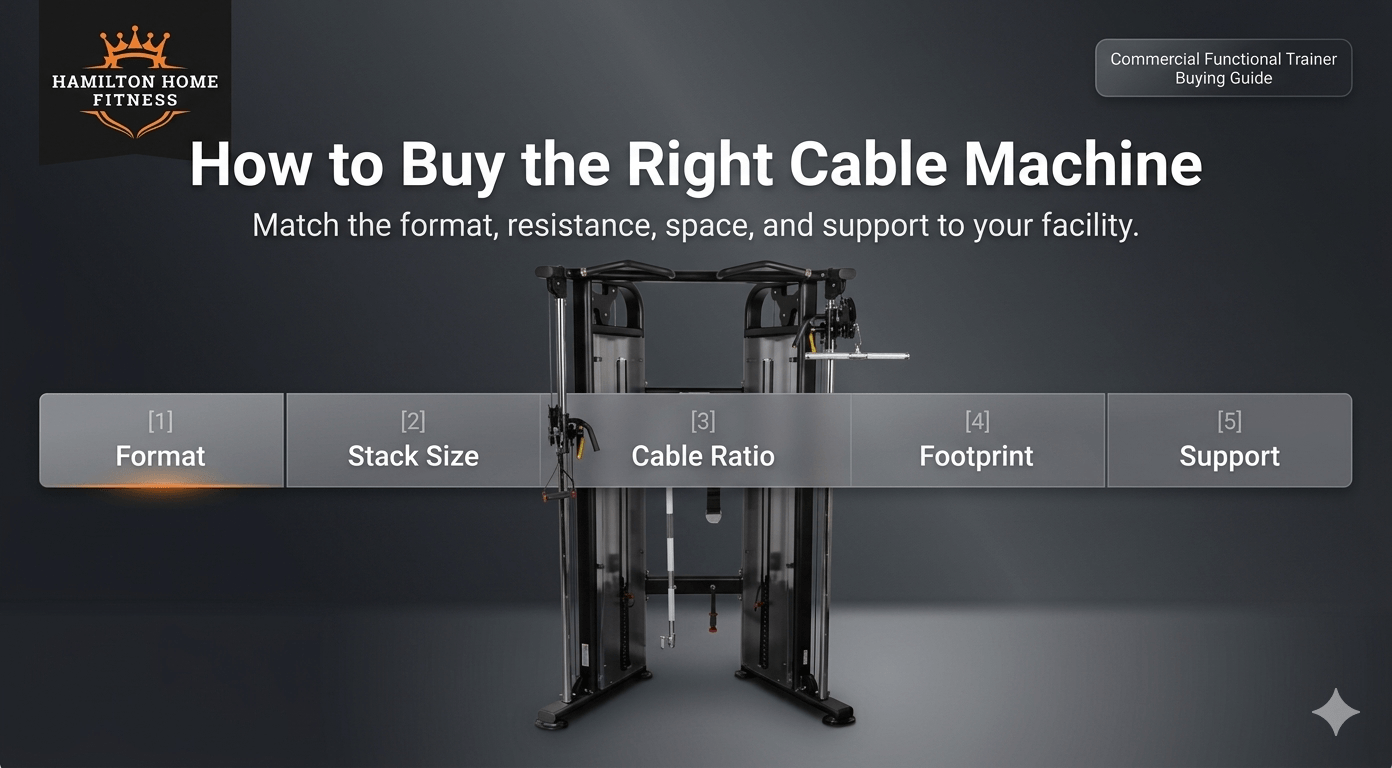
Work through these five decisions in order before comparing specific products:
1. Machine format — Identify which format fits the facility type and daily user volume. Compact or wall-mounted for hospitality and residential spaces. Full commercial dual cable column for studios, training facilities, and commercial gyms. Multi-station for high-traffic environments with a dedicated strength zone. The format decision limits the field significantly before any spec comparison begins.
2. Weight stack size—Match the stack capacity to the actual user population, not the theoretical maximum user. A hotel gym serving general fitness guests needs less stack than a performance studio serving competitive athletes. Factor in the cable ratio before finalizing the number.
3. Cable ratio — Confirm whether the machine uses a 1:1 or 2:1 ratio and adjust the stack size expectation accordingly. A 200 lb stack on a 2:1 machine delivers approximately 100 lbs of effective working resistance. Comparing stack numbers across machines with different ratios without accounting for this leads to inaccurate comparisons.
4. Floor footprint — Measure the available space against the machine's actual dimensions and the active training clearance requirement. Use the 36-inch minimum clearance rule on all user-facing sides. Confirm ceiling height against the model's minimum requirement before ordering.
5. Support after delivery — Confirm what is included beyond the machine itself. Assembly support, installation guidance for wall-mounted units, replacement cable availability, warranty coverage for commercial use, and access to service parts are all worth verifying at the point of purchase. A commercial machine that cannot be serviced locally or by the supplier is a liability in a shared-use facility.
Four objections buyers commonly raise—answered directly:
"The price is too high." Commercial functional trainers range from approximately $1,500 for entry-level compact models to $5,000–$8,000 or more for full commercial dual cable columns with large stacks, commercial-rated warranties, and heavy-gauge steel frames. That range is wide because the category spans machines built for residential use and machines built for daily shared commercial use — and those are genuinely different products.
The more useful comparison is not machine cost against budget in isolation, but machine cost against the alternative. A facility that would otherwise need a lat pulldown station, a low-row machine, a cable crossover, a triceps pressdown station, and a dedicated core rotation machine to cover the same exercise range would spend significantly more in total equipment cost, installation footprint, and ongoing maintenance across five separate machines. A single commercial functional trainer consolidates that into one purchase.
"Installation seems complicated." Most freestanding functional trainers require standard assembly—bolting the frame together, routing the cables, attaching the pulleys, and confirming cable tension. The process is straightforward for two people following the manufacturer's instructions and typically takes two to four hours for a full commercial model. Professional assembly services are available nationwide for buyers who prefer not to handle the process themselves.
Wall-mounted functional trainers are the exception. These require anchoring into structural wall studs or a reinforced mounting surface, and the installation should be performed by someone qualified to confirm wall load capacity. Attempting to mount a wall-mounted trainer into standard drywall without structural backing is a safety risk and will void most manufacturer warranties.
"How much maintenance does a cable machine actually need?" Less than most buyers expect, but not zero. Commercial-grade cables are coated steel and typically last several years under normal shared use before showing meaningful wear. The practical maintenance routine is straightforward: monthly visual inspection of cables for fraying, kinking, or sheath damage; monthly check of carabiner clips and pulley swivels for smooth rotation; quarterly wipe-down of the frame, weight stack guides, and selector pin housing; and annual inspection of cable tension and guide rod alignment.
Replacement cables for commercial models should be available directly from the supplier or manufacturer. Confirming parts availability before purchase is a reasonable step for any commercial facility—a machine that cannot be serviced is a machine that eventually goes out of service permanently.
"Will staff and members actually know how to use it?" The learning curve for a functional trainer is shorter than most new buyers anticipate. The adjustment mechanism — moving the pulley arm to the correct height and clipping in the appropriate attachment — takes most users under five minutes to understand the first time. Experienced gym users adapt immediately. Beginners and hotel guests benefit from a simple laminated exercise reference card mounted near the machine, which most commercial suppliers can provide or which can be produced inexpensively in-house.
For facilities with personal trainers on staff, a single 20 to 30-minute machine orientation covers the core exercises and attachment options thoroughly. For uncoached environments, a QR code linking to a short exercise
A demonstration removes the learning barrier entirely for most users.
When the five buying decisions are clear and the objections are addressed, the next step is straightforward. Choose the best commercial gym equipment at Hamilton Home Fitness to browse functional trainers and commercial cable machines by format, stack size, and facility type — or request a quote to get specific guidance for your space.
For buyers who are also planning a broader facility equipment mix beyond cable machines, the Commercial Gym Equipment Buying Guide covers the full category selection process across cardio, strength, free weights, and flooring.
FAQ
What is a functional trainer?
A functional trainer is a dual-cable strength machine with two independently height-adjustable pulley arms built into a single frame. Each arm can be set at a different height — from floor level to overhead — and repositioned between exercises without changing machines. This allows resistance from virtually any angle, supporting pushing, pulling, rotating, hinging, and stabilizing movements across the full body. Unlike fixed-path selectorized machines, a functional trainer allows free-motion resistance that adapts to the exercise rather than restricting the user to a single movement plane.
Is a functional trainer good for commercial gyms?
Yes. A commercial-rated functional trainer handles daily shared use across a wide range of users, fitness levels, and training goals from a single compact footprint. It covers full-body training — lat pulldowns, rows, cable flies, triceps pressdowns, curls, face pulls, core rotations, hip exercises, and more — without requiring a dedicated station for each movement. For commercial gyms that need to maximize exercise variety within a limited equipment floor, a functional trainer is one of the most efficient strength investments available.
How is a functional trainer different from a cable crossover?
The key differences are frame width, height adjustment range, and exercise versatility. A cable crossover has a wide frame—typically 82 to 118 inches across—with two or three fixed pulley positions per side. A functional trainer has a narrower, more compact frame with 15 to 20 continuously adjustable height positions per arm. The functional trainer offers more exercise variety, takes up less floor space, and adapts to a wider range of users. The cable crossover has a mechanical advantage for wide-arc chest cable flies, where its wider column spacing creates a fuller pull arc. For most facilities, the functional trainer is the more practical choice.
What weight stack size should a cable machine have?
For most commercial facilities, dual stacks of 150 to 200 lbs per side cover the majority of user populations comfortably. That range accommodates rehab clients and beginners working at low resistance up to advanced users training near maximum loads—depending on the machine's cable ratio. For rehabilitation clinics and senior fitness spaces, 100 to 150 lbs per side with 5 lb increments are typically sufficient. For performance-focused facilities serving competitive athletes, 200 lbs or more per side may be appropriate. Always factor in the cable ratio before comparing stack numbers across different machines—a 200 lb stack on a 2:1 machine delivers approximately 100 lbs of effective working resistance, not 200.
How much space does a functional trainer need?
A full commercial dual cable column typically requires a floor footprint of approximately 64 inches wide by 44 inches deep, a minimum ceiling height of 84 to 90 inches, and at least 36 inches of clear active training space on all user-facing sides. That clearance is not optional — users performing cable flies, lunges, rotational movements, and full-extension pulls need that space to move safely. Compact models run narrower, often under 50 inches wide, and some are available in shorter frame heights for spaces with lower ceilings. Measure the actual room against all three dimensions—footprint, ceiling height, and active clearance—before ordering.
Can a functional trainer work in a hotel gym?
Yes. A compact functional trainer with dual 150- to 175-lb stacks, 15 or more height positions per side, and a frame under 50 inches wide is well-suited for hotel fitness rooms. It delivers full-body training capability in a fraction of the floor space that a comparable multi-machine layout would require, leaving room for cardio equipment and an open training area. Selectorized models with clearly labeled height positions are intuitive for hotel guests who are using the machine without staff guidance. For wall-mounted options in particularly tight spaces, confirm structural wall requirements before installation.
Are functional trainers good for rehab exercises?
Yes. The cable system on a functional trainer provides constant tension through the full range of motion—including the eccentric phase—which is useful for controlled rehabilitation work. The fine-grain height adjustment allows precise cable angles for movements that fixed-pulley machines cannot replicate. Common rehab-supportive exercises include shoulder external rotation, hip abduction, terminal knee extension, seated cable rows for postural correction, and low-load Pallof presses for core stability. The user can also release the handle safely at any point without injury risk, which matters in post-surgical or injury-recovering populations.
One important note: exercise programming for injury recovery or post-surgical clients should always be designed and supervised by a qualified physical therapist or licensed medical professional. A functional trainer is a useful tool in rehabilitation-supportive environments—it is not a substitute for clinical guidance.
What attachments should I buy with a cable machine?
The most practical starting set for a commercial functional trainer covers the majority of exercises most users will perform:
D-handle (pair) — the standard attachment for single-arm and bilateral pulls, rows, curls, and presses
Rope attachment — triceps pressdowns, face pulls, hammer curls, and cable crunches
Ankle strap — hip abduction, hip extension, cable kickbacks, and lower-body rehab exercises
Short straight bar — biceps curls, triceps pressdowns, and upright rows
Long straight bar or EZ curl bar — lat pulldowns, cable rows, and curls with a bilateral grip
Triceps pressdown bar (V-bar) — focused triceps isolation with a neutral grip
For facilities serving coached programming or a wide client range, a single-grip handle, a revolving seated row triangle, and a multi-grip revolving curl bar extend the exercise library further. Confirm that all attachments are compatible with the machine's carabiner clip diameter before purchasing third-party accessories.
Is a functional trainer worth it?
For most space-limited facilities and home gyms, yes. One commercial functional trainer replaces the exercise function of four to six single-purpose machines—a lat pulldown, a seated row, a cable crossover, a triceps station, a biceps curl machine, and a core rotation station—at a lower combined cost, a smaller total footprint, and reduced maintenance complexity. For large commercial gyms with a full existing equipment floor, a functional trainer complements rather than replaces a broader cable and strength setup. The value case is strongest when floor space is limited and training variety is a priority.
Can you build muscle with a functional trainer?
Yes. Cable training provides constant tension throughout the full range of motion—including the eccentric phase, which is particularly effective for muscle hypertrophy. Compound movements like cable rows, lat pulldowns, and cable presses engage large muscle groups under sustained load. Isolation exercises like cable curls, triceps pressdowns, cable flies, and face pulls target smaller muscle groups with precise, controlled resistance. Both categories are supported on a functional trainer across all major muscle groups. For users whose primary goal is maximum-load compound lifting—heavy squats, deadlifts, and bench press—a functional trainer works most effectively alongside a power rack and free weights rather than as a complete replacement.
Are cable machines better than free weights?
Neither is universally better—they serve different training purposes and work most effectively together. Cable machines provide constant tension throughout the range of motion, are safer for unspotted training, offer more precise angle control, and are more accessible for beginners and rehabilitation users. Free weights build greater stabilizer muscle engagement, are better suited for maximum-load compound lifts, and more closely replicate athletic movement patterns under full gravitational load. Most complete commercial facilities and serious home gyms use both. If a single choice must be made due to space or budget constraints, a functional trainer covers more exercise variety for more user types than any single free-weight setup.
What muscles do functional trainers work?
A functional trainer covers all major muscle groups:
Chest — cable fly, cable press, low-to-high cable fly
Back — lat pulldown, seated row, single-arm row, straight-arm pulldown
Shoulders — face pull, lateral raise, front raise, overhead press, upright row
Arms — biceps curl, hammer curl, triceps pressdown, overhead triceps extension
Core—Pallof press, wood chop, cable crunch, cable rotation, anti-rotation hold
Legs and hips — hip abduction, hip extension, cable squat, Romanian deadlift, terminal knee extension
The height adjustability of the pulley arms is what enables this full-body range. A fixed-pulley cable machine covers a fraction of these movement patterns. A dual adjustable pulley system with 15 to 20 height positions per side covers all of them.
How much does a functional trainer cost?
Commercial functional trainer pricing varies significantly by format, build quality, stack size, and warranty tier:
Entry-level compact models — approximately $1,500 to $2,500; lighter stack capacity, residential or light commercial rating
Mid-range commercial models—approximately $3,000 to $5,000; full dual cable column, 150 to 200 lb stacks per side, commercial-rated frame and warranty
Full commercial high-stack models — approximately $5,000 to $8,000 or more; heavy-gauge steel, large stack capacity, comprehensive commercial warranty, designed for high daily use
Installation, professional assembly, and attachments add to the total cost and should be factored into the budget from the start. For facilities replacing multiple single-purpose machines, the total cost comparison often favors a single commercial functional trainer — even at the higher end of the price range.
Can beginners use cable machines?
Yes. Cable machines are among the most accessible strength training tools for beginners. Resistance is controlled and released safely without a spotter. Movement is guided by the cable path without being fully fixed, which helps users develop form with less injury risk than free weights. Selectorized weight stacks allow precise, incremental resistance progression—a beginner can start at the lowest setting and increase by one increment at a time as strength develops. For hotel gym guests, apartment residents, and home gym users who are new to strength training, a functional trainer requires minimal orientation and delivers a safe, adjustable, effective starting point.
What is a dual adjustable pulley?
A dual-adjustable pulley (DAP) is a cable machine system with two independent cable arms—one on each side of the frame—each of which can be adjusted to a different height along a vertical track. Most commercial models offer 15 to 20 height positions per side, and quality units include 360-degree swiveling pulleys at the attachment point for natural cable tracking through movement. Because both arms adjust independently, the left and right cable positions can be set at completely different heights simultaneously — enabling unilateral training, bilateral training, and rotational or diagonal movement patterns from a single machine. A dual adjustable pulley system is the defining feature that separates a functional trainer from simpler cable machines with fixed or limited-adjustment pulleys.
Final Thought
A commercial functional trainer is one of the few pieces of strength equipment that genuinely earns its floor space in almost every facility type. One machine covers the full body, adapts to every fitness level, supports coached programming and independent training equally, and fits into spaces where a comparable multi-machine layout simply would not.
The buying decision becomes straightforward once the right questions are asked in the right order. Identify the facility type first. Match the machine format to the floor space and user volume. Confirm the weight stack and cable ratio together — not in isolation. Measure the room against the active training clearance requirement before ordering. And verify service and parts support before committing to any commercial machine purchase.
That process eliminates most of the uncertainty buyers face in this category. It also tends to confirm what the SERP data, facility operators, and training professionals consistently point toward: for most gyms, studios, hotel fitness rooms, apartment amenity spaces, rehab clinics, and home setups, a well-specified commercial functional trainer delivers more training value per square foot than any other single strength machine available.
Hamilton Home Fitness supplies commercial fitness equipment to facilities across the United States, from its Tennessee base to all fifty states. Whether you are outfitting a single room or planning a full commercial gym buildout, the goal is the same — equipment that performs reliably, fits the space correctly, and serves the people who use it every day.
If you are ready to find the right cable machine for your facility, choose the best commercial gym equipment at Hamilton Home Fitness and browse functional trainers and commercial cable systems by format, stack size, and facility type.
If you are still planning your full equipment mix, shop quality fitness gear and equipment at Hamilton Home Fitness for the complete range — from functional trainers and strength machines to cardio equipment, free weights, and everything a commercial or home gym space needs to function at its best.