Introduction
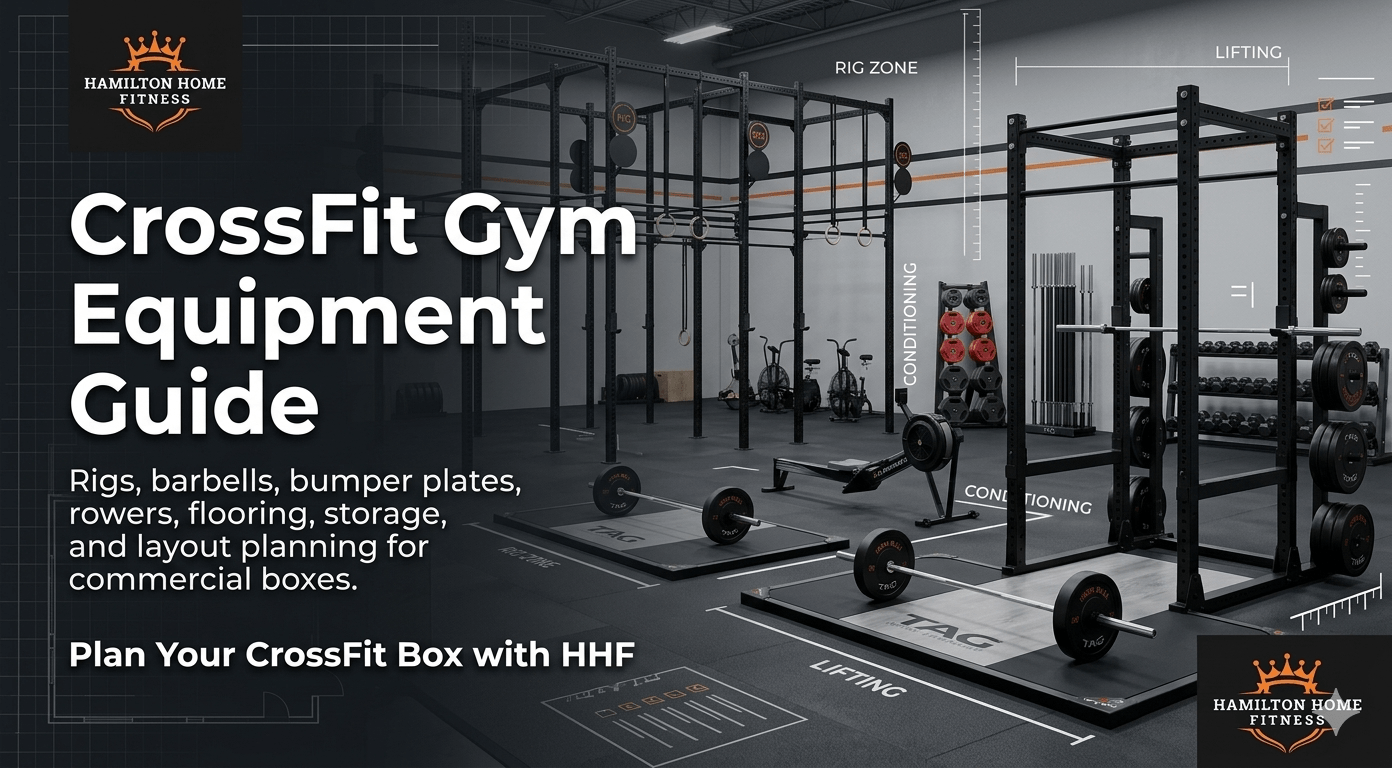
Choosing CrossFit gym equipment for a commercial box is different from buying general gym gear. Your space needs to handle daily WODs, Olympic lifting, gymnastics movements, conditioning intervals, group classes, and repeated high-impact use without slowing down your members or coaches.
For box owners, affiliates, and facility operators, the real challenge is not just buying equipment. It is choosing the right rig, barbells, bumper plates, rowers, flooring, storage, and layout plan so every square foot supports safe, efficient training.
This guide will help you understand what your CrossFit box needs, how to plan equipment around class size and WOD flow, and where Hamilton Home Fitness may fit if you need commercial-grade equipment, CrossFit rig design, or a full gym design consultation.
Core CrossFit Equipment List
A complete CrossFit box needs equipment that supports strength work, Olympic lifting, gymnastics, conditioning, and group WODs. The goal is not to fill the space with random gear. The goal is to choose commercial-grade equipment that matches your class size, coaching style, floor plan, and programming needs.
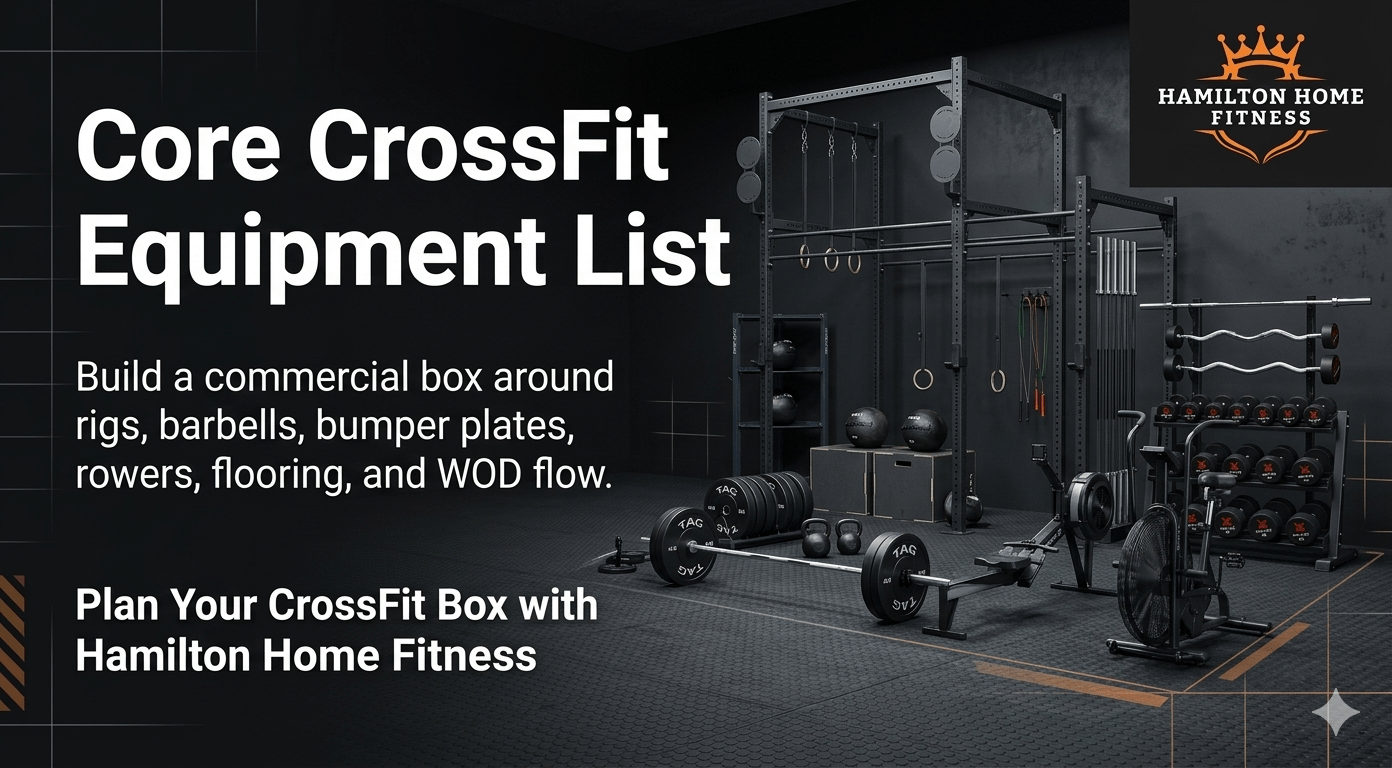
For most box owners, the core list starts with a rig, Olympic barbells, bumper plates, rowers or air bikes, kettlebells, wall balls, plyo boxes, jump ropes, gymnastics accessories, rubber flooring, and smart storage. These items create the foundation for AMRAPs, EMOMs, “For Time” workouts, Olympic lifts, pull-ups, rope climbs, box jumps, and conditioning intervals.
If you are outfitting a new facility or upgrading an existing one, start with the equipment your members will use every day. Then add specialty pieces as your class schedule, membership base, and programming demands grow.
Must-Have Box Equipment
The must-have CrossFit equipment list starts with a commercial rig, barbells, bumper plates, conditioning machines, kettlebells, plyo boxes, wall balls, jump ropes, flooring, and storage. These categories cover the movements most CrossFit boxes program every week.
A practical starter list includes:
Commercial CrossFit rig or functional fitness rig
Pull-up bars, ring attachments, and rope climb options
20 kg and 15 kg Olympic barbells
Training or competition bumper plates
Barbell collars and plate storage
Concept2 rowers or commercial rowing machines
Air bikes or other conditioning machines
Kettlebells in light, moderate, and heavy weights
Medicine balls, wall balls, and slam balls
Wood, foam, or commercial plyo boxes
Jump ropes and speed ropes
Ab mats, resistance bands, and mobility tools
Rubber flooring or lifting-friendly floor protection
Storage racks for plates, bars, balls, ropes, and kettlebells
For a broader facility setup beyond CrossFit-specific gear, Hamilton Home Fitness also offers commercial gym equipment for facilities & gyms, which can help owners plan strength, cardio, free weight, and functional training areas together.
The right equipment mix should support both RX and scaled athletes. A box that only buys heavy equipment may frustrate beginners. A box that only buys light equipment may limit stronger athletes. A balanced setup gives coaches more flexibility during group classes.
Class Size Quantity Planning
Equipment quantity should be based on class size, programming style, station flow, and how often athletes share implements during WODs. A 6-person class, 12-person class, and 20-person class do not need the same equipment package.
Start by looking at your busiest class block. Then ask how many athletes need to work at the same time during common workouts. If ten athletes are doing a barbell cycling WOD, you need enough barbells, bumper plates, collars, and floor space to run that workout safely. If the workout includes rowing intervals, you may be able to rotate athletes through machines instead of buying one rower per person.
A simple planning rule is:
Buy enough core equipment for your average class size.
Add extra barbells, bumpers, kettlebells, and wall balls for peak classes.
Use rotations for rowers, bikes, and specialty conditioning machines.
Keep storage close enough for fast transitions but away from the main WOD floor.
Leave open space for burpees, box jumps, carries, lunges, and warm-ups.
This is where many new box owners overspend or underbuy. A cheap package may look attractive, but it can create bottlenecks if the quantities do not match the way your coaches program classes. A custom plan often works better because it accounts for class size, ceiling height, rig layout, lifting zones, and storage.
For broader procurement planning, the Commercial Gym Equipment Buying Guide can support decisions around durability, equipment categories, commercial use, and buyer priorities.
Essential vs Optional Gear
A new CrossFit box can start with core WOD equipment first, then add specialty conditioning tools, expanded storage, and advanced accessories as membership grows. The best starting point is the equipment that supports the highest number of daily workouts.
Essential equipment usually includes rigs, barbells, bumper plates, rowers, kettlebells, wall balls, plyo boxes, jump ropes, flooring, and storage. Optional or second-phase equipment may include SkiErgs, BikeErgs, battle ropes, specialty bars, extra platforms, sleds, yokes, sandbags, climbing ropes, and larger accessory stations.
A phased buying plan may look like this:
Phase 1: Open the box
Buy the rig, barbells, bumper plates, rowers, kettlebells, wall balls, plyo boxes, flooring, and storage needed to run daily group classes.
Phase 2: Improve class flow
Add more plate sets, additional barbells, extra wall balls, more rowers or bikes, and better storage to reduce sharing and transition delays.
Phase 3: Expand programming
Add SkiErgs, BikeErgs, battle ropes, sleds, specialty bars, rope climbs, advanced gymnastics attachments, or dedicated Olympic lifting platforms.
This approach helps box owners protect cash flow while still building a facility that feels professional from day one. It also prevents buying equipment that looks impressive but does not support the workouts your members actually perform.
For a full build-out, a CrossFit box equipment quote can help match your budget, class size, rig design, free weight needs, conditioning equipment, and storage into one practical plan.
Build the Rig Around WOD Flow
The best CrossFit rig is the one that supports your class size, ceiling height, pull-up volume, barbell work, ring work, rope climbs, and open WOD floor space. A rig should not be chosen only by size or price. It should be planned around how athletes move during real classes.
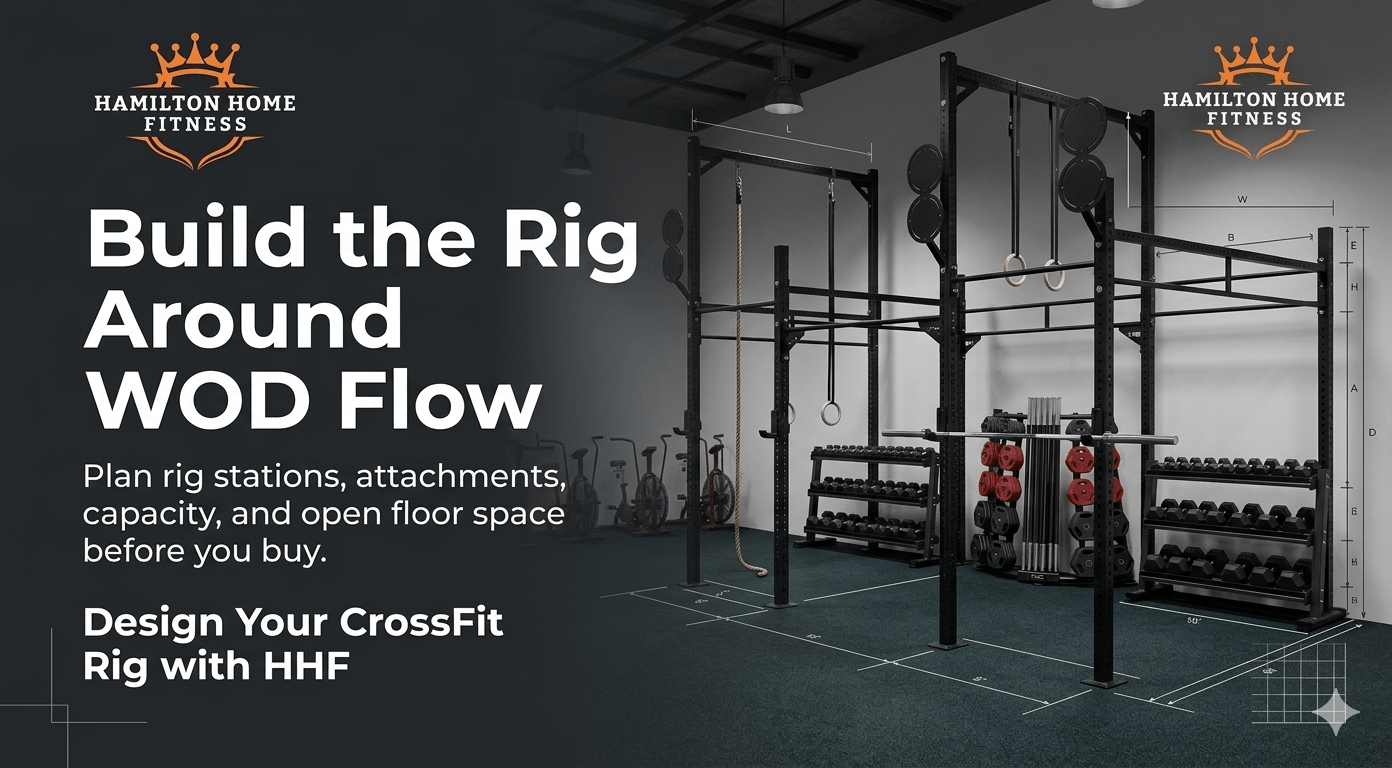
In a CrossFit box, the rig often becomes the center of the training floor. It may support pull-ups, toes-to-bar, bar muscle-ups, ring rows, squats, wall ball targets, rope climbs, band work, and accessory strength movements. Because so many workouts depend on it, the wrong rig configuration can create traffic problems, limit programming, and reduce the number of athletes your space can handle.
A good CrossFit rig design should answer three questions:
How many athletes need to use the rig during peak classes?
Which movements will the rig support most often?
How much open floor space must remain for WODs, lifting, and conditioning?
When the rig is planned correctly, coaches can run smoother classes, athletes can transition faster, and the box can use its square footage more efficiently.
Wall-Mounted vs Freestanding
Wall-mounted rigs save floor space, while freestanding rigs usually provide more flexible stations and attachment options for larger classes. The right choice depends on your building layout, wall structure, ceiling height, class size, and long-term expansion plan.
A wall-mounted CrossFit rig can be a strong fit when you want to preserve the center of the room for WOD floor space. It works well for facilities with strong structural walls and a layout that places gymnastics and squat stations along the perimeter.
A freestanding CrossFit rig may be better when you need stations on multiple sides, more pull-up capacity, or a central training structure. This style can support larger groups and may offer more flexibility for ring attachments, monkey bars, squat stations, and multi-athlete workouts.
A modular CrossFit rig gives owners more room to adapt. It can be useful if you are opening with a smaller setup but want the option to expand as membership grows.
Use this simple decision rule:
Choose a wall-mounted rig if floor space is tight and your wall structure supports it.
Choose a freestanding rig if you need more stations and multi-direction class flow.
Choose a modular rig if you expect to expand or reconfigure the space later.
If you are unsure which configuration fits your building, class size, and programming style, the next step is to design your CrossFit rig with HHF.
Stations, Attachments, Capacity
A rig station should be planned around how many athletes need pull-ups, squats, rings, wall balls, and barbell transitions during peak classes. Capacity is not only about how many uprights the rig has. It is about how safely and efficiently athletes can use each station during a WOD.
Common CrossFit rig components include:
Pull-up bars
Rig uprights
J-cups or squat stations
Monkey bars
Ring attachments
Wall ball targets
Dip attachments
Band pegs
Climbing rope attachments
Storage add-ons where appropriate
For example, a rig may technically have several pull-up spaces, but if athletes also need room for toes-to-bar, kipping pull-ups, ring work, and barbell transitions, the usable capacity may be lower than it looks on paper.
A well-planned rig should support:
Gymnastics movements without crowding
Squat and barbell stations without blocking walkways
Rope climbs without interfering with pull-up or ring stations
Wall ball targets with enough throwing and landing space
Clear coach visibility across the training floor
This is also where box owners should understand the difference between a CrossFit rig and a traditional rack. A CrossFit rig is usually built for multiple athletes and functional training stations, while a power rack or squat cage is typically a single-station strength setup. If your facility needs both CrossFit-style rig planning and traditional strength zones, this Commercial Power Racks & Squat Cages: The Gym Buyer's Guide can help clarify where each setup fits.
Rig Design Mistakes to Avoid
The biggest CrossFit rig mistakes are buying before measuring, ignoring class flow, underplanning storage, and choosing a setup that limits future expansion. A rig can look impressive in a product photo but still fail inside your actual box if it does not match the room, the programming, or the way athletes move.
Avoid these common mistakes:
Buying without a floor plan
Do not choose a rig until you know your ceiling height, wall strength, available square footage, traffic flow, and required WOD space.
Forgetting open floor space
A large rig is not always better if it steals space from burpees, lunges, carries, warm-ups, box jumps, or barbell cycling.
Underestimating attachment needs
Pull-up bars alone are not enough for many boxes. You may need ring attachments, wall ball targets, rope climb points, J-cups, monkey bars, or band stations.
Ignoring class transitions
Athletes need to move from the rig to barbells, rowers, bikes, boxes, and kettlebells without crossing paths or crowding each other.
Failing to plan for growth
A rig that works for six athletes may not work when your peak class grows to twelve or twenty. Modular design can help protect future expansion.
A strong CrossFit gym design starts with the way your coaches program classes. The rig should support the WOD, not fight against it. If you want help planning rig size, station count, floor flow, and equipment placement before you buy, book a CrossFit gym design consultation.
Choose Barbells and Bumpers
CrossFit boxes should choose commercial Olympic barbells, 20 kg and 15 kg bar options, durable bumper plates, secure collars, and storage that supports frequent loading and dropping. These pieces are used in daily strength work, Olympic lifting, barbell cycling, partner workouts, and competition-style WODs, so durability matters more than the cheapest upfront price.
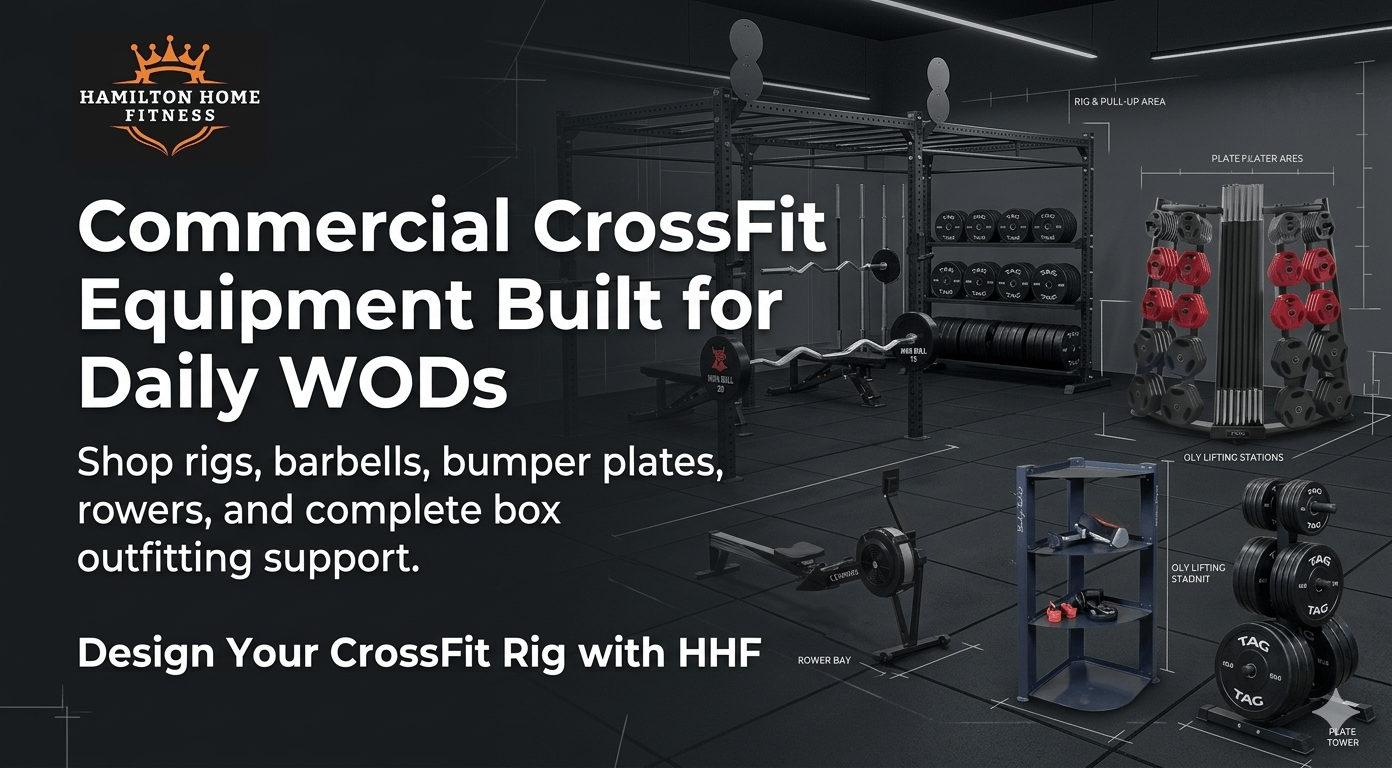
For most owners, barbells and bumper plates are among the highest-use purchases in the facility. They need to support cleans, snatches, deadlifts, squats, presses, thrusters, and high-rep workouts without creating avoidable safety issues or slowing down class transitions.
The goal is not just to buy bars and plates. The goal is to build a free-weight system that works for different athletes, different loads, and different programming formats.
Commercial Barbell Criteria
A commercial CrossFit barbell should handle Olympic lifts, cycling, heavy strength work, and repeated daily use without feeling too sharp or too passive in the hands. The right bar should feel reliable for both technical lifting and fast WOD transitions.
Most CrossFit boxes need a mix of 20 kg men’s barbells and 15 kg women’s barbells. This gives coaches more flexibility for RX workouts, scaled athletes, beginner classes, strength cycles, and mixed-level group training.
When comparing commercial CrossFit barbells, look at:
Bar weight: 20 kg and 15 kg options
Sleeve rotation for Olympic lifts
Knurling that grips without tearing hands too quickly
Shaft strength and durability
Sleeve durability for repeated plate changes
Finish or coating for long-term use
Warranty and commercial-use suitability
Quantity needed for peak class size
Storage compatibility
Avoid choosing barbells only by price. A low-cost bar may work for light home use, but a commercial CrossFit box needs bars that can handle daily classes, repeated drops with bumper plates, and multiple athletes using them throughout the day.
Also think about athlete variety. A good barbell mix should support beginners learning technique, experienced lifters training heavy, and members doing high-rep barbell cycling in metcons.
When you are ready to outfit your lifting area, shop bumper plates & Olympic barbells through Hamilton Home Fitness.
Bumper Plate Buying Rules
The best bumper plates for CrossFit are commercial-grade rubber or competition-style plates that can handle repeated drops, fast weight changes, and high class volume. A strong bumper plate setup should protect your floor, support Olympic lifting, and make class loading simple.
Most boxes use a mix of common plate weights, including:
10 lb bumper plates
15 lb bumper plates
25 lb bumper plates
35 lb bumper plates
45 lb bumper plates
Some facilities also use kilogram plates, color bumper plates, or competition bumper plates depending on their programming style and athlete base.
Training bumper plates are usually a practical choice for daily WODs because they are built for frequent use and are often more budget-friendly than competition plates. Competition bumper plates may be worth considering if your box hosts events, runs advanced Olympic lifting sessions, or wants more precise plate thickness and weight consistency.
Use this simple buying rule:
Choose training bumpers for high-volume daily class use.
Choose competition bumpers when precision, appearance, and event-style lifting matter more.
Add more 10 lb, 25 lb, and 45 lb plates if your programming includes frequent scaling and barbell cycling.
Plan storage at the same time so plates do not end up scattered across the WOD floor.
Bumper plate quantity should match your barbell quantity and class size. If twelve athletes are using barbells at once, you need enough plates for warm-ups, working sets, scaled loads, and RX weights without constant sharing delays.
For deeper free-weight planning, use the Commercial Free Weights Buying Guide to compare commercial barbells, plates, dumbbells, and storage needs before finalizing your order.
Platforms and Weight Storage
CrossFit gyms do not always need a platform for every athlete, but they do need durable lifting zones and storage that keeps bars and plates off the WOD floor. Good storage protects equipment, improves safety, and helps classes move faster.
A dedicated Olympic lifting platform may be useful if your box offers weightlifting classes, heavy strength cycles, open gym lifting, or advanced barbell programming. However, many CrossFit boxes use rubber flooring and designated lifting zones instead of individual platforms for every member.
Consider platforms or reinforced lifting areas when
Heavy Olympic lifting is part of your weekly programming
Athletes regularly drop loaded barbells from overhead
You need to reduce floor damage and noise
You want a dedicated strength or barbell technique area
Your layout has enough room for platforms without crowding WOD space
Storage should be planned before equipment arrives. Plate trees, bumper plate racks, vertical bar storage, horizontal bar racks, wall ball shelves, and kettlebell racks all help keep the floor clear.
A smart storage plan should keep frequently used plates close to lifting zones while leaving enough room for safe movement. Barbells should be easy to access but protected from being stepped over, leaned in corners, or left on the floor between classes.
For many box owners, the best setup is a balanced system: durable flooring, clear lifting zones, enough bumper plates for peak classes, and storage that supports fast setup and cleanup. This keeps the space professional, safer, and easier for coaches to manage during busy class blocks.
Plan Conditioning Equipment
Most CrossFit boxes should prioritize rowers, air bikes, and simple conditioning tools that can handle high-output intervals, fast transitions, and repeated daily use. Conditioning equipment supports metcons, warm-ups, partner workouts, endurance days, and benchmark-style WODs, so it should be selected for durability, programming value, and class flow.
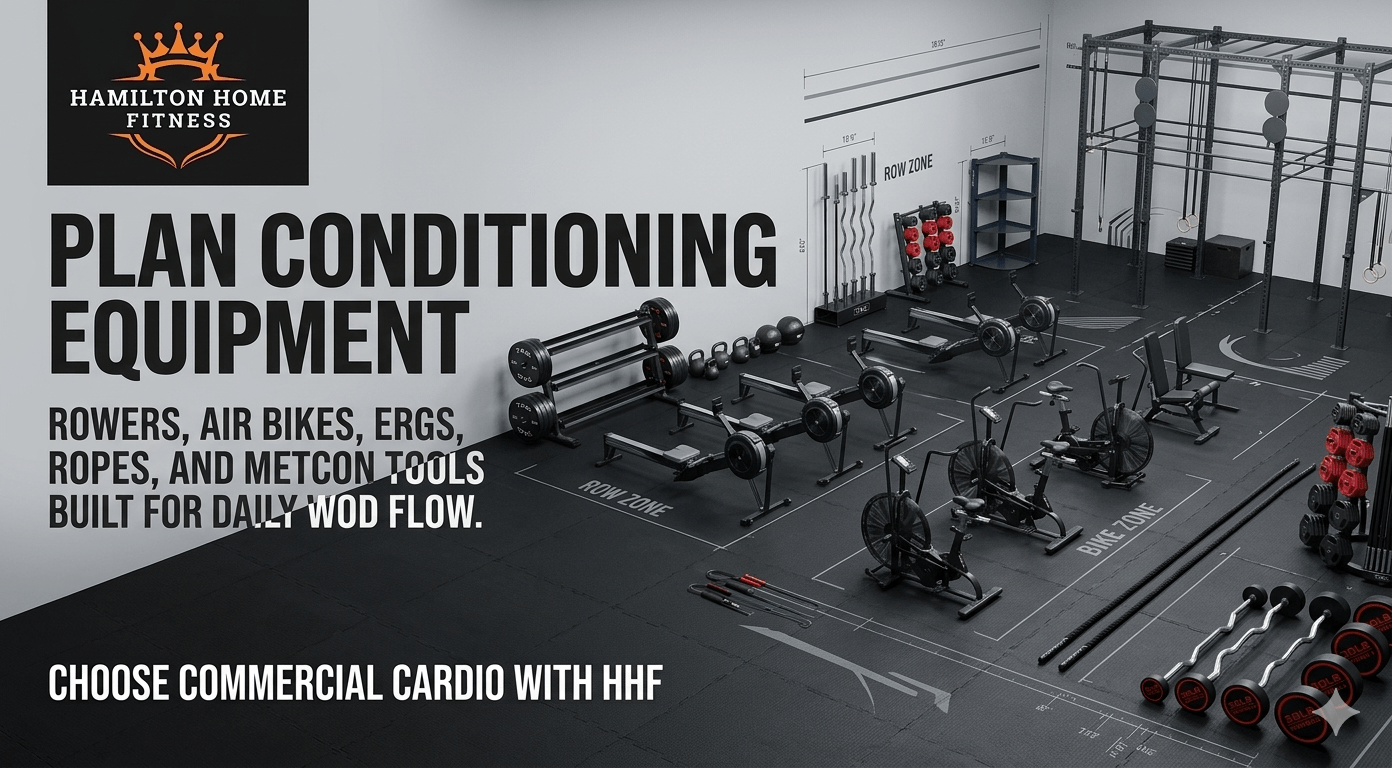
The right conditioning setup does not have to include every machine at once. A new box may start with rowers and air bikes, then add SkiErgs, BikeErgs, battle ropes, sleds, or extra machines as membership grows. The key is to choose equipment that gives coaches enough variety without crowding the training floor.
For commercial CrossFit programming, conditioning equipment should be
Durable enough for daily group classes
Easy for athletes to adjust quickly
Simple to maintain
Useful across many workout formats
Space-efficient
Suitable for scaled and advanced athletes
Easy to rotate through during large classes
A strong conditioning area helps prevent class bottlenecks. If every WOD involving rowing creates long wait times, the equipment count or layout may need adjustment. If bikes are placed too far from the rig or barbell zone, transitions can become messy. Plan machines around how athletes will actually move during class.
Concept2 Rowers and Ergs
The Concept2 RowErg is the rower most CrossFit athletes expect to see because it is widely used for rowing-based conditioning, testing, and WOD programming. For many box owners, it is one of the first commercial cardio purchases because it fits short intervals, long endurance pieces, partner workouts, warm-ups, and benchmark-style training.
A Concept2 rower works well in a CrossFit box because it supports athletes at different fitness levels. Beginners can row at a controlled pace, while advanced athletes can push high-intensity intervals. Coaches can also use distance, calories, pace, and time targets to keep workouts measurable and easy to run.
A practical conditioning setup may include:
Concept2 RowErg units for rowing WODs
SkiErgs for pulling endurance and upper-body conditioning
BikeErgs or air bikes for lower-impact conditioning options
Enough machine spacing for safe mounting, dismounting, and transitions
A storage or parking plan so machines do not crowd the WOD floor
The exact number of rowers depends on class size and programming. Some boxes prefer more rowers to support simultaneous work. Others use smaller machine counts with heats, partner rotations, or mixed stations.
If your box needs rowing machines or broader cardio planning, you can choose the best commercial cardio equipment through Hamilton Home Fitness. When the direct product page is available, this is also the right section to place the CTA: Get a Concept 2 Rower for Your Box.
Air Bikes and Metcon Tools
Air bikes and simple metcon tools help CrossFit coaches add hard conditioning without taking up as much setup time as complex machines. They are useful for sprint intervals, mixed-modal workouts, partner WODs, warm-ups, and low-skill conditioning that still creates a strong training effect.
Commercial air bikes are common in CrossFit-style training because they scale well. A beginner can work at a manageable pace, while a competitive athlete can push very high intensity. This makes them useful in group classes where athletes have different strength, skill, and conditioning levels.
Common conditioning tools include:
Air bikes
Assault-style bikes
Echo-style bikes
Stationary bikes
Battle ropes
Jump ropes
Speed ropes
Resistance bands
Agility ladders
Sleds or turf-based tools if space allows
Battle ropes can be useful for short conditioning intervals, grip endurance, warm-up circuits, and team workouts. If you add ropes, plan for a commercial battle rope anchor and enough open floor space so athletes do not interfere with nearby lifting or rig work.
Jump ropes and speed ropes are smaller purchases, but they matter. Double-unders, single-unders, warm-up drills, and conditioning finishers are common in CrossFit programming. Keep enough ropes available for different athlete heights and skill levels.
For more cardio and conditioning options, use commercial cardio equipment for fitness facilities when planning machines beyond rowers.
Quantity by Class Programming
A box does not need one rower per athlete for every class, but it does need enough conditioning stations to avoid bottlenecks during rowing, biking, and interval workouts. The right quantity depends on your class size, WOD style, heat structure, and available floor space.
Start with your busiest class. If your peak class has 16 athletes, decide whether conditioning work will happen all at once or in rotations. For example, a workout may rotate athletes through rowers, barbells, and box jumps. In that case, you may need fewer rowers than athletes. But if the programming often calls for everyone to row at the same time, you will need more machines.
Use this planning logic:
For small classes, fewer rowers and bikes may work if rotations are simple.
For larger classes, increase machine count or design workouts in stations.
For partner WODs, one machine per pair may be enough.
For benchmark-style workouts, more matching machines can improve consistency.
For limited floor space, choose machines that are easy to move and store.
For high-volume programming, prioritize durable commercial-grade equipment.
Also think about coach control. Conditioning machines should be placed where coaches can see screens, correct pacing, manage transitions, and keep athletes moving safely. Avoid spreading machines so far apart that the coach cannot monitor the full class.
The best approach is to match equipment quantity to programming reality. If your box runs frequent rowing intervals, invest more heavily in rowers. If your members respond well to mixed conditioning, combine rowers, air bikes, SkiErgs, jump ropes, and battle ropes. This gives coaches more flexibility without overcrowding the gym.
Design Layout, Flooring, Storage
A CrossFit gym layout should separate rig stations, open WOD space, lifting zones, conditioning machines, storage, coaching sightlines, and entry flow without wasting square footage. The goal is to make the box feel open, safe, coachable, and easy to run during busy group classes.
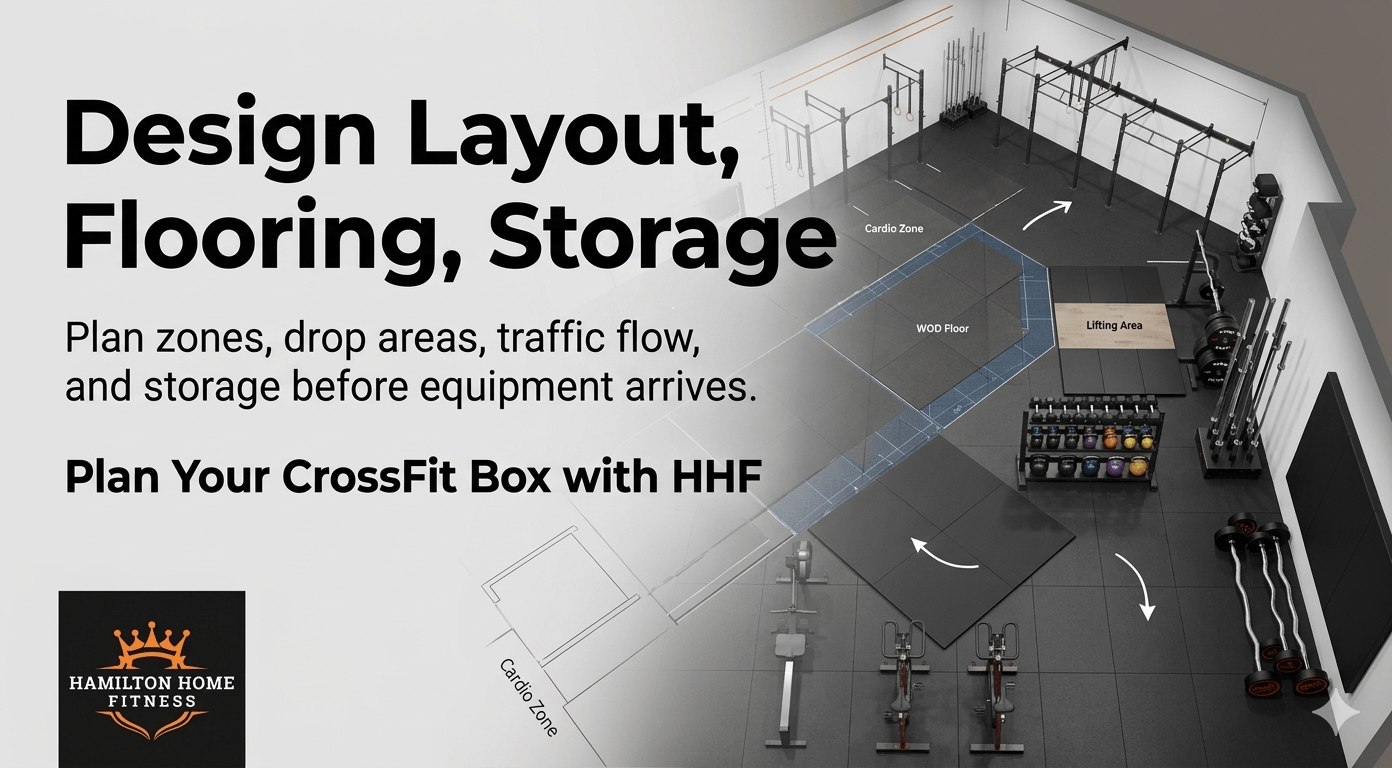
Good layout planning starts before equipment is ordered. A rig may fit inside the building, but that does not mean it supports clean movement. Rowers may look organized along a wall, but they may create transition problems if they are too far from the main WOD floor. Bumper plates may be easy to store in one corner, but that corner may slow down every barbell workout if athletes have to cross the room to load their bars.
A strong CrossFit gym design should support:
Fast class setup and cleanup
Clear traffic flow between stations
Safe lifting and dropping zones
Enough open space for bodyweight movements
Coach visibility across the full class
Easy access to plates, bars, kettlebells, wall balls, and ropes
A layout that can grow with membership
For Tennessee-based facilities and nationwide buyers, working with a supplier that understands both equipment and space planning can make the build-out smoother. Hamilton Home Fitness is a commercial gym equipment supplier in Tennessee that can support commercial facility planning, equipment selection, and gym design conversations.
Zone the Box by movement.
The easiest way to design a CrossFit box is to plan zones around how athletes move during class, not just where equipment fits on paper. Every zone should support a specific training function while keeping transitions simple.
A practical CrossFit floor plan usually includes:
Zone | Purpose | Common Equipment |
Rig and gymnastics zone | Pull-ups, toes-to-bar, rings, rope work, squats | CrossFit rig, pull-up bars, rings, ropes, J-cups |
Open WOD space | Burpees, lunges, carries, warm-ups, bodyweight work | Open rubber flooring, plyo boxes, jump ropes |
Olympic lifting zone | Cleans, snatches, deadlifts, squats, presses | Barbells, bumper plates, platforms or drop zones |
Conditioning zone | Rowing, biking, intervals, mixed-modal work | Rowers, air bikes, SkiErgs, BikeErgs |
Storage zone | Fast access and floor control | Plate racks, bar storage, kettlebell racks, wall ball storage |
Coach and entry flow | Check-in, briefing, coaching visibility | Whiteboard, desk, display, open sightlines |
The best layout keeps high-use items near the movements they support. Bumper plates should live near lifting zones. Wall balls should be near targets. Rowers and bikes should be easy to roll into position without blocking the rig. Kettlebells and plyo boxes should be accessible but not scattered across walking paths.
A movement-based layout also helps coaches run smoother classes. When the coach can see the rig, barbell area, and conditioning stations at the same time, it becomes easier to manage safety, pacing, scaling, and class energy.
Flooring and Drop Zones
CrossFit flooring must protect the subfloor, absorb repeated drops, reduce noise, and support safe footwork during lifting and conditioning. Flooring is not just a finishing detail. It is part of the equipment system.
A CrossFit box typically needs durable rubber flooring across the main training area. This helps protect the facility during burpees, box jumps, kettlebell work, carries, rowing transitions, and general WOD traffic. For Olympic lifting or deadlift-heavy zones, thicker rubber, platforms, or reinforced drop areas may be worth considering.
When planning flooring, think about:
Where barbells will be dropped most often
Whether Olympic lifting will happen in one area or across the WOD floor
How much noise control the building needs
Whether the subfloor can handle repeated impact
How rowers, bikes, and racks will sit on the surface
How easy the flooring is to clean after high-sweat classes
Whether seams or edges could create trip hazards
Horse stall mats are sometimes used in functional fitness spaces, but commercial gym owners should evaluate thickness, odor, finish, installation quality, and long-term durability before choosing them. Purpose-built commercial rubber flooring may offer a cleaner and more professional solution for a high-traffic CrossFit facility.
Drop zones should be planned around real lifting patterns. If athletes clean, snatch, deadlift, and drop bars across the entire room, the whole floor needs to support that use. If heavy lifting is concentrated in one area, dedicated platforms or reinforced lifting lanes may help protect the building and organize class flow.
Storage That Protects Flow
Good storage keeps plates, kettlebells, barbells, wall balls, ropes, and bands easy to reach without crowding the WOD floor. In a CrossFit box, storage is not only about neatness. It directly affects safety, speed, and usable training space.
Poor storage creates common problems:
Athletes step over barbells or plates during transitions.
Wall balls roll into walkways.
Kettlebells crowd the edge of the WOD floor.
Jump ropes and bands become tangled.
Bumper plates are too far from lifting stations.
Coaches lose time resetting equipment between classes.
A better storage plan puts each item close to where it is used. Bumper plate racks should support the barbell zone. Vertical or horizontal bar storage should make bars easy to grab without blocking traffic. Kettlebell racks should be stable, visible, and organized by weight. Wall ball shelves should sit near targets but outside throwing space. Jump ropes, bands, and mobility tools should have smaller storage points that keep accessories controlled.
Storage also protects equipment life. Barbells should not be left leaning in corners where sleeves, shafts, or finishes can be damaged. Bumper plates should not be stacked randomly where athletes have to dig through piles. Rowers and bikes should have a parking area that keeps them accessible without reducing open floor space.
For most CrossFit boxes, the best layout is simple: keep the center of the floor as open as possible, place high-use storage near training zones, and avoid putting equipment where athletes need to move fast. This makes the gym easier to coach, easier to clean, and easier for members to use during every class.
Budget, Packages, and Next Steps
CrossFit equipment cost depends on class size, rig configuration, barbell and bumper quality, conditioning equipment count, flooring, storage, freight, and installation or design needs. A small startup box and a high-capacity commercial CrossFit facility may need many of the same equipment categories, but not the same quantities, brands, layout support, or budget.
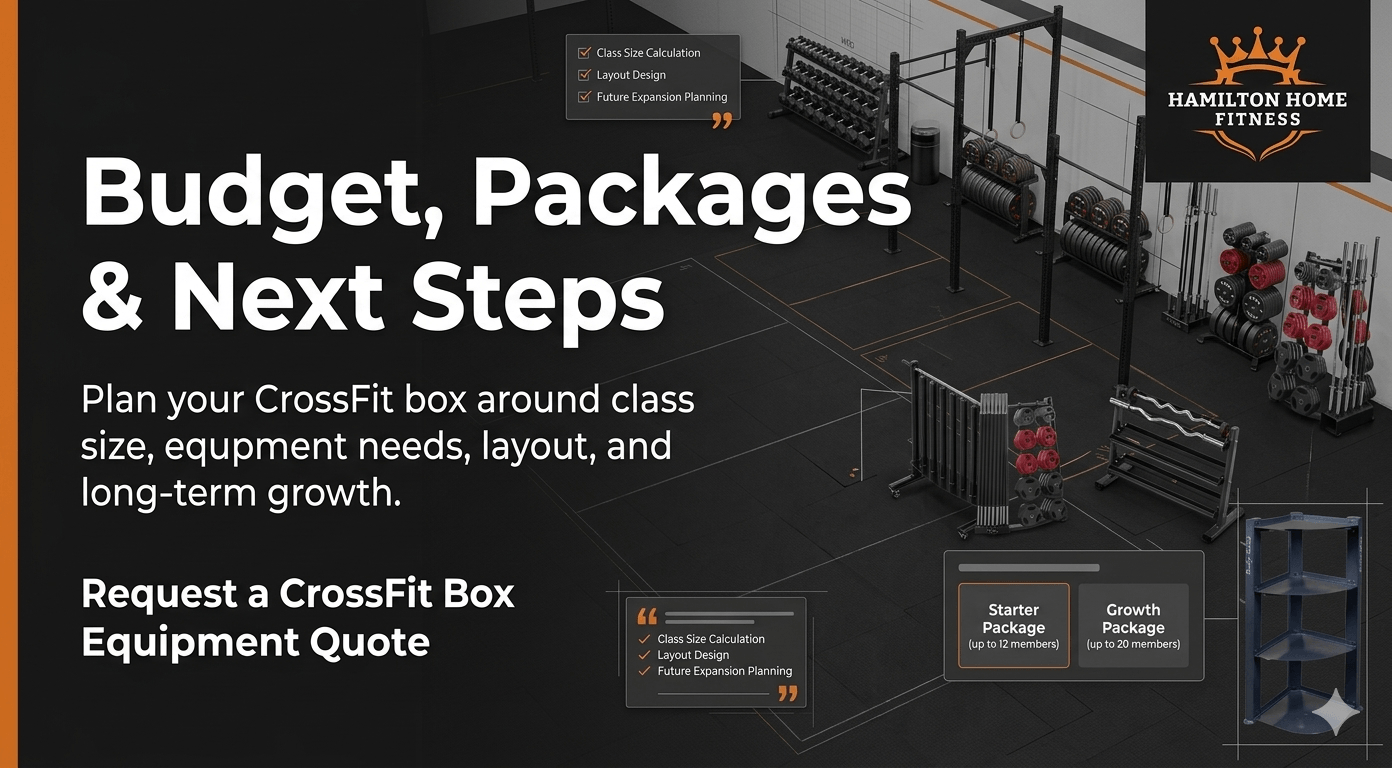
The most important thing is to avoid planning your budget around equipment alone. A complete CrossFit gym setup also needs usable floor space, safe traffic flow, durable flooring, storage, coaching visibility, and enough equipment to support peak class times.
For most box owners, the biggest cost drivers are:
CrossFit rig size and configuration
Number of rig stations
Commercial barbells
Bumper plate sets
Rowers, air bikes, and other conditioning machines
Rubber flooring or lifting zones
Kettlebells, wall balls, plyo boxes, and accessories
Storage systems
Shipping, installation, and design support
Future expansion needs
A quote-based plan is usually more useful than a generic price estimate because every box is different. Your ceiling height, class size, programming style, equipment preferences, and available square footage all affect the final outfitting plan.
What Drives Equipment Cost
The biggest cost drivers in a CrossFit gym setup are the rig, barbells, bumper plates, conditioning machines, flooring, and the number of athletes the space must support. A box designed for 8 athletes per class will not need the same investment as a facility built for 20 or more athletes per class.
Rig cost depends on size, number of uprights, pull-up bars, squat stations, wall ball targets, monkey bars, rope attachments, ring stations, and whether the setup is wall-mounted, freestanding, or modular. A simple wall-mounted rig may cost less than a large freestanding system, but the right choice should come from your layout and class flow, not price alone.
Barbells and bumper plates also scale quickly. More athletes means more bars, more collars, more plate sets, and more storage. Commercial-grade bars and bumpers may cost more upfront, but they are better suited for repeated drops, fast loading, Olympic lifts, and daily group use.
Conditioning equipment can also change the budget. Concept2 rowers, air bikes, SkiErgs, BikeErgs, and other machines are valuable for CrossFit programming, but the right quantity depends on whether athletes work at the same time or rotate through stations.
Flooring should not be treated as optional. Rubber flooring, lifting zones, and platform areas help protect the building, reduce noise, and support safer movement.
If you are comparing options and trying to choose the best commercial gym equipment, focus on long-term fit, not just upfront cost. The right setup should support your programming, protect your space, and help coaches run better classes.
Package vs Custom Quote
A package can speed up buying, but a custom quote usually fits better when class size, rig layout, ceiling height, and programming style matter. CrossFit equipment packages are useful when you want a faster way to buy the basics, but they may not account for your exact floor plan or coaching model.
A standard CrossFit equipment package may include barbells, bumper plates, kettlebells, wall balls, plyo boxes, jump ropes, rowers, and storage. This can be a good starting point for a new box owner who wants a simple opening setup.
A custom quote is usually better when:
You need a specific CrossFit rig configuration
Your building has unusual dimensions
You want to maximize WOD floor space
You expect larger group classes
You need a phased purchasing plan
You want to combine CrossFit, strength, and cardio zones
You need help balancing budget with durability
The risk with a generic package is that it may include too much of what you do not need and too little of what your classes actually use. For example, a package may include several accessory items but not enough bumper plates for peak barbell workouts. Or it may include rowers without solving storage, layout, or traffic flow.
A custom quote can help match equipment to real use. That means the rig, free weights, conditioning machines, flooring, and storage are planned together instead of purchased separately.
When comparing vendors, start by reviewing product range, commercial support, design help, and quote options. You can also shop quality fitness gear and equipment at Hamilton Home Fitness to explore broader equipment categories before requesting a full box outfitting plan.
For a more precise next step, use the Request a CrossFit Box Equipment Quote CTA so HHF can help align your equipment list with your class size, layout, and budget.
When to Book HHF Design
Book a CrossFit gym design consultation when you need help matching rig size, floor space, equipment quantities, storage, and class flow before buying. Design support is especially useful when your purchase decision affects the entire layout of the facility.
HHF design support may be a strong fit if:
You are opening a new CrossFit box
You are expanding into a larger space
You need a commercial CrossFit rig layout
You are unsure how many rig stations you need
You want to preserve open WOD space
You need to plan lifting, conditioning, and storage zones
You want help building an equipment package around class size
You are combining CrossFit with traditional strength or cardio areas
The best time to book design help is before equipment is ordered. Once a rig is installed, flooring is placed, and storage is arranged, layout changes can become more expensive and disruptive.
A design consultation can help you answer practical questions:
Should the rig be wall-mounted or freestanding?
How many athletes can use the rig at once?
Where should rowers and bikes go?
How much open WOD space should remain?
Where should bumper plates and barbells be stored?
Do you need dedicated Olympic lifting platforms?
Can the space support future expansion?
If your facility will include traditional strength areas beyond the CrossFit floor, the Commercial Strength Machines: The Selectorized & Plate-Loaded Guide can help you think through selectorized and plate-loaded options for hybrid training zones.
For CrossFit-specific planning, the next step is to request a CrossFit box equipment quote or browse CrossFit functional rigs. This helps move your project from a general equipment list to a practical outfitting plan built around your space, members, and programming.
People Also Ask
What equipment does a CrossFit box need?
A CrossFit box needs a commercial rig, Olympic barbells, bumper plates, rowers or air bikes, kettlebells, wall balls, plyo boxes, jump ropes, gymnastics rings, climbing rope options, rubber flooring, and storage. These items support the core movements used in most CrossFit programming: Olympic lifting, gymnastics, conditioning, squats, pulls, jumps, carries, and bodyweight work.
The exact equipment list depends on your class size, square footage, budget, and programming style. A startup box may begin with the essentials, while a larger facility may need multiple rig stations, more bumper plate sets, extra conditioning machines, and dedicated lifting zones.
How much does it cost to fully outfit a CrossFit gym?
The cost to fully outfit a CrossFit gym depends on the rig size, number of athletes per class, barbell and bumper plate quantity, conditioning equipment, flooring, storage, shipping, and installation needs. A small box will usually need a different budget than a high-capacity facility with multiple stations and larger class sizes.
The best approach is to build a quote around your actual space and programming. A custom equipment quote helps match your rig, barbells, rowers, flooring, and storage to your class flow instead of relying on a generic package that may not fit your facility.
What is the standard rower used in CrossFit?
The Concept2 RowErg is the rower most commonly associated with CrossFit-style training. Many CrossFit athletes expect to see Concept2 rowers because they are widely used for rowing intervals, calories, distance-based workouts, warm-ups, and benchmark-style conditioning.
A CrossFit box may also add SkiErgs, BikeErgs, air bikes, or other commercial cardio equipment for more programming variety. The right mix depends on class size, budget, floor space, and how often conditioning machines appear in your WODs.
What barbell is best for CrossFit?
The best barbell for CrossFit is a commercial Olympic barbell that can handle Olympic lifts, barbell cycling, heavy strength work, and repeated daily use. Most boxes should carry both 20 kg men’s barbells and 15 kg women’s barbells so coaches can support RX, scaled, beginner, and advanced athletes.
Look for a barbell with reliable sleeve rotation, durable construction, comfortable knurling, strong shaft quality, and commercial-use suitability. Avoid choosing only by price, because barbells are among the most frequently used pieces of CrossFit gym equipment.
How many bumper plate sets does a CrossFit gym need?
A CrossFit gym should plan bumper plate sets around class size, barbell quantity, and workout style. If many athletes use barbells at the same time, the box needs enough 10 lb, 15 lb, 25 lb, 35 lb, and 45 lb plates to support warm-ups, scaled loads, RX weights, and strength work without constant sharing delays.
A small class may need fewer full sets, while a larger box should add more plates for peak hours. The safest planning method is to match plate quantity to the number of barbells used during your busiest barbell-based classes.
What rig configuration is best for a CrossFit box?
The best CrossFit rig configuration depends on your class size, ceiling height, wall structure, available floor space, and movement needs. Wall-mounted rigs can save space, freestanding rigs can support more stations, and modular rigs can help owners expand or adjust the layout later.
A good rig should support pull-ups, toes-to-bar, squats, ring work, rope climbs, wall ball targets, and open WOD flow. The rig should fit the way your coaches program classes, not just the size of the room.
How do I design a CrossFit gym layout?
Design a CrossFit gym layout by planning zones for the rig, open WOD space, Olympic lifting, conditioning machines, storage, entry flow, and coaching sightlines. The layout should let athletes move between stations without crowding, crossing unsafe paths, or blocking the coach’s view.
Start with your busiest class size and most common workouts. Then place high-use equipment near the movements it supports. Barbells and bumpers should be near lifting areas, wall balls should be near targets, rowers and bikes should be easy to move, and storage should protect open training space.
Can Hamilton Home Fitness design a CrossFit rig?
Yes. Hamilton Home Fitness can help box owners plan a CrossFit rig around facility size, class flow, station needs, and equipment goals. This can be useful when you are choosing between wall-mounted, freestanding, or modular rig options.
HHF’s CrossFit rig design support is especially relevant if you are opening a new box, upgrading an existing space, expanding into a larger facility, or trying to avoid layout mistakes before ordering equipment.
What conditioning equipment is essential for CrossFit classes?
Essential CrossFit conditioning equipment usually includes rowers, air bikes, jump ropes, and sometimes SkiErgs, BikeErgs, battle ropes, or other metcon tools. Rowers and bikes are useful for intervals, partner workouts, warm-ups, and conditioning tests.
The right quantity depends on your programming. Some boxes need more rowers for simultaneous work, while others can use station rotations with rowers, bikes, barbells, boxes, and kettlebells.
How many people can one CrossFit rig station handle?
One CrossFit rig station may handle one athlete for movements like pull-ups, toes-to-bar, squats, or ring work, but real capacity depends on spacing, movement type, attachment placement, and class flow. Kipping pull-ups, bar muscle-ups, rings, and wall balls need more room than basic strict movements.
Do not calculate rig capacity only by counting uprights or bars. Plan around how athletes move during actual WODs, how much space they need, and whether multiple athletes can work safely at the same time.
What equipment do you need to open a CrossFit gym?
To open a CrossFit gym, you need enough core equipment to run daily classes safely and efficiently. That usually includes a commercial rig, barbells, bumper plates, collars, rowers or bikes, kettlebells, wall balls, plyo boxes, jump ropes, rings, flooring, and storage.
You can add specialty items later, such as SkiErgs, BikeErgs, battle ropes, sleds, sandbags, extra platforms, and advanced gymnastics attachments. Start with the equipment your members will use every week, then expand as your programming and membership grow.
How much does it cost to start a CrossFit box?
The cost to start a CrossFit box includes more than equipment. Owners also need to consider lease costs, build-out, flooring, insurance, coaching staff, affiliate requirements, software, signage, marketing, and operating expenses.
For equipment specifically, cost depends on your rig, class size, barbell and bumper plate quantities, cardio equipment, flooring, and storage. A custom quote is the most reliable way to estimate your outfitting budget.
What rower do CrossFit gyms use?
CrossFit gyms commonly use the Concept2 RowErg for rowing workouts. It is popular because it supports measurable conditioning through calories, distance, pace, and time, which makes it easy for coaches to program and athletes to track.
Some gyms also use SkiErgs, BikeErgs, air bikes, or other commercial cardio equipment to create more conditioning options. The best setup depends on your workout style and available floor space.
What barbell weight is used in CrossFit competitions?
CrossFit competition-style workouts often use 45 lb or 20 kg barbells for men and 35 lb or 15 kg barbells for women when workouts specify standard barbell loads. Exact requirements depend on the specific workout, division, and event standards.
For a commercial box, carrying both 20 kg and 15 kg barbells helps support mixed classes, RX athletes, scaled athletes, beginners, and competition-style training.
How do you set up a CrossFit rig?
Set up a CrossFit rig by measuring your space, confirming ceiling height, checking wall or floor anchoring needs, choosing a wall-mounted or freestanding configuration, planning station count, and selecting attachments. The rig should leave enough open floor space for WODs, lifting, conditioning, and safe traffic flow.
Before ordering, map where athletes will perform pull-ups, squats, rings, wall balls, rope climbs, and barbell transitions. A rig should improve class flow, not block it.
How many Olympic platforms does a CrossFit gym need?
A CrossFit gym does not always need one Olympic platform per athlete. The number of platforms depends on class size, lifting frequency, available floor space, noise control, and whether heavy lifting happens in dedicated zones or on the main WOD floor.
Some boxes use dedicated lifting platforms for Olympic lifting classes and heavy strength work. Others use durable rubber flooring with clearly marked lifting zones. The right choice depends on programming and space.
What kettlebell weights should a CrossFit gym have?
A CrossFit gym should carry a spread of light, moderate, and heavy kettlebells so athletes can scale workouts properly. Common needs include lighter bells for beginners and warm-ups, moderate bells for standard WODs, and heavier bells for advanced athletes.
The exact weights and quantities should match your class size and programming. A balanced kettlebell set helps coaches run swings, carries, goblet squats, cleans, snatches, lunges, and conditioning circuits without bottlenecks.
What are the best bumper plates for CrossFit?
The best bumper plates for CrossFit are durable commercial-grade plates that can handle repeated drops, frequent loading changes, and daily class use. Training bumper plates are often practical for high-volume WODs, while competition bumper plates may be useful for events, Olympic lifting sessions, or facilities that want more precise weight consistency.
Choose plates based on durability, bounce, thickness, noise, storage needs, and budget. Also make sure you have enough 10 lb, 25 lb, and 45 lb plates for both scaled and RX workouts.
How do I get a CrossFit affiliate license?
A CrossFit affiliate license is handled separately from equipment purchasing. Owners should review CrossFit’s official affiliate process, requirements, fees, insurance expectations, and naming rules before opening under the CrossFit brand.
After the licensing path is clear, the equipment plan should be built around your facility size, class model, coaching approach, and member capacity.
What is the difference between a CrossFit rig and a power rack?
A CrossFit rig is usually a multi-station functional training structure built for group classes, pull-ups, squats, rings, wall balls, rope attachments, and multiple athletes. A power rack is usually a single-station strength setup designed mainly for squats, presses, rack pulls, and barbell training.
A CrossFit box may need a rig, power racks, or both depending on its layout. For group WODs and functional training, a commercial CrossFit rig usually gives more station capacity. For dedicated strength areas, power racks or squat cages may still be useful.
Final Thought
A strong CrossFit box is not built by buying random equipment and hoping the layout works later. It starts with a clear plan for your rig, barbells, bumper plates, rowers, flooring, storage, class size, and WOD flow.
The right CrossFit gym equipment should help coaches run smoother classes, give athletes enough room to train safely, and support both daily programming and future growth. That means every major purchase should connect back to how your members actually move through the space.
Hamilton Home Fitness can help box owners move from a basic equipment list to a practical commercial outfitting plan. Whether you are opening a new affiliate, upgrading an existing facility, or expanding into a larger space, HHF can help you compare equipment options, plan your rig, and build a setup around your training floor.
To take the next step, request a CrossFit box equipment quote or book a CrossFit gym design consultation with Hamilton Home Fitness.