Introduction
You've already narrowed your search. You're not asking what commercial gym equipment is—you're asking which brand deserves your budget, your floor space, and your long-term trust.
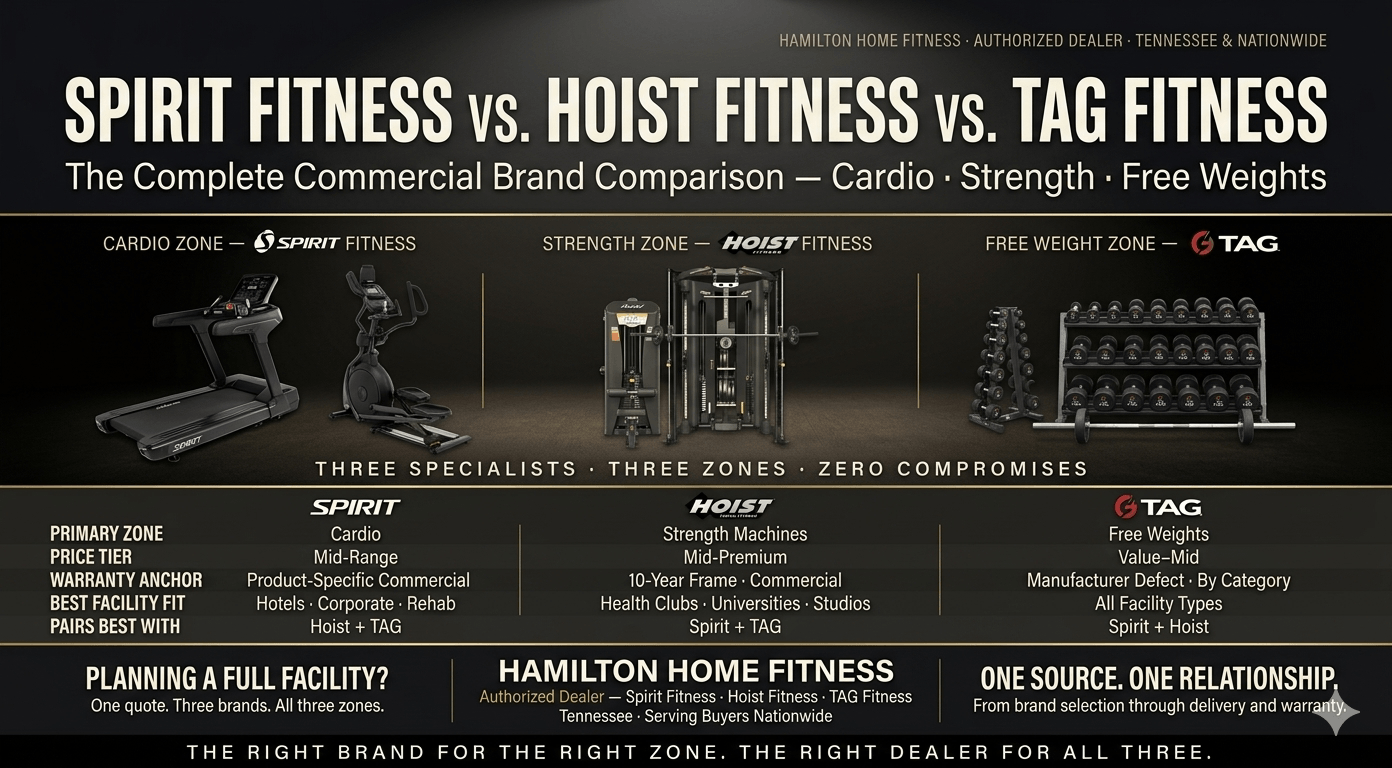
Spirit Fitness, Hoist Fitness, and TAG Fitness are three of the most respected names in commercial gym equipment for facilities & gyms, but they are not interchangeable. Each brand leads in a different zone of a commercial facility. Choosing the wrong one for your space doesn't just mean a suboptimal setup; it can mean equipment that underperforms for your user base, warranty terms that don't match your usage classification, and a cost you'll feel for years.
At Hamilton Home Fitness, we are an authorized dealer for all three brands. That means this comparison has no brand loyalty conflict — we carry Spirit, Hoist, and TAG, and our goal is to help you match the right brand to the right zone in your facility.
What follows is a direct, honest side-by-side: what each brand is built for, where each one leads, where each one has limits, and which facility types they serve best—so you can move from comparison to confident decision.
What These Three Brands Are Built For
Spirit Fitness, Hoist Fitness, and TAG Fitness each lead in a different zone of a commercial facility. Before comparing them on warranty, price, or use-case fit, it helps to understand what each brand was actually designed to do—because buying a strength specialist for your cardio zone or a cardio brand for your free weight floor is the kind of mismatch that costs real money.
Spirit Fitness at a Glance
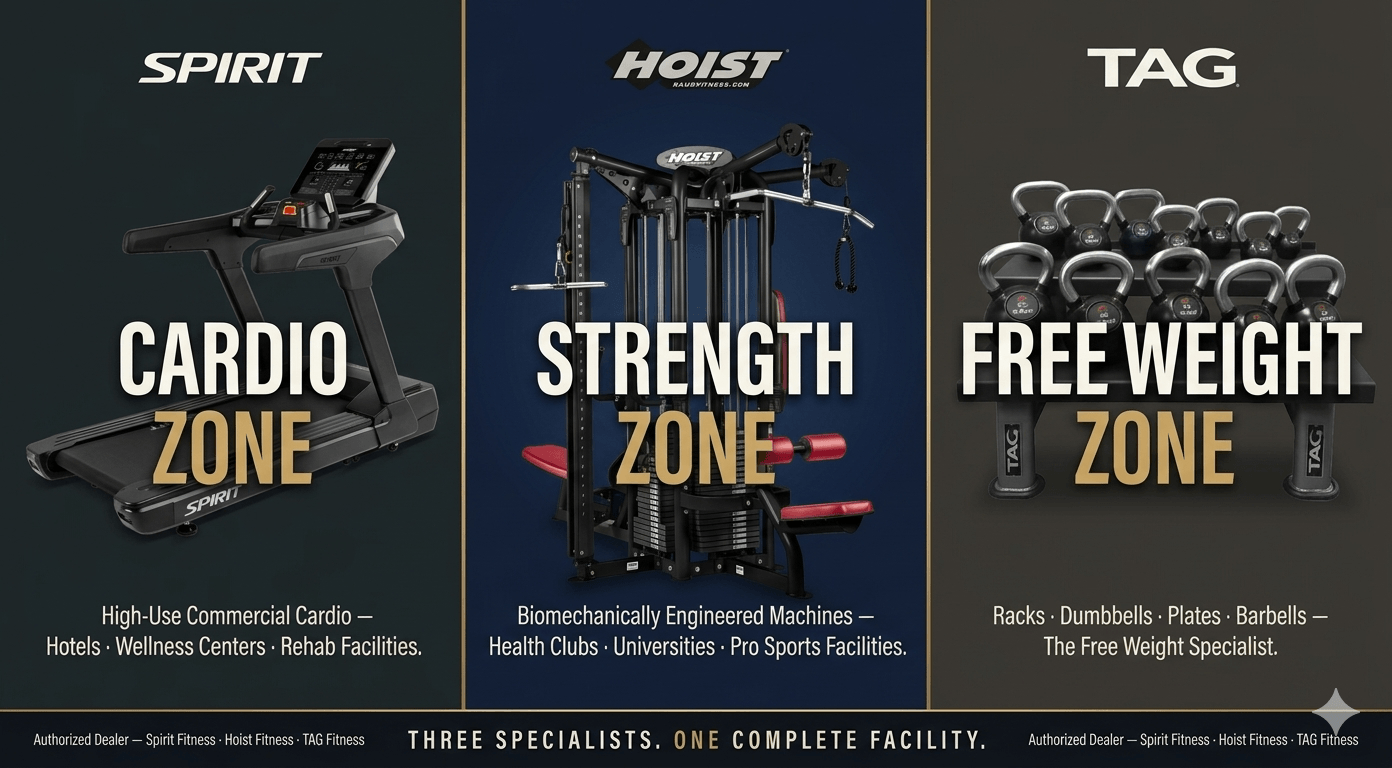
Spirit Fitness is primarily a commercial cardio brand. Their treadmills, ellipticals, upright bikes, recumbent bikes, and stair climbers are engineered for high-use commercial environments — hotels, wellness centers, health clubs, and rehabilitation facilities. Spirit also produces strength machines and rehab equipment, but cardio is where the brand's depth, reputation, and proven track record genuinely sit.
Hoist Fitness at a Glance
Hoist Fitness is a strength-focused commercial brand, founded in 1977 in San Diego, California. They are best known for selectorized machines, cable systems, functional trainers, and plate-loaded equipment built around biomechanically correct movement. Hoist's commercial products are found in health clubs, universities, professional sports facilities, and corporate fitness centers worldwide. Hoist does not offer a cardio line — strength equipment is their entire focus, and that specialization shows in the engineering.
TAG Fitness at a Glance
TAG Fitness is a free weight and strength zone specialist. Founded in 2007, they produce commercially rated dumbbells — rubber hex, ultrathane, and urethane — alongside barbells, bumper plates, rubber Olympic plates, racks, benches, fitness bay systems, and accessory storage. TAG is not a full-line brand competing head-to-head with Spirit or Hoist. It is the specialist that equips the free weight zone that neither of the other two fully covers.
Brand | Primary Category | Price Tier | Best Zone Coverage | Available at HHF |
Spirit Fitness | Commercial Cardio | Mid-Range | Cardio Zone | ✓ Authorized Dealer |
Hoist Fitness | Commercial Strength (Machines) | Mid-Premium | Strength Zone | ✓ Authorized Dealer |
TAG Fitness | Free Weights & Accessories | Value–Mid | Free Weight Zone | ✓ Authorized Dealer |
Spirit Fitness: Commercial Cardio Equipment
Spirit Fitness is a strong choice for commercial cardio zones, particularly in hotels, corporate wellness facilities, and light-to-medium use health clubs where durable, cost-effective cardio is the priority. Their commercial lineup is broad, their build quality is consistent, and their price-to-performance ratio is one of the more competitive in the mid-range commercial market.
Spirit's Commercial Product Range
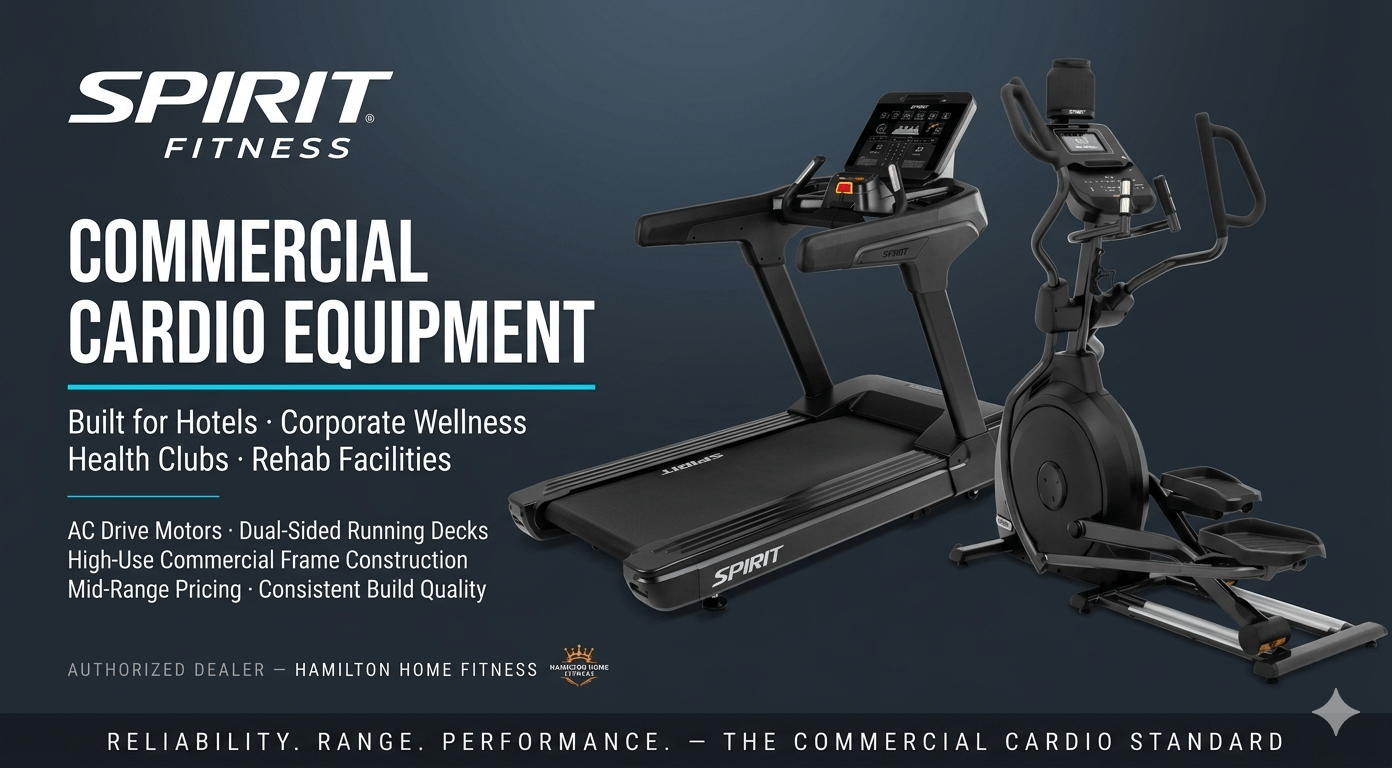
Spirit's commercial lineup is led by cardio. Their CT series and CSS series treadmills are designed for commercial use, with AC drive motors, thick dual-sided running decks, and frame construction built to handle multi-user daily traffic. Beyond treadmills, Spirit offers commercial ellipticals, upright bikes, recumbent bikes, stair climbers, and rowers — giving facilities enough variety to build a complete cardio zone from a single brand.
Spirit also produces strength machines and rehabilitation equipment, including abdominal and core stations. That said, their strength line is a secondary offering, not a primary one. Facilities that need deep machine-based strength coverage will need to look beyond Spirit for that zone.
For facilities planning a full cardio zone, Spirit's range makes it straightforward to choose the best commercial cardio equipment without mixing brands across the cardio floor.
Spirit Fitness Warranty and Build Quality
Spirit's residential products carry strong warranty terms—lifetime coverage on the frame, motor, and deck is standard across much of their residential lineup, with ten-year parts coverage on qualifying models. Commercial warranty terms, however, are product-specific and use-classification-dependent.
This distinction matters. A Spirit treadmill installed in a hotel gym may fall under different warranty coverage than the same model installed in a dues-paying health club. The commercial classification is tied to usage volume and facility type, and the terms vary accordingly.
What this means for buyers: confirm the exact commercial warranty tier for each Spirit model you're considering, based on your facility's usage classification. Your authorized dealer — not the residential product page — is the right source for that confirmation.
On build quality, Spirit machines are consistently noted for frame durability, low-maintenance deck systems, and reliable motor performance in high-use settings. The CT900 series, for example, uses a 5.0 HP AC drive system and a cushioned polyurethane shock absorption design—construction choices that reflect a genuine commercial use standard, not a residential machine rebranded for light commercial.
When to Choose Spirit Fitness
Spirit Fitness is the right fit when your facility's primary need is a reliable, mid-range commercial cardio zone. It performs consistently across hotel gyms, corporate wellness spaces, apartment complexes, rehabilitation-adjacent facilities, and light-to-medium use health clubs.
If your facility is cardio-heavy — meaning cardio is the main offering and strength equipment is secondary — Spirit can carry that zone without requiring a premium brand budget. If your facility needs both a strong cardio zone and a professionally equipped strength zone, Spirit handles cardio while Hoist or TAG covers strength.
Where Spirit is not the strongest fit: facilities that need deep, selectorized strength coverage or buyers whose primary requirement is premium machine aesthetics and biomechanical engineering. For those needs, Hoist is the more appropriate choice.
For a closer look at how Spirit fits into a broader facility plan, the guide to commercial cardio equipment for fitness facilities covers cardio zone planning in more detail.
Shop Spirit Fitness Equipment at HHF — browse the full Spirit Fitness commercial lineup at Hamilton Home Fitness.
Hoist Fitness: Commercial Strength Equipment
Hoist Fitness is one of the most technically advanced commercial strength brands available at the mid-premium price tier. For facilities where machine-based strength training is a primary offering — not an afterthought — Hoist's engineering quality, warranty backing, and biomechanical design make it worth serious consideration. The investment is higher than some alternatives, but for the right facility type, it is a justified one.
Hoist's Commercial Product Range
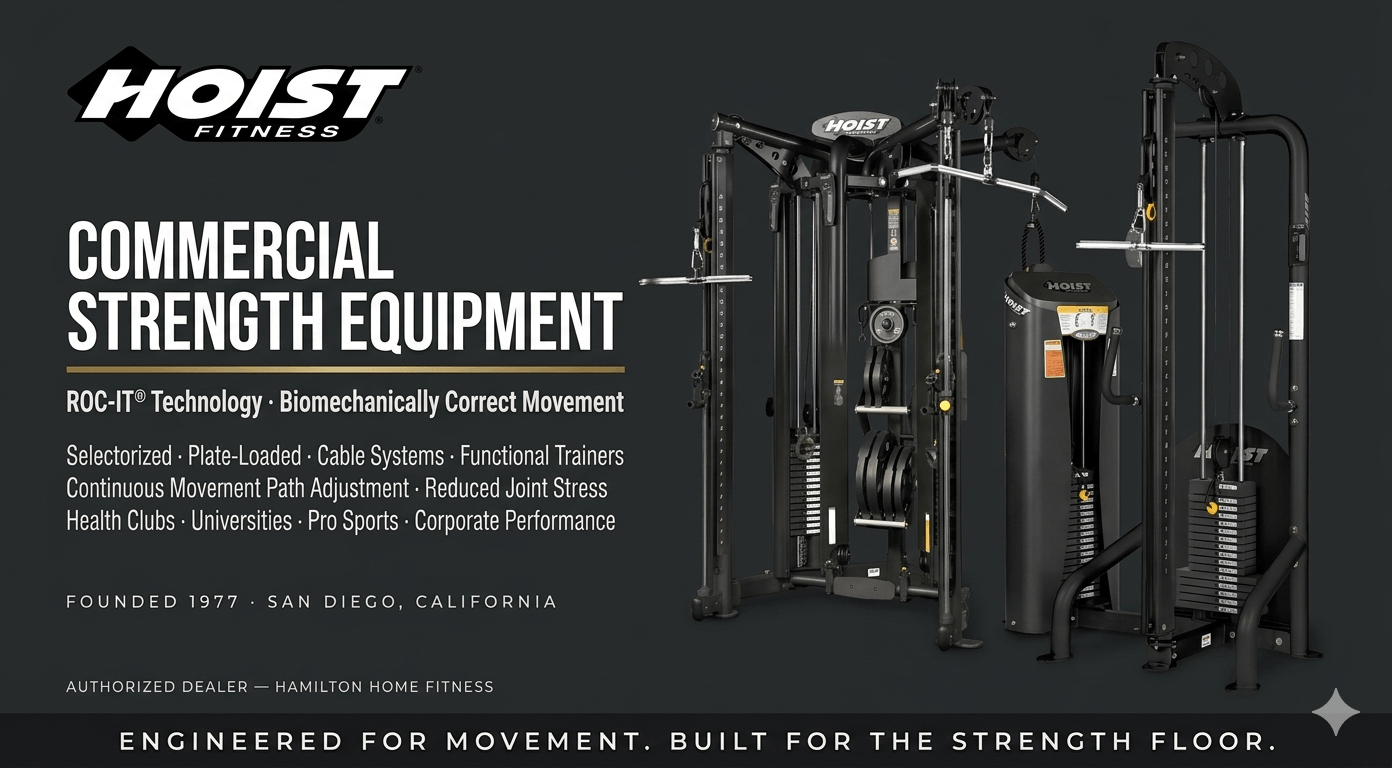
Hoist's commercial product range centers entirely on strength. There is no cardio line — every product Hoist makes is designed to train the body through resistance, cable movement, or functional loading.
Their flagship commercial offering is the ROC-IT selectorized series. ROC-IT machines use Hoist's proprietary ROX technology, which synchronizes the seat position with the movement of the exercise arm throughout each rep. The result is a biomechanically correct movement path that adjusts continuously to the user—reducing joint stress, improving muscle engagement, and delivering a smoother training experience than fixed-path selectorized machines. The ROC-IT line is available in both selectorized and plate-loaded configurations.
Alongside ROC-IT, Hoist produces the CF Commercial Freeweight line — a range of plate-loaded machines, Olympic benches, hack squats, and multi-press stations built with European-influenced aesthetics and American engineering. Their cable machine and functional trainer options complete the strength floor, and their rack systems serve facilities that need heavy-duty free weight infrastructure alongside selectorized equipment.
For facilities evaluating selectorized and plate-loaded options in detail, the Commercial Strength Machines: The Selectorized & Plate-Loaded Guide covers the category thoroughly before you commit to a brand.
Hoist Fitness Warranty and Build Quality
Hoist's warranty structure is one of the stronger ones in commercial fitness, and understanding it correctly matters because Hoist applies different terms depending on how a facility is classified.
Under Hoist's own definitions, "commercial" applies to facilities that charge monthly membership dues and where equipment is used by more than 50 people per day. "Light commercial" applies to facilities that do not charge membership dues and where daily usage stays below 50 users—a category that includes hotels, apartment complexes, personal training studios, fire stations, and similar environments.
For residential products, Hoist offers a lifetime frame and body warranty. For commercial and light commercial classifications, frame and body coverage is confirmed at 10 years, with structural moving parts and cable, upholstery, and accessory terms varying by product—with the commercial classification carrying shorter consumable coverage than light commercial, reflecting higher usage expectations.
The practical implication: a hotel gym and a dues-paying health club will not receive the same Hoist warranty terms. Confirm which classification applies to your facility before finalizing your order. Your authorized dealer is the right place to verify this—warranty terms are tied to original purchaser status and proper registration.
On build quality, Hoist machines are consistently recognized for smooth cable travel, solid weight stack engineering, durable powder coat finishes, and a premium aesthetic that holds up visually in high-end facilities. Their gas-assisted seat adjustments and color-coded levers reduce setup friction for new users — a practical detail that matters in high-traffic commercial environments.
When to Choose Hoist Fitness
Hoist Fitness is the right fit for facilities where the strength zone is a core part of the offering. Health clubs, university fitness centers, corporate performance gyms, professional training facilities, and boutique studios that want premium selectorized or plate-loaded machines are all strong candidates.
The ROC-IT series is particularly well-suited to facilities where member experience and movement quality are differentiators — the biomechanical engineering is visible and felt in use, which reflects positively on the facility's overall standard.
Where Hoist is not the strongest fit: facilities with a tight budget that need broad zone coverage across cardio, strength, and free weights simultaneously. Hoist earns its price in the strength zone, but it does not cover cardio — meaning any facility choosing Hoist will need a cardio brand alongside it. Spirit Fitness is the natural pairing for that gap.
A hoist is also less appropriate as a standalone choice for facilities where free weight training—barbells, dumbbells, and bumper plates—is the dominant programming style. For that zone, TAG Fitness is the more focused and cost-effective solution.
Shop Hoist Fitness Equipment at HHF — browse the full Hoist Fitness commercial lineup at Hamilton Home Fitness.
TAG Fitness: Free Weights and Strength Zone Equipment
TAG Fitness is the free weight specialist of the three brands. Its role in a commercial facility is different from Spirit and Hoist — TAG does not compete for the cardio zone or the selectorized machine floor. It equips the free weight area, the dumbbell rack, the barbell station, and the functional strength accessories that complete a facility's strength offering. For any commercial buyer planning a full facility, TAG is typically the third layer — but it is a necessary one.
TAG's Commercial Product Range
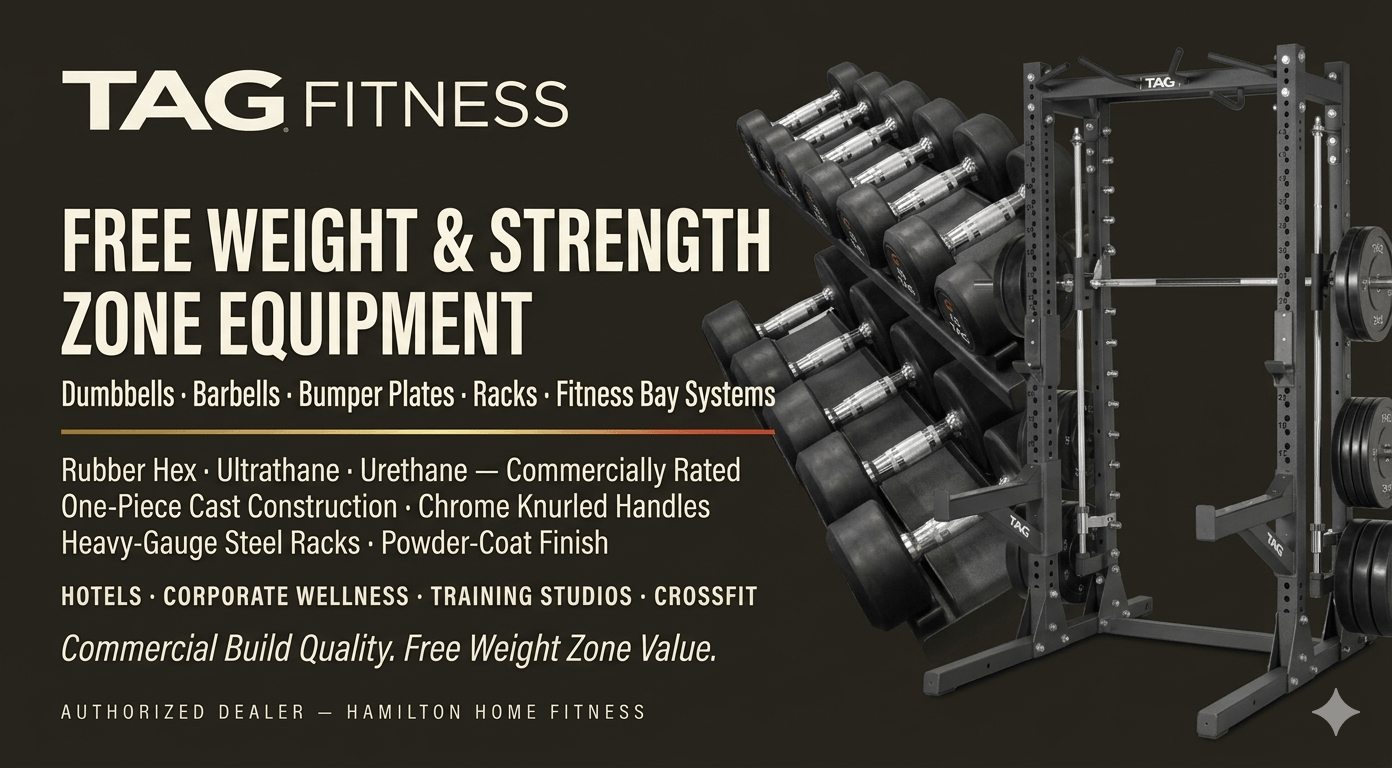
TAG Fitness covers the free weight zone comprehensively. Their dumbbell range alone spans three commercial-grade surface options: rubber hex dumbbells, 8-sided urethane dumbbells, and premium ultrathane dumbbells—each designed for different facility priorities around floor protection, durability, aesthetics, and odor resistance.
Rubber hex dumbbells use a one-piece solid cast construction encased in virgin rubber, with chrome knurled handles and a 6-sided design that prevents rolling and protects flooring. Ultrathane dumbbells step up in durability and appearance—urethane outperforms rubber in longevity, resists cracking and fading, and maintains a cleaner look under heavy daily use. Both options are commercially rated and available in full sets with matching rack systems.
Beyond dumbbells, TAG produces Olympic barbells, bumper plates, rubber Olympic plates, fixed straight barbells, and EZ curl bars—giving facilities everything needed to build a complete barbell training station. Their rack lineup includes hex dumbbell racks, vertical dumbbell racks, saddle racks, plate trees, barbell racks, and multi-tier storage systems built from heavy-gauge commercial steel with powder-coat finishes.
TAG's fitness bay systems — including their Double Standard Fitness Bay and multi-station jungle gym configurations — extend their range into organized multi-user strength zones suitable for schools, training studios, and corporate wellness facilities. Accessory storage, medicine ball racks, kettlebell racks, and cable accessory racks round out a product line built to organize and equip an entire strength floor.
For facilities evaluating their full free weight needs before committing to a brand, the Commercial Free Weights Buying Guide covers selection criteria in depth.
TAG Fitness Warranty and Value Position
TAG Fitness products are backed by manufacturer warranties against defects—the specific terms vary by product category, and commercial buyers should confirm coverage for each item at the time of purchase through their authorized dealer.
For dumbbells, the standard warranty covers manufacturing defects for the original owner under normal usage conditions. Normal usage is defined carefully — dropping, throwing, or bouncing dumbbells falls outside warranty coverage, which is consistent with commercial free weight standards across the industry. Rack and frame products carry their own separate terms, generally reflecting the structural nature of the product.
What TAG brings beyond warranty is a strong value position. Commercially rated free weights and racks at TAG's price tier are difficult to match without stepping down in quality or moving to an overseas manufacturer with less consistent quality control. For facilities that need to equip a full dumbbell rack set — say, 5 to 100 lbs in pairs with a matching rack system — TAG delivers commercial build quality without the premium pricing that a full-line brand would attach to the same zone.
This value position makes TAG particularly practical for buyers allocating a larger share of their budget to cardio or selectorized strength machines. The free weight zone does not have to be where a budget gets stretched—and with TAG, it typically does not need to be.
When to Choose TAG Fitness
TAG Fitness is the right fit when you need to equip a complete free weight zone with commercially rated dumbbells, barbells, plates, and racks at a strong price-to-quality ratio. That applies whether TAG is the only brand in the facility or the third layer in a Spirit and Hoist setup.
For hotel gyms, TAG's dumbbell sets and compact rack options provide a professional free weight area without overcrowding a smaller footprint. For corporate wellness facilities, a TAG dumbbell rack set alongside Spirit cardio and Hoist machines covers all three zones cleanly. For CrossFit boxes and training studios, TAG's bumper plates, Olympic barbells, and fitness bay systems are a natural match for the programming demands of those environments.
For facilities planning their rack and structural strength zone alongside free weights, the Commercial Power Racks & Squat Cages: The Gym Buyer's Guide is a useful next step before finalizing the free weight floor plan.
Where TAG is not the right standalone choice: any facility that needs cardio equipment or selectorized strength machines as primary offerings. TAG completes a facility — it does not replace a full-line brand for those zones. Pair it with Spirit for cardio, Hoist for machines, or both for a complete three-zone setup.
Shop TAG Fitness Equipment at HHF — browse the full TAG Fitness commercial lineup at Hamilton Home Fitness.
Spirit vs. Hoist vs. TAG: Side-by-Side Comparison
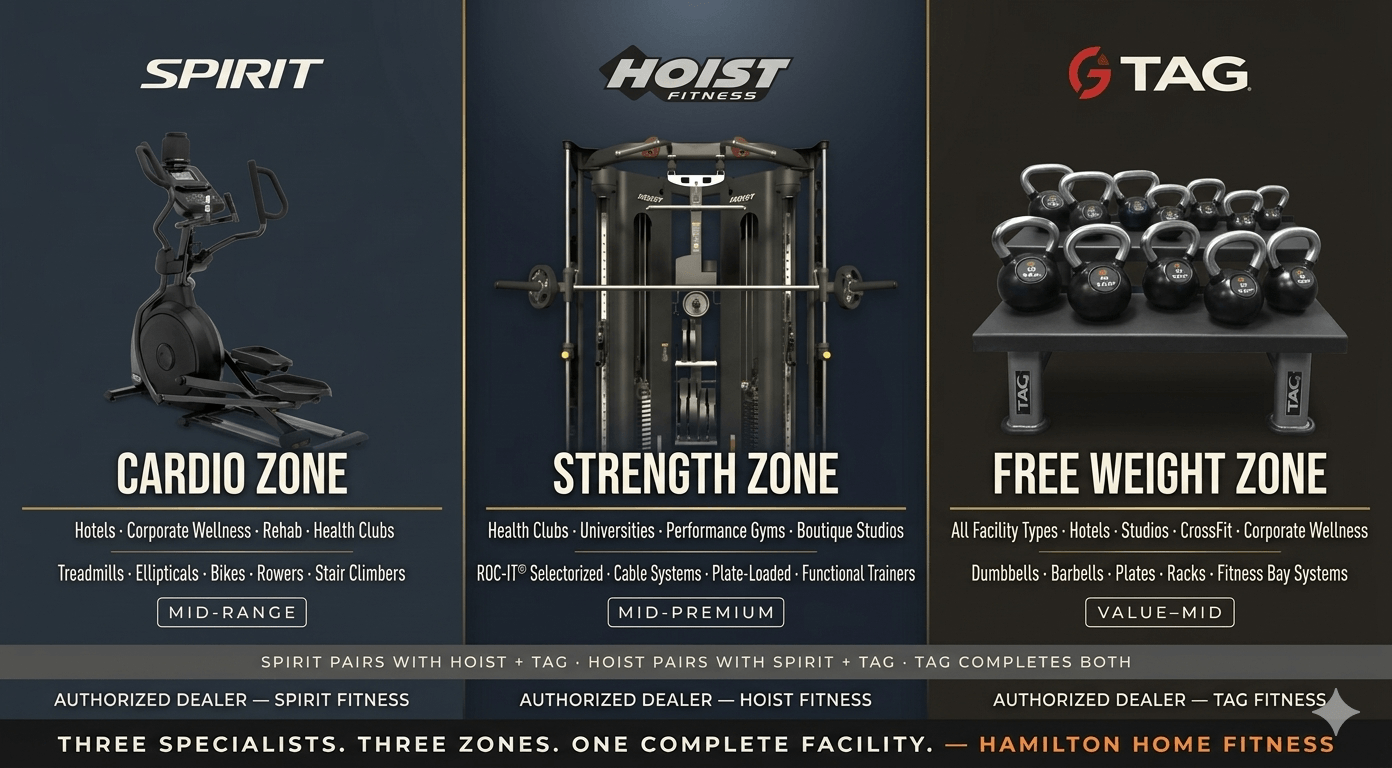
No single brand in this comparison wins across every criterion, and that is not a weakness in any of them. It reflects the reality that Spirit, Hoist, and TAG were each built to lead in a specific zone. The table below consolidates the most important buying criteria so you can compare at a glance, rather than holding three separate brand profiles in mind simultaneously.
If you are still working through broader equipment decisions beyond brand selection, the Commercial Gym Equipment Buying Guide covers facility planning criteria in fuller depth.
Criteria | Spirit Fitness | Hoist Fitness | TAG Fitness |
Primary Category | Commercial Cardio | Commercial Strength (Machines) | Free Weights & Accessories |
Cardio Coverage | Full — treadmills, ellipticals, bikes, rowers, stair climbers | None | None |
Selectorized Strength | Limited secondary offering | Full — ROC-IT series, cable machines, functional trainers, CF plate-loaded line | None |
Free Weight Coverage | None | Partial rack systems and CF benches | Full — dumbbells, barbells, plates, racks, fitness bays |
Commercial Warranty | Product-specific; confirm tier with dealer based on facility classification | Lifetime frame (original purchaser); moving parts and consumables vary by commercial vs. light commercial classification | Manufacturer defect warranty; terms vary by product category |
Relative Price Tier | Mid-Range | Mid-Premium | Value–Mid |
Brand Depth in Primary Zone | Strong | Strong | Strong |
Best Facility Fit | Hotels, corporate wellness, rehab-adjacent, health clubs | Health clubs, universities, boutique studios, performance gyms | All facility types—free weight zone complement |
Works Best When Paired With | Hoist (strength) + TAG (free weights) | Spirit (cardio) + TAG (free weights) | Spirit and/or Hoist for a complete facility |
Available at HHF | ✓ Authorized Dealer | ✓ Authorized Dealer | ✓ Authorized Dealer |
The pattern in this table is deliberate: Spirit and Hoist each lead in their respective zones but leave gaps that the other fills. TAG completes the picture by covering free weights—the zone neither Spirit nor Hoist addresses fully.
A few points worth holding from this comparison before moving to facility-specific guidance:
On warranty: All three brands tie warranty terms to usage classification—commercial, light commercial, or residential. The frame-level coverage across all three brands is genuinely strong, but consumable and parts coverage narrows in true commercial classifications. Confirm the specific tier for your facility type before purchasing, regardless of which brand you choose.
On price tier: The gap between Spirit and Hoist reflects their respective zones, not a quality gap within those zones. Spirit is competitive for mid-range commercial cardio. Hoist commands a higher price because premium biomechanical engineering in selectorized machines costs more to produce. TAG's value position reflects the free weight category, where commercial-grade quality does not require premium brand pricing.
On coverage gaps: No facility should expect a single brand from this group to cover all three zones at full commercial depth. A complete facility—cardio zone, machine strength zone, and free weight zone—almost always benefits from at least two of these brands working together. The next section maps that out by facility type.
Which Brand Fits Your Facility?
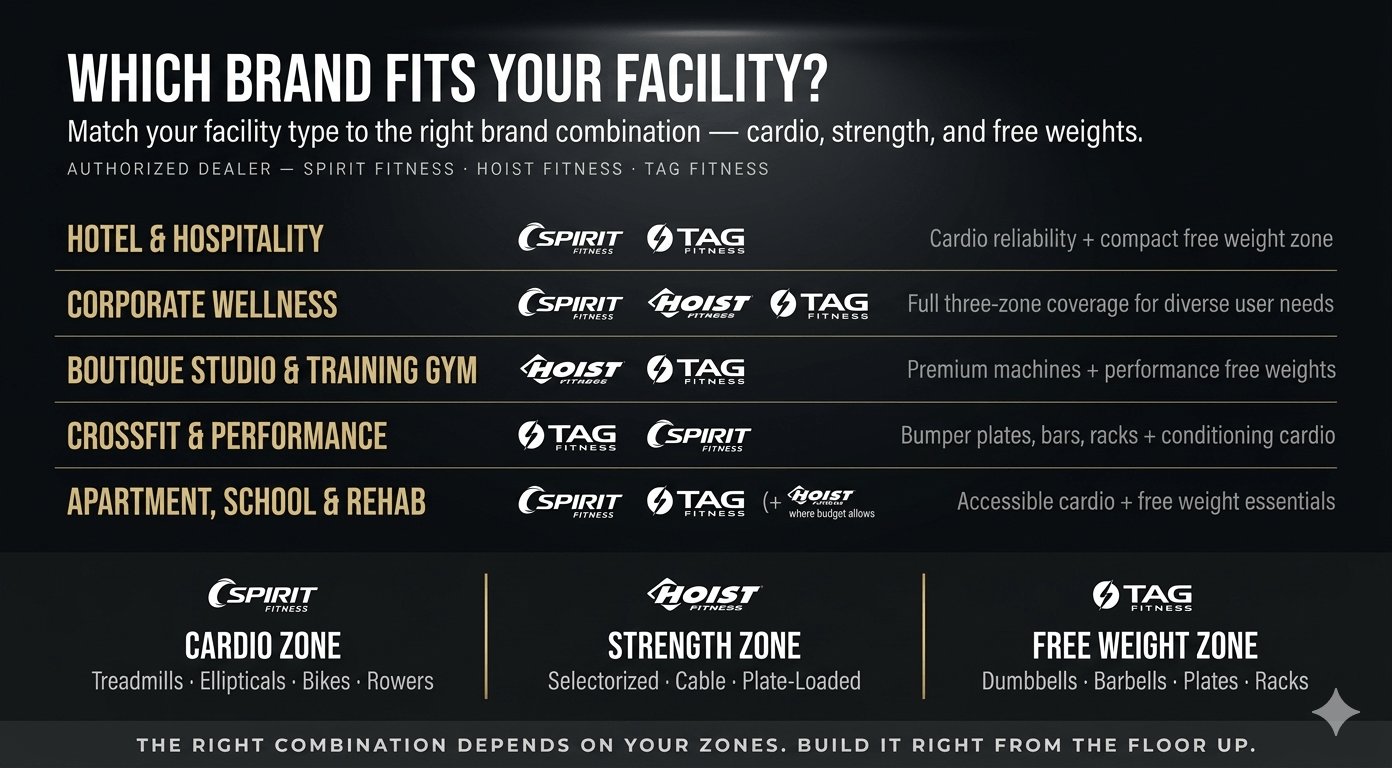
The right brand — or brand combination — depends on three things: your facility type, your dominant usage pattern, and which zones matter most to your members or guests. The guidance below maps each major facility type to a direct brand recommendation. Where a multi-brand approach delivers a better outcome than a single brand, it says so clearly.
Hotel and Hospitality Gyms
For hotel gyms, Spirit Fitness handles the cardio zone reliably. The CT and CSS series treadmills are well-suited to unsupervised, multi-user environments — they are built for consistent daily use, require minimal operator intervention, and offer simple interfaces that guests can navigate without staff assistance. Spirit's ellipticals and upright bikes round out a compact cardio floor without requiring complex maintenance routines.
TAG Fitness completes the picture. A professionally specified dumbbell rack set—rubber hex or urethane dumbbells from 5 to 50 lbs paired with a matching saddle or vertical rack—gives hotel guests a functional free weight area in a compact footprint. TAG's rack systems are designed for organized, space-efficient storage, which matters in hotel fitness rooms where floor space is limited and visual presentation reflects directly on the property.
A practical hotel gym configuration: two to three Spirit treadmills, one or two Spirit ellipticals, a Spirit upright or recumbent bike, and a TAG dumbbell rack set. That combination covers what the majority of hotel guests expect from a fitness center, at a budget that most hospitality operators can defend.
Hoist is worth considering for hotels positioning their fitness center as a genuine guest experience differentiator—a boutique property or full-service resort where premium strength machines signal a higher standard. For standard hotel gyms, the Spirit and TAG combination is the more practical and cost-efficient route.
Corporate and Workplace Wellness Facilities
Corporate wellness facilities serve a diverse user base — some employees want cardio, others want machine-based strength training, and a portion want free weights. That range of needs almost always calls for a multi-brand approach.
Spirit Fitness covers the cardio zone. Their commercial treadmills, ellipticals, and bikes are appropriate for the daily usage patterns of a corporate wellness room—consistent but not extreme volume, a mix of user fitness levels, and a need for reliable uptime since downtime in a corporate facility reflects on the program's credibility.
Hoist Fitness handles the machine strength zone. For a corporate gym where selectorized equipment needs to serve users ranging from first-time exercisers to experienced lifters, Hoist's intuitive gas-assisted adjustments, color-coded levers, and biomechanically guided movement paths reduce the learning curve and support safe independent use—both important in an environment without full-time fitness staff.
TAG Fitness completes the free weight area. A dumbbell set with a hex rack or saddle rack system, a set of bumper plates and an Olympic barbell, and an adjustable bench give employees a functional strength zone that complements the Hoist machines without duplicating them.
A well-specified corporate wellness facility running Spirit cardio, Hoist selectorized machines, and TAG free weights covers all three zones at a standard that reflects well on the organization's commitment to employee well-being—without requiring a health club budget.
Boutique Studios and Training Gyms
Boutique studios and performance-focused training gyms have higher expectations for equipment quality, aesthetics, and movement precision than most other facility types. Members in these environments notice the difference between machines that are engineered well and machines that merely function.
Hoist Fitness is the primary recommendation for the machine strength zone in a boutique studio. The ROC-IT series carries a visual and functional premium that fits the positioning of a boutique training environment—the design is modern, the movement quality is genuinely different from standard selectorized machines, and the engineering story gives trainers something real to explain to clients. A hoist-cable machine or functional trainer as the centerpiece of a studio strength zone makes a clear statement about the facility's standard.
TAG Fitness covers the free weight floor. For strength-focused studios, TAG's ultrathane dumbbell sets, Olympic barbells, bumper plates, and fitness bay systems match the programming demands of performance training without the cost of a premium brand for every item on the floor.
For CrossFit boxes specifically, TAG's bumper plate sets, Olympic bars, and rack systems are a natural match. The equipment is commercially rated for the drop frequency and loading intensity that CrossFit programming generates. A TAG fitness bay system can organize the functional strength zone efficiently, keeping the floor clear for conditioning work. For a full picture of what a CrossFit facility needs across all equipment categories, the CrossFit Gym Equipment Guide covers the complete setup in detail.
Spirit may be added for conditioning cardio—bikes and rowers integrate naturally into CrossFit and metabolic conditioning programming—but the primary investment for a training gym or CrossFit box sits with Hoist and TAG.
Apartment Complexes, Schools, and Rehab Facilities
These three facility types share a common characteristic: their users are diverse in age, fitness level, and training experience. Equipment needs to be accessible, durable, and easy to use without staff supervision.
For apartment and multi-family complexes, Spirit Fitness is the most practical cardio choice. Their light commercial classification covers the usage volume of a typical apartment gym, their interfaces are straightforward for residents of all fitness levels, and their build quality holds up under the variable maintenance attention that residential-managed facilities typically receive. TAG completes the free weight area with a compact dumbbell rack setup that serves the majority of resident needs without requiring significant floor space.
For school and university fitness centers, the combination depends on budget and programming. A Spirit and TAG setup covers the core needs at an accessible price point—Spirit for the cardio zone and TAG for dumbbells, racks, and barbell stations. Where budget allows, Hoist selectorized machines add a supervised strength zone appropriate for student populations who benefit from guided movement paths and lower injury risk compared to free weight training alone.
For rehabilitation-adjacent facilities—hospital wellness centers, physical therapy clinics, and community rehab programs—Spirit's commercial rehab-friendly cardio equipment, including recumbent bikes and low-impact ellipticals, is well-suited to the movement demands of recovering users. TAG's lighter dumbbell increments and adjustable bench options support progressive resistance programming in a rehab context. Hoist's biomechanically guided machines may also be appropriate where supervised machine-based resistance training is part of the clinical program.
In all three facility types, the budget-conscious route is Spirit for cardio and TAG for free weights. Where the facility's programming or user population justifies the additional investment, Hoist strengthens the strength zone without disrupting the overall brand strategy.
Single Brand or Multi-Brand Strategy?
Most commercial buyers arrive at this question eventually: Is it better to commit to one brand across the entire facility or to source the best brand for each zone and combine them?
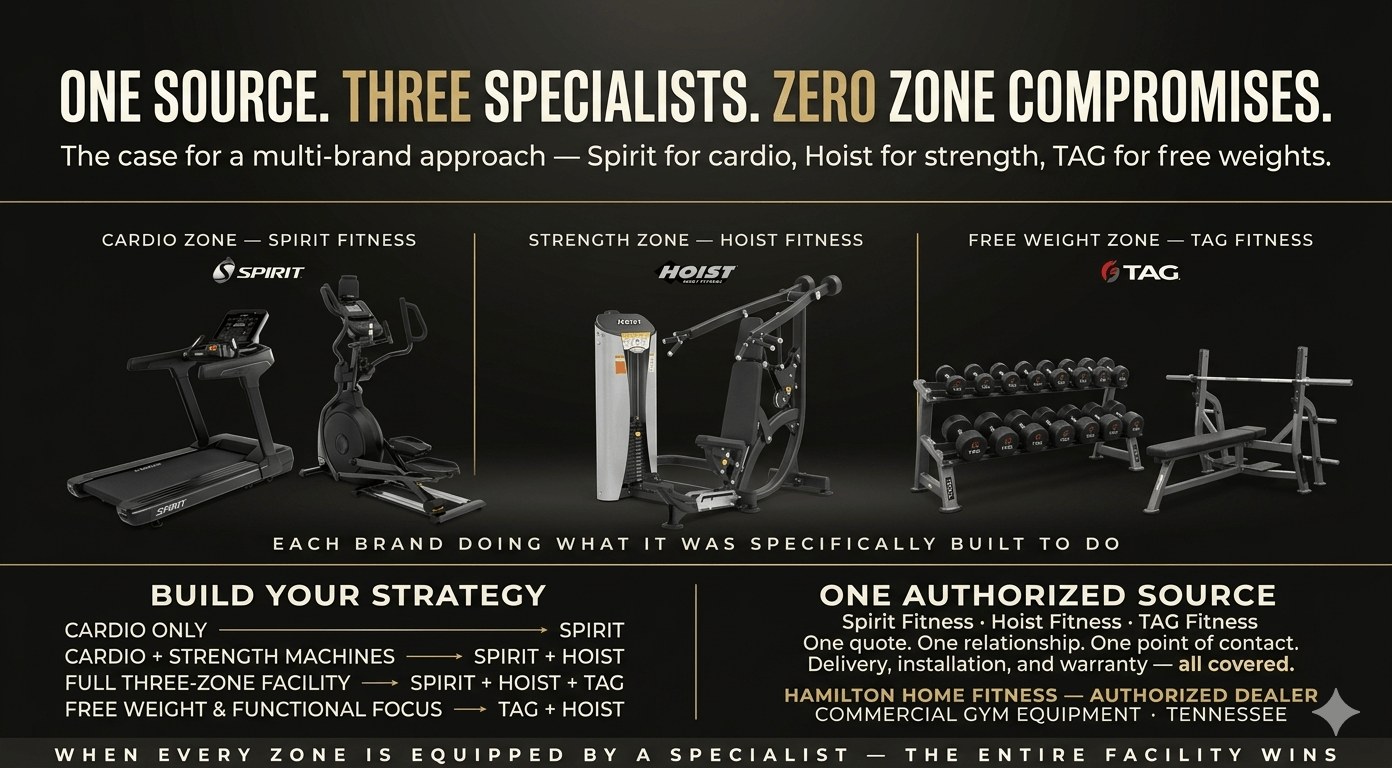
The honest answer depends on your facility type and priorities — but for most commercial setups in the mid-range to mid-premium tier, a multi-brand approach delivers a better outcome than forcing a single brand to cover zones it was not designed to lead.
The case for a single-brand strategy is straightforward: visual consistency, simplified procurement, a single warranty contact, and a unified aesthetic across the floor. It works well when one brand genuinely covers all the zones your facility needs at the depth you require. In practice, that condition is rarely met by Spirit, Hoist, or TAG individually—each leads in one zone and leaves meaningful gaps in the others. A single-brand approach makes more sense with full-line brands that manufacture strong cardio, selectorized strength, and free weight equipment under one roof. For the three brands in this comparison, it is not the strongest argument.
The case for a multi-brand strategy is that each zone of a commercial facility has different engineering demands. Cardio equipment requires motor reliability, belt and deck durability, and user-interface simplicity. Selectorized strength machines require biomechanical precision, cable system quality, and frame integrity under heavy repeated loading. Free weights require material density consistency, surface durability, and rack structural integrity. These are different problems—and brands that specialize solve them better than brands that generalize.
Spirit, Hoist, and TAG were each built around one of those problems. Running them together across their respective zones produces a facility where every piece of equipment is doing what it was specifically designed to do. That is a stronger foundation than stretching one brand across all three zones at uneven depth.
A practical decision framework:
If your facility is cardio-only or cardio-primary — Spirit alone is a defensible single-brand choice.
If your facility needs cardio and selectorized strength—Spirit and Hoist together cover both zones at full commercial depth.
If your facility needs cardio, strength machines, and free weights—Spirit, Hoist, and TAG are the complete three-zone strategy.
If your facility is free weight and functional training focused, TAG handles the floor, with HOIST added for machine-based strength if programming requires it.
The one practical concern buyers raise about a multi-brand approach is procurement complexity — managing multiple dealer relationships, coordinating separate deliveries, and handling warranty questions across different brand contacts. That concern is real when you are sourcing from multiple dealers. It largely disappears when all three brands come from one authorized source.
Hamilton Home Fitness carries Spirit Fitness, Hoist Fitness, and TAG Fitness under one roof as an authorized dealer for each. That means one quote covers all three brands, one relationship manages delivery and installation coordination, and one point of contact handles warranty questions regardless of which brand the equipment belongs to. For buyers mixing brands across zones—which most complete commercial facilities do—that single-source structure removes the friction that makes multi-brand procurement feel complicated.
Whether you are outfitting a single zone or planning a full facility across all three, working with a commercial gym equipment supplier in Tennessee that carries authorized inventory for all three brands means your equipment selection is not limited by what one dealer happens to stock.
If you are still working through the broader equipment decision before narrowing to brand selection, the resource to choose the best commercial gym equipment covers the full commercial buying process from zone planning through final specification.
When you are ready to move from comparison to purchase, you can shop quality fitness gear and equipment at Hamilton Home Fitness—Spirit, Hoist, and TAG Fitness are all available through HHF, with consultation support for buyers who want guidance before committing to a configuration.
Frequently Asked Questions
What is the difference between Spirit Fitness and Hoist Fitness?
Spirit Fitness and Hoist Fitness serve different zones of a commercial facility. Spirit is primarily a cardio brand — treadmills, ellipticals, bikes, and rowers built for high-use commercial environments. Hoist is a strength brand—selectorized machines, cable systems, functional trainers, and plate-loaded equipment engineered around biomechanically correct movement. They are complementary brands, not competing ones. Most complete commercial facilities benefit from running both.
Is Spirit Fitness good for commercial gyms?
Yes. Spirit Fitness is a well-established commercial cardio brand used in hotels, health clubs, corporate wellness facilities, and rehabilitation centers. Their CT and CSS series treadmills, along with their commercial ellipticals and bikes, are designed and rated for commercial use. Spirit is best suited for facilities where cardio is the primary offering—for facilities that also need deep selectorized strength coverage, Spirit works best alongside HOIST.
Is Hoist Fitness worth the price for a commercial facility?
For facilities where machine-based strength training is a core part of the offering, Hoist's engineering quality, biomechanical precision, and warranty backing typically justify the investment. The ROC-IT series in particular delivers a movement quality that users notice and that reflects positively on the facility. Where Hoist is harder to justify is in facilities with minimal machine-based strength programming, tight budgets spread across all three zones, or usage patterns that do not demand premium selectorized engineering.
What type of equipment does TAG Fitness specialize in?
TAG Fitness specializes in commercially rated free weights and strength zone accessories. Their product range includes rubber hex dumbbells, ultrathane dumbbells, 8-sided urethane dumbbells, Olympic barbells, bumper plates, rubber Olympic plates, hex dumbbell racks, vertical racks, saddle racks, fitness bay systems, benches, plate trees, barbell racks, and accessory storage. TAG is not a full-line brand—it is the specialist that equips the free weight zone that Spirit and Hoist do not fully cover.
Which brand has the best warranty — Spirit, Hoist, or TAG?
Each brand's warranty strength depends on the product category and the facility's usage classification—so a direct ranking is not straightforward. Hoist offers a lifetime frame and body warranty for original purchasers on qualifying products, with structural moving parts and consumable coverage varying by commercial versus light commercial classification. Spirit's residential products carry strong lifetime frame, motor, and deck coverage, but commercial warranty terms are product-specific and use-classification-dependent. TAG's products are covered by manufacturer defect warranties that vary by product category. For all three brands, commercial buyers should confirm the exact warranty tier that applies to their facility type with their authorized dealer before purchasing.
Is Hoist better than Spirit Fitness for strength machines?
Yes. Hoist is the strength specialist of the two—selectorized machines, cable systems, and functional trainers are the entirety of their commercial focus. Spirit's strength machine line exists but is secondary to their cardio offering and does not match Hoist's depth, engineering precision, or product range in that category. For any facility where selectorized strength machines are a primary offering, Hoist is the more appropriate choice.
Does Hamilton Home Fitness carry Spirit Fitness, Hoist, and TAG Fitness?
Yes. Hamilton Home Fitness is an authorized dealer for all three brands — Spirit Fitness, Hoist Fitness, and TAG Fitness — serving buyers in Tennessee and nationwide. This means all three brands can be sourced through a single point of contact, with authorized warranty support, genuine manufacturer inventory, and consultation available for buyers planning a multi-brand facility setup.
Which brand is best for a hotel gym?
Spirit Fitness is the most practical cardio choice for hotel gyms. Their CT and CSS series treadmills are built for unsupervised multi-user environments, require minimal operator maintenance, and offer interfaces simple enough for guests to use without staff assistance. TAG Fitness rounds out the space with a commercially rated dumbbell rack set at a strong price point. For hotels positioning their fitness center as a premium guest experience differentiator, Hoist selectorized machines are worth considering as an upgrade to the strength zone.
What brands do authorized commercial gym dealers carry in the USA?
Authorized commercial dealers vary by brand agreement and region. Buying from an authorized dealer matters because it guarantees access to manufacturer warranty support, genuine replacement parts, and brand-direct service — none of which are assured when purchasing through unauthorized resellers or gray-market channels. Hamilton Home Fitness is an authorized dealer for Spirit Fitness, Hoist Fitness, and TAG Fitness, among other commercial brands, serving buyers across the United States.
Which brand is best for a CrossFit box?
TAG Fitness is the natural fit for a CrossFit box's free weight floor—bumper plates, Olympic barbells, hex dumbbells, and rack systems are all commercially rated for the drop frequency and loading intensity that CrossFit programming generates. TAG's fitness bay systems work well for organizing a multi-user functional strength zone. Hoist can serve the accessory machine zone if the facility programs machine-based accessory work. Spirit bikes and rowers integrate naturally into conditioning programming where cardio equipment is part of the training model.
Final Thoughts
Spirit Fitness, Hoist Fitness, and TAG Fitness each earn their place in a commercial facility—but none of them earn it everywhere. Spirit leads the cardio zone. Hoist leads the machine strength zone. TAG leads the free weight floor. The clearest takeaway from this comparison is that the right brand is not the one with the best overall reputation — it is the one built for the zone you are trying to equip.
For most complete commercial facilities, that means at least two of these brands working together. For a full three-zone setup—cardio, selectorized strength, and free weights—all three working in combination is the most logical and practical outcome this comparison points toward.
The decision you are facing is a significant capital investment. It deserves more than a specification sheet and a price list. It deserves a conversation with someone who carries all three brands, understands the differences between them, and has no incentive to push you toward one over another.
That is exactly the position Hamilton Home Fitness is in.
As an authorized dealer for Spirit Fitness, Hoist Fitness, and TAG Fitness — serving buyers in Tennessee and across the United States — HHF can help you plan a single-zone purchase or a complete multi-brand facility setup from one place. One quote. One authorized source. One point of contact from selection through delivery.
Your next step depends on where you are in the process:
Know which brand you need? Browse Spirit Fitness, Hoist Fitness, or TAG Fitness equipment directly at HHF and request a commercial quote.
Still weighing your options? Book a brand consultation with the HHF team—bring your floor plan, your budget range, and your facility type, and get a recommendation built around your specific situation.
Planning a full facility? Request a multi-brand quote that covers all three zones in a single conversation.
Whatever your facility type — hotel gym, corporate wellness space, boutique studio, CrossFit box, school fitness center, or rehabilitation facility — the right equipment combination exists within these three brands. The right place to source all of it is to shop for quality fitness gear and equipment at Hamilton Home Fitness.