Introduction
If you run a gym, manage a property, or oversee a school, hotel, clinic, or corporate wellness space in Tennessee, you need more than a website that ships boxes. You need a commercial gym equipment Tennessee partner who can help you choose the right machines, plan the layout, deliver on time, install safely, and stay reachable when something needs service.
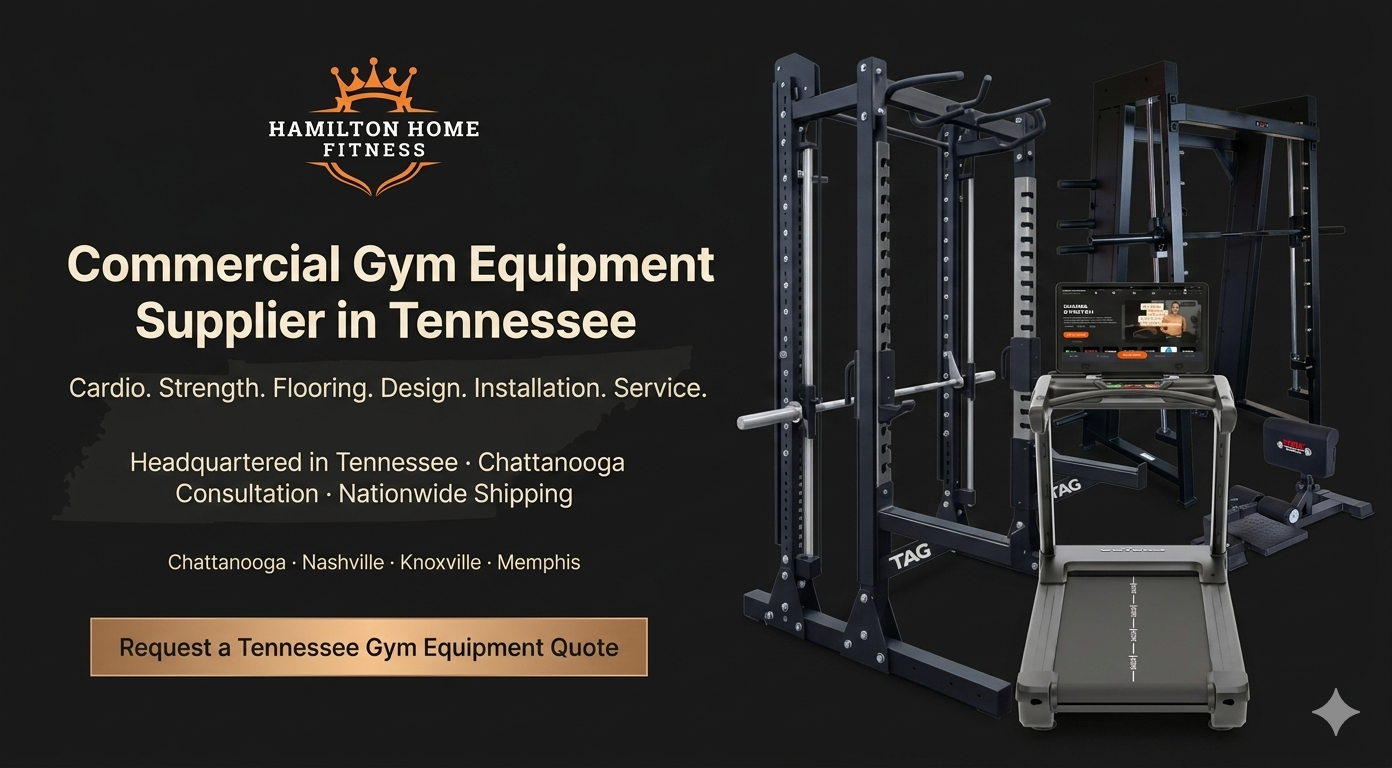
That is where Hamilton Home Fitness fits in. Headquartered in Tennessee with consultation support out of Chattanooga, we supply commercial-grade cardio, strength, free weights, flooring, and accessories for facilities across Nashville, Knoxville, Memphis, and the wider Southeast — with online ordering and nationwide shipping when your project reaches beyond state lines.
This page is built to help you decide with confidence. You will see what services to expect from a Tennessee supplier, which equipment categories fit your facility, how design and installation work, and how to choose the right company for your project.
When you are ready, you can Request a Tennessee Gym Equipment Quote, Book a Chattanooga Consultation, or Call a Local Expert — and start planning a space your members, residents, students, or staff will actually want to use.
What a Tennessee Commercial Gym Equipment Supplier Should Provide
A Tennessee commercial gym equipment supplier should deliver more than products — it should support equipment selection, layout planning, delivery, installation, and ongoing service from one local point of contact. If a supplier only sells boxes and walks away after checkout, your facility carries every risk that follows.
Use the standard below to evaluate Hamilton Home Fitness or any other supplier on the same fair criteria.
What "full-service" really means
Full-service support means one supplier can guide your project from first consultation to final installation and long-term maintenance. For a commercial facility, that scope matters far more than a low sticker price.
A credible Tennessee supplier should cover these five capabilities:
Equipment supply — commercial-grade cardio, strength, free weights, functional, flooring, and accessories from trusted brand partners.
Layout planning — space evaluation, zone mapping, and equipment-to-floor fit before you order.
Delivery and assembly — scheduled freight, careful handling, and correct on-site assembly.
Professional installation — anchoring, calibration, and a final safety check by trained technicians.
Ongoing service — repair coordination, preventive maintenance, and equipment relocation when your facility evolves.
Hamilton Home Fitness is built around this full scope. The Commercial Gym Equipment for Facilities & Gyms collection gives Tennessee buyers a single starting point for equipment, while consultation, installation coordination, and service support move the project forward off-page.
If a supplier handles only one or two of these five, you will end up managing the rest yourself — usually with separate vendors, separate contracts, and gaps no one is responsible for closing.
Why local presence still matters in a nationwide market
A Tennessee headquarters gives buyers local accountability, faster project communication, and stronger trust on long-term service decisions. Nationwide shipping is useful, but it does not replace a real local point of contact.
Three reasons local presence still matters for commercial buyers in 2026:
Faster project communication — quotes, layout questions, and timeline updates move quicker when your supplier shares your time zone and region.
Stronger service accountability — a Tennessee-based supplier has reputational skin in the game across Chattanooga, Nashville, Knoxville, and Memphis.
Better long-term fit — local suppliers tend to understand regional facility types, building codes, and amenity expectations more accurately than out-of-state sellers.
Hamilton Home Fitness pairs Tennessee headquarters and Chattanooga consultation with nationwide shipping, so you get the benefits of a local partner without losing reach if your project, portfolio, or franchise extends beyond state lines.
The decision rule is simple: choose a supplier that is local enough to be accountable and resourced enough to deliver at scale. That combination protects your budget, your timeline, and the experience your members or residents will actually have on the floor.
Service Areas Across Tennessee and Beyond
Hamilton Home Fitness supports commercial gym equipment buyers across Tennessee — including Chattanooga, Nashville, Knoxville, Memphis, and surrounding regions — with nationwide shipping for projects beyond the state. Whether you are planning a single apartment fitness room or outfitting a multi-site athletic program, the goal is the same: a clear local point of contact backed by real delivery and service reach.
Tennessee metros and surrounding regions
Coverage spans Tennessee's largest fitness and facility markets, anchored in Chattanooga and extending across the state.
Hamilton Home Fitness supports commercial projects in the following Tennessee regions:
Chattanooga and Hamilton County — local consultation hub, ideal for in-person planning conversations and Southeast Tennessee facility projects.
Nashville and Middle Tennessee — apartment communities, hotels, corporate wellness centers, schools, and clinics across the Nashville metro.
Knoxville and East Tennessee — universities, athletic programs, recreation centers, and commercial gyms throughout the region.
Memphis and West Tennessee — multifamily developments, hospitality groups, and community fitness facilities across the Memphis area.
Smaller Tennessee cities and counties — including Clarksville, Murfreesboro, Franklin, Johnson City, and Jackson, plus surrounding rural and suburban facilities.
Southeast USA reach — neighboring states often served through the same regional planning and shipping pipeline.
If your city is not listed above, that does not mean you are out of scope. Tennessee buyers in smaller markets are welcome to request a quote directly — coverage is broader than any short list can capture.
Nationwide shipping for projects outside Tennessee
Buyers outside Tennessee can order online and arrange nationwide delivery, with installation coordinated through certified service partners where available. This is useful for property management groups, franchise operators, and multi-site facility teams whose portfolios cross state lines.
Three things to keep in mind for out-of-state projects:
Shipping is nationwide. Equipment can be delivered to commercial addresses across all fifty US states.
Installation is coordinated, not always direct. Outside Tennessee, installation is typically handled through certified regional partners. Confirm scope when requesting your quote.
Service support varies by region. Repair and preventive maintenance availability depends on your project location. Ask about service coverage before finalizing your order.
The decision rule is simple. If your facility is in Tennessee, you get the strongest combination of local consultation, delivery, installation, and service. If your facility is outside Tennessee, you still get full e-commerce access, nationwide shipping, and project guidance — with installation and service coordinated based on what is available in your area.
Either way, the next step is the same: Request a Tennessee Gym Equipment Quote or Call a Local Expert to confirm coverage, timing, and the right scope for your project.
Commercial Gym Equipment Categories We Supply in Tennessee
Hamilton Home Fitness supplies commercial-grade cardio, strength, free weights, functional training, flooring, and accessories from trusted partner brands — designed for high-traffic Tennessee facilities. The right mix depends on your facility type, your member or resident profile, and your floor space, but every category below is part of a complete commercial gym build.
Brand partners visible across the catalog include Body-Solid, Tag Fitness, Hoist, Legend Fitness, York Barbell, Hudson Steel, Spirit Fitness, Concept 2, Power Plate, STEPR, Cascade, Bison, and HHF Commercial Fitness, among others.
Commercial cardio equipment
Commercial cardio equipment for Tennessee facilities should be rated for continuous, high-traffic use — not light residential cycles. The wrong rating leads to early failures, warranty headaches, and member complaints in apartment, hotel, and gym environments where machines run almost all day.
Core commercial cardio categories supplied include:
Commercial treadmills — built for sustained running and walking traffic with stronger motors, decks, and belts than residential models.
Commercial ellipticals — low-impact cardio that fits a wide range of users from athletes to seniors.
Exercise bikes — upright, recumbent, and indoor cycling bikes for cardio zones and group fitness.
Rowers — full-body cardio with low joint impact, popular in functional and CrossFit-style spaces.
Stair climbers and steppers — high-intensity cardio favored in commercial gyms and hotel fitness rooms.
If you want a clearer framework for matching cardio mix to facility type, the guide on how to choose the best commercial cardio equipment walks through the trade-offs in more detail.
Commercial strength and free weights
Commercial strength equipment should combine durable steel construction, ergonomic design, and configurations that fit the facility's training style. A balanced strength floor usually pairs selectorized machines for general members with plate-loaded and free weight options for stronger users and athletes.
Strength categories commonly specified for Tennessee facilities:
Power racks, squat racks, and cages — the anchor of any serious strength zone.
Selectorized machines — pin-loaded stations that are intuitive and member-friendly.
Plate-loaded machines — durable, training-focused options for athletic and performance facilities.
Functional trainers and cable machines — versatile single-station options that save floor space.
Weight benches — flat, adjustable, and Olympic benches for free weight training.
Dumbbells, kettlebells, barbells, and plates — the foundation of any free weight zone, including bumper plates for performance training.
Cardio and strength choices are not made in isolation. Your cardio-to-strength ratio shapes traffic flow, member experience, and even the long-term wear on your floor. The breakdown of Commercial Cardio Equipment for Fitness Facilities is worth reviewing alongside your strength plan so the two zones support each other instead of competing for space.
Commercial gym flooring and accessories
Commercial gym flooring protects equipment, members, and the building itself — and should be specified before equipment installation, not after. Flooring choices also affect noise, vibration, and the long-term feel of the space.
Common flooring and accessory specifications include:
Rubber gym flooring — the standard for cardio zones, strength floors, and free weight platforms.
Turf strips and turf zones — for sled work, functional training, and athletic conditioning.
Gym mirrors — for form correction in strength and free weight zones.
Storage racks — for plates, dumbbells, kettlebells, accessories, and member items.
Lighting and finishing details — small touches that make the space feel professional rather than improvised.
For Tennessee facilities planning a new build, renovation, or amenity upgrade, the Commercial Gym Flooring Fitness Facilities collection is the right starting point for matching surface to use. Specify flooring early, plan zones around it, and your equipment installation will go faster, safer, and cleaner.
Facility Types We Equip Across Tennessee
Hamilton Home Fitness equips a wide range of Tennessee facilities — from apartment fitness rooms and hotel gyms to schools, clinics, churches, sports facilities, and corporate wellness centers. Each facility type has its own member profile, traffic load, and budget reality, so the equipment mix should reflect the space — not a generic template.
Apartments, multifamily, and hotels
Apartment, multifamily, and hotel gyms benefit from compact, durable equipment that handles rotating users with minimal staff oversight. Residents and guests use these spaces at all hours, often without supervision, so reliability and safety matter more than feature complexity.
Common priorities for these facilities:
Compact footprint — cardio and strength options that fit small to mid-size amenity rooms.
Low-maintenance equipment — fewer service calls and predictable upkeep.
Member-friendly interfaces — intuitive controls that work for first-time users.
Quiet operation — important when fitness rooms sit near units, lobbies, or guest floors.
For property managers and developers, the right amenity build directly affects leasing, retention, and guest reviews. A well-equipped fitness room is one of the few amenities residents and travelers use almost every day.
Schools, universities, and athletic facilities
School and athletic facility equipment should prioritize heavy-duty steel, safety features, and capacity for repeated team use. Athletic directors plan for full squads moving through weight rooms in tight windows, so durability and layout efficiency are critical.
Typical specifications include:
Heavy-duty power racks and platforms for team strength training.
Plate-loaded and free weight stations suited to athletic programming.
Plyometric and functional zones with turf, sleds, and storage.
Conditioning cardio built for short, high-intensity team blocks.
Schools, universities, and athletic facilities across Tennessee use commercial-grade equipment to protect athletes, simplify maintenance, and stretch their budgets across multi-year cycles.
Clinics, rehab, and corporate wellness
Clinics and corporate wellness centers often need low-impact cardio, accessible strength options, and quiet, professional aesthetics. Users in these environments range from rehabilitation patients to office staff on a midday break, so equipment should support gentle progression rather than peak performance.
Common needs in this segment:
Low-impact cardio — recumbent bikes, ellipticals, and easy-step models.
Accessible strength stations — selectorized machines with simple adjustments.
Recovery and flexibility tools — stretching stations, foam rollers, and supportive accessories.
Calm, professional design — equipment that fits clinical and corporate aesthetics.
For rehabilitation and clinical use, equipment selection should align with guidance from licensed professionals on staff. Hamilton Home Fitness supplies the equipment; clinical decisions remain with your physical therapy, medical, or wellness team.
Churches, recreation centers, and community facilities
Church fitness centers and recreation facilities often balance budget, durability, and community-friendly equipment choices. These spaces serve a wide age range — children, parents, seniors, and ministry staff — so versatility matters as much as raw performance.
Practical priorities for community-focused builds:
Durable basics first — cardio, simple strength stations, and flexible free weight zones.
Family-friendly options — equipment safe and intuitive for casual users.
Phased upgrades — building out the space across multiple budget cycles instead of one large purchase.
Multipurpose flooring — surfaces that handle fitness classes, youth programs, and equipment use.
If you are still weighing options for any of the facility types above, the broader collection on how to choose the best commercial gym equipment is a useful next step — especially when matching equipment categories to the realistic mix of users your facility actually serves day to day.
The right facility-type fit comes from honest answers to three questions: who uses the space, how often, and what does success look like for your members, residents, students, athletes, patients, or congregation? Once those are clear, the equipment plan tends to write itself.
Commercial Gym Design and Layout Planning in Tennessee
Hamilton Home Fitness supports commercial gym design and layout planning in Tennessee — covering space evaluation, zone mapping, equipment selection, and traffic flow before purchase. Good planning is what separates a fitness space that members actually use from one that looks fine in renderings but feels cramped, awkward, or unsafe in real life.
How layout planning protects your investment
Layout planning before purchase prevents two expensive problems: equipment that does not fit and zones that do not flow. Both happen often when buyers order from a list instead of starting with the space itself.
A weak layout shows up in predictable ways:
Wasted square footage — large dead zones that could have been useful.
Crowded equipment — cardio and strength packed too tightly for safe use.
Awkward traffic flow — members crossing free weight platforms or squeezing past machines mid-set.
Missed zones — no real space for stretching, functional work, or recovery.
Replacement costs — equipment that has to be moved, returned, or sold off later.
Strong planning solves these issues before any equipment is ordered. A clear floor plan, defined zones, and a realistic traffic pattern give you a space that works on day one and still works two years in.
For most Tennessee facilities, the planning effort breaks down into a few core zones:
Cardio zone — treadmills, ellipticals, bikes, rowers, and stair climbers grouped for ventilation and member flow.
Strength zone — selectorized and plate-loaded machines arranged by muscle group sequence.
Free weight zone — racks, benches, and platforms with safe spacing and clear sight lines.
Functional zone — turf strips, rigs, sleds, and accessory storage.
Recovery or stretching zone — quieter space for warm-up, cool-down, and mobility work.
Specialty zones where relevant — rehab, recovery, sauna, or cold therapy areas in clinical, hospitality, or premium facilities.
Get the zones right first, and the equipment list becomes a much simpler decision.
What a Tennessee design consultation typically covers
A typical consultation reviews your space, your member or user profile, your budget, and your operational goals — then maps equipment and zones to fit. The point is to surface trade-offs early, while they are still cheap to change.
A useful Tennessee design consultation usually covers:
Space evaluation — square footage, ceiling height, column placement, door swings, ventilation, and any structural constraints.
User profile review — who uses the space, how often, and how heavy the peak-hour traffic gets.
Goal alignment — whether the priority is member retention, resident amenity, athletic performance, rehabilitation, or general wellness.
Equipment recommendations — cardio, strength, free weight, functional, and accessory mix matched to the goal and the space.
Layout proposal — zone mapping, traffic flow, safety clearances, and flooring specification.
Budget mapping — phased purchase options when the full build cannot happen in one cycle.
Timeline planning — coordinating delivery, installation, and any building or renovation work happening alongside the fitness build.
Hamilton Home Fitness handles this consultation process with Tennessee facilities directly, anchored in Chattanooga and supported across Nashville, Knoxville, Memphis, and the wider Southeast. Whether you are launching a new gym, refreshing an apartment amenity, upgrading a school weight room, or building a corporate wellness center, the consultation step is the cheapest insurance you can buy on the project.
When you are ready to move forward, Book a Chattanooga Consultation or Request a Tennessee Gym Equipment Quote — and start the project with a real plan, not a guess.
Gym Equipment Installation, Repair, and Maintenance in Tennessee
Hamilton Home Fitness coordinates delivery, professional installation, equipment relocation, repair, and preventive maintenance for commercial fitness equipment in Tennessee. The goal is simple: your equipment arrives safely, gets installed correctly, and keeps running long after the build is complete.
For commercial buyers, post-purchase support is not a small detail. It protects your members, your warranty coverage, and your operating budget — especially in high-traffic apartment, hotel, school, and gym environments where downtime is felt immediately.
Delivery and professional installation
Commercial gym equipment installation should include safe delivery, correct assembly, anchoring where needed, and a final safety check. Skipping any of these steps creates risk that shows up later — usually at the worst possible time.
A clean commercial installation typically covers:
Scheduled delivery — coordinated freight to commercial addresses with realistic timing for your project.
On-site placement — equipment moved to the correct zone before assembly, not left at the dock.
Correct assembly — performed in the right sequence, with the right torque specs, by trained installers.
Anchoring and stabilization — power racks, rigs, and large stations secured where the manufacturer or facility design requires it.
Calibration and function check — cardio consoles, cable systems, and adjustment mechanisms tested before sign-off.
Final safety check — fasteners, guards, cables, and clearances reviewed before the space goes live.
Site cleanup — packaging removed and the space left ready for use.
For Tennessee buyers, installation is coordinated through Hamilton Home Fitness as part of the project scope. For out-of-state buyers, installation is typically handled through certified regional partners — confirm scope when requesting your quote so there are no surprises on delivery day.
Repair and preventive maintenance
Preventive maintenance keeps commercial equipment safer, extends its life, and reduces unplanned downtime in busy Tennessee facilities. The math is straightforward: planned upkeep almost always costs less than emergency repairs and member complaints.
Common service needs in commercial gym environments:
Treadmill repair — belt and deck inspection, motor diagnostics, console issues, and lubrication.
Cable machine repair — cable replacement, pulley alignment, and weight stack adjustments.
Elliptical, bike, and stepper service — bearings, drive systems, and resistance calibration.
Strength equipment service — fastener checks, upholstery replacement, and frame inspections.
Preventive maintenance plans — scheduled visits to catch small issues before they become big ones.
Equipment relocation — proper disassembly and reassembly when zones change, facilities expand, or properties move.
A few practical habits that keep commercial equipment healthier for longer:
Wipe down equipment daily — sweat is the single biggest enemy of consoles, upholstery, and metal finishes.
Inspect cables and fasteners weekly — small issues caught early cost a fraction of a full repair.
Lubricate treadmill decks on schedule — most belt and motor failures trace back to missed lubrication.
Document every service visit — useful for warranty claims, facility audits, and future planning.
Train staff to flag issues early — front-desk and maintenance teams are your first line of defense.
For Tennessee facilities, repair and preventive maintenance can be coordinated alongside your equipment purchase — so service is a planned part of the project, not a problem you scramble to solve later. Out-of-state service support varies by region and is best confirmed during your initial quote conversation.
If you already have equipment that needs attention — even gear you bought elsewhere — Ask About Installation or Repair when you reach out. A quick conversation usually clarifies what is fixable, what is worth replacing, and what a realistic service plan looks like for your facility.
How to Choose a Commercial Gym Equipment Company in Tennessee
Choose a Tennessee commercial gym equipment company by evaluating local presence, brand partnerships, project services, installation and repair capability, transparent pricing, and reference projects. Marketing copy is easy to write. The real test is whether a supplier can carry your project from first call to final service visit without dropping it.
Use the framework below to compare suppliers on the same standard — including Hamilton Home Fitness.
Selection criteria checklist
Use a fixed checklist so you compare suppliers on the same standard, not on marketing copy. Eight criteria cover most of what actually matters for a commercial buyer:
Local presence — a real Tennessee headquarters or service base, not just a shipping address.
Brand partnerships — verifiable relationships with commercial-grade brands you recognize.
Project services — design, layout, equipment selection, and consultation handled in-house.
Installation capability — direct or coordinated, with a clear scope on delivery day.
Repair and preventive maintenance — ongoing service support, not just sales support.
Transparent pricing process — quote-based pricing with clear inclusions and exclusions.
Reference projects — facility types similar to yours that the supplier has equipped before.
Communication quality — how quickly and clearly they respond before you are even a customer.
A simple rule helps: if a supplier scores poorly on three or more of these eight, keep looking. Commercial projects are too expensive to start with the wrong partner.
For a deeper walk-through of equipment specifications, brand considerations, and decision logic before you commit, the Commercial Gym Equipment Buying Guide is a useful companion to this checklist. It covers the equipment side of the decision in more detail, while the criteria above focus on the supplier side.
A few practical questions to ask any Tennessee supplier before you sign:
Where is your Tennessee service base, and which metros do you cover directly?
Which brand partners do you carry, and are you authorized to sell and service them?
Is installation included, separate, or coordinated through a third party?
What does your repair and preventive maintenance support actually look like?
Can you share examples of similar facility types you have equipped in Tennessee?
Honest answers to these questions usually tell you more than any sales deck.
What drives commercial gym equipment cost in Tennessee
Commercial gym equipment cost in Tennessee depends on equipment tier, brand selection, facility size, flooring scope, installation needs, and financing structure — not a single sticker price. Anyone who quotes a flat number without seeing your space is guessing.
The real cost of a Tennessee commercial gym build is shaped by these factors:
Equipment tier — light commercial, standard commercial, and premium commercial tiers all carry different price points and durability profiles.
Brand selection — premium brands cost more upfront but often last longer and hold value better in high-traffic use.
Facility size — square footage drives both equipment quantity and the supporting flooring and accessory budget.
Equipment mix — cardio-heavy, strength-heavy, and functional-heavy builds price out very differently.
Flooring scope — rubber flooring, turf strips, and platform builds add real cost that many buyers underestimate.
Delivery and installation — distance, building access, freight type, and labor scope all affect the final number.
Financing structure — leasing, financed purchase, and outright purchase change the cash flow even when the total price looks similar.
Service add-ons — preventive maintenance plans and extended service coverage are budget items worth planning for, not afterthoughts.
A practical way to budget without guessing: define your facility type, your peak-hour user count, and your square footage first. Those three numbers shape every other decision in the quote.
When you are ready, Request a Tennessee Gym Equipment Quote with that information in hand. The conversation moves faster, the quote comes back more accurate, and you avoid the back-and-forth that slows most commercial projects in the early stages.
People Also Ask
Direct, practical answers to the questions Tennessee commercial gym equipment buyers ask most often. Pricing, service coverage, and project scope should always be confirmed by direct contact before you commit.
Where can I buy commercial gym equipment in Tennessee?
You can buy commercial gym equipment in Tennessee from Hamilton Home Fitness, a Tennessee-headquartered supplier with consultation support out of Chattanooga and online ordering across the full commercial catalog. Coverage extends across Chattanooga, Nashville, Knoxville, Memphis, and surrounding regions, with nationwide shipping for projects beyond the state.
Do you provide commercial gym equipment in Chattanooga?
Yes. Chattanooga is Hamilton Home Fitness's local consultation hub, which means Chattanooga buyers get the strongest combination of in-person planning conversations, equipment supply, and project coordination. Apartment communities, hotels, schools, clinics, churches, and commercial gyms across the Chattanooga metro are all within direct service scope.
Can you help design a Tennessee fitness facility?
Yes. Hamilton Home Fitness supports Tennessee facility design through a consultation process that covers space evaluation, zone mapping, equipment selection, traffic flow, and flooring specification. The goal is to surface trade-offs early — while they are still cheap to change — and hand off a layout that works on day one and still works two years in.
Do you install gym equipment in Tennessee?
Yes. Installation in Tennessee is coordinated through Hamilton Home Fitness as part of the project scope and typically covers scheduled delivery, on-site placement, correct assembly, anchoring where needed, calibration, a final safety check, and site cleanup. For out-of-state projects, installation is usually handled through certified regional partners — confirm scope when requesting your quote.
Do you repair commercial fitness equipment?
Yes. Common repair work coordinated through Hamilton Home Fitness includes treadmill repair, cable machine repair, elliptical and bike service, strength equipment service, and preventive maintenance plans. Repair coverage is strongest within Tennessee. Out-of-state service availability varies by region and is best confirmed during your initial quote conversation.
Can Tennessee buyers order online?
Yes. Tennessee buyers can order commercial gym equipment online through the Hamilton Home Fitness store, including cardio, strength, free weights, functional equipment, flooring, and accessories. For larger projects, most buyers combine online ordering with a consultation so layout, installation, and service are planned together rather than handled in pieces.
What equipment is best for Tennessee apartment gyms?
Tennessee apartment gyms work best with compact, durable, low-maintenance equipment that handles rotating residents at all hours. A typical mix includes a few commercial treadmills, an elliptical or two, a recumbent or upright bike, a functional trainer or selectorized strength station, a small free weight set, and durable rubber flooring. The exact mix depends on your unit count, peak-hour traffic, and amenity room footprint.
Do you support schools, clinics, hotels, and commercial gyms?
Yes. Hamilton Home Fitness equips a wide range of facility types across Tennessee, including schools, universities, athletic facilities, rehabilitation and physical therapy clinics, corporate wellness centers, hotels, apartment communities, churches, recreation centers, and standalone commercial gyms. Each facility type uses a different equipment mix, so the consultation step is built around your actual users — not a generic template.
How much does commercial gym equipment cost in Tennessee?
Commercial gym equipment cost in Tennessee depends on equipment tier, brand selection, facility size, flooring scope, installation needs, and financing structure — there is no single sticker price. Light commercial, standard commercial, and premium commercial tiers all price differently, and add-ons like flooring, installation, and preventive maintenance plans shape the final number. The fastest way to a realistic budget is to share your facility type, peak-hour user count, and square footage when you request a quote.
Who installs gym equipment in Chattanooga?
In Chattanooga, gym equipment installation is coordinated through Hamilton Home Fitness as part of the project scope, including delivery, assembly, anchoring, calibration, and a final safety check. Several independent service companies also operate in the Chattanooga area for repair-only and assembly-only work. For new commercial projects, working with the same supplier on equipment, installation, and service usually keeps the timeline cleaner and accountability clearer.
Final Thought
A Tennessee commercial gym equipment supplier is worth choosing carefully because the decision affects far more than your equipment list. It shapes your timeline, your member experience, your service costs, and how confident you feel about the space two and three years from now.
The takeaway from this guide is straightforward. A strong Tennessee partner gives you local accountability, commercial-grade equipment from trusted brand partners, layout planning before you order, professional installation, and ongoing repair and maintenance — all coordinated through one point of contact. That combination protects your budget, your timeline, and the people who actually use the space.
Hamilton Home Fitness is built around exactly that scope. Headquartered in Tennessee with consultation support out of Chattanooga, the team supplies cardio, strength, free weights, functional equipment, flooring, and accessories to apartments, hotels, schools, clinics, churches, athletic facilities, corporate wellness centers, and commercial gyms across Nashville, Knoxville, Memphis, and the wider Southeast — with online ordering and nationwide shipping when your project reaches beyond state lines.
When you are ready to move your project forward, choose the next step that fits where you are right now:
Request a Tennessee Gym Equipment Quote if you have a project scope in mind and want pricing.
Book a Chattanooga Consultation if you want layout, equipment selection, and zone planning handled before you order.
Call a Local Expert if you want a quick conversation before deciding anything.
Ask About Installation or Repair if you have existing equipment that needs attention.
Shop Quality Fitness Gear and Equipment — Hamilton Home Fitness if you want to browse the full commercial catalog and start building your list.
Pricing, service coverage, and timing should always be confirmed by direct contact before you finalize anything. Every facility is different, and the best quote is the one built around your real space, your real users, and your real goals — not a generic template.