Introduction
Choosing the right commercial free weights for gyms is not just about buying a few dumbbells and weight plates. For a gym owner, personal training studio, CrossFit box, school weight room, hotel gym, or corporate fitness facility, the right setup affects member experience, floor space, training flow, safety, and long-term equipment value.
A strong free weight area usually starts with the right mix of commercial dumbbells, barbell sets, Olympic plates, kettlebells, racks, and storage. The challenge is knowing which dumbbell material, weight range, rack style, barbell type, and plate option fits your facility’s users, traffic level, and budget.
This guide will help you compare urethane vs. rubber dumbbells, pro-style dumbbells, commercial dumbbell sets, Olympic barbells, bumper plates, rubber weight plates, and free weight storage options so you can build a practical setup for your gym. You will also see where brands like TAG Fitness, Hudson Steel, York Barbell, and commercial-grade barbell options may fit into your buying decision.
Hamilton Home Fitness helps commercial facilities in Tennessee and across the USA plan, source, and build free weight systems that match their space, training style, and budget. Whether you need a basic dumbbell set with a rack or a complete commercial free weight package, the goal is to choose equipment that works for your members today and can scale as your facility grows.
Choose Your Free Weight System
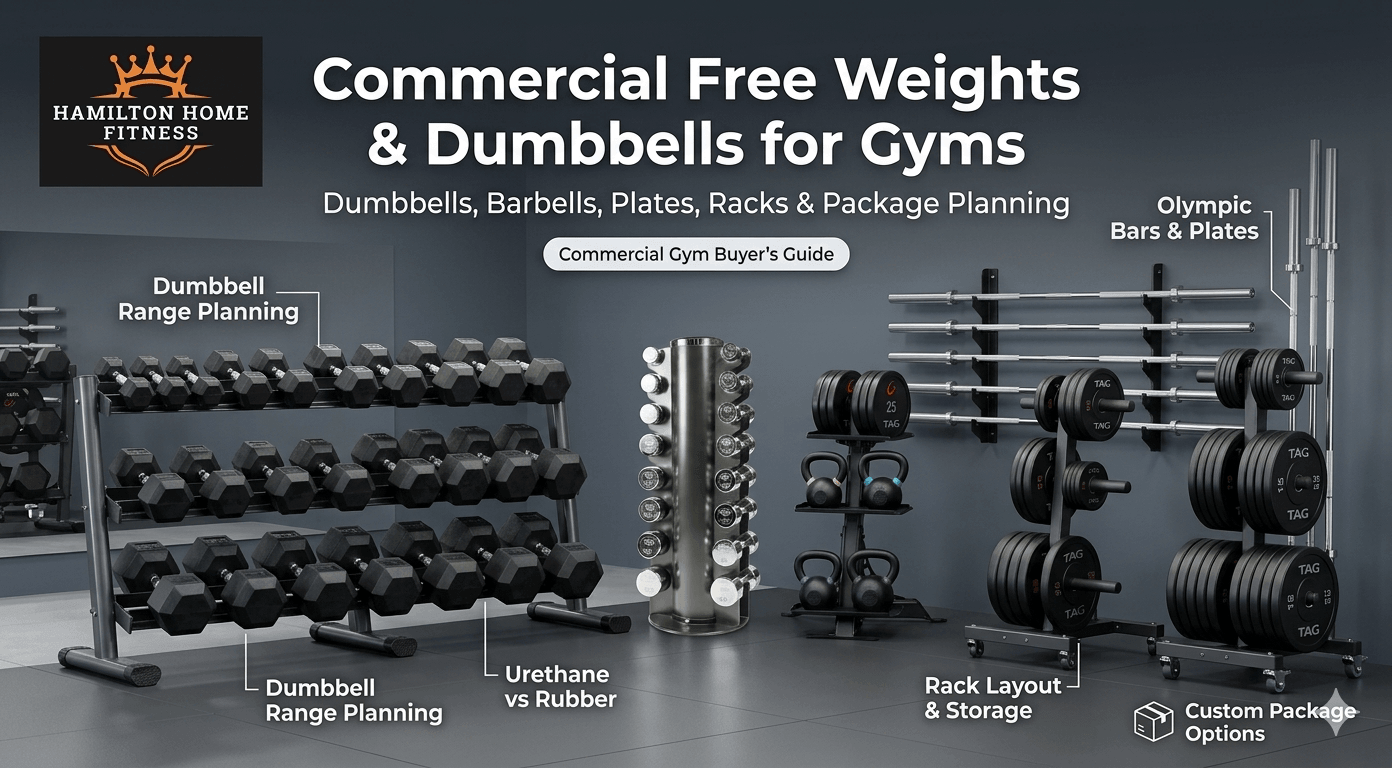
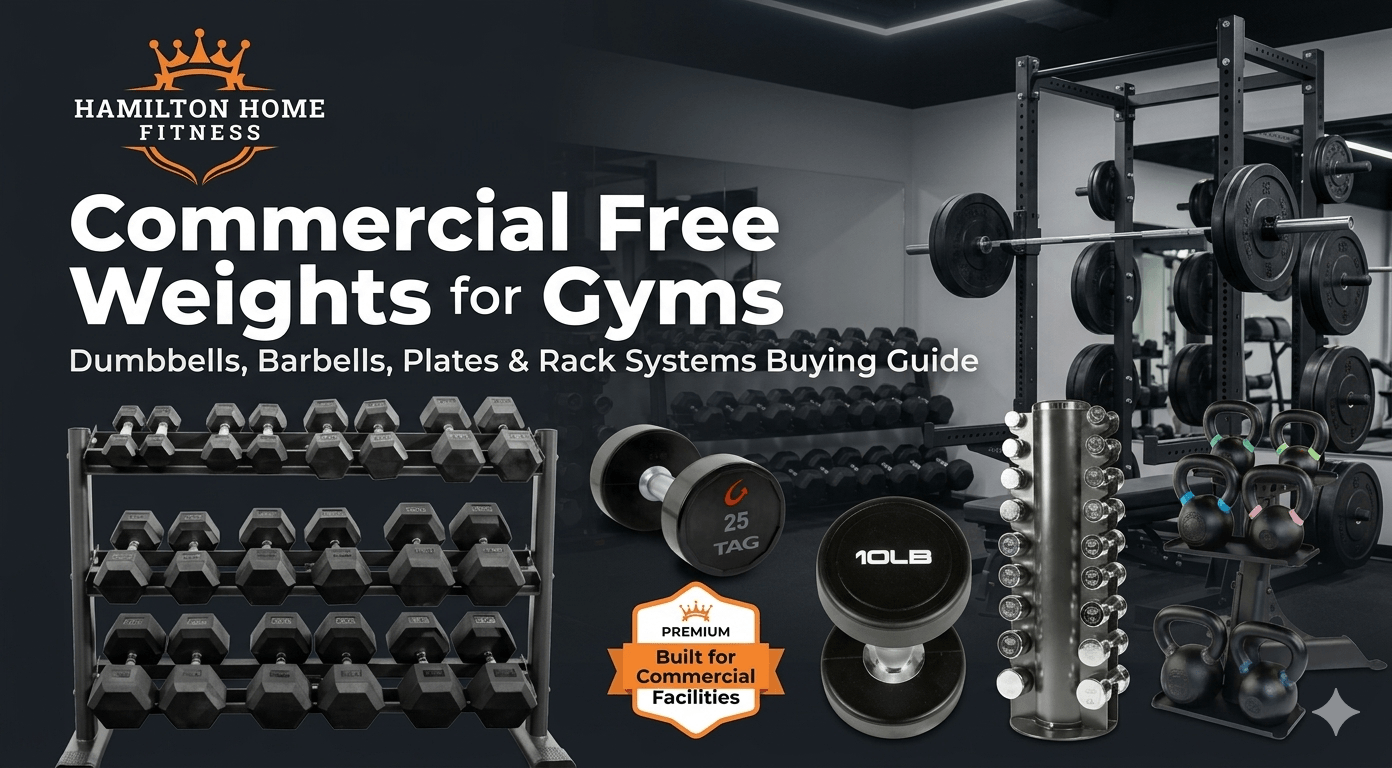
A commercial free weight system should be planned as a complete training zone, not as separate equipment pieces bought at random. Most gyms need a balanced mix of commercial dumbbells, Olympic barbells, weight plates, kettlebells, racks, and storage so members can train safely without crowding the floor or waiting too long for popular weights.
For a broader facility build-out, free weights should also fit into your full equipment plan. If you are planning more than one training area, start by mapping your free weight zone alongside your strength machines, cardio area, stretching space, and storage needs. You can also review commercial gym equipment for facilities & gyms to see how free weights fit into a complete commercial setup.
What Gyms Usually Need
Most gyms use fixed commercial dumbbells, Olympic barbells, bumper plates or rubber Olympic plates, kettlebells, and durable storage racks. These pieces cover the widest range of strength training needs, from basic dumbbell exercises to barbell lifts, functional training, Olympic lifting, and accessory work.
A practical commercial free weight setup often includes the following:
A commercial dumbbell set, such as 5–50 lb, 5–75 lb, or 5–100 lb
A commercial dumbbell rack that matches the set size and available floor space
Olympic barbells for bench press, squats, deadlifts, rows, and overhead pressing
Commercial bumper plates or rubber weight plates
Plate storage trees or Olympic plate racks
Commercial kettlebells for functional training and conditioning
Barbell storage for extra Olympic bars, curl bars, trap bars, or specialty bars
The exact mix depends on the facility. A personal training studio may need a compact 5–50 lb dumbbell set, a rack, a few kettlebells, and one or two Olympic bars. A full commercial gym may need multiple dumbbell pairs, heavier weight ranges, several barbells, bumper plates, rubber Olympic plates, plate trees, and dedicated barbell storage.
The goal is to create a free weight area where members can train without clutter, confusion, or missing weight options.
Match Equipment to Facility Type
The right free weight setup depends on who uses the space and how they train. A CrossFit box, hotel gym, school weight room, personal training studio, and luxury fitness facility should not all buy the same dumbbell range, plate type, or rack layout.
A personal training studio usually needs space-efficient dumbbells, clean storage, and enough variety for one-on-one or small-group sessions. Rubber hex dumbbells, urethane dumbbells, compact racks, kettlebells, and a few Olympic bars may be enough.
A CrossFit box or functional training facility usually needs bumper plates, Olympic barbells, kettlebells, platforms, and open floor space for fast movement. In this setting, plate durability, barbell spin, and layout flow matter more than a luxury showroom look.
A hotel gym or corporate wellness space may benefit from urethane dumbbells, clean horizontal racks, lighter dumbbell ranges, and low-maintenance storage. These facilities often prioritize appearance, ease of use, and a premium member experience.
A school weight room or sports training facility may need heavier dumbbell ranges, multiple Olympic bars, bumper plates, rubber plates, and durable storage because many athletes train at the same time.
Hamilton Home Fitness supports commercial buyers in Tennessee and across the United States. If you need local planning support, product sourcing, or facility-focused guidance, HHF can also serve as a commercial gym equipment supplier in Tennessee while helping facilities nationwide plan commercial free weight systems.
Build Around User Volume
Higher-traffic gyms need stronger planning than low-traffic spaces. The more people using the free weight area at the same time, the more important it becomes to choose durable materials, wider dumbbell ranges, enough duplicate pairs, and storage that keeps the floor organized.
A low-traffic studio may only need one pair of each dumbbell and a compact rack. A busy commercial gym may need duplicate pairs of popular weights such as 15 lb, 20 lb, 25 lb, 30 lb, 35 lb, 40 lb, and 50 lb dumbbells because those weights are used often during peak hours.
User volume also affects material choice. Urethane dumbbells may be a strong fit for premium facilities or high-use environments where appearance and long-term wear matter. Rubber dumbbells may be a practical option for gyms that need commercial durability at a lower starting cost. Pro-style dumbbells may suit strength-focused facilities that want a classic commercial feel.
Do not only ask, “What weights should we buy?” Ask:
How many people train during peak hours?
Are users mostly beginners, general fitness members, athletes, or strength-focused lifters?
Will dumbbells be used for controlled lifting, classes, or high-volume functional training?
Do we need a 5–50 lb, 5–75 lb, 5–100 lb, or heavier dumbbell range?
How much wall space or floor space can be used for racks?
Do we need bumper plates, rubber plates, or both?
Will we need room to expand later?
A well-planned free weight system should solve today’s training needs without blocking future growth. For larger gyms, new facilities, or high-volume training spaces, building a custom commercial free weight package can be easier than buying dumbbells, racks, barbells, and plates one piece at a time.
Compare Dumbbell Materials
The best commercial dumbbell material depends on how your facility is used, how much traffic the free weight area gets, how important appearance is, and how closely you need to manage budget. For most commercial gyms, the main choice comes down to urethane dumbbells, rubber dumbbells, or pro-style dumbbells.
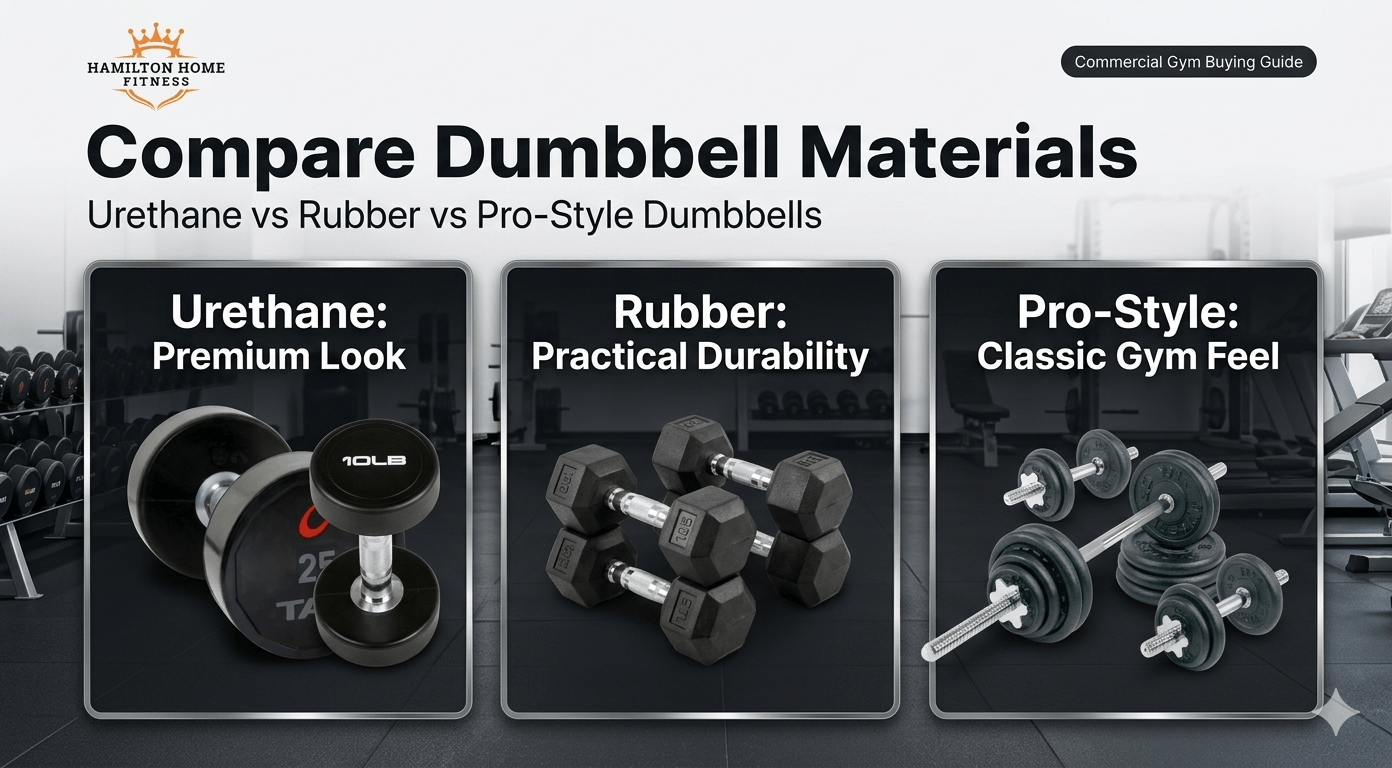
Each option can work well in the right setting. Urethane is often chosen for premium commercial spaces and high-use facilities that want a cleaner long-term look. Rubber dumbbells are common in gyms that need durability at a more budget-conscious price point. Pro-style dumbbells may be a strong fit for traditional strength training areas where members prefer a classic commercial dumbbell feel.
The key is not to choose based on material alone. Choose based on facility type, member expectations, replacement planning, rack compatibility, and how the dumbbells will be used every day.
Urethane vs Rubber Dumbbells
Urethane dumbbells generally fit premium and high-traffic commercial spaces, while rubber dumbbells may be better for budget-conscious gyms, functional training areas, and facilities that need larger sets at a lower starting cost.
Urethane dumbbells are usually selected when appearance, coating quality, and long-term presentation matter. They can be a strong fit for luxury fitness studios, hotel gyms, corporate wellness centers, high-end personal training studios, athletic facilities, and commercial gyms that want the free weight area to look polished over time.
Urethane is often preferred because it may resist scuffs, fading, odor, and cosmetic wear better than standard rubber options. That makes it useful in facilities where equipment appearance is part of the member experience.
Rubber dumbbells are widely used in commercial gyms because they are practical, familiar, and often more cost-effective. Rubber hex dumbbells and rubber round dumbbells can work well for general fitness spaces, school weight rooms, small gyms, CrossFit-style areas, and personal training studios that need dependable equipment without moving into the highest price tier.
Here is the simple buying logic:
Dumbbell Type | Strong Fit For | Main Advantage | Watch For |
Urethane dumbbells | Premium gyms, high-traffic facilities, hotels, corporate gyms | Clean look, strong commercial feel, long-term presentation | Higher upfront cost |
Rubber dumbbells | General gyms, studios, school weight rooms, functional training | Practical durability and lower starting cost | Odor, scuffing, and cosmetic wear can vary |
Rubber hex dumbbells | Training studios, functional areas, compact gyms | Stable shape and common gym use | May not look as premium as urethane |
Rubber round dumbbells | Commercial strength areas | Traditional gym feel | Requires proper rack fit |
If your gym depends on a premium look and long service life, Hudson Steel urethane dumbbells may be worth considering. If you need a durable commercial dumbbell set for a broader training population, TAG Fitness dumbbells may also fit the buying conversation. The right choice depends on your facility’s budget, traffic, and member expectations.
CTA placement: Shop TAG Fitness Dumbbells
CTA placement: Shop Hudson Steel Urethane Dumbbells
Pro-Style Dumbbells
Pro-style dumbbells use a traditional commercial design with weighted heads secured to a handle. They are commonly associated with classic strength gyms and facilities where members want a balanced, compact dumbbell feel.
A pro-style dumbbell may be right for a gym when members perform heavier pressing, rows, curls, and traditional bodybuilding-style movements. Because the weight sits closer to the handle compared with some larger dumbbell head designs, pro-style dumbbells can feel compact during certain lifts.
They may be useful for:
Strength-focused commercial gyms
Bodybuilding-style training areas
Personal training studios with experienced lifters
Facilities that want a traditional dumbbell look and feel
Gyms that prefer round dumbbells over hex dumbbells
However, pro-style dumbbells should still be evaluated carefully. Look at handle construction, head security, grip style, rack compatibility, and how easily the dumbbells can be inspected over time. A commercial gym should avoid buying any pro-style dumbbell that feels light-duty or poorly suited for repeated daily use.
For buyers comparing urethane dumbbells commercial, rubber dumbbells commercial, and pro-style dumbbells commercial, the decision should come down to how the dumbbells will be used, not just how they look.
Avoid Cheap Light-Use Models
Commercial gyms should be careful with cheap light-use dumbbells because high traffic can expose weak handles, coating issues, loose heads, and storage problems much faster than home use.
Some dumbbells are useful in limited settings but should not be treated as the foundation of a commercial free-weight area. For example, neoprene dumbbells may work for light wellness classes, senior fitness, rehab-style movement, or small accessory stations, but they are not usually the main dumbbell system for a commercial gym.
Adjustable dumbbells can save space in a home gym, but they are often not ideal as the primary dumbbell solution for a busy commercial facility. Multiple users need fast access to the same weight ranges, and adjustable systems can slow down training flow during peak hours.
Chrome dumbbells may fit light-use areas or specific studio settings, but buyers should confirm whether the product is suitable for commercial traffic before placing it in a high-use free weight zone.
Avoid these common mistakes:
Buying home-grade dumbbells for a commercial facility
Choosing based only on the lowest price
Ignoring rack compatibility
Buying too narrow of a weight range
Using adjustable dumbbells as the main system for a busy gym
Forgetting that coatings, handles, and heads must handle daily use
Mixing too many styles without a clear layout plan
A commercial gym needs equipment that can handle repeated use, quick member turnover, and organized storage. If your current dumbbells are damaged, mismatched, or too limited in range, upgrading to a properly planned commercial dumbbell set can improve both training quality and the overall look of the free weight area.
Pick Dumbbell Ranges
The right commercial dumbbell weight range depends on your facility size, member strength level, training style, and peak-hour traffic. A small studio may only need a 5–50 lb dumbbell set, while a full commercial gym often benefits from a 5–100 lb dumbbell range or heavier options if members train seriously for strength, bodybuilding, powerlifting support, or sports performance.
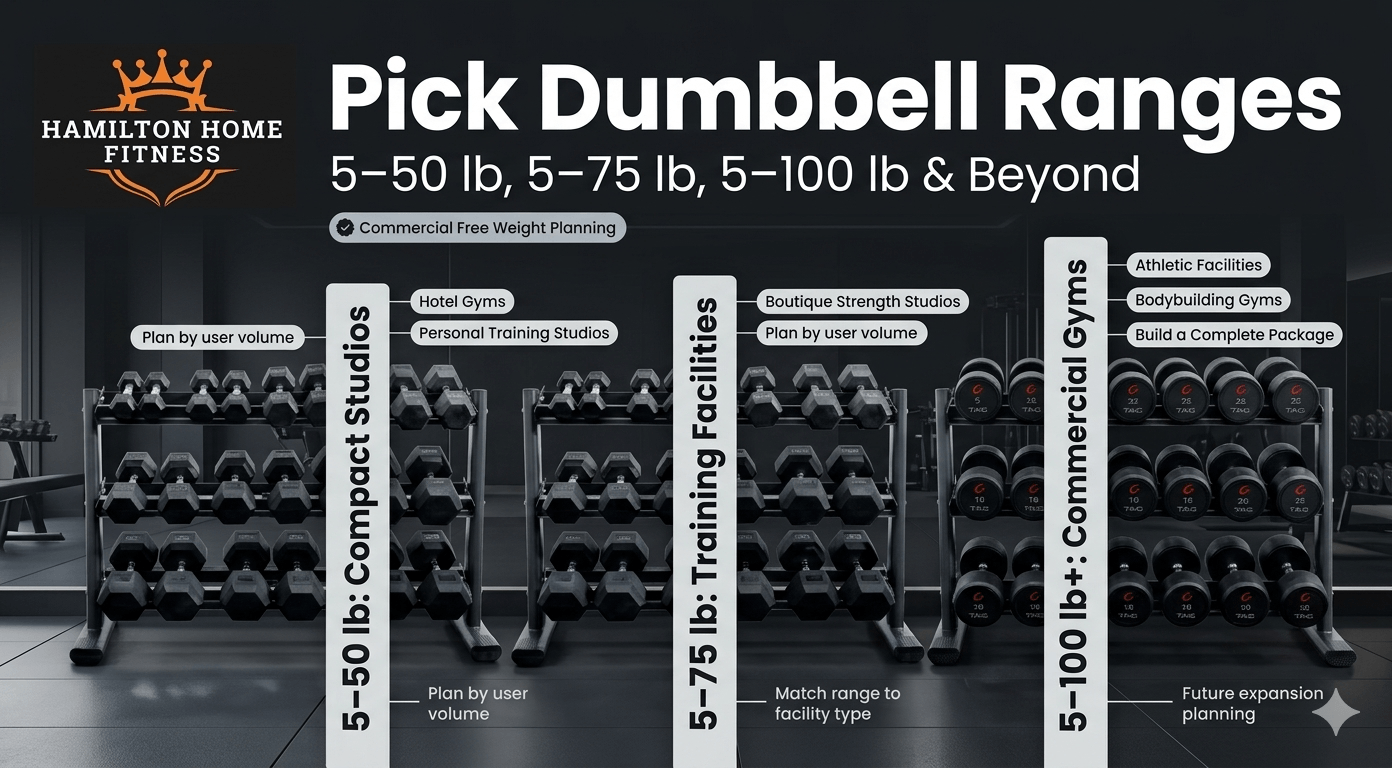
Do not choose a dumbbell set only by price. A cheaper range can become expensive if members quickly outgrow it, popular weights are always missing, or you need to reorder heavier pairs within a few months. A better approach is to plan the full dumbbell system from the start: weight range, number of pairs, rack size, floor space, delivery, and future expansion.
5–50, 5–75, or 5–100 lb
A 5–50 lb dumbbell set can work well for smaller studios, hotel gyms, apartment fitness centers, corporate wellness rooms, rehab-focused spaces, and beginner-friendly training areas. This range supports curls, presses, rows, lateral raises, lunges, step-ups, warmups, and general strength work without requiring too much rack space.
A 5–75 lb dumbbell set is a stronger option for personal training studios, boutique gyms, school weight rooms, and small commercial gyms where members need more room to progress. It gives intermediate lifters more usable weight without requiring the same space and budget as a full heavy dumbbell wall.
A 5–100 lb dumbbell set is often a better fit for full commercial gyms, strength training facilities, sports performance centers, and busy free-weight areas. This range supports stronger members and reduces the chance that advanced lifters will outgrow the dumbbell area too quickly.
A simple decision rule:
Facility Type | Practical Dumbbell Range | Why It Fits |
Hotel gym or wellness room | 5–50 lb | Compact, approachable, space-efficient |
Personal training studio | 5–50 lb or 5–75 lb | Good for coached sessions and mixed users |
Boutique strength studio | 5–75 lb | Allows more progression without overbuilding |
General commercial gym | 5–100 lb | Covers most member strength levels |
Athletic or strength facility | 5–100 lb+ | Supports heavier training and advanced users |
Bodybuilding-focused gym | 5–125 lb or 5–150 lb | Better for serious pressing, rows, and strength work |
If you are unsure which range to choose, start with your member profile. A facility serving beginners and general fitness users may not need a full 150 lb dumbbell rack. A high-volume strength gym, however, may frustrate members if the dumbbell area stops too soon.
How Many Pairs to Buy
The number of dumbbells a commercial gym needs depends on peak traffic, class size, floor space, and how often members use the same weights at the same time. One full set may be enough for a small private studio, but a busy commercial gym may need duplicate pairs of popular weights to reduce bottlenecks.
Most facilities should pay close attention to the middle range. Dumbbells between 15 lb and 50 lb are often used by the widest group of members for presses, rows, lunges, curls, raises, and accessory work. If those pairs are always taken, the free weight area feels underbuilt even if the gym technically owns a complete set.
For a small studio, one pair per weight may be enough. For a high-traffic commercial gym, consider duplicates of common weights such as:
10 lb
15 lb
20 lb
25 lb
30 lb
35 lb
40 lb
45 lb
50 lb
For group training, functional fitness, or athletic programs, duplicates may matter even more because several users may need the same weight during the same training block. A CrossFit box or sports training facility may also need more bumper plates and barbells than a traditional personal training studio.
When planning quantity, ask:
How many people use the free weight area during peak hours?
Do members train alone, in classes, or in small groups?
Which dumbbell weights are most likely to be used at the same time?
Will the facility need heavier dumbbells for advanced lifters?
Is there enough rack space for duplicates?
Can the set be expanded later without disrupting the layout?
For larger builds, a commercial free weights package deal can be easier than ordering one pair at a time. Hamilton Home Fitness can help buyers think through a complete dumbbell set, rack style, barbell set, plates, storage, and future expansion needs before finalizing the order.
Plan Cost by Full System
The cost of commercial free weights should be planned as a full system, not just as a price per dumbbell or price per pound. The final investment depends on dumbbell material, weight range, number of pairs, rack style, barbell type, plate type, storage, delivery, and installation needs.
A rubber dumbbell set may have a lower starting cost than a urethane dumbbell set. A 5–50 lb set will usually cost less than a 5–100 lb set because it includes fewer total pounds and fewer heavy pairs. Adding duplicate popular weights, premium racks, bumper plates, ceramic bearing bars, kettlebells, or platform zones will also change the total package cost.
When comparing quotes, make sure you are comparing the same system. One quote may include only dumbbells. Another may include dumbbells, racks, barbells, plates, plate storage, delivery, and facility planning support. The second quote may look higher at first, but it may be more complete and easier to install correctly.
Use this checklist when reviewing commercial free weight pricing:
Dumbbell material: rubber, urethane, or pro-style
Dumbbell range: 5–50 lb, 5–75 lb, 5–100 lb, or heavier
Number of duplicate pairs
Rack type and rack capacity
Olympic barbells and specialty bars
Bumper plates, rubber plates, or cast iron plates
Plate trees or wall-mounted storage
Kettlebells, medicine balls, or slam balls
Delivery, setup, and installation needs
Financing or leasing options
Future expansion plan
For a wider budgeting view, review the Commercial Gym Equipment Buying Guide before finalizing your free weight order. It can help you think beyond the dumbbell set and plan the full facility budget.
If you are building a full gym, expanding a busy free weight area, or replacing damaged equipment, ask for a custom quote instead of guessing from individual product prices. A quote can help match your dumbbell set, commercial dumbbell rack, barbell package, plates, and storage to the space you actually have.
CTA placement: Build Your Custom Free Weight Package
CTA placement: Get Financing for Your Free Weight System
Match Barbells and Plates
A commercial free-weight area needs more than dumbbells. Most facilities also need the right mix of Olympic barbells, specialty bars, bumper plates, rubber Olympic plates, and plate storage so members can train safely and efficiently.
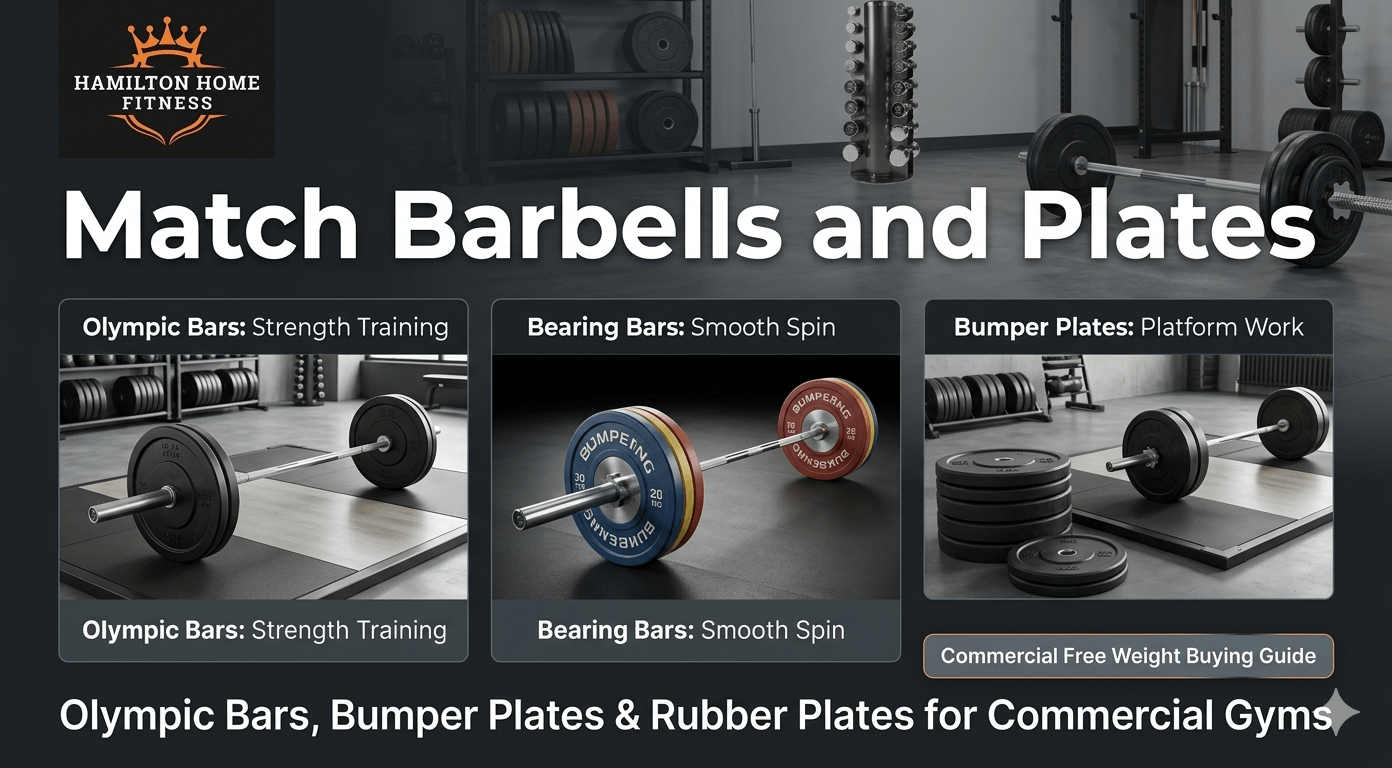
The best barbell and plate setup depends on how your gym is used. A general commercial gym may need durable Olympic bars and rubber plates for bench press, squats, rows, and deadlifts. A CrossFit box or Olympic lifting facility may need bumper plates, better sleeve rotation, and platform-friendly setups. A school weight room or sports performance facility may need multiple bars and plate sets so several athletes can train at the same time.
The goal is simple: match the bar and plates to the lift, the user, and the space.
Olympic Barbell Basics
A commercial Olympic barbell should match your facility’s main training style, grip needs, sleeve rotation, durability expectations, and plate compatibility. Most gyms use Olympic barbells because they work with standard Olympic plates and support major strength movements like squats, deadlifts, bench press, overhead press, rows, cleans, and snatches.
When comparing a commercial Olympic barbell, look at these features:
Bar weight: Standard men’s Olympic bars are commonly 45 lb, while women’s Olympic bars are commonly lighter and smaller in diameter.
Bar length: Most standard Olympic bars are about 7 feet long, but specialty bars may vary.
Sleeve design: The sleeves hold the plates and affect how smoothly the plates rotate.
Knurl pattern: The grip texture should support secure lifting without being too aggressive for general users.
Bar diameter: Affects grip feel, especially for Olympic lifting, powerlifting, and women’s bars.
Whip: Some bars flex more under load, which can matter for Olympic lifting.
Spin: Sleeve rotation matters most for fast lifts like cleans, snatches, and jerks.
Finish: Chrome, stainless steel, or other coatings can affect feel, maintenance, and appearance.
Weight capacity: Commercial gyms should choose bars built for repeated heavy use.
For a general commercial gym, a durable multipurpose Olympic bar may be the most practical starting point. It can support bench press, squats, deadlifts, rows, and general barbell training. For strength-focused gyms, you may also need power bars, deadlift bars, squat bars, EZ curl bars, trap bars, or safety squat bars.
A simple rule: choose the barbell based on the lift your members perform most often. If members mostly do general strength training, start with durable multipurpose Olympic bars. If your facility supports Olympic lifting, choose bars with better sleeve rotation. If your members train heavy powerlifting movements, consider stronger bars with grip and stiffness suited for squats, bench press, and deadlifts.
CTA placement: Browse Olympic Barbells & Plates
Ceramic Bearing Bars
A ceramic bearing Olympic bar is designed to support smooth sleeve rotation, which may matter most for Olympic lifting and fast bar turnover. This type of bar can be useful in facilities where athletes perform cleans, snatches, jerks, and other movements where the sleeves need to rotate smoothly under load.
The main difference between a bearing barbell and a bushing barbell is how the sleeves rotate. A bushing bar usually has simpler sleeve rotation and can be a good fit for general strength training. A bearing bar is designed for smoother, faster spin, which is more useful for Olympic lifting and technical barbell movements.
Ceramic bearing bars may be worth considering if your facility includes the following:
Olympic weightlifting
CrossFit-style training
Sports performance training
Advanced barbell coaching
High-repetition technical lifting
Athletes who need smoother sleeve rotation
They may not be necessary for every gym. If most members perform bench press, squats, deadlifts, rows, and curls, a strong commercial bushing bar may be enough. If your gym has a dedicated platform zone or Olympic lifting program, a ceramic bearing Olympic bar can be a better fit.
Use this decision rule:
Facility Need | Barbell Fit |
General commercial strength training | Multipurpose Olympic bar or bushing bar |
Olympic lifting and CrossFit | Needle bearing or ceramic bearing bar |
Heavy squats, bench press, deadlifts | Power bar, squat bar, or deadlift bar |
Accessory arm training | EZ curl bar |
Deadlifts, carries, and beginner hinge work | Trap bar or hex bar |
For Hamilton Home Fitness buyers, ceramic bearing barbell options should be considered when sleeve spin and Olympic-style lifting performance matter. They should not be treated as required for every facility, but they can be a strong fit for weightlifting-focused rooms and performance training spaces.
Bumper vs Rubber Plates
Bumper plates are best for Olympic lifts and controlled drops, while rubber Olympic plates are better for general strength areas where plates are used on racks, benches, machines, and bars without frequent drops from height.
Commercial bumper plates are designed for movements where the bar may return to the floor, such as cleans, snatches, deadlifts, and CrossFit-style workouts. They are commonly used on lifting platforms because they can help reduce noise, protect flooring, and make loaded bar height more consistent.
Bumper plates may be a strong fit for:
CrossFit boxes
Olympic lifting facilities
Sports performance centers
Deadlift platforms
Functional training zones
School weight rooms with coached lifting
Rubber Olympic plates are often used for general commercial strength training. They work well for bench press, squats, leg press, plate-loaded machines, rows, and controlled barbell movements. They are practical for gyms where members are not regularly dropping bars from overhead or platform height.
Rubber Olympic plates may be a strong fit for
General commercial gyms
Personal training studios
Hotel gyms
Corporate fitness centers
Plate-loaded strength machine areas
Traditional free weight zones
Cast iron plates can work in some strength settings, but they may be louder and less forgiving on floors than rubber-coated options. Change plates and fractional plates are useful for small weight jumps, especially in Olympic lifting, powerlifting, or coached strength programs. Calibrated plates may fit serious powerlifting environments where precise loading matters.
Use this simple comparison:
Plate Type | Best For | Main Benefit | Watch For |
Bumper plates | Olympic lifts, CrossFit, platforms | Better for controlled drops | Requires proper platform and storage |
Rubber bumper plates | Functional training and weightlifting | Floor-friendly and versatile | Can take more storage space |
Rubber Olympic plates | General strength training | Practical for racks and machines | Not ideal for repeated overhead drops |
Cast iron plates | Traditional strength rooms | Compact and familiar | Louder and less floor-friendly |
Change plates | Small weight jumps | Better progression control | Usually needed in smaller quantities |
Calibrated plates | Powerlifting-focused gyms | Precise loading | More specialized use case |
Many commercial gyms use both bumper plates and rubber Olympic plates. Bumper plates can live near platforms and Olympic lifting zones, while rubber plates can stay near squat racks, benches, plate-loaded machines, and general barbell stations.
If your facility needs barbells, bumper plates, rubber plates, storage trees, or a full commercial barbell set, this is the right point to compare your plate needs with your dumbbell package and rack layout.
CTA placement: Browse Olympic Barbells & Plates
Plan Racks and Layout
The best commercial free weight area is easy to move through, easy to keep organized, and built around the way members actually train. Dumbbells, barbells, benches, plates, kettlebells, and storage should not compete for the same floor space. A good layout keeps equipment visible, accessible, and safely stored.
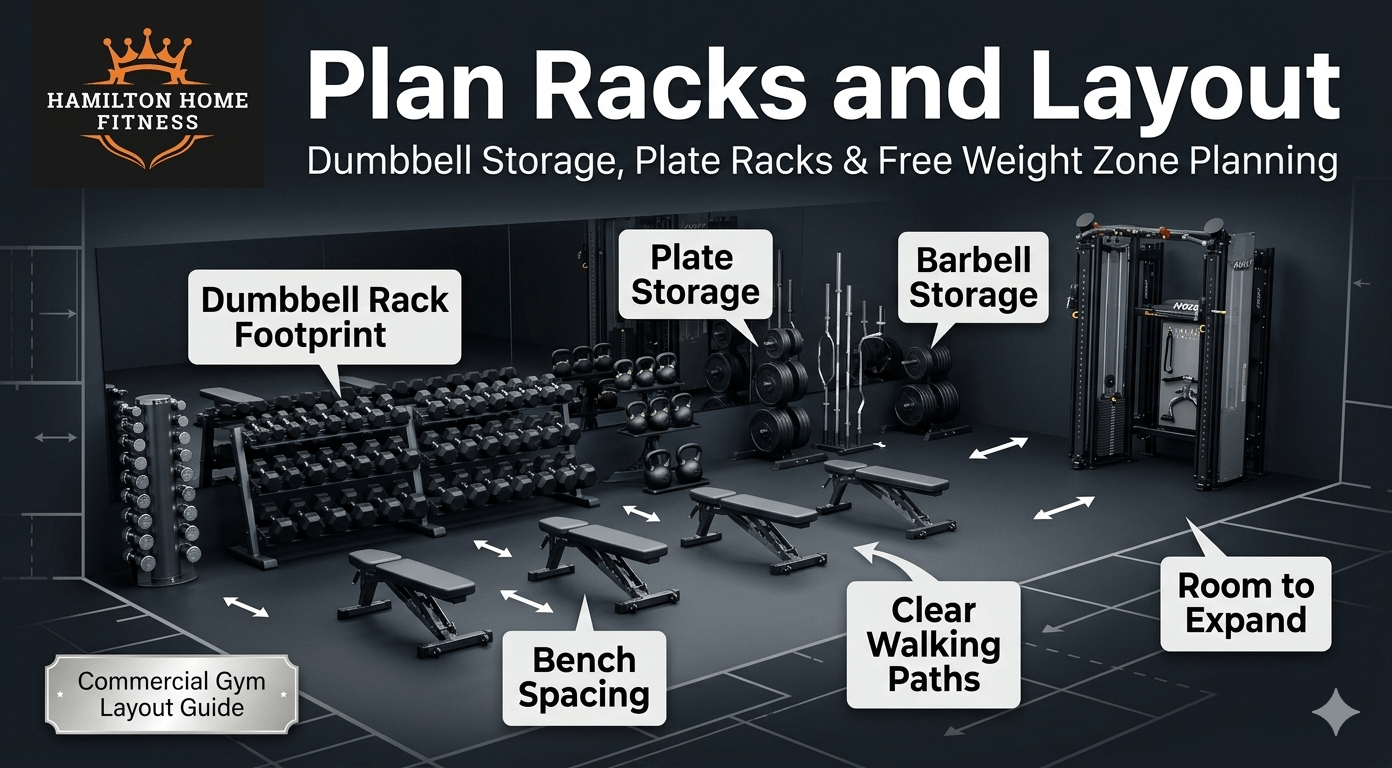
For most gyms, rack planning is just as important as the free weights themselves. A poorly placed dumbbell rack can create traffic jams. Too little plate storage can leave plates on the floor. No barbell storage can make the room feel messy and unsafe. Before buying a complete commercial dumbbell set or barbell package, plan where every piece will live.
A free weight layout should account for the following:
Dumbbell rack footprint
Bench spacing
Walking paths
Plate storage
Barbell storage
Lifting platforms
Mirror or wall placement
Member flow during peak hours
Future equipment expansion
If you are planning a full facility, free weights should also be coordinated with racks, cages, machines, and cardio zones. This is where working from a complete layout plan can prevent expensive mistakes.
Choose the Right Rack
Horizontal and 3-tier dumbbell racks usually work well for larger dumbbell sets, while vertical racks and A-frame racks can save space in smaller rooms. The right commercial dumbbell rack depends on the size of your dumbbell set, the shape of the dumbbells, the available wall space, and how quickly members need to access weights.
A horizontal dumbbell rack is common in commercial gyms because it keeps dumbbells easy to see and grab. It is a strong fit for larger sets, especially 5–75 lb or 5–100 lb dumbbell ranges. The tradeoff is footprint. Horizontal racks need more wall or floor length.
A 3-tier dumbbell rack can help store more dumbbells in less horizontal space. It is useful for busy gyms that need a full commercial dumbbell set but want to control the footprint. A 5-tier dumbbell rack may fit certain spaces, but buyers should make sure the rack is still easy and safe to use.
A vertical dumbbell rack or A-frame rack can work well in compact studios, hotel gyms, small wellness rooms, or light commercial spaces. These racks save space, but they usually hold fewer pairs and may not be ideal for heavy commercial dumbbell ranges.
A flat dumbbell rack or dumbbell tree may work for smaller sets, specialty dumbbells, or lighter weights, but it should be matched carefully to the dumbbell style and user traffic.
Rack Style | Best Fit | Main Advantage | Watch For |
Horizontal rack | Full commercial dumbbell sets | Easy access and visibility | Larger footprint |
3-tier rack | Mid-size to large sets | Better storage density | Needs careful spacing |
5-tier rack | Compact storage needs | Holds more in less width | May be harder to access |
Vertical rack | Small studios and hotels | Saves floor space | Limited capacity |
A-frame rack | Light to moderate ranges | Compact and simple | Not ideal for heavy sets |
Dumbbell tree | Small specialty sets | Minimal footprint | Limited commercial use |
If your free weight zone also includes squat racks, cages, or bench stations, plan the dumbbell rack so it does not block lifting paths. You can also use the Commercial Power Racks & Squat Cages: The Gym Buyer's Guide when coordinating dumbbell storage with rack-based training areas.
Design the Free Weight Zone
A good free weight layout keeps heavy lifting areas, dumbbell racks, benches, plate storage, and traffic paths separated enough to reduce congestion. Members should be able to pick up dumbbells, move to a bench, return weights, and walk through the area without crossing directly in front of someone lifting.
Start by placing the dumbbell rack where users can see the full weight range quickly. Then leave enough working space in front of the rack so members are not forced to stand in a walkway while choosing or returning dumbbells.
Benches should be close enough to the dumbbell area to make training convenient, but not so close that lifters crowd the rack. Heavy barbell stations, Olympic lifting platforms, and deadlift platforms should have their own clear zones because these lifts need more space and stronger floor planning.
A practical free weight zone may include the following:
Dumbbell rack against a wall or open training boundary
Flat, incline, or adjustable benches near dumbbells
Plate trees near racks and barbell stations
Bumper plates near platforms
Rubber Olympic plates near squat racks and benches
Barbell storage close to the stations where bars are used
Open walking paths between equipment zones
Space for future dumbbell or kettlebell expansion
For commercial free weight area setup, do not only think about how equipment looks on a floor plan. Think about how people move at peak hours. A layout that works for two users may feel crowded when ten members are training at the same time.
If you are building a larger space, replacing old equipment, or planning multiple zones, review how to choose the best commercial gym equipment before finalizing the layout. Free weights should support the full gym experience, not fight against cardio, machines, racks, or functional training areas.
CTA placement: Book a Gym Design Consultation
Add Storage for Bars and Plates
Commercial free weight areas need dedicated storage for plates, bars, and accessories so members can train without cluttering walkways, platforms, or lifting stations. Storage is not an afterthought. It protects equipment, improves room flow, and makes the gym look more professional.
For plates, most gyms need one or more of the following:
Plate storage tree
Olympic plate rack
Wall-mounted plate rack
Plate storage attached to racks or cages
Platform-side bumper plate storage
Bumper plates should usually be stored near Olympic lifting platforms, deadlift platforms, or functional training zones. Rubber Olympic plates should be stored near squat racks, bench stations, and plate-loaded strength machines. Change plates and fractional plates should be kept where they are easy to find, especially in coached lifting environments.
For barbells, commercial gyms may need:
Vertical barbell rack
Horizontal barbell rack
Wall-mounted barbell rack
Storage for EZ curl bars
Storage for trap bars or hex bars
Storage for specialty bars such as safety squat bars
A common mistake is buying enough barbells and plates but not enough storage. When that happens, plates end up leaning against walls, bars sit on the floor, and members waste time looking for what they need.
Good storage should make the correct behavior easy. Members should know where each bar, plate, kettlebell, and dumbbell belongs without needing staff to reorganize the area all day.
If your facility is buying dumbbells, commercial dumbbell racks, Olympic bars, bumper plates, rubber plates, kettlebells, and storage together, a custom free weight package can help make sure the storage system matches the equipment list and the room layout.
Choose Brands and Packages
The best commercial free weight brand depends on your facility’s training style, budget, material preference, and long-term use expectations. Instead of choosing a brand by name alone, compare how each option fits your dumbbell range, rack system, barbell needs, plate selection, and support requirements.
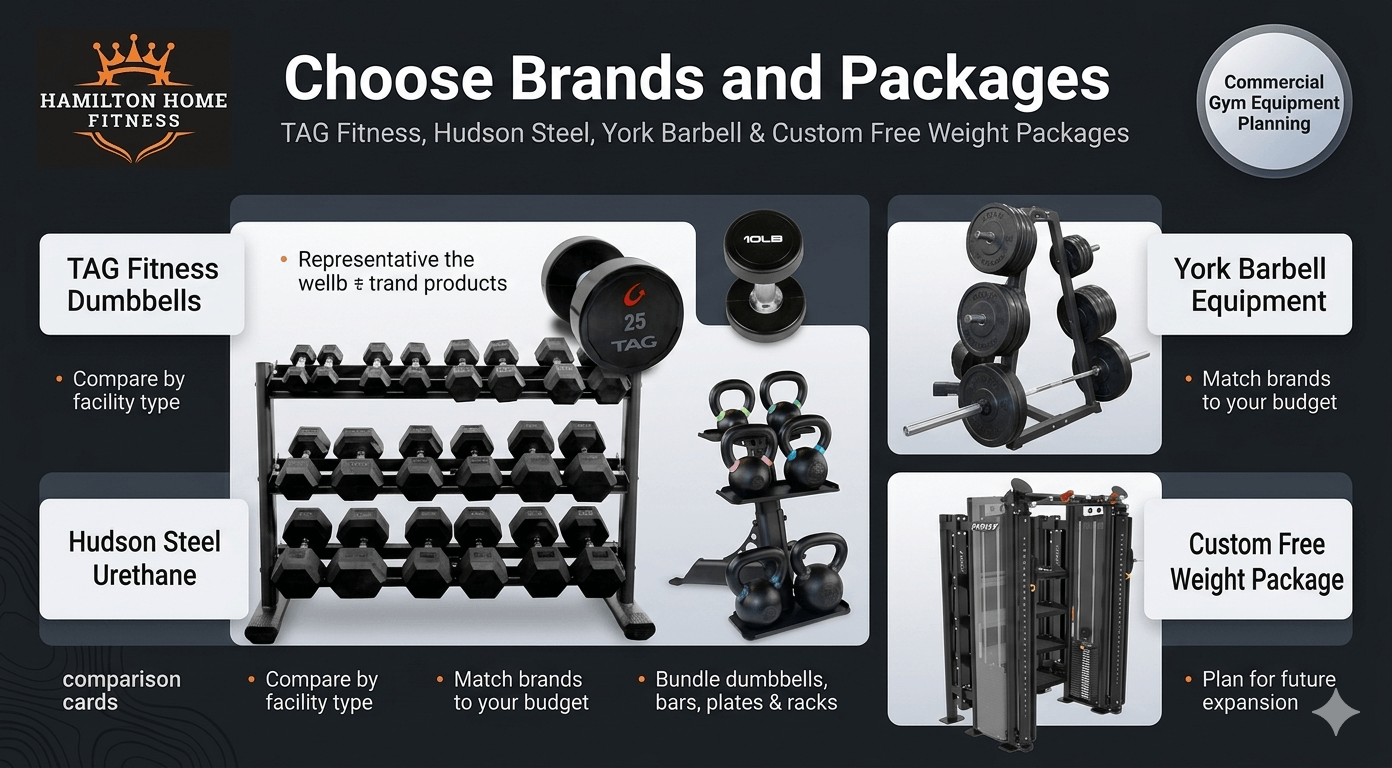
For many gym owners, the smartest path is to build a complete free weight package rather than buying dumbbells, racks, barbells, and plates separately. A package-based approach helps make sure the pieces work together, the rack has the right capacity, the plate storage matches the barbell area, and the final setup fits the available floor space.
Hamilton Home Fitness can help commercial buyers compare options such as TAG Fitness dumbbells, Hudson Steel urethane dumbbells, York Barbell commercial equipment, Olympic bars, commercial bumper plates, rubber plates, racks, kettlebells, and storage systems based on the facility’s real needs.
Compare HHF brand options.
TAG Fitness, Hudson Steel, and York Barbell may each fit different commercial free weight needs depending on material preference, price range, facility type, and member expectations. The right choice is the one that matches how your gym will use the equipment every day.
TAG Fitness dumbbells may be worth considering for commercial buyers who want dependable dumbbell options for general training, personal training studios, school weight rooms, and full gym builds. If your main goal is to create a practical commercial dumbbell area with a strong range of weights and compatible storage, TAG Fitness can fit naturally into the buying conversation.
Hudson Steel urethane dumbbells may be a strong fit for facilities that want a cleaner, more premium presentation. Urethane dumbbells are often considered for hotel gyms, corporate wellness centers, luxury studios, high-end training spaces, and commercial gyms where appearance and long-term surface quality matter.
York Barbell commercial equipment may appeal to facilities that want established strength training options across dumbbells, barbells, plates, and related free-weight products. For buyers building a more traditional strength area, York Barbell can be part of the comparison alongside other commercial free weight brands.
When comparing brands, ask:
Does the brand offer the dumbbell material you want?
Does the range support your users?
Is the rack compatible with the dumbbell style?
Does the equipment match your facility image?
Can the product line support future expansion?
Does the quote include the full system or only individual pieces?
Avoid choosing only by the lowest price. A cheaper dumbbell set may not be the better value if it does not match your usage level, rack needs, or long-term replacement plan.
CTA placement: Shop TAG Fitness Dumbbells
CTA placement: Shop Hudson Steel Urethane Dumbbells
Build a Package Deal
A complete commercial free weight package can include dumbbells, racks, barbells, plates, kettlebells, storage, delivery, and layout support. This can be easier than buying one product at a time because every piece is planned around the same facility goal.
A free weight package may include:
Commercial dumbbell set
Commercial dumbbell rack
Olympic barbells
Ceramic bearing bars where needed
Bumper plates
Rubber Olympic plates
Plate trees or Olympic plate racks
Kettlebells
Medicine balls, slam balls, or wall balls
Barbell storage racks
Lifting platforms
Delivery and installation planning where available
Future expansion recommendations
The biggest benefit of a package is compatibility. A full package helps make sure your dumbbell rack can hold the selected range, your plates fit the barbell stations, your storage matches the room layout, and your equipment mix supports the way members actually train.
Package planning is especially useful for:
New commercial gym build-outs
Free weight area expansions
CrossFit box setups
School weight room upgrades
Hotel or corporate fitness centers
Personal training studios replacing old dumbbells
Facilities that need quote-based budgeting
Hamilton Home Fitness can help buyers move from a rough equipment idea to a more complete free-weight system. You can start by browsing Shop Quality Fitness Gear and equipment—Hamilton Home Fitness—and then request help building the right combination of commercial dumbbells, racks, barbells, plates, and storage.
CTA placement: Build Your Custom Free Weight Package
Expand Beyond Free Weights
Free weights are often the foundation of a strength area, but many facilities also need racks, selectorized machines, plate-loaded machines, cardio equipment, flooring, and layout support to complete the member experience.
A gym that only buys dumbbells and plates may still feel incomplete if members also need guided strength machines, cardio stations, or power racks. A balanced commercial fitness facility usually connects free weights with other training zones so users can move smoothly between strength, conditioning, mobility, and recovery work.
For example, a full commercial facility may include the following:
Dumbbells and benches for free weight training
Power racks and squat cages for barbell strength work
Selectorized machines for guided resistance training
Plate-loaded machines for heavier strength options
Commercial cardio equipment for conditioning
Kettlebells, medicine balls, and slam balls for functional training
Storage systems to keep the floor organized
If your facility needs more than dumbbells and plates, use the Commercial Strength Machines: Selectorized & Plate-Loaded Guide to plan your machine area alongside your free weight system.
You can also choose the best commercial cardio equipment if your build-out includes treadmills, bikes, ellipticals, rowers, or other conditioning equipment. For a more facility-focused cardio plan, review Commercial Cardio Equipment for Fitness Facilities.
The main goal is to avoid building isolated equipment zones that do not support the full training journey. Your free weight area should work with the rest of the gym, not compete with it for space, budget, or member attention.
Maintain and Replace Weights
Commercial dumbbells, barbells, plates, and racks last longer when they are stored correctly, cleaned regularly, and inspected before small issues become expensive problems. Even durable commercial free weights can wear faster if members drop them carelessly, leave them on the floor, overload storage racks, or use them in areas without proper flooring.
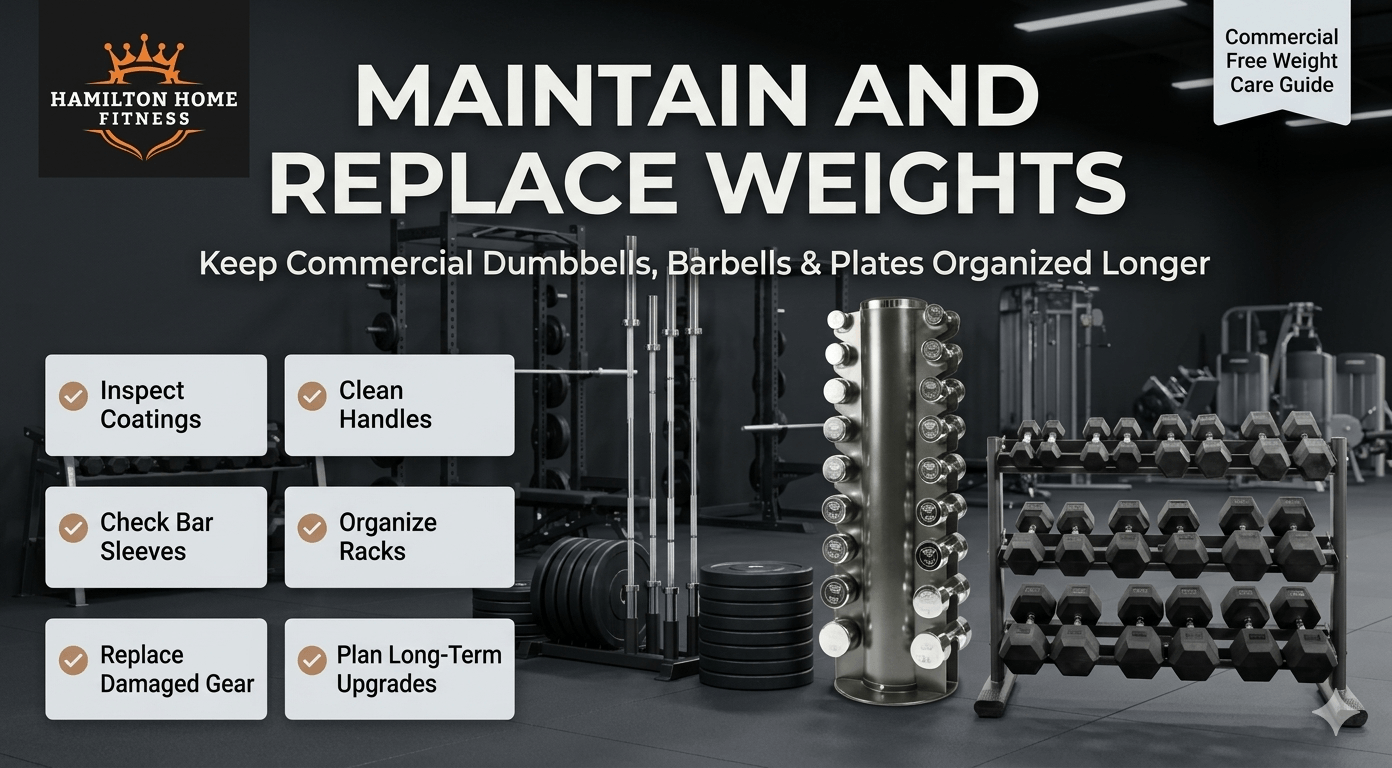
Maintenance should be part of the buying decision from the beginning. A gym that chooses the right dumbbell material, rack style, plate storage, and layout will usually have an easier time keeping the free weight area clean, organized, and professional.
For busy facilities, maintenance is not only about appearance. It also affects member experience, staff workload, equipment safety, replacement planning, and long-term cost.
Dumbbell Lifespan Factors
Dumbbell lifespan depends on material, construction, traffic level, cleaning habits, drop behavior, flooring, and storage quality. A premium dumbbell can still wear quickly if it is constantly dropped on hard flooring or stored on the wrong rack.
The biggest factors that affect how long commercial dumbbells last include:
Material type: Urethane dumbbells may hold their appearance better in premium or high-use spaces, while rubber dumbbells can be practical for general commercial use.
Daily traffic: A hotel gym and a high-volume commercial gym will not wear equipment at the same rate.
Training style: Controlled strength training creates different wear than fast-paced functional training or class-based workouts.
Drop behavior: Repeated drops can damage dumbbell heads, handles, coatings, flooring, and racks.
Rack fit: A poorly matched rack can scrape dumbbells, make storage awkward, or increase the chance of equipment being left on the floor.
Cleaning routine: Sweat, chalk, dust, and cleaning chemicals can affect handles, coatings, and overall appearance.
Flooring quality: Proper gym flooring helps reduce impact damage and protects both the equipment and the facility.
A small personal training studio may get years of use from a well-maintained dumbbell set because equipment is used under supervision. A busy strength gym, school weight room, or CrossFit box may need more frequent inspections because more users handle the same equipment every day.
The smartest approach is to plan for durability before purchase. If your facility expects heavy use, wider weight ranges, class traffic, or advanced lifters, it may be worth investing in commercial-grade dumbbells, strong racks, and proper storage from the start.
Maintenance Checklist
A basic maintenance routine should include wiping handles, checking loose heads or sleeves, inspecting coatings, keeping racks organized, and removing damaged equipment from use. This routine does not need to be complicated, but it should be consistent.
Use this free weight maintenance checklist:
Wipe dumbbell handles regularly to remove sweat, chalk, and residue.
Inspect dumbbell heads for cracks, looseness, coating damage, or separation.
Check rubber and urethane coatings for cuts, peeling, scuffs, or exposed metal.
Make sure dumbbells return to the correct rack position after use.
Inspect dumbbell racks for bending, sharp edges, loose bolts, or unstable placement.
Clean barbell knurling carefully so grip does not become packed with chalk or debris.
Check barbell sleeves for smooth rotation and visible damage.
Inspect collars, sleeves, and end caps when bars are used heavily.
Review bumper plates and rubber plates for cracks, loose inserts, or warping.
Keep plate trees and Olympic plate racks organized by size.
Remove damaged dumbbells, plates, or bars from the floor until they are reviewed.
Staff should also watch for repeated layout problems. If members keep leaving plates near platforms, the plate storage may be too far away. If dumbbells are often out of order, the rack may be crowded or poorly labeled. If popular weights are always missing, the gym may need duplicate pairs instead of more signs reminding members to re-rack.
Maintenance also helps with replacement planning. If several dumbbells in the same range are damaged or constantly unavailable, it may be time to expand or replace part of the set. If plates are cracked or bars no longer spin smoothly, the issue may affect training quality and member trust.
For facilities with damaged, mismatched, or undersized free weight areas, replacing one item at a time may not solve the bigger problem. A planned upgrade can help you refresh the dumbbell set, improve rack storage, add missing barbells or plates, and make the free weight area easier to manage long-term.
People Also Ask
What type of dumbbells do gyms use?
Most gyms use fixed commercial dumbbells because they are durable, easy to organize, and fast for members to grab during training. Common options include rubber hex dumbbells, rubber round dumbbells, urethane dumbbells, and pro-style dumbbells.
Rubber dumbbells are often used in general commercial gyms, school weight rooms, personal training studios, and functional training spaces. Urethane dumbbells are often chosen for premium gyms, hotel fitness centers, corporate wellness rooms, and high-traffic facilities that want a cleaner long-term look. Pro-style dumbbells may fit traditional strength gyms where members prefer a classic commercial dumbbell feel.
What is the difference between urethane and rubber commercial dumbbells?
Urethane commercial dumbbells usually offer a more premium appearance and may resist scuffs, fading, odor, and cosmetic wear better than many standard rubber options. Rubber commercial dumbbells are often more budget-friendly and work well for general strength training, functional fitness, and facilities that need a practical dumbbell set at a lower starting cost.
Choose urethane if appearance, long-term presentation, and premium facility image matter most. Choose rubber if you need dependable commercial dumbbells while keeping the upfront budget more controlled.
What dumbbell weight range should a commercial gym have?
A commercial gym should usually choose its dumbbell range based on facility size, member strength level, and training style. A small studio, hotel gym, or wellness room may only need a 5–50 lb dumbbell set. A personal training studio or boutique gym may need 5–75 lb weights. A full commercial gym, athletic facility, or strength-focused space often benefits from a 5–100 lb range or heavier weights.
The right range should cover the weights members use most often while leaving room for progression. Busy gyms may also need duplicate pairs of popular middle-range weights.
What is a pro-style dumbbell, and is it right for a gym?
A pro-style dumbbell is a traditional fixed dumbbell design with weighted heads secured to a handle. It is often used in commercial strength training spaces because it gives members a classic dumbbell feel and a compact lifting profile.
Pro-style dumbbells may be right for bodybuilding gyms, strength-focused facilities, personal training studios, and commercial gyms that want a traditional round dumbbell design. They should still be evaluated for handle quality, head security, rack compatibility, and commercial durability.
How many dumbbells does a commercial gym need?
A commercial gym needs enough dumbbells to support peak-hour traffic without creating bottlenecks. Small studios may only need one pair of each weight. Larger commercial gyms may need duplicate pairs of commonly used weights such as 15 lb, 20 lb, 25 lb, 30 lb, 35 lb, 40 lb, and 50 lb.
The right quantity depends on member volume, class size, training style, rack space, and whether users often need the same weights at the same time. A custom free weight package can help match the dumbbell count to the facility instead of guessing.
What barbell should a commercial gym use?
Most commercial gyms should start with durable Olympic barbells because they work with standard Olympic plates and support major lifts like squats, bench presses, deadlifts, rows, and overhead presses. General fitness facilities may do well with multipurpose Olympic bars, while Olympic lifting gyms, CrossFit boxes, and sports performance centers may need bearing bars with smoother sleeve rotation.
Strength-focused gyms may also need power bars, deadlift bars, squat bars, EZ curl bars, trap bars, or safety squat bars depending on the training program.
What is a ceramic bearing barbell, and why does it matter?
A ceramic-bearing barbell is an Olympic bar designed to support smooth sleeve rotation. This matters most for Olympic-style lifts such as cleans, snatches, and jerks, where faster and smoother spin can help the bar move more naturally during technical lifts.
Not every gym needs ceramic-bearing bars. A general commercial gym may be fine with strong multipurpose or bushing barbells, while a CrossFit box, Olympic lifting facility, or sports performance center may benefit from ceramic-bearing Olympic bars.
What is the difference between bumper plates and rubber plates?
Bumper plates are designed for Olympic lifting, CrossFit, deadlifts, and controlled drops on proper flooring or platforms. They are commonly used where the bar may return to the floor from height.
Rubber Olympic plates are better for general strength training, plate-loaded machines, squat racks, bench stations, and controlled barbell work. Many commercial gyms use both bumper plates near platforms and rubber plates near racks, benches, and strength machines.
What dumbbell rack style is best for a commercial gym?
The best dumbbell rack style depends on the dumbbell set size, room layout, and traffic flow. Horizontal racks and 3-tier racks usually work well for full commercial dumbbell sets because they keep weights visible and easy to access. Vertical racks and A-frame racks can save space in smaller studios, hotel gyms, and compact training rooms.
For larger facilities, choose a rack that supports the full dumbbell range, leaves clear walking space, and makes re-racking easy for members.
How long do commercial dumbbells last?
Commercial dumbbells can last for years when they are matched to the facility, stored on the right rack, cleaned regularly, and inspected for damage. Lifespan depends on material, construction, traffic level, flooring, drop behavior, and maintenance.
Urethane dumbbells may be a strong fit where appearance and long-term presentation matter. Rubber dumbbells can be practical for high-use general training spaces. In either case, poor storage, repeated drops, and weak maintenance can shorten equipment life.
Does Hamilton Home Fitness sell complete commercial free weight packages?
Yes. Hamilton Home Fitness can help commercial buyers build complete free weight packages that may include commercial dumbbells, dumbbell racks, Olympic barbells, bumper plates, rubber plates, kettlebells, plate storage, barbell storage, and layout support.
This is useful for new gym build-outs, free weight area upgrades, school weight rooms, personal training studios, CrossFit boxes, hotel gyms, corporate fitness centers, and facilities replacing damaged or incomplete equipment.
How much does a commercial dumbbell set cost?
The cost of a commercial dumbbell set depends on the material, brand, weight range, number of pairs, rack style, shipping, and whether the set is part of a larger free weight package. A 5–50 lb rubber dumbbell set will usually cost less than a 5–100 lb urethane dumbbell set because the total weight, material, and package size are different.
For accurate pricing, compare complete systems instead of isolated product prices. Include dumbbells, racks, barbells, plates, storage, delivery, and future expansion needs in the quote.
What is the best commercial dumbbell brand?
The best commercial dumbbell brand depends on the facility’s needs, budget, user volume, material preference, and rack requirements. TAG Fitness, Hudson Steel, and York Barbell may each be worth considering depending on whether the buyer wants rubber dumbbells, urethane dumbbells, pro-style dumbbells, or a broader commercial free weight setup.
Rather than choosing by brand name alone, compare material, handle feel, weight range, rack compatibility, replacement planning, and total package value.
What are bumper plates used for in a gym?
Bumper plates are used for Olympic lifts, CrossFit workouts, deadlifts, platform training, and movements where the loaded bar may return to the floor. They are common in facilities that train cleans, snatches, jerks, and functional strength movements.
Commercial bumper plates should be paired with proper flooring, platform space, and plate storage. For general rack work and machine loading, rubber Olympic plates may be the better fit.
How do you maintain commercial dumbbells?
Maintain commercial dumbbells by wiping handles, inspecting heads and coatings, checking for loose parts, keeping racks organized, and removing damaged dumbbells from use. Staff should also monitor whether dumbbells are being dropped too often or stored on the wrong rack.
A clean maintenance routine helps protect the equipment, improve the member experience, reduce clutter, and make the free weight area look more professional.
Can you buy commercial dumbbells online?
Yes, commercial dumbbells can be purchased online, but gym buyers should confirm more than the product name before ordering. Check the material, weight range, rack compatibility, delivery options, package pricing, and whether the dumbbells fit the facility layout.
For larger commercial orders, requesting a custom quote is often better than buying individual pieces separately because it helps match the dumbbells, racks, plates, barbells, and storage to the full gym plan.
Final Thought
The right commercial free weight system is not just a dumbbell purchase. It is a full facility planning decision that includes dumbbell material, weight range, rack layout, Olympic barbells, bumper plates, rubber plates, storage, traffic flow, and long-term growth.
For most gym owners, the best setup is the one that matches how members actually train. A compact studio may need a clean 5–50 lb dumbbell set with space-saving storage. A busy commercial gym may need a wider 5–100 lb range, duplicate popular weights, multiple Olympic barbells, bumper plates, plate trees, and a layout that keeps members moving safely.
Hamilton Home Fitness helps commercial facilities in Tennessee and across the USA plan free weight areas that fit their space, budget, and training goals. Whether you are replacing damaged dumbbells, expanding your strength area, or building a new gym from the ground up, HHF can help you compare commercial dumbbells, barbells, plates, racks, and complete free weight package options.
To take the next step, shop HHF commercial free weights or request a custom free weight package quote built around your facility’s layout, user volume, and equipment needs.