
Introduction
Picking the wrong rack is one of the most expensive mistakes a commercial gym can make. A residential rack put under daily multi-user load typically fails inside 18–24 months — and replacement, downtime, and member safety risk all stack on top of the original price tag.
This guide is built for the people making that call: gym owners, CrossFit box operators, school and university weight room directors, and hotel or corporate facility managers who lift and know what good training feels like — but haven't dealt with commercial procurement specs like steel gauge, load rating, bolt-down requirements, or warranty tiers.
Below, you'll learn what actually makes a power rack commercial-grade, how commercial power racks for gyms differ from home racks, which rack format fits your facility, the specs to verify before you buy, and how to plan footprint, attachments, and multi-rack rows for real member volume. You'll also see realistic cost ranges and the brands most commercial buyers shortlist.
Hamilton Home Fitness builds out Commercial Gym Equipment for Facilities & Gyms across the United States from our Tennessee base — so by the end of this guide, you'll know exactly what to look for, and you'll have a clear path to quote, buy, or design your space with help.
What Makes a Power Rack Commercial-Grade
A commercial power rack is built to handle daily multi-user lifting at heavy loads. In practical terms, that means 11-gauge steel, 3x3-inch uprights, a rackable load rating of 1,000+ lb, oversized hardware, robotic welds, and a lifetime structural warranty that explicitly covers commercial use.
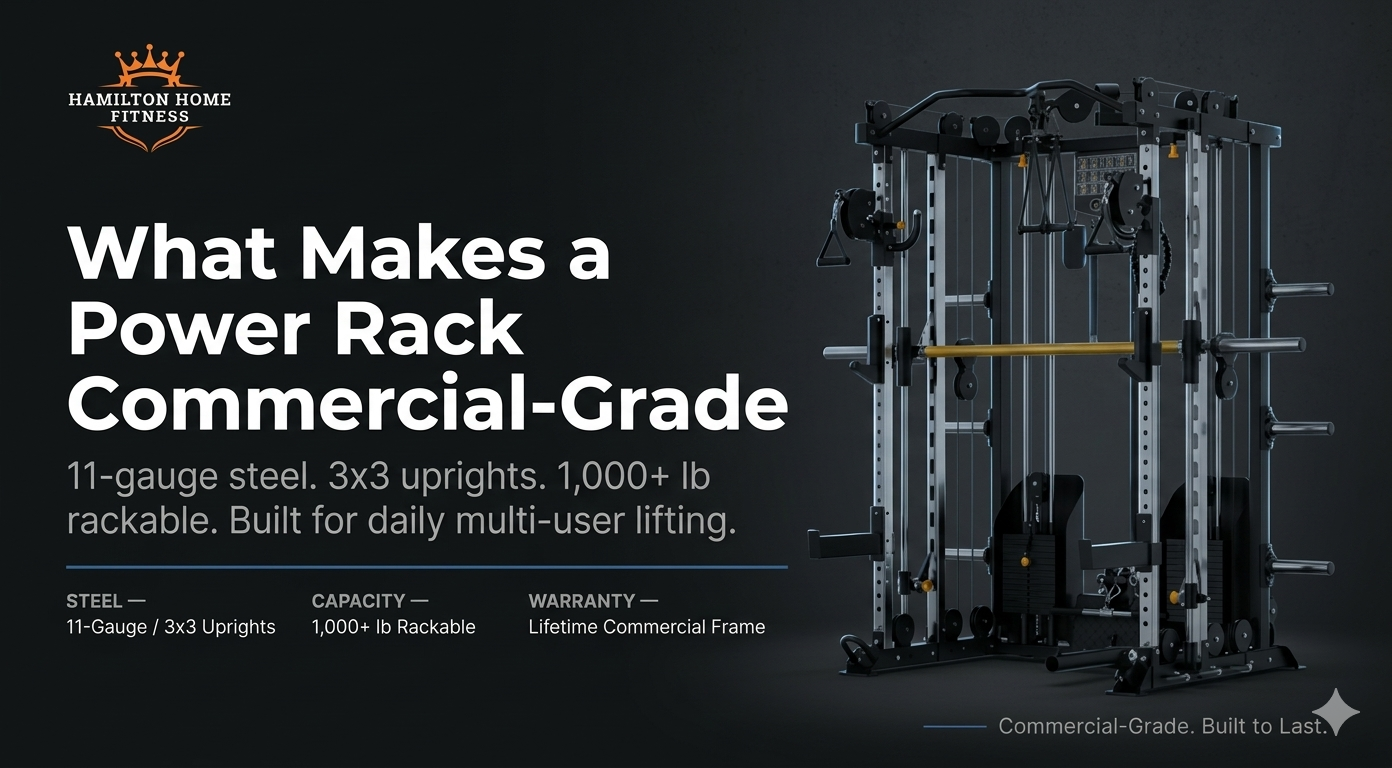
The word "commercial" gets used loosely on product pages. A truly commercial-grade rack is defined by what it's engineered to survive — not by marketing language. Three spec areas separate the real ones from the mislabeled ones.
Steel Gauge and Upright Size
For commercial use, look for 11-gauge steel and 3x3-inch uprights. That combination is the build standard that handles daily heavy lifting without flex or fatigue.
Steel gauge measures wall thickness, and lower numbers mean thicker steel. Most commercial racks use 11-gauge (roughly 3 mm thick). Lighter racks often use 12 or 14-gauge, which works for moderate home loads but flexes under sustained commercial use.
Upright size matters just as much. A 3x3-inch upright contains significantly more steel than a 2x3 or 2x2 — meaning more rigidity, less sway, and a higher attachment ceiling. If a spec sheet hides the gauge or upright dimensions, treat that as a warning sign.
Weight Capacity and Load Rating
Most commercial power racks support 1,000–1,500+ lb of rackable load, with whole-rack capacity often well above 5,000 lb. Premium commercial models like the Body-Solid SPR1000 are built around a 3x3, 11-gauge frame rated at 1,000 lb, while heavier-duty bolt-down racks like the Titan X-3 list rackable capacity around 1,650 lb and whole-rack capacity above 6,000 lb.
Two numbers matter, and buyers often confuse them. Rackable capacity is what the J-hooks and uprights can safely hold during a lift. Whole-rack capacity includes plate storage, pull-up loading, and structural total — a much larger number that doesn't reflect what you can actually rack.
There's no universal testing standard across the industry, so confirm how the manufacturer arrived at the number. European EN957-certified racks undergo cyclical fatigue testing; many budget brands publish capacity numbers with no verification at all.
Hardware, Welds, and Warranty Tier
Commercial-grade racks use oversized hardware, full-penetration welds, and a lifetime structural warranty that's rated for commercial use — not home use only.
Look for 5/8" or 1" hardware, robotic-welded joints, and sandwich-style J-hooks with UHMW plastic inserts that protect both the bar knurling and the upright finish. These details aren't cosmetic — they're what separates a frame that survives 10 years of daily use from one that loosens, scratches, or fatigues inside two.
Warranty tier is the spec most buyers skip. Many brands offer a lifetime frame warranty for residential use but cut that coverage sharply when the rack is placed in a commercial setting. Before you buy, confirm the warranty terms apply in your facility type — gym, school, hotel, corporate, or rehab.
Commercial Power Rack vs Home Power Rack
A commercial power rack is engineered for non-stop multi-user load — heavier steel, higher capacity, oversized hardware, and a warranty that covers commercial use. A home rack is built for one or two users and a fraction of the daily volume.
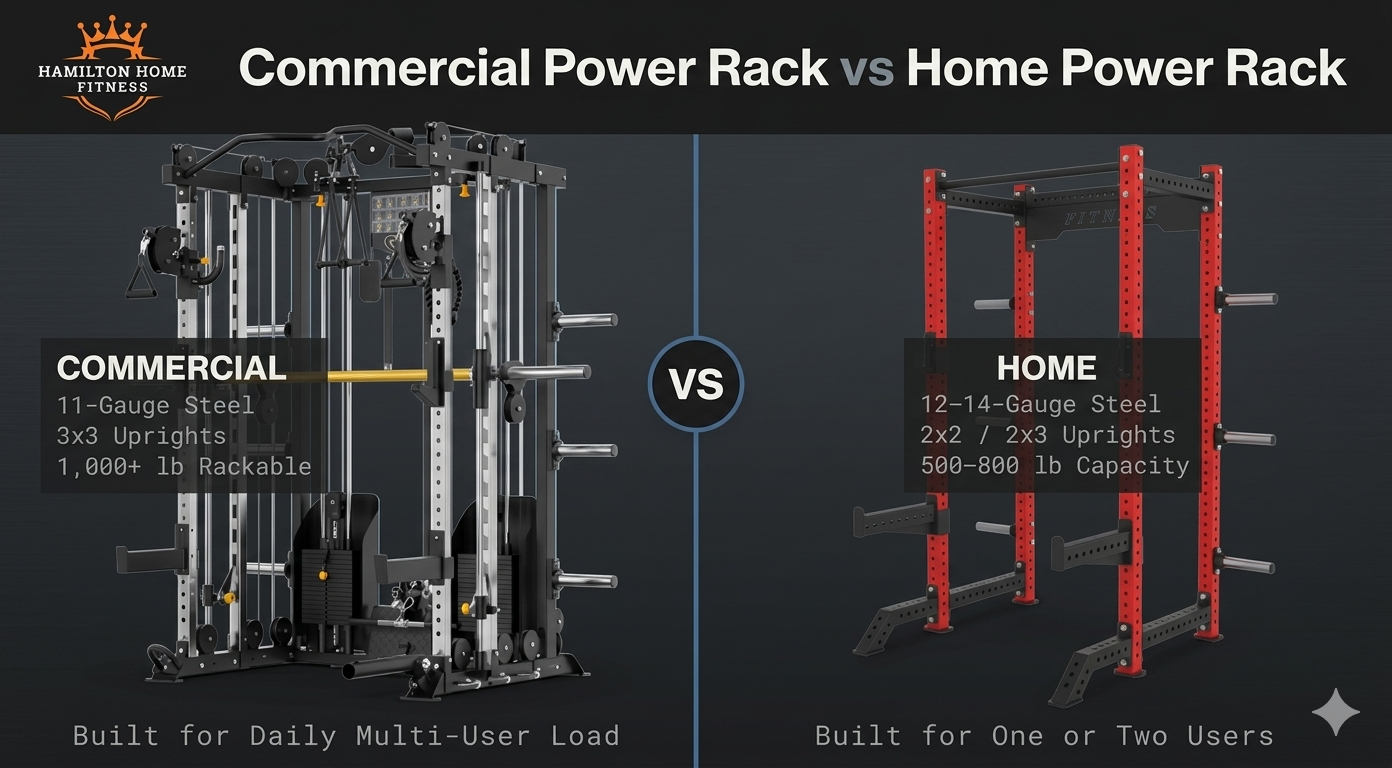
The difference shows up in three places: how the rack is built, how it behaves under simultaneous use, and what it actually costs over time.
Build Quality and Daily Use Tolerance
Home racks often use 12 or 14-gauge steel and 2x2 or 2x3 uprights. Commercial racks default to 11-gauge and 3x3 — and the gap is bigger than the numbers suggest.
A 60x60x2mm upright contains roughly 60% less steel than a 75x75x3mm commercial upright. That difference is invisible during a single squat session. It becomes painfully visible after a year of daily use across dozens of members — frame flex, loosened bolts, scratched powder coat, and worn J-hook attachment points.
Commercial racks are also assembled with oversized hardware and full robotic welds rather than stamped hardware and spot welds. The build tolerances are tighter because the daily wear cycle is longer.
Multi-User Stability and Footprint
Commercial racks stay rigid under simultaneous pull-ups, rack pulls, and bench loads. Home racks flex or wobble under the same conditions.
Picture a busy hour at a CrossFit box: one member doing kipping pull-ups on the cross-member, another loading 405 for a rack pull, a third unracking a bench. That's three dynamic load events on the same frame at the same time. A 200-lb member doing kipping or muscle-up work generates 350–450 lb of instantaneous force on the pull-up bar — the kind of load a 2x2 home upright was never designed to absorb.
Commercial 3x3 frames with bolt-down anchoring stay locked through that. Home racks loosen, shift, and eventually crack at the welds — often without obvious warning.
Long-Term Cost and Replacement Cycle
A residential rack used commercially typically needs replacement within 18–24 months. The total cost almost always exceeds buying commercial-grade up front.
Run the math against the real cost of ownership: rack purchase + freight + installation + downtime + replacement freight + member experience hit + potential liability if a frame fails during a lift. A $700 home rack that lasts two commercial years costs more than a $1,800 commercial rack that runs ten.
For most facilities, the right framing isn't "what does this rack cost?" — it's "what does this rack cost per year of reliable service in my gym?" Once you reframe it that way, the commercial-grade choice usually wins on price, not just performance.
Types of Commercial Racks and Cages
Commercial racks come in four main formats — full power cages, half racks, squat stands and monolifts, and wall-mount fold-back racks. Each suits a different facility footprint and training culture.
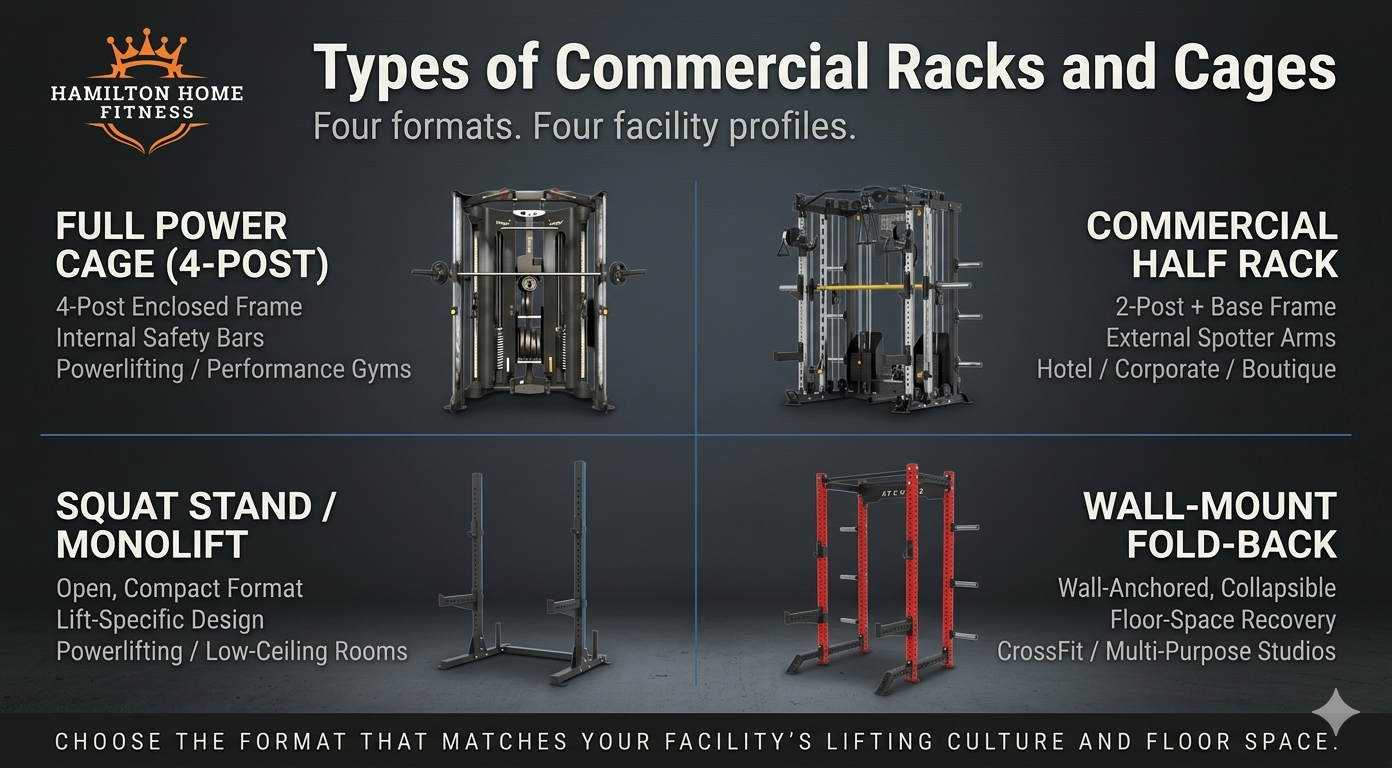
The right format depends on three things: how heavy the lifting goes, how much floor space you can dedicate, and whether members lift inside an enclosed safety zone or train more openly.
Full Power Cages (4-Post)
A full power cage is a 4-post enclosed structure that lets a lifter train heavy alone, safely, with internal spotter bars catching a missed lift.
This is the most common commercial format for serious strength facilities. A typical commercial full cage like the Body-Solid SPR1000 measures around 81" long, 53" wide, and 90" tall, built from 3x3 11-gauge steel with a 1,000 lb rackable capacity and 1-inch hole spacing through the bench-press zone. Pull-up bar, J-cups, and safety spotter arms come standard, with a deep attachment ecosystem available on top.
Full cages fit best in powerlifting gyms, school and university weight rooms, performance training facilities, and any space where members regularly lift near or above bodyweight. The enclosed geometry is what makes solo heavy training safe — internal safety bars or straps catch the bar at the failure point, not after it lands on the lifter.
Commercial Half Racks
A commercial half rack uses two uprights with external spotter arms — smaller footprint than a full cage, with most of the same training capability.
Half racks free up depth in the room because the lifter trains in front of the rack rather than inside it. Most commercial half racks include a base frame with built-in plate storage, an integrated pull-up bar, and adjustable spotter arms that extend forward to catch failed lifts. Capacity runs in the same commercial 1,000+ lb range as a full cage when the build quality is comparable.
Half racks are a strong fit for hotel and corporate gyms, multifamily and apartment fitness rooms, boutique studios, and rehabilitation facilities — anywhere floor space, ceiling height, or visual openness matters more than full cage enclosure. They also work well in CrossFit boxes that want lifting stations along a wall without committing to a full rig.
Squat Stands and Monolifts
Squat stands and monolifts are open, compact rack formats — built for specific lifts rather than full versatility.
A squat stand consists of two short uprights, a base frame, J-cups, and safety arms. They're minimal by design, easy to reposition, and useful in low-ceiling rooms where a full cage won't fit. A monolift attachment goes a step further: it allows powerlifters to unrack a heavy squat without walking the bar out, then swings clear during the lift.
These formats fit a narrower set of facilities. Squat stands work in basement gyms, low-ceiling hotel rooms, and small-footprint studios. Monolifts belong in dedicated powerlifting gyms or sports performance facilities where competition-style squats are part of the programming. Outside those use cases, most commercial buyers will get more value from a half rack or full cage.
Wall-Mount and Fold-Back Racks
Wall-mounted fold-back racks collapse against the wall when unused — ideal for CrossFit boxes and multi-purpose studios where floor space rotates between uses.
A fold-back rack mounts directly to a structural wall and folds flat when the room shifts to group training, mobility work, conditioning circuits, or class-style functional fitness. When deployed, it functions as a full commercial-grade squat and pressing station with a pull-up bar overhead.
This format earns its place in CrossFit gyms running mixed programming, boutique studios that flip rooms between strength and group classes, school auxiliary spaces, and apartment or hotel fitness rooms with strict floor-space budgets. The trade-off is reduced attachment versatility compared to a full cage — but for facilities where space rotates, the floor space recovered is usually worth it.
Specs to Check Before You Buy
Before buying, verify five specs: steel gauge, upright size, hole spacing, weight capacity, and bolt-down requirement — and confirm safety hardware ratings separately from the frame.
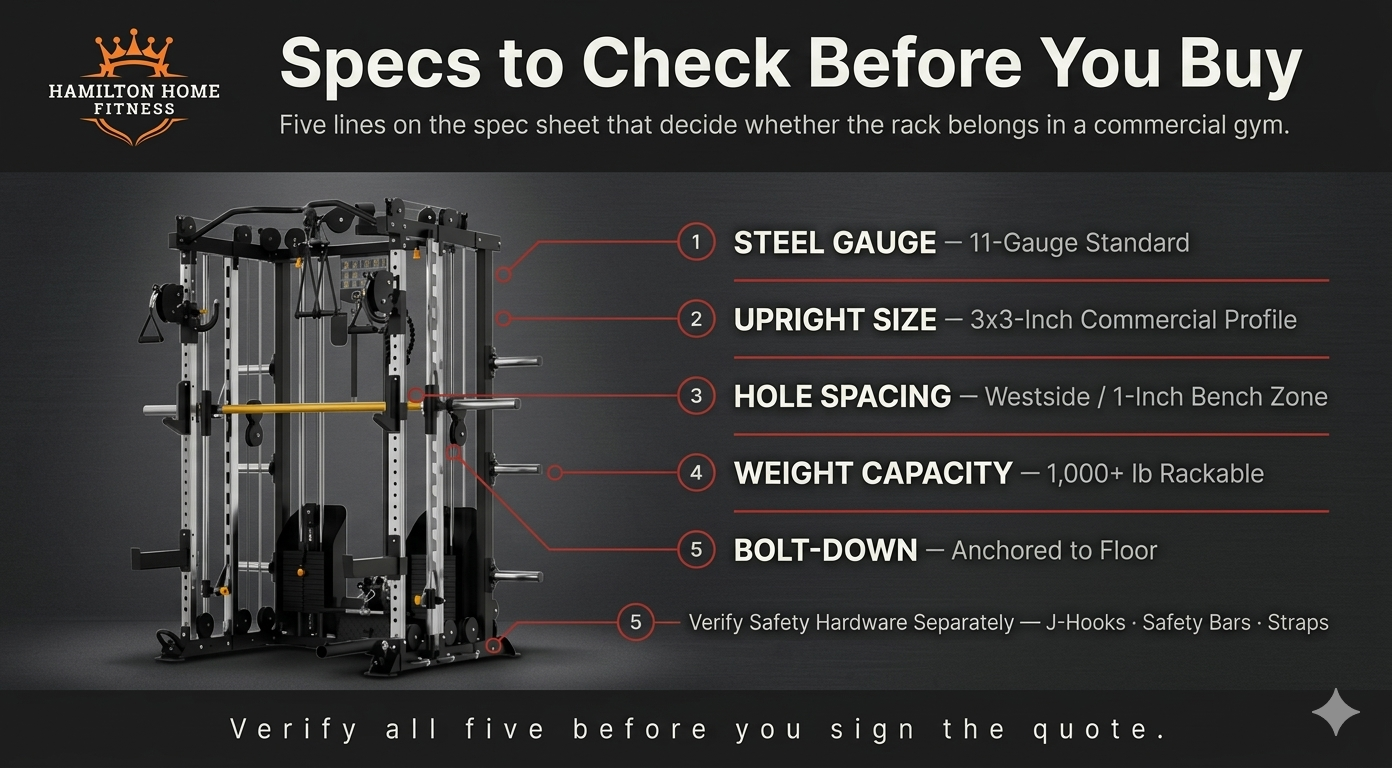
These are the five lines on a spec sheet that decide whether the rack will hold up in a commercial setting. Skip any of them and you're buying on marketing language.
Steel Gauge (11-Gauge Standard)
Default to 11-gauge steel for commercial use — and walk away from any spec sheet that hides the gauge number.
11-gauge is the practical baseline for daily multi-user lifting. 12-gauge can work in light-use commercial settings like apartment or corporate fitness rooms, but it flexes under sustained heavy load. 14-gauge is residential territory and shouldn't appear on a commercial buying shortlist.
The bigger warning sign isn't a higher gauge number — it's no gauge listed at all. If a manufacturer doesn't publish steel gauge and upright dimensions on the product page, treat that as a quiet admission. Commercial-tier brands publish those specs because the numbers are part of the value.
Hole Spacing (Westside vs 2-Inch)
Westside hole spacing offers 1-inch precision in the bench-press and clean-pull zones — the standard for serious commercial racks.
Most commercial racks use one of two hole patterns. Uniform 2-inch spacing runs the same gap top to bottom, which is fine for general training. Westside spacing tightens to 1-inch in the bench and rack-pull range and stays at 2-inch elsewhere.
That extra precision matters when members are setting up heavy bench presses, partial-range rack pulls, or pin presses. Half an inch of J-cup height changes how the bar sits over the chest at lockout — and on a heavy lift, that detail decides whether the set is safe and clean or awkward and risky. For powerlifting gyms, school weight rooms, and performance facilities, Westside spacing is the default expectation.
Bolt-Down vs Freestanding
Most commercial power racks should be bolted to the floor. Manufacturers recommend it for stability, and it's effectively required for kipping pull-ups, dynamic loading, or any rack over 80 inches tall.
A bolted rack stays locked under simultaneous use. A freestanding rack — even a heavy commercial one — can shift, rock, or in extreme cases tip during dynamic pull-up work. Most commercial frames include anchor points in the base specifically because the manufacturer expects the rack to be installed permanently.
Bolt-down installation depends on the floor underneath. A concrete slab takes wedge anchors directly. Floors with rubber tile or gym flooring need anchors that pass through the flooring into the slab below — which is why rack placement, platform design, and flooring choice all need to be planned together. For more on building the right base, see our guide to Commercial Gym Flooring Fitness Facilities.
Safety Bars, Straps, and J-Hooks
Sandwich J-hooks with UHMW inserts and reinforced strap or pin-pipe safeties are the commercial standard — and their ratings often set the real load ceiling, not the frame.
J-hooks come in two main styles. Stamped J-hooks are thinner and sag under heavy benching. Sandwich-style J-hooks layer a steel frame with UHMW plastic inserts that protect both the bar knurling and the upright finish. Commercial sandwich hooks typically rate 700–900 lb — and that rating is what actually limits a 1,500 lb-rated rack during a heavy lift.
Safety systems split into two formats. Pin-and-pipe safeties are steel bars that catch a failed lift with a hard stop. Strap safeties use 3-inch reinforced nylon webbing that absorbs more impact, runs quieter, and protects the bar finish on a missed rep. Most commercial gyms run strap safeties for benching and pin-pipe for squats and rack pulls. Whichever format you choose, verify the rated capacity matches what your strongest members actually lift — including a margin for dynamic drops.
Attachments, Footprint & Multi-Rack Layout
A commercial rack typically occupies a 4 x 6 ft footprint with 3–5 ft of safety clearance on every active side. Most gyms scale by adding 2–6 racks in a row, sharing uprights or connector bars to build a cohesive strength zone.
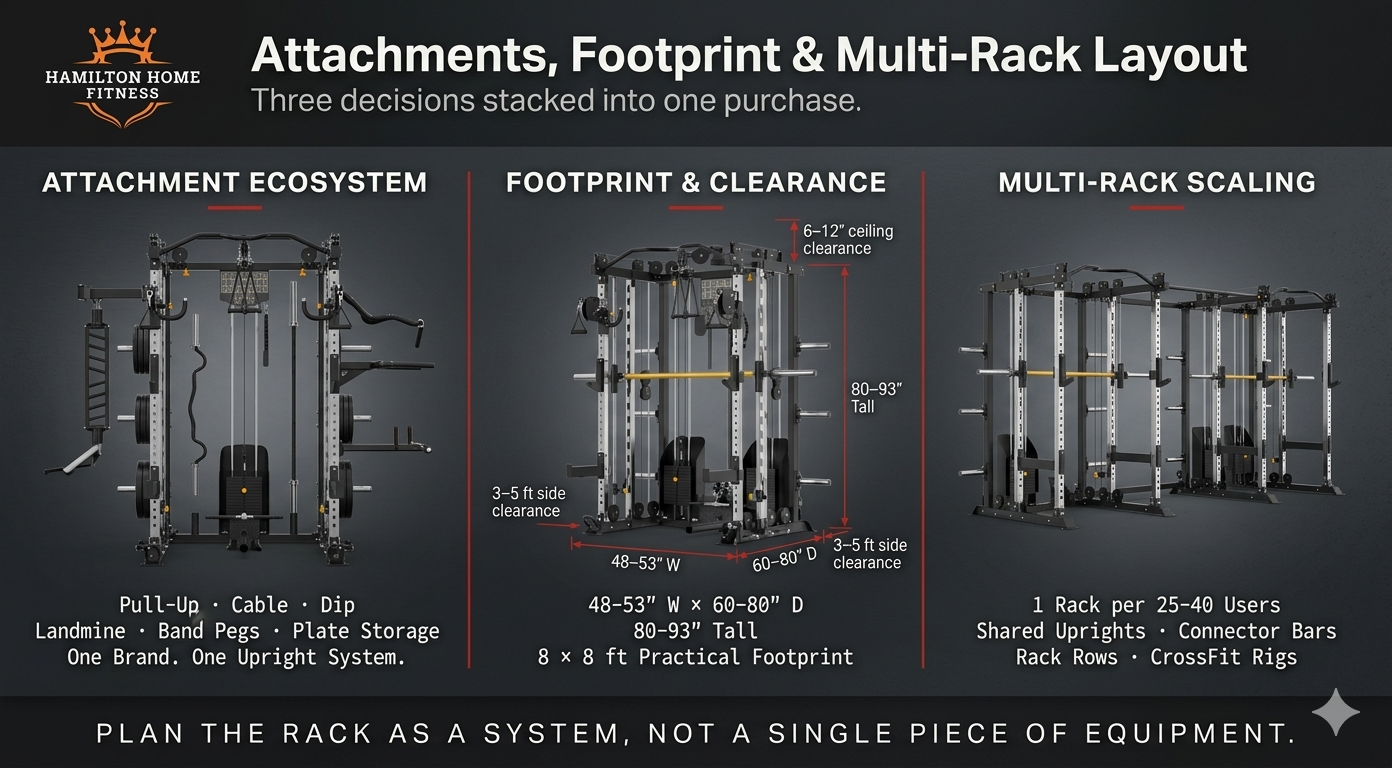
Buying a rack is really three decisions stacked together: which attachments will members actually use, how the rack fits the room, and how many racks the facility needs to serve peak-hour demand without bottlenecks.
Core Attachment Ecosystem
Most commercial racks expand into a full strength station through attachments: pull-up bars, lat and cable pulleys, dip stations, landmines, band pegs, and plate storage.
The standard ecosystem covers six categories. Pull-up and chin-up bars (single, multi-grip, or fat-grip) sit across the top. J-hooks, safety bars, and spotter arms handle the lift itself. Lat pulldown and low-row cable attachments turn the rack into a pulling station. Dip stations and landmine attachments add upper-body and rotational work. Band pegs allow accommodating resistance for advanced lifters. Plate storage pegs and weight horns keep the floor clear and the rack stable.
The detail most buyers miss is ecosystem lock-in. Once a rack is installed, you're committed to that brand's upright system — which means the attachments you can add later depend on the brand you choose now. Before buying, look at the full attachment line, not just what's bundled with the base rack. A commercial power rack with cable pulley capability built into the same upright system gives you years of expansion room without replacing the frame.
Footprint and Ceiling Clearance
Plan on 48–53 inches wide, 60–80 inches deep, and 80–93 inches tall — and add at least 6–12 inches of ceiling clearance for pull-ups.
Width and depth are predictable across commercial brands. Height is where most facilities run into trouble. A 90"-tall rack needs roughly 96–102 inches of ceiling clearance for safe pull-up extension. An 8-foot ceiling (96 inches) only fits short commercial racks — typically 80" or under. A 10-foot ceiling clears the full range comfortably.
Floor clearance is the other dimension that gets overlooked. Plan 3–5 feet of unobstructed space on every active side: in front for the lifter and bar path, behind for spotters or rear extension, and on each side for plate loading. A rack pressed too close to a wall or column blocks plate changes and creates collision risk during dynamic lifts. For a single full cage, the practical room footprint is closer to 8 x 8 ft once clearance is included — not the 4 x 6 ft frame size on the spec sheet.
Multi-Rack and Rig Configurations
Most commercial gyms plan for one rack per 25–40 simultaneous strength users — scaling through rack rows or full CrossFit rigs in higher-volume facilities.
The exact ratio depends on facility type. Boutique strength studios run one rack per 15–20 members. School and university weight rooms scale to class-style training with 6–12 racks in a row, often sharing uprights through connector bars. CrossFit boxes typically build full rigs that combine 4–8 squat stations along a single integrated structure with shared pull-up bars overhead. Hotel and corporate gyms usually run a single half rack or full cage as part of a broader functional zone.
Multi-rack rows save floor space and cost per station because adjacent racks share uprights. They also improve coaching sightlines — a strength coach can supervise six lifters from one position. The trade-off is that the layout becomes permanent. Once a 6-rack row is anchored to the slab, reconfiguring the strength zone means moving the entire system.
The rack zone is also the anchor for the rest of the facility. A balanced strength area pairs naturally with the cardio zone and free-weight area — and most gym builds plan all three together. If you're sizing the full facility, our guidance on how to choose the best commercial cardio equipment walks through cardio sizing alongside strength capacity, and our Commercial Cardio Equipment for Fitness Facilities collection shows the equipment options that pair cleanly with a multi-rack strength zone.
Brands, Cost & How to Buy from HHF
Commercial power racks typically range from about $700 for a half rack to $3,000+ for a fully attachment-loaded full cage. TAG Fitness and Body-Solid Pro Clubline are among the most common brands in commercial buyer shortlists.
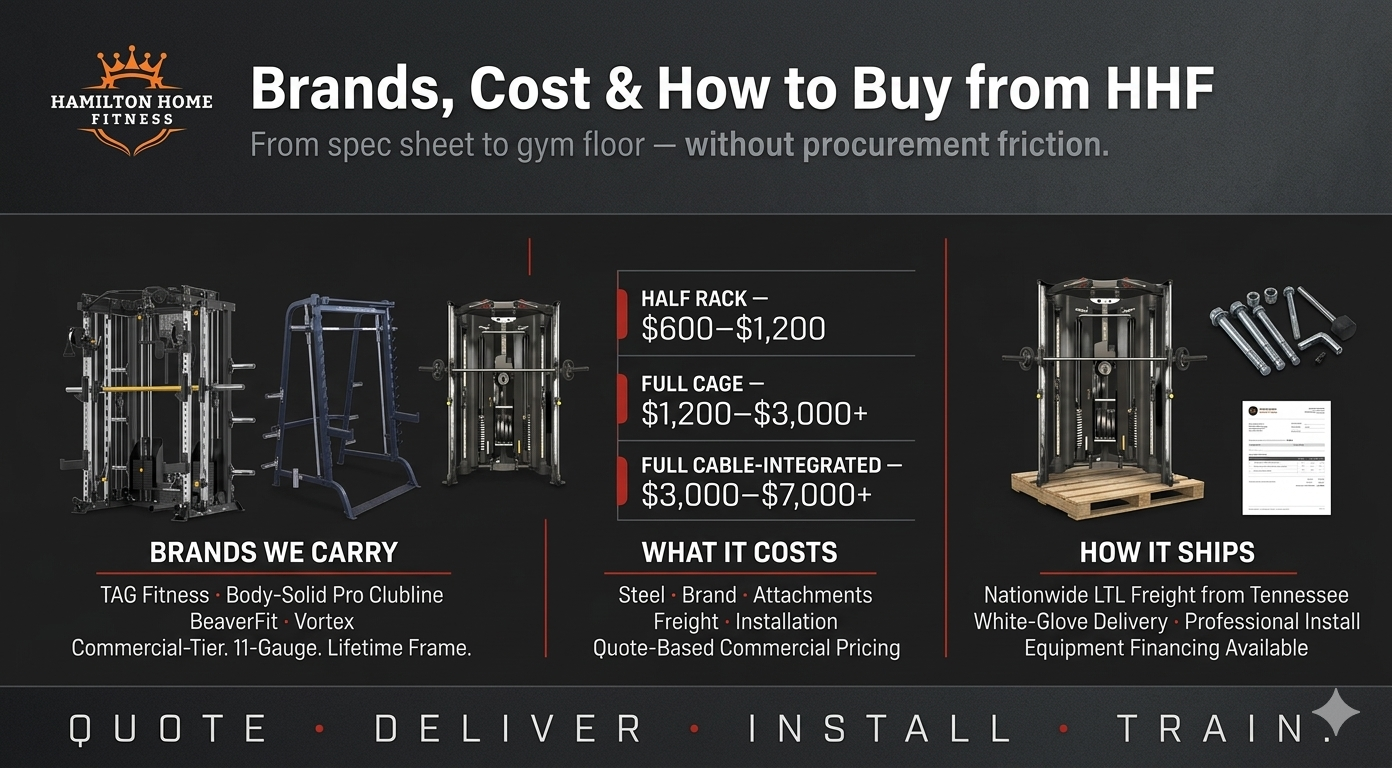
Once the spec, format, and layout decisions are made, the rest is a procurement conversation: which brand fits your facility, what to budget, and how the rack actually gets from the warehouse onto your gym floor.
Brand Snapshot: TAG Fitness & Body-Solid
TAG Fitness and Body-Solid Pro Clubline are two commercial brands gym buyers most often shortlist — both offering 11-gauge, 3x3 commercial-tier builds and lifetime structural warranties.
TAG Fitness is known for heavy commercial builds aimed at high-volume facilities and athletic programs. Their racks are designed for daily institutional use — schools, universities, sports performance centers, and large training facilities — with overbuilt frames and a deep attachment line.
Body-Solid Pro Clubline covers a wider range of commercial use cases. The SPR500 half rack and SPR1000 full cage are the workhorses of the line. Both use 3x3 11-gauge steel, the SPR1000 stands 90" tall with 1-inch hole spacing through the bench-press zone, and both rate 1,000 lb. The Pro Clubline also supports rear extensions, monkey bar attachments, and connector bars for multi-rack setups — so a single rack can grow into a full strength zone over time.
Beyond TAG and Body-Solid, HHF carries other commercial-tier options including BeaverFit rigs (7-gauge USA steel for heavy-duty installations) and the Vortex squat cage line for facilities looking for integrated cable, dip, and landmine attachments in a single unit. The right pick depends on facility volume, attachment plan, and how much the rack needs to grow.
What a Commercial Rack Typically Costs
Plan on $600–$1,200 for a commercial half rack, $1,200–$3,000+ for a full cage, and $3,000–$7,000+ for a fully attachment-loaded rack with integrated cable system.
Five factors drive the spread:
Steel and build: 11-gauge 3x3 commercial frames cost more than 12-gauge or 2x3 light-commercial builds — and they should.
Attachments: Lat/cable pulley systems, dip stations, monolifts, and band-peg packages can add $500–$3,000 to the base rack price.
Brand tier: Premium commercial brands carry pricing premiums tied to warranty terms, attachment ecosystem, and load testing standards.
Freight: A commercial rack ships on a pallet via LTL freight. Curbside delivery is usually included in the quoted price; inside delivery and assembly are extras.
Installation: Bolt-down installation, anchor hardware, and floor platform integration are typically quoted separately from the rack itself.
Rack budget is one of the larger line items in any strength zone build, but it doesn't sit in isolation — it ties into flooring, free weights, and the rest of the facility plan. For full-facility budgeting, our Commercial Gym Equipment Buying Guide walks through how to plan rack spend alongside the rest of the equipment list.
Delivery, Installation & Financing
HHF ships commercial racks nationwide from Tennessee with options for white-glove delivery, professional installation, and equipment financing — so the rack arrives ready to train, not ready to assemble alone.
Three procurement details matter most for commercial buyers:
Delivery path. A commercial rack arrives on a pallet, typically via LTL freight with curbside drop-off. Confirm dock access, doorway clearance, and whether the facility has staff or a forklift to move the pallet inside.
Installation. Bolting a rack into a concrete slab is straightforward; bolting through rubber flooring into the slab below requires the right anchor hardware and depth. Professional installation also handles squareness, level, and torque checks that affect long-term rack life.
Financing. Commercial racks often ship as part of a larger equipment order. Equipment financing spreads the cost across a payment term, which keeps procurement budgets predictable for school districts, municipalities, and growing gyms.
As a Commercial Gym Equipment Supplier in Tennessee, HHF coordinates delivery, installation, and quote-based pricing for commercial buyers across all 50 states. If the project extends beyond racks into a full facility build, we can also help you choose the best commercial gym equipment for the whole space — strength, cardio, flooring, and storage included.
People Also Ask
What makes a power rack commercial grade?
A commercial-grade power rack is built for daily multi-user lifting. Look for 11-gauge steel, 3x3-inch uprights, a rackable load rating of 1,000+ lb, oversized 5/8" or 1" hardware, robotic welds, and a lifetime structural warranty that explicitly covers commercial use — not just residential.
How much does a commercial power rack cost?
Commercial half racks typically run $600–$1,200, full cages $1,200–$3,000+, and fully attachment-loaded racks with integrated cable systems $3,000–$7,000+. Steel grade, brand, attachments, freight, and installation drive the price spread, so most commercial buyers request a quote rather than buying off a fixed price.
What is the weight capacity of a commercial squat rack?
Most commercial squat racks support 1,000–1,500+ lb of rackable load, with whole-rack capacity often above 5,000 lb. The J-hook rating — typically 700–900 lb on commercial sandwich-style hooks — usually sets the real working ceiling, not the frame itself.
Do gyms bolt down their power racks?
Yes. Most commercial power racks are bolted to the floor for stability, and manufacturers recommend it as standard. Bolt-down installation is effectively required for racks over 80 inches tall and for any facility where members do kipping pull-ups, rack pulls, or other dynamic loading.
What is the difference between a power rack and a squat cage?
The terms are often used interchangeably. A power rack and a full power cage both refer to a 4-post enclosed frame with internal safety bars catching a missed lift. A "squat rack" is the broader term — it can mean a full cage, a 2-post half rack, or an open squat stand depending on the brand.
What attachments are available for commercial power racks?
Standard commercial rack attachments include pull-up and chin-up bars, sandwich J-hooks, safety bars and straps, spotter arms, lat pulldown and cable pulley systems, dip stations, landmine attachments, band pegs, plate storage pegs, and monolift attachments. Compatibility depends on the rack's upright system, so attachments are usually tied to a single brand ecosystem.
How many power racks does a gym need?
Plan for one rack per 25–40 simultaneous strength users. Boutique strength studios run one rack per 15–20 members, school and university weight rooms scale to multi-rack rows for class-style training, CrossFit boxes typically build full rigs with 4–8 stations, and hotel or corporate gyms usually run a single rack inside a broader functional zone.
What is the best brand for commercial power racks?
Among commercial-tier options, TAG Fitness and Body-Solid Pro Clubline are commonly shortlisted for 11-gauge 3x3 builds, lifetime structural warranties, and broad attachment ecosystems. The right brand depends on facility volume, attachment plan, and warranty fit — most buyers shortlist 2–3 brands and compare on spec and total cost rather than name alone.
How wide is a commercial power rack?
Commercial power racks typically measure 48–53 inches wide, 60–80 inches deep, and 80–93 inches tall. Plan 3–5 feet of clearance on every active side and 6–12 inches of ceiling clearance above the rack, so the practical room footprint is closer to 8 x 8 ft once safety clearance is included.
Can you add a cable pulley to a commercial power rack?
Yes. Most commercial racks accept high and low cable pulley attachments, lat pulldown stations, low row attachments, and full integrated cable trainers — provided the rack's upright system supports the brand's attachment line. If a cable system is part of the long-term plan, confirm compatibility before buying the base rack.
Final Thought
A commercial power rack is the cornerstone of any strength facility. The right one is structurally sound for daily multi-user load, fits the room and ceiling, accepts the attachments your members will actually use, and arrives with installation and warranty support that match commercial use — not residential.
The decision really comes down to one rule: choose 11-gauge, 3x3 commercial steel, size it to your member volume, bolt it down, and buy from a supplier who ships, installs, and stands behind it. Get those four right and the rack will outlast the facility's first equipment refresh cycle. Get any of them wrong and you'll be replacing the rack — or paying the cost of an avoidable safety incident — within two years.
Hamilton Home Fitness ships commercial-grade racks and cages nationwide from our Tennessee base, carrying TAG Fitness, Body-Solid Pro Clubline, BeaverFit, Vortex, and other commercial-tier brands matched to real facility needs. Whether you're outfitting a CrossFit box, a school weight room, a corporate wellness space, a hotel gym, or a full strength training facility, we coordinate quotes, white-glove delivery, professional installation, and equipment financing — so the project moves from spec sheet to first lift without procurement friction.
If you're ready to move forward, the next step is simple. Shop Commercial Power Racks & Cages to see live inventory, Request a Quote for Your Rack Setup for facility-specific pricing, or Book a Gym Design Consultation if you need help planning the full layout. For buyers building out the rest of the space alongside the rack, browse the full equipment range at Shop Quality Fitness Gear and Equipment — Hamilton Home Fitness and we'll help you build a strength zone your members will train hard in for years.