Introduction
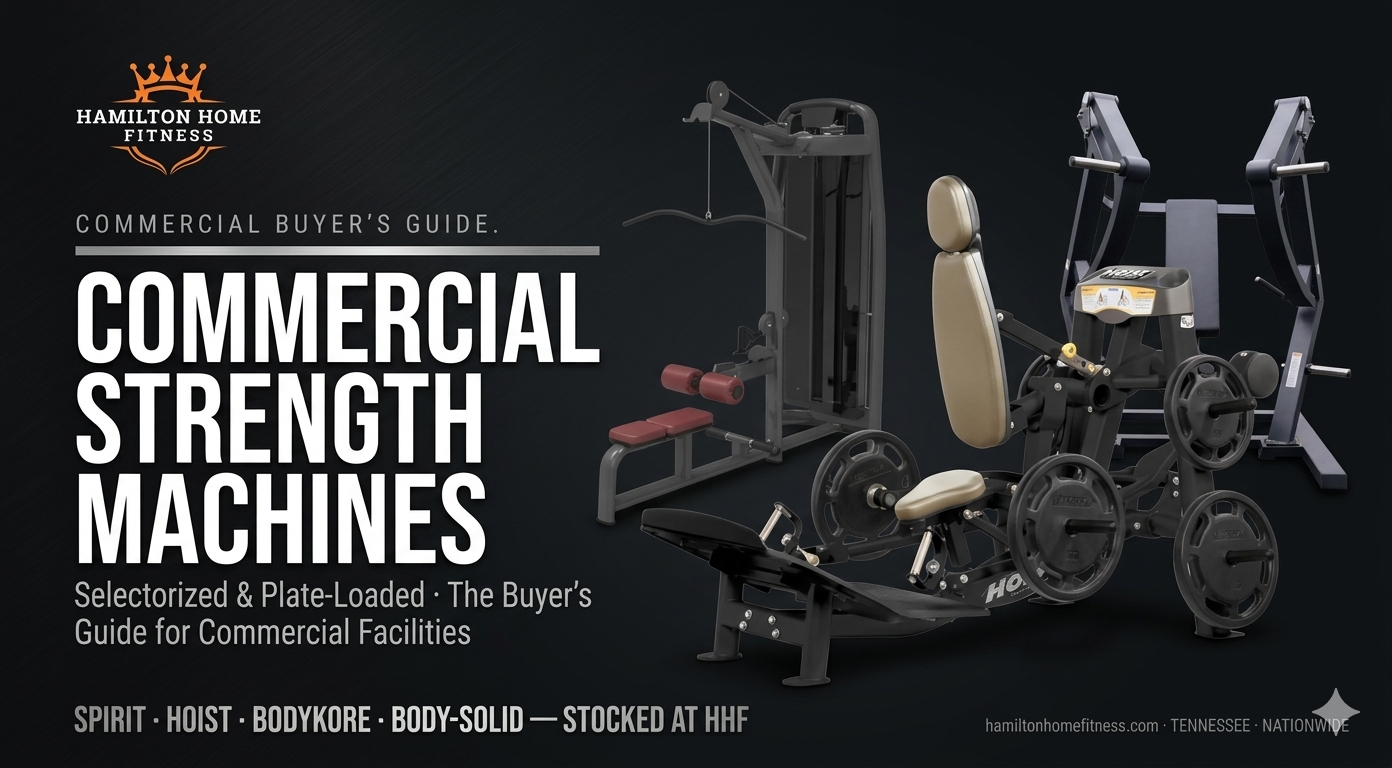
Equipping a commercial gym with strength machines is a five-to-six-figure decision, and the wrong call shows up on the floor every day. Buyers shopping for commercial strength machines for gyms face two configuration choices — selectorized or plate-loaded — and a brand list that often blurs together.
This guide cuts through it. You'll see how the two machine types differ, which lineup a commercial floor actually needs; how Spirit Fitness, Hoist, BodyKore, and Body Solid compare; and what realistic pricing, warranty, and footprint mean for ten-year ownership cost.
Hamilton Home Fitness is a Tennessee-based supplier serving commercial buyers in all 50 states, and our Commercial Gym Equipment for Facilities & Gyms catalog stocks every brand referenced here.
By the end, you'll know which machines to spec, which brand fits your facility, and what to ask before signing a quote.
Selectorized vs Plate-Loaded: Quick Guide
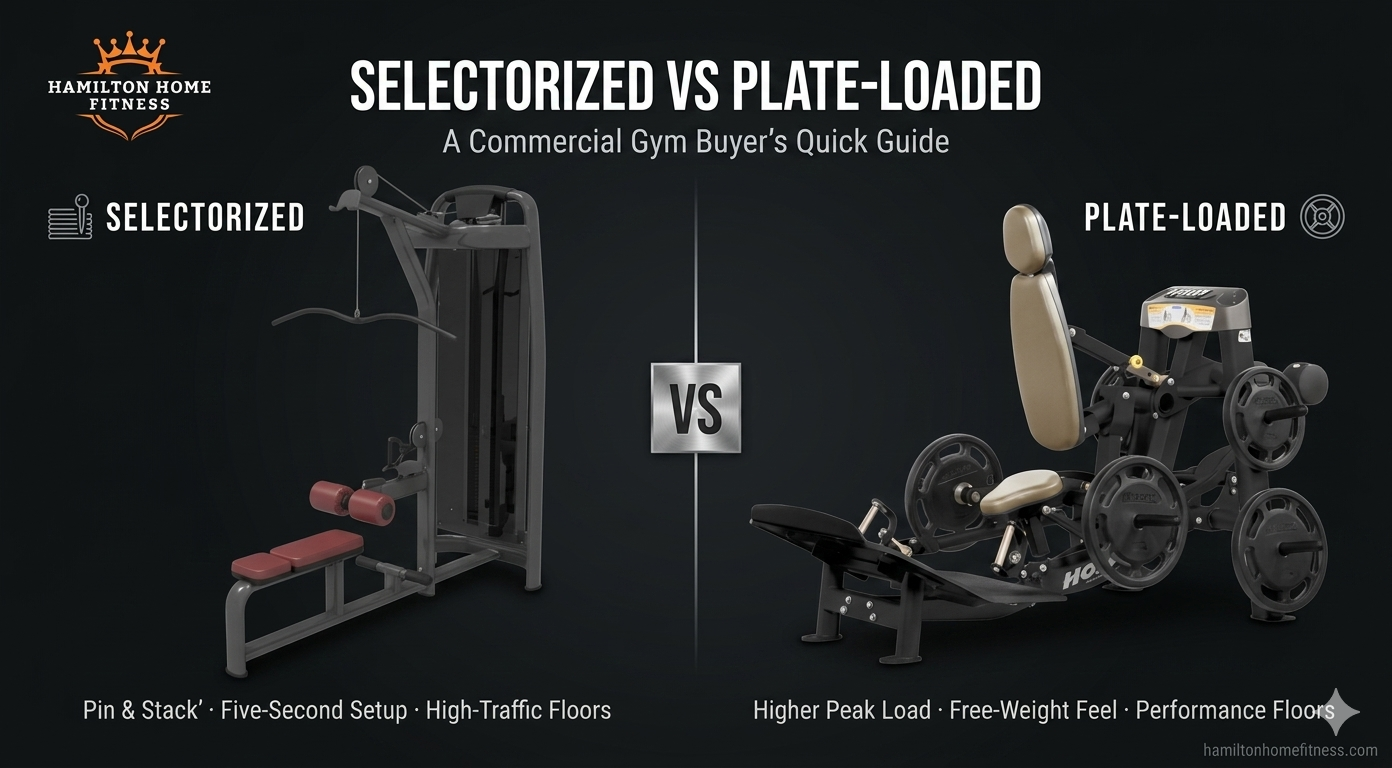
Selectorized machines use a built-in weight stack and a pin for fast resistance changes. Plate-loaded machines use standard weight plates loaded onto a leverage arm or sled. Selectorized fits high-traffic, mixed-skill facilities. Plate-loaded fits performance-focused or cost-sensitive builds. Most successful commercial gyms run both, sized to the member mix on the floor.
How Selectorized Machines Work
Selectorized strength machines use an integrated weight stack and a pin selector, letting users change resistance in seconds without handling plates. The stack is enclosed in a shroud, the load travels along guide rods, and the movement path is guided by cams and pulleys tuned for the target muscle group.
This configuration earns its place anywhere throughput and ease of use matter. Hotel gyms with rotating guests, corporate fitness rooms, multi-family properties, and circuit-based commercial floors all standardize on selectorized machines for the same reason—a member sits down, sets the pin, and trains within five seconds. No plate handling. No spotter required.
Stack sizes typically run 200–300 lb on single machines and 150–200 lb on dual cable stations. The Spirit Fitness CSS series and Hoist ROC-IT selectorized, both stocked at HHF, are examples of full-commercial selectorized lines built around this exact use case.
How Plate-Loaded Machines Work
Plate-loaded strength machines use leverage arms or sled rails that the user loads with standard or Olympic weight plates, allowing higher peak resistance and a freer feel than fixed weight stacks. The biomechanics often replicate barbell movement patterns, which is why serious lifters prefer them.
This configuration fits performance-driven environments. Sports training facilities, athletic departments, bodybuilding-focused gyms, and any commercial floor with a serious-lifter member base benefit from plate-loaded units. They also work well for budget-conscious builds — facilities can save real money by reusing existing plate inventory instead of paying for built-in weight stacks.
Iso-lateral options let each side work independently, exposing strength imbalances and improving recruitment. BodyKore's plate-loaded leg presses (G277, GR808, FL1801, and FL1809) and Body-Solid Pro ClubLine plate-loaded machines—both available at HHF—cover the range from value tier to premium performance.
Which Type Fits Your Facility
Choose selectorized when speed of use and mixed-skill members matter most. Choose plate-loaded when peak load, athletic feel, or budget flexibility leads the brief.
A quick decision rule:
High traffic and mixed skill → selectorized first
Low supervision + first-time users → selectorized first
Performance or athletic floor → plate-loaded for primary lifts
Tight equipment budget with existing plates → plate-loaded
Full-service health club → both, in deliberate ratio
Most successful commercial floors don't pick one. They build a strength zone where each configuration handles the work it does best.
Essential Machines for a Commercial Gym
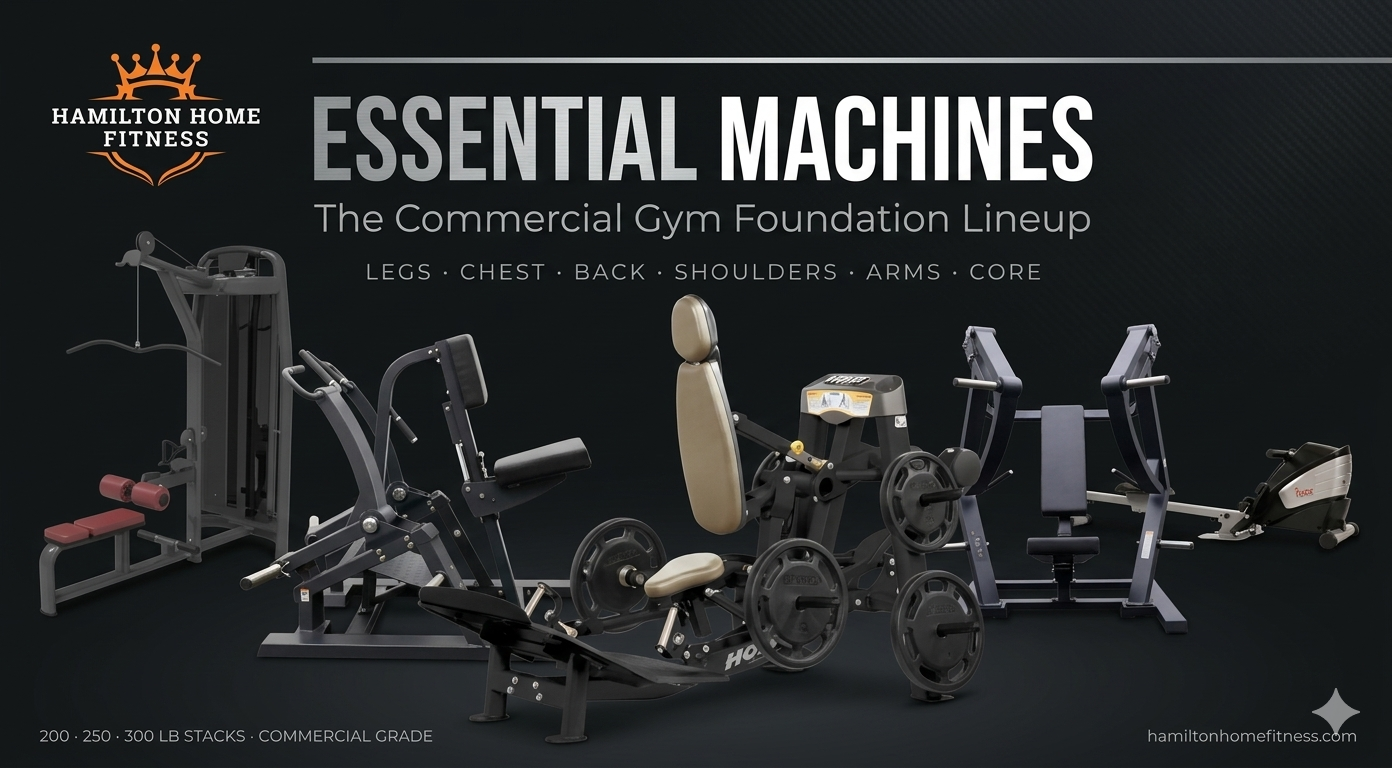
A standard commercial gym lineup covers six muscle-group zones — legs, chest, back, shoulders, arms, and core. The foundation is a leg press, lat pulldown, chest press, shoulder press, leg extension, leg curl, cable station, and ab machine. Specialty machines layer in after the core lineup is set.
Lower Body Strength Machines
The lower body anchor for any commercial floor is a leg press, paired with a leg extension, leg curl, and at least one calf option to cover the full chain.
A complete lower-body shortlist:
Leg press — primary compound builder
Hack squat — squat-pattern alternative for users avoiding the rack
Leg extension — quad isolation
Seated leg curl — hamstring isolation
Prone leg curl — secondary hamstring work and variety
Seated calf raise — soleus emphasis
Standing calf raise — gastrocnemius emphasis
Hip abductor and adductor — glute medius and inner thigh
Glute trainer or hip thrust — direct posterior-chain loading
Most commercial floors run a leg press plus four to six of the above. Pair this strength zone with a free-weight squat area—our Commercial Power Racks & Squat Cages: The Gym Buyer's Guide walks through rack selection in the same buyer-focused detail.
Upper Body & Push/Pull Machines
The upper-body core of a commercial floor is a chest press, lat pulldown, seated row, shoulder press, and dual-stack cable machine. Together they cover every push-and-pull pattern members will train.
Push side:
Chest press (flat)
Incline chest press
Decline press
Pec deck or chest fly
Shoulder press / overhead press
Lateral raise
Tricep pushdown station
Pull side:
Lat pulldown
Seated row
Low row
Rear delt fly
Bicep curl machine
Cable crossover or dual-stack functional trainer
Spirit Fitness CSS chest press and lat pulldown, Hoist Dual Series push/pull combos, and Body-Solid Pro ClubLine equivalents — all carried at HHF — cover this lineup at different price tiers.
Core, Glutes & Specialty Machines
Core, glute, and arm-specific machines fill out a commercial floor after the primary push, pull, and lower-body machines are in place. They drive variety and member retention without consuming primary equipment slots.
Specialty machines worth adding in phase two:
Ab crunch / abdominal machine — direct rectus work
Torso rotation — oblique and rotational core
Back extension or hyperextension — posterior chain support
Glute trainer or hip thrust machine — direct glute loading
Preacher curl—biceps with strict form
Tricep extension — overhead triceps isolation
Buyers on a phase-one budget can defer most specialty units and add them as membership grows.
Weight Stack Sizes for Commercial Use
Most commercial selectorized machines ship with 200–300 lb weight stacks. Cable stations commonly use dual 150–200 lb stacks. Performance and athletic facilities often spec the higher end.
A practical sizing guide:
200 lb stack — hotel, hospitality, multi-family, light corporate
250 lb stack — standard health club, boutique studio, mixed membership
300 lb stack — full-service club, athletic facility, performance-focused floor
Dual 150 lb stacks — cable crossover and functional trainers in most facilities
Dual 200 lb stacks — performance and serious-lifter cable stations
Stack increments matter as much as total weight. Smaller 5 lb add-on plates let beginners progress in finer steps, which improves the experience for first-time members.
Top Commercial Strength Brands at HHF
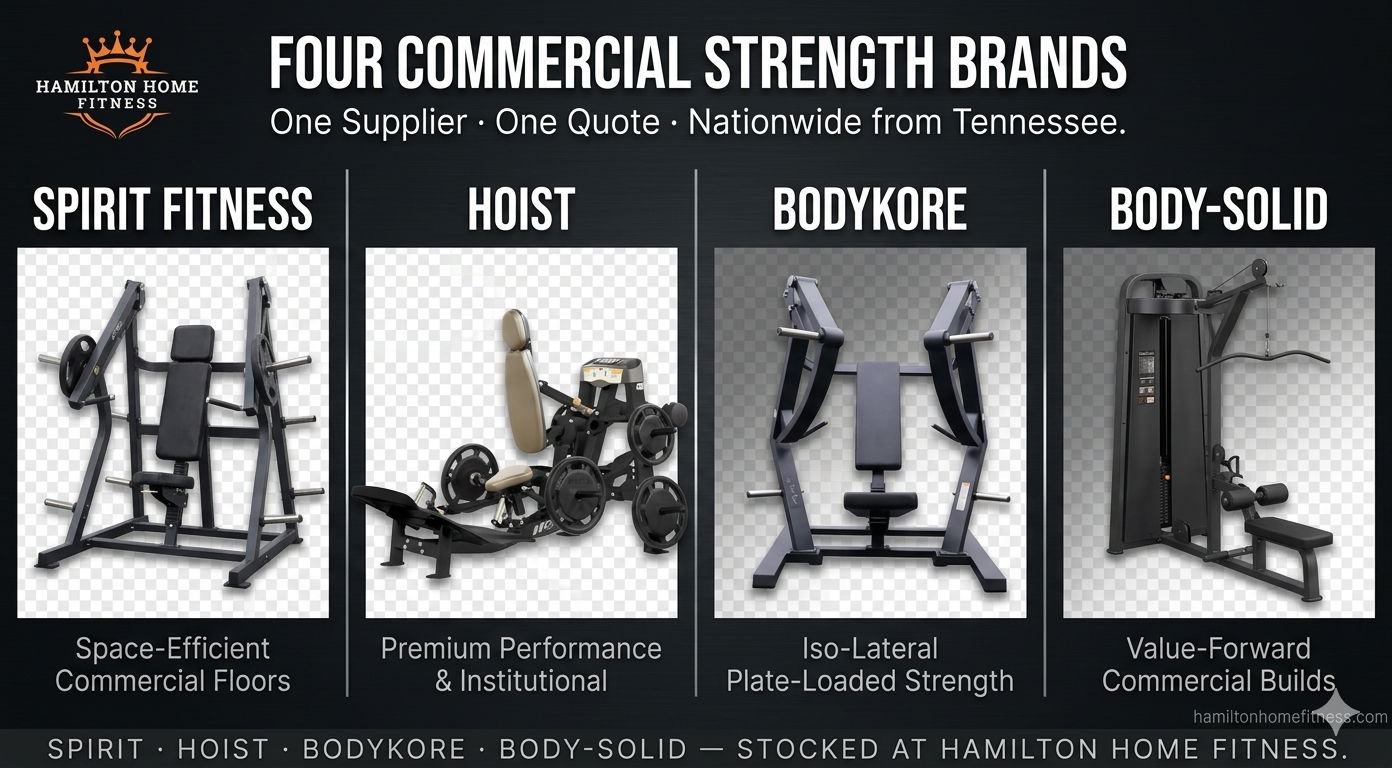
Hamilton Home Fitness stocks four commercial strength brands trusted across US health clubs, hotels, schools, and corporate gyms—Spirit Fitness, Hoist, BodyKore, and Body-Solid. Each earns its slot on the floor for a different reason, and the right shortlist usually combines two of them.
Spirit Fitness CSS Series
Spirit Fitness is a US-based commercial brand (founded 1983, headquartered in Jonesboro, AR) whose CSS series and Dual Strength line are designed for space-efficient commercial floors—hotels, multi-family, corporate, and light-commercial clubs.
The Dual Strength line combines two exercises in one machine, useful when floor space is limited but member coverage needs to stay broad. The C-Series carries Spirit's published commercial warranty, and HHF currently ships Spirit Fitness equipment free.
Spirit examples on HHF, with current listed pricing:
CSF-SMTH Smith Machine — $5,199.99
CSF-HRAC Half Rack — $3,799.99
CSS leg press, lat pulldown, chest press, shoulder press, and ab machine—full selectorized lineup
Spirit may be the right fit when the brief calls for clean aesthetics, predictable maintenance, and a tighter footprint per machine.
Hoist Fitness Commercial
Hoist Fitness is a San Diego-based brand producing commercial selectorized, plate-loaded, and dual-series machines. Per Hoist's own published positioning, its commercial equipment is used in health clubs, colleges and universities, professional sports facilities, and government installations worldwide.
The ROC-IT plate-loaded and ROC-IT selectorized lines, the Dual Series, and the Multi-Jungle systems anchor most premium Hoist installations. Biomechanics are tuned for natural movement paths, which translates to safer reps and a more consistent member experience.
Hoist examples on HHF:
HF-4357-MB Leg Press Hack Combo — $2,445
PS-Half Rack and PS-Barbell Rack also stocked
Hoist orders at HHF run via private invoice—request a quote for current pricing on full Hoist commercial machines. The brand fits when the brief leans premium, performance-driven, or institutional.
BodyKore Commercial Strength
BodyKore makes plate-loaded leverage and selectorized commercial machines built for performance gyms, athletic training facilities, and serious-lifter floors. The line is strongest on iso-lateral and isolateral options, where each side works independently to expose strength imbalances.
BodyKore examples currently on HHF:
G277 45° Leg Press — $3,850
FL1801 Iso-lateral Plate-Loaded Leg Press — $5,280
FL1809 Isolateral Horizontal Swing Leg Press — $4,400
GR808 Plate-Loaded Leg Press — $3,190
G702 Full Squat Cage — $2,640
BodyKore may be a strong fit when the buyer wants plate-loaded biomechanics in the Hammer-Strength tradition with broader price flexibility. It pairs well alongside a selectorized brand on the same floor.
Body Solid Pro ClubLine
Body Solid's Pro ClubLine and Pro Select machines are a value-forward commercial option suited to apartment gyms, corporate fitness rooms, schools, and small-studio buildouts. The lineup is broad, warranty terms are accessible, and the price-to-build-quality ratio is hard to match in this tier.
Body Solid examples on HHF:
GLP-STK Pro Select Leg Press — from $1,965
SPR1000SSDB Pro ClubLine Double Power Rack with Monkey Bars — $3,420
GPR378 Power Rack — $599 (entry-level commercial)
GLM85B Pro plate-loaded lat pulldown for heavy back training
Body Solid earns its slot when the brief is value-led, phased, or covering a wide muscle-group range without a premium budget.
All four brands ship through HHF, which means a single point of contact handles the quote, freight, and follow-up across mixed-brand orders. As a commercial gym equipment supplier in Tennessee serving facilities in all 50 states, Hamilton Home Fitness consolidates Spirit, Hoist, BodyKore, and Body-Solid under one purchase order—a real time-saver when a strength buildout pulls from two or three brands at once.
Cost of Commercial Strength Machines
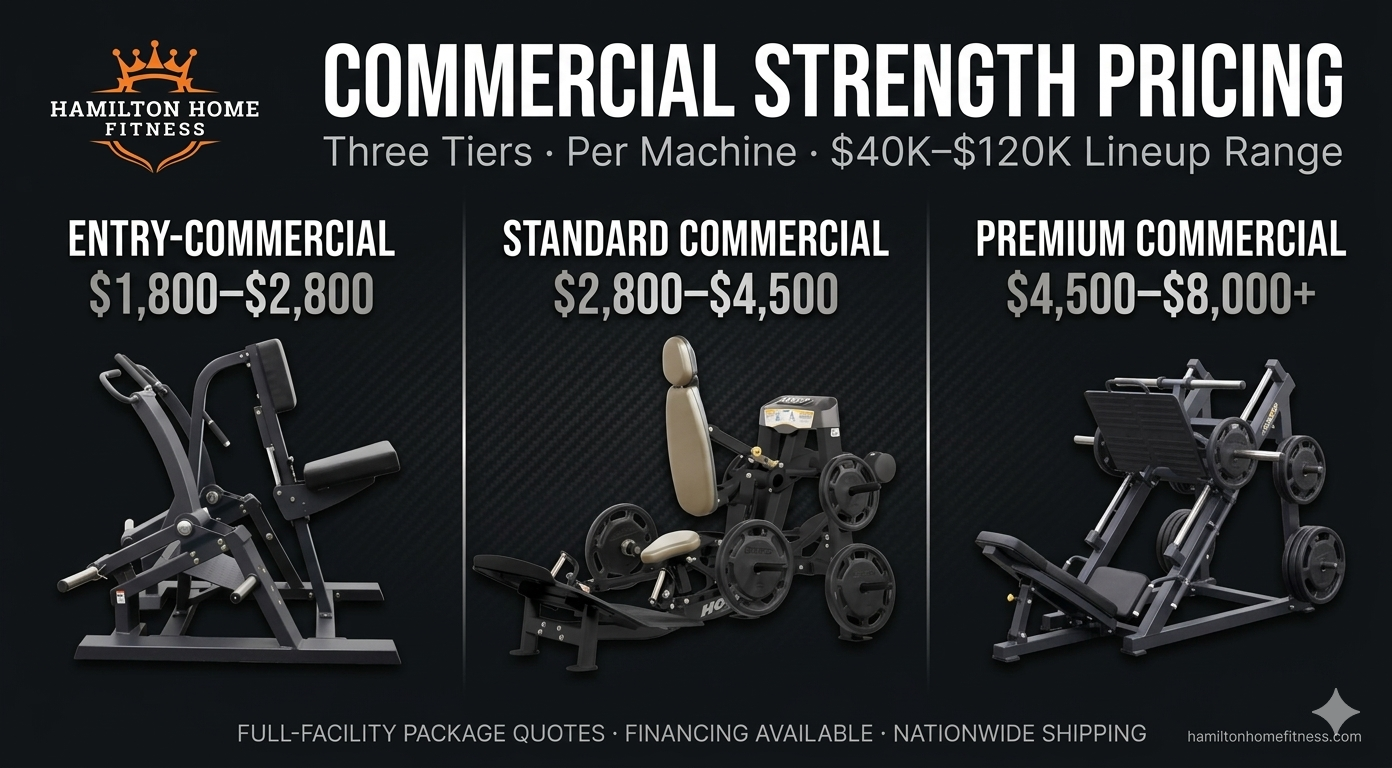
Commercial strength machines typically run $1,800–$5,500 per unit, with premium iso-lateral and dual-stack stations reaching $5,000–$8,000+. A complete commercial strength lineup of 12–18 machines usually lands between $40,000 and $120,000, depending on brand mix and configuration.
Per-Machine Price Ranges
Per-machine pricing for commercial strength equipment generally falls into three tiers: $1,800–$2,800 entry-commercial, $2,800–$4,500 standard commercial, and $4,500–$8,000+ premium plate-loaded or dual-stack systems.
Anchor examples from current HHF inventory:
Entry-commercial ($1,800–$2,800): Body-Solid GLP-STK Pro Select Leg Press from $1,965; Hoist HF-4357-MB Leg Press Hack Combo at $2,445
Standard commercial ($2,800–$4,500): BodyKore G702 Full Squat Cage at $2,640; BodyKore GR808 Plate-Loaded Leg Press at $3,190; BodyKore G277 45° Leg Press at $3,850; Spirit CSF-HRAC Half Rack at $3,799.99
Premium commercial ($4,500–$8,000+): BodyKore FL1809 Isolateral Horizontal Swing Leg Press at $4,400; BodyKore FL1801 Iso-lateral Leg Press at $5,280; Spirit CSF-SMTH Smith Machine at $5,199.99
Use these brackets to sense-check any vendor quote. A "commercial" leg press priced under $1,500 likely falls into light-commercial or residential-grade specs.
Full Facility Package Costs
A 12-machine commercial strength lineup typically totals $40,000–$70,000. A 16-machine lineup runs $55,000–$100,000. A flagship 20+ machine floor with premium brands often crosses $120,000.
Industry budgeting data shows strength equipment usually consumes 60–70% of a commercial gym's total equipment budget—so a $200,000 facility typically allocates $120,000–$140,000 to strength alone.
Three realistic buildout scenarios:
Hotel or corporate gym (8–10 machines, mostly Body Solid + Spirit Dual): $25,000–$50,000
Boutique studio or community gym (12–14 machines, mixed brand): $40,000–$80,000
Full-service commercial club (18–22 machines, premium brand mix): $80,000–$160,000+
For a deeper procurement walk-through that covers cardio, flooring, and strength together, our Commercial Gym Equipment Buying Guide breaks down the full-facility math step by step.
Financing & Bulk Quote Options
Most commercial-strength purchases over $25,000 qualify for package pricing or financing through fitness-equipment specialty lenders. Buyers ordering a full strength lineup almost always pay less per machine than buyers ordering one at a time.
Two paths to lower the upfront number:
Bulk quote—submit the full lineup at once for package pricing instead of single-line invoicing
Equipment financing or leasing — spread the capital outlay over 24–60 months while the floor starts earning
HHF builds quote-based pricing for full-facility buyers across all four commercial brands. Single-machine buyers see standard listed pricing online; multi-machine and full-facility buyers should request a quote to access real package math.
Build Quality, Warranty & Lifespan
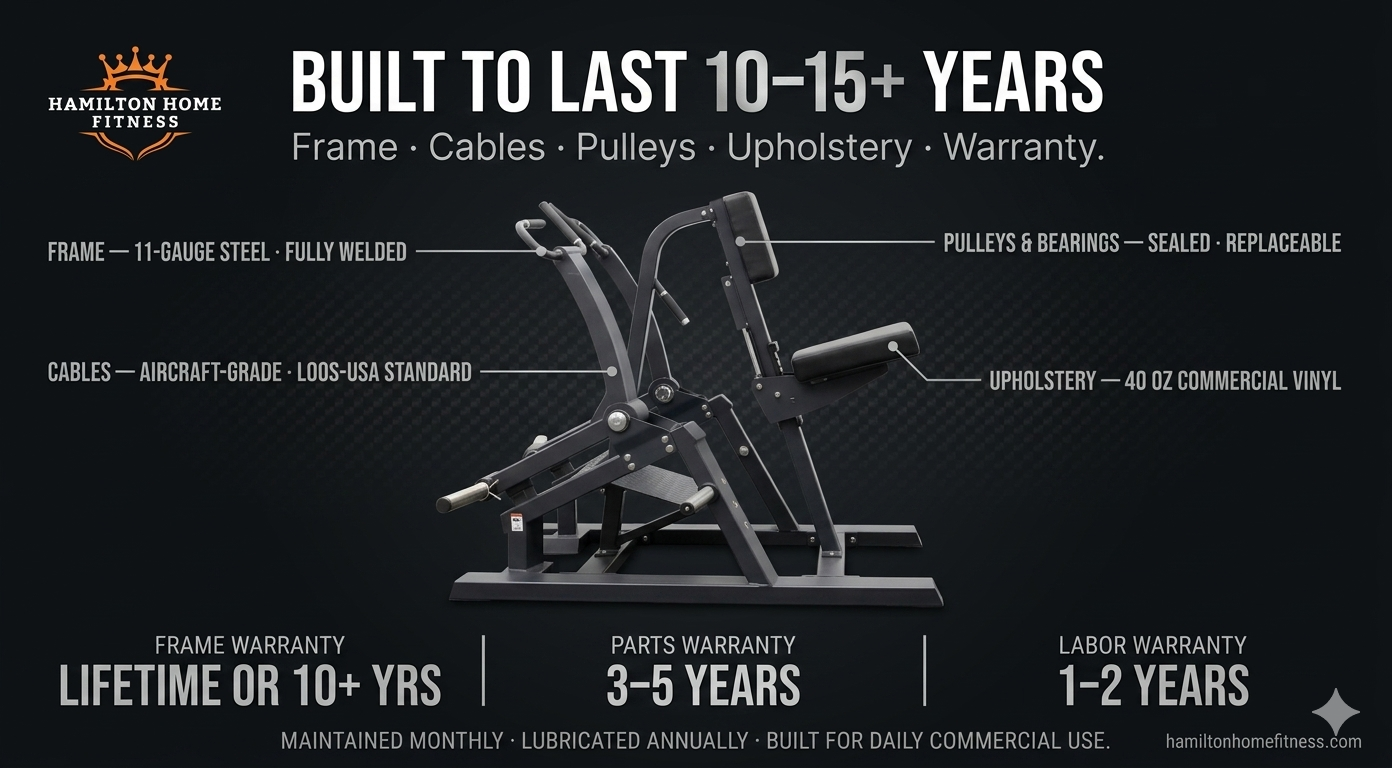
Well-maintained commercial strength machines typically last 10–15+ years. Lifespan depends on frame steel gauge, cable and pulley quality, upholstery grade, and warranty backing—not brand name alone. Compare these specs the same way you compare prices.
Frame, Cables & Upholstery
Commercial-grade strength machines use 11-gauge or heavier steel frames, sealed bearings, premium cables, and high-density upholstery rated for daily continuous use.
A six-point spec sheet to verify on any quote:
Frame steel — 11-gauge minimum; heavier on plate-loaded machines that bear higher loads
Welds — fully welded, not bolted, at high-stress junctions
Cables—aircraft-grade with nylon coating; LOOS USA cables (used on Spirit's CSF-FUNT functional trainer) are a known commercial standard
Pulleys and bearings — sealed, fiberglass-reinforced, replaceable
Guide rods — chrome-plated, hardened, precision-aligned
Upholstery—high-density foam over 40 oz commercial vinyl, antimicrobial where available
Ask the supplier for the spec sheet, not the brochure. The spec sheet is where comparisons actually happen.
Warranty Tiers to Compare
Strong commercial warranties are usually structured as lifetime or 10+ years on the frame, 3–5 years on parts, and 1–2 years on labor. The fine print on each is what separates real coverage from marketing language.
What to ask the dealer about each tier:
Frame warranty — Is it lifetime or capped at a year count? Is "structural failure" defined narrowly?
Parts warranty — Are cables, bearings, pulleys, and guide rods covered? What's excluded?
Labor warranty — Does it include onsite service, or only shipping the part back?
Wear items—Upholstery, cables, and grips are usually owner-paid replacements; confirm this upfront
Two machines with the same headline warranty can deliver very different real coverage. Read the exclusions before signing the quote.
Maintenance & Lifespan Outlook
With monthly inspections, annual lubrication, and timely cable and upholstery replacement, commercial-strength machines reliably deliver 10–15 years of continuous service.
A practical maintenance schedule:
Daily — wipe upholstery, check pin function, clear obstructions
Monthly — visual inspection of cables, pulleys, welds, and stack alignment
Quarterly — tighten hardware; grease guide rods; inspect cables for fraying
Annual — full lubrication of pivots and bearings; replace any cable showing wear; assess upholstery condition
Plan for one cable replacement and one upholstery refresh somewhere between years five and eight. Build that into the ten-year ownership budget—it isn't a surprise; it's normal commercial wear.
Layout, Footprint & Mixing Machines
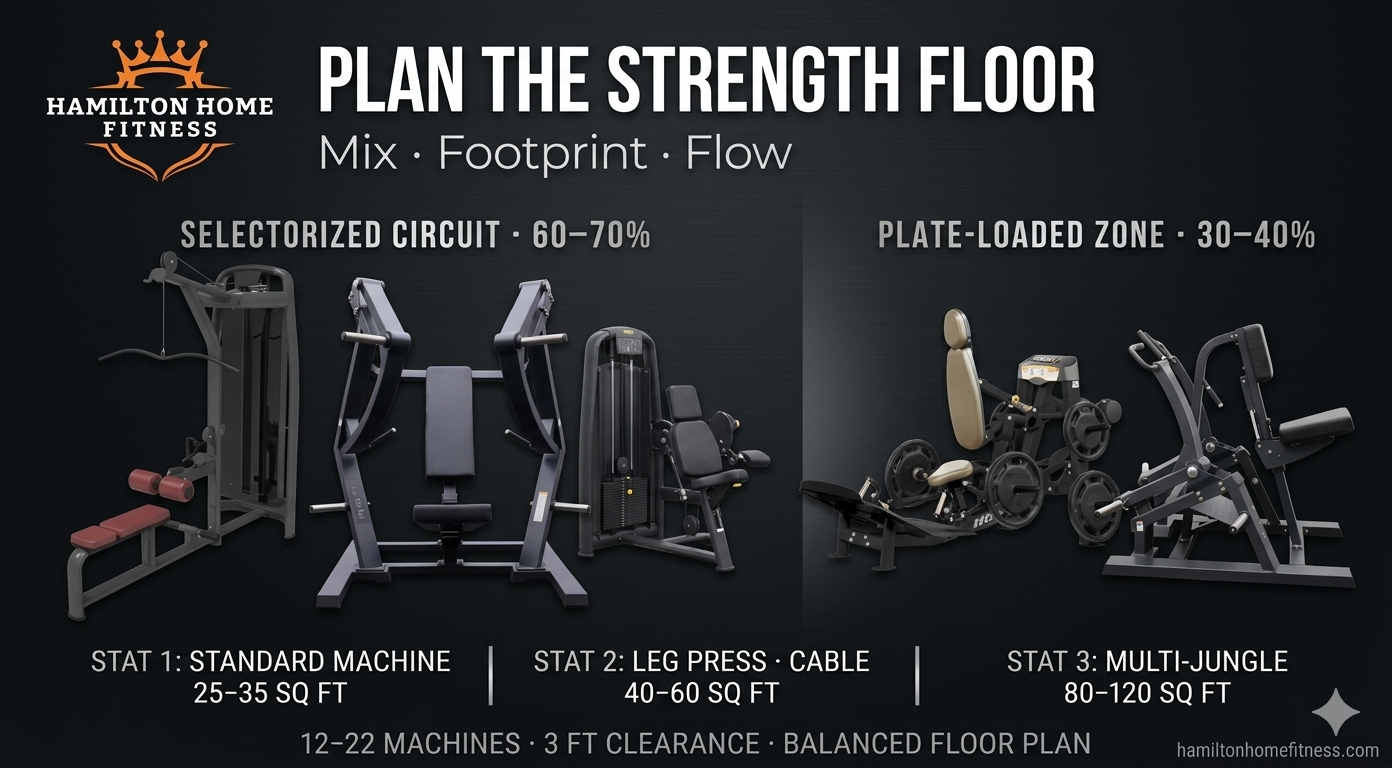
A typical commercial strength machine occupies 25–60 sq ft, including user clearance. Most successful commercial gyms run 12–22 machines and intentionally mix selectorized and plate-loaded units to serve mixed-skill members on the same floor.
Footprint Per Machine
Most commercial selectorized machines need 25–35 sq ft including user clearance, while leg presses, cable stations, and multi-jungle systems each demand 50–120 sq ft.
A planning reference for the floor plan:
Standard selectorized machine — 25–35 sq ft (chest press, lat pulldown, shoulder press, leg extension, leg curl)
Cable station / functional trainer — 40–50 sq ft, plus a 5 ft buffer for crossover travel
Leg press — 50–60 sq ft
Hack squat — 45–55 sq ft
Smith machine — 40–50 sq ft including bar travel
Multi-jungle or dual-stack system — 80–120 sq ft
Plan three feet of walkable clearance between machines and a clear traffic lane along each row. The right commercial gym flooring fitness facilities layer underneath protects both the equipment and the floor itself, especially under plate-loaded stations and free-weight zones.
How Many Machines a Gym Needs
Hotel and corporate gyms typically run 6–10 strength machines, boutique studios 10–14, and full-service commercial clubs 16–22 or more depending on member volume.
Machine count by facility type:
Hotel / multi-family / corporate — 6–10 selectorized machines
Apartment community fitness center — 8–12 mixed machines
Boutique studio — 10–14 machines, often heavily selectorized
Mid-size community gym — 12–18 machines, mixed configuration
Full-service commercial club — 16–22+ machines, mixed configuration
Athletic or performance facility — 15–25 machines, plate-loaded heavy
Strength count drives the cardio plan in parallel. A balanced commercial floor usually pairs every two strength machines with one cardio unit. To plan that side of the floor, our guide on how to choose the best commercial cardio equipment walks through treadmill, bike, and rower selection in the same buyer-focused detail.
Mixing Selectorized & Plate-Loaded
Most successful commercial gyms run a mix of selectorized and plate-loaded machines—typically 60–70% selectorized for everyday throughput and 30–40% plate-loaded for performance-focused members.
Suggested splits by facility type:
Hotel / multi-family / corporate — 90% selectorized / 10% plate-loaded (or zero plate-loaded)
Boutique studio / community gym — 70% selectorized / 30% plate-loaded
Full-service commercial club — 60% selectorized / 40% plate-loaded
Athletic or performance facility — 40% selectorized / 60% plate-loaded
Place plate-loaded machines together in their own zone, separate from the selectorized circuit. This protects traffic flow, lets serious lifters work without crowding members on the circuit, and makes the floor read clearly to first-time visitors.
People Also Ask
What is the difference between selectorized and plate-loaded strength machines?
Selectorized machines use a built-in weight stack and pin selector, letting users change resistance instantly. Plate-loaded machines use standard weight plates loaded onto a leverage arm, allowing higher peak resistance and a more free-weight feel. Selectorized fits high-traffic, mixed-skill facilities; plate-loaded fits performance-driven floors and budget-flexible builds with existing plate inventory.
Which strength machines are essential for a commercial gym?
A core commercial strength lineup covers leg press, leg extension, leg curl, lat pulldown, seated row, chest press, shoulder press, a cable station, and an ab machine. Specialty units—torso rotation, glute trainer, preacher curl, and calf raises—get added in phase two as membership and budget grow. Together, this lineup covers every major muscle group.
How many strength machines does a commercial gym need?
Hotel and corporate gyms typically run 6–10 strength machines, boutique studios 10–14, and full-service commercial clubs 16–22 or more. Athletic and performance facilities often push past 25 when plate-loaded equipment dominates the floor. Member volume, training style, and available square footage drive the final number more than any industry average.
What weight stack size is best for commercial machines?
Most commercial selectorized machines ship with 200–300 lb stacks, and cable stations typically use dual 150–200 lb stacks. Hotels and light-commercial sites do well with 200 lb; standard health clubs spec 250 lb; performance and athletic facilities upsize to 300 lb or larger. Stack increment size matters as much as total weight for member experience.
How long do commercial strength machines last?
Well-maintained commercial strength machines typically deliver 10–15+ years of service. Lifespan depends on frame steel gauge, cable quality, upholstery grade, and how consistently the maintenance schedule is followed. Plan for one cable replacement and one upholstery refresh between years five and eight — that's normal commercial wear, not a failure.
What brands make the best commercial strength machines?
Widely trusted commercial brands include Spirit Fitness, Hoist, BodyKore, Body Solid, Life Fitness/Hammer Strength, Precor, and TRUE Fitness. The right brand depends on facility type—Spirit and Body Solid lean light-to-mid commercial, while Hoist and BodyKore lean premium and performance-focused. Hamilton Home Fitness stocks Spirit, Hoist, BodyKore, and Body Solid under one roof.
Are Spirit Fitness machines good for commercial use?
Yes. Spirit Fitness has produced commercial fitness equipment since 1983, and its CSS series and Dual Strength line are designed specifically for commercial floors—hotels, multifamily properties, corporate gyms, and light-commercial clubs. The C-Series carries Spirit's published commercial warranty, and Spirit equipment currently ships free through Hamilton Home Fitness.
How much does it cost to equip a gym with strength machines?
Per-machine pricing falls into three tiers: $1,800–$2,800 entry-commercial, $2,800–$4,500 standard commercial, and $4,500–$8,000+ premium. A 12-machine lineup typically totals $40,000–$70,000; a 16-machine lineup, $55,000–$100,000; and a flagship 20+ machine floor often crosses $120,000. Strength usually consumes 60–70% of the total equipment budget.
Can I mix selectorized and plate-loaded machines in my gym?
Yes — and most successful commercial floors deliberately do. A typical mix is 60–70% selectorized for high-traffic everyday training and 30–40% plate-loaded for serious lifters and athletic programming. Place plate-loaded units in their own zone, separate from the selectorized circuit, to protect traffic flow and member experience.
Does Hamilton Home Fitness sell Spirit Fitness and Hoist commercial machines?
Yes. Hamilton Home Fitness stocks Spirit Fitness, Hoist, BodyKore, and Body Solid commercial strength machines, with free shipping currently offered on Spirit Fitness and several other lines. Hoist orders run via private invoice — request a quote for current pricing. HHF is headquartered in Tennessee and ships nationwide to all 50 states.
Final Thought
Choosing commercial strength machines isn't really a single decision. It's four configurations, lineups, brand mixes, and budgets stacked into one quote. This guide gave you a framework for each one.
The single biggest takeaway: the right commercial strength lineup is rarely one-brand or one-configuration. It's a deliberate mix of member traffic, training style, and ten-year ownership cost—not just headline price.
Hamilton Home Fitness sits in the middle of that decision. From our Tennessee headquarters, we ship nationwide to all 50 states and stock the four brands most US facility buyers already shortlist — Spirit Fitness, Hoist, BodyKore, and Body Solid — under a single quote. That means one point of contact, one freight schedule, and one invoice, even when the floor pulls from three brands at once.
If you're ready to move from research to a real floor plan, here are three places to start:
Browse the full commercial catalog and choose the best commercial gym equipment for your facility type
Pair the strength floor with Commercial Cardio Equipment for Fitness Facilities so the cardio-to-strength ratio works on day one
Or start at the source and Shop Quality Fitness Gear and equipment—Hamilton Home Fitness—to see what's currently in stock
Request a package quote when the shortlist is set — it's the fastest path from this guide to a real floor plan, and full-facility buyers consistently see better per-machine pricing than single-line orders.
Build the lineup once. Maintain it for a decade. Make every dollar earn.