Introduction
A treadmill that breaks down mid-workout, a cable machine making a grinding sound, a torn bench pad, or a power rack with loose bolts—every one of those moments costs a commercial facility money, member trust, and equipment lifespan. Commercial gym equipment maintenance is the difference between a fleet that lasts a decade or more and one that needs costly replacements every few years.
This guide is built for gym managers, facility directors, and commercial gym owners who need a practical, schedule-based maintenance system — one that extends machine life, protects manufacturer warranties, and keeps members safe. It covers what to clean daily, what to inspect weekly, what to service monthly and quarterly, when to call a professional technician, and when a machine has crossed the line from "repair" to "replace."
The right maintenance plan also shapes smarter equipment buying. When a machine is engineered for high-traffic use and backed by accessible parts and service, a consistent routine can keep it running for over ten years. If you're planning your next purchase or upgrade alongside your maintenance system, browse Hamilton Home Fitness's commercial gym equipment for facilities & gyms for facility-grade options built for that kind of long life.
Why Maintenance Matters for Your Facility
Commercial gym equipment maintenance protects member safety, extends machine lifespan, preserves manufacturer warranties, and reduces total repair spend over the life of your fleet. It is the single most controllable factor in how long a facility's equipment investment actually lasts.
Preventive maintenance is the proactive side of that equation. It is the scheduled cleaning, inspection, lubrication, and minor servicing performed before a problem appears — not after. Reactive maintenance, by contrast, is the work done after a machine has already failed: a snapped cable, a smoking motor, or a console error code that shut the unit down mid-session. Reactive repairs almost always cost more, take longer, and disrupt members.
When commercial gym equipment is not maintained, the consequences stack up quickly:
Unplanned downtime. "Out of order" signs drive negative reviews and erode member retention.
Shortened lifespan. A treadmill that should last 10 years may fail at 4 or 5.
Voided warranties. Most manufacturer warranties require documented preventive maintenance, and improper care or non-OEM parts can invalidate coverage.
Higher repair bills. A worn belt that grinds an unprotected deck turns a routine belt replacement into a far more expensive belt-and-deck job.
Member injuries and liability. A frayed cable or loose rack bolt that fails under load is a negligence claim waiting to happen.
Reputation damage. Members notice. So do prospects reading your Google reviews.
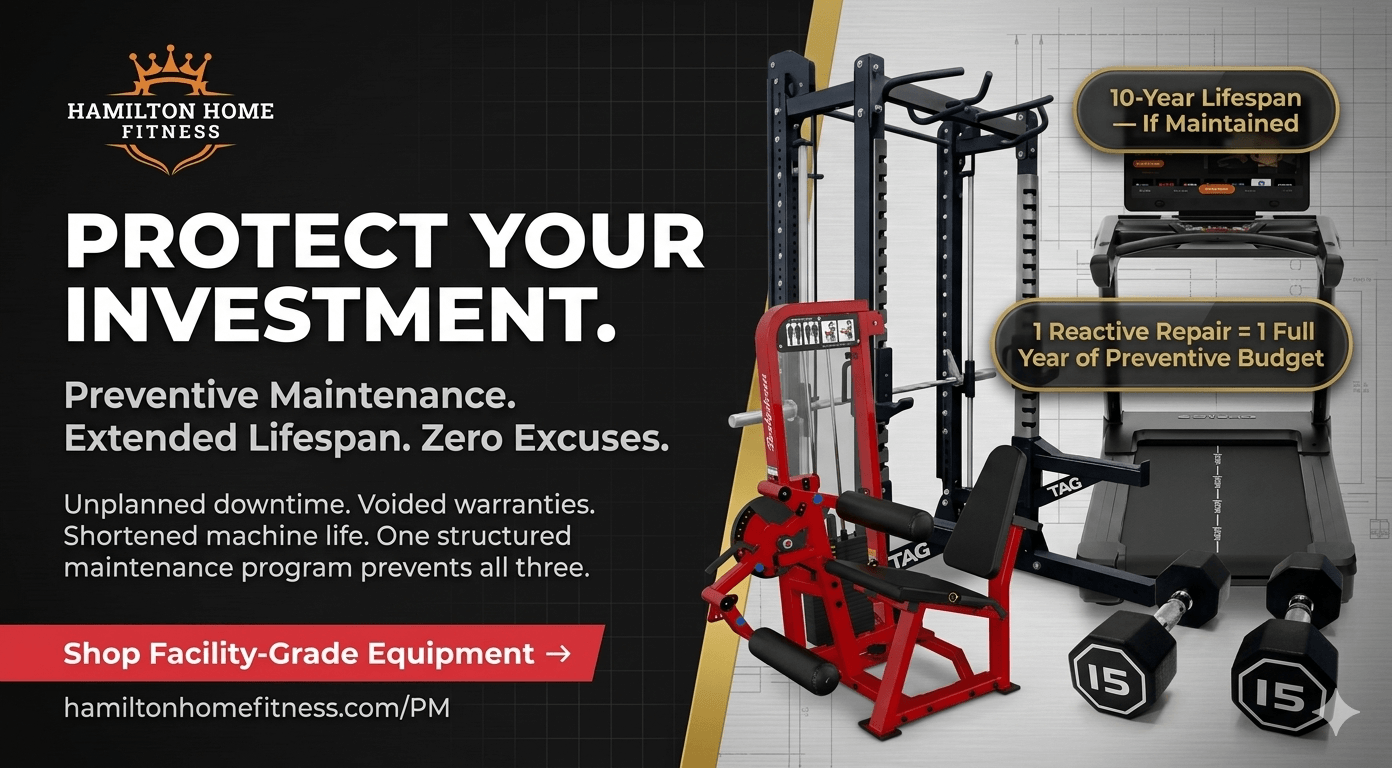
The cost comparison is straightforward. A structured preventive program—consumables, staff time, and one or two professional service visits per year—typically runs a small percentage of equipment replacement value annually. A single reactive repair on a high-end commercial treadmill or selectorized machine can equal a full year of that preventive budget. Across a fleet of 20–40 machines, the math gets worse fast.
There is also a buying-side dimension worth recognizing. Equipment that is engineered for commercial traffic, designed with accessible service points, and supported by an OEM parts pipeline is fundamentally easier to maintain than budget-grade alternatives forced into commercial use. Maintenance discipline matters, but so does what you started with. If your current fleet is fighting you on serviceability, it may be time to shop quality fitness gear and equipment at Hamilton Home Fitness and plan future additions around facility-grade durability.
The Master Maintenance Schedule
A commercial gym should run on a five-layer maintenance schedule — daily cleaning, weekly inspections, monthly deeper service, quarterly equipment-specific tasks, and an annual professional service visit. Each layer protects a different part of the equipment lifecycle, and skipping any one of them accelerates wear on the others.
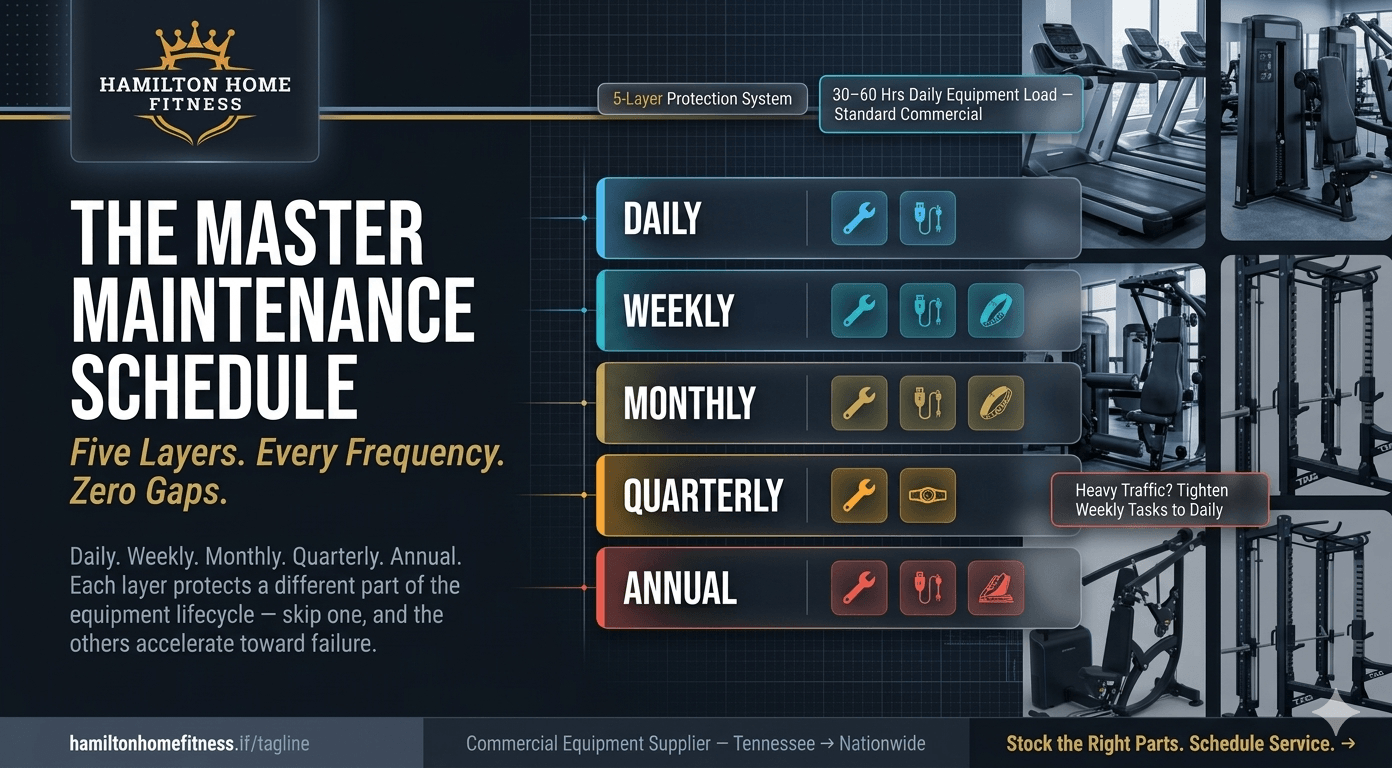
Use the table below as the starting framework for the full fleet. Adjust intervals based on your facility's traffic level—guidance follows the table.
Frequency | Cardio | Strength Machines | Racks & Free Weights | Flooring & Mirrors | Documentation |
Daily | Wipe belts, consoles, and handlebars; vacuum around bases | Wipe pads, handles, and weight stacks and check selector pins | Wipe barbells, dumbbells, and bench pads and clean spills | Sweep and spot-mop; wipe mirrors, and empty bins | Log any issues reported by staff or members |
Weekly | Walk-through inspection; check belt alignment; vacuum motor compartments | Inspect cables for fraying; test pulley rotation, and scan pad wear | Visual rack bolt check; bench pad inspection; barbell sleeve rotation | Deep mop; inspect floor seams and mirror mounting | Complete inspection log; flag follow-ups |
Monthly | Belt tension and alignment; deck inspection; console diagnostics | Lubricate guide rods, check weight stack travel, and retighten visible hardware | Tighten all rack bolts; clean barbell knurling, and check bumper plates for cracks | Deep-clean rubber flooring; inspect tile seams and curling | Review service log and schedule flagged repairs |
Quarterly | Treadmill belt lubrication (per manufacturer); roller inspection; firmware check | Full cable system inspection; bearing check; upholstery assessment | Bench reupholstery review; rack upright damage check | Replace damaged tiles and reseal seams as needed | Quarterly compliance review |
Annual | Professional technician service — motors, calibration, internals | Professional cable, bearing, and upholstery audit | Annual structural inspection; barbell sleeve service | Full facility deep clean and condition audit | Annual summary for insurance and warranty records |
These intervals assume typical commercial use — roughly 30–60 hours of cumulative equipment time per day across the floor. Heavy-traffic facilities (24-hour gyms, university recreation centers, and high-volume CrossFit boxes) should tighten weekly tasks into daily routines and shorten monthly intervals into bi-weekly ones, especially for treadmill belt lubrication and cable inspection. Lower-traffic spaces (apartment gyms, corporate wellness rooms, and small hotel fitness rooms) can extend monthly servicing slightly, but daily cleaning and weekly safety inspections should never be relaxed—those two layers protect against the issues most likely to injure a member.
Sourcing the lubricants, replacement cables, belts, pads, and consumables this schedule requires is easier when your supplier already knows the equipment on your floor. As a commercial gym equipment supplier in Tennessee serving facilities nationwide, Hamilton Home Fitness can help operators stock the right parts and coordinate professional service when needed.
Equipment-Specific Maintenance Protocols
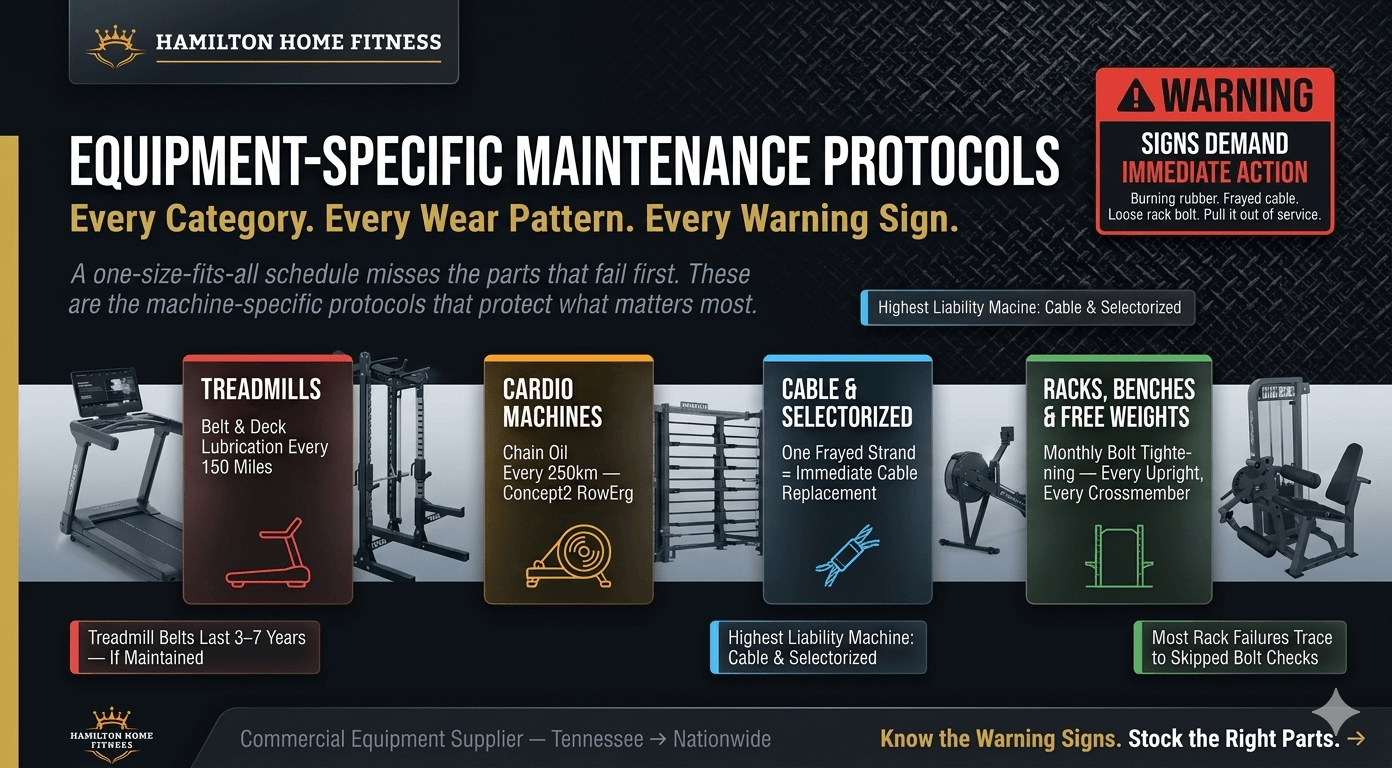
Each equipment category has its own wear pattern and service priority—and a one-size-fits-all schedule misses the parts that fail first. The schedule in the previous section covers the fleet at a high level; what follows is the deeper, machine-specific protocol that protects the components most likely to fail.
Treadmill Maintenance Essentials
Commercial treadmills need belt and deck lubrication every 3–6 months or roughly every 150 miles of use, daily belt wipe-downs, weekly motor compartment vacuuming, and monthly belt tension and alignment checks. They are the highest-failure category in most gyms because they combine high traffic, electronics, a heavy motor, and a wear surface (the belt) that contacts another wear surface (the deck) under load thousands of times per session.
Key recurring tasks:
Daily: Wipe the belt and console with an ammonia-free cleaner; vacuum around the base to prevent dust ingestion into the motor.
Weekly: Vacuum the motor compartment with the unit unplugged; listen for unusual noise during a short test run.
Monthly: Check belt tension (a properly tensioned belt should lift about 2–3 inches at the center when raised); check belt alignment and re-center if drifting.
Quarterly: Apply 100% silicone lubricant under the belt per the manufacturer's specified volume — usually around one ounce — and run the belt for several minutes to distribute it evenly.
Warning signs that need immediate attention: a burning rubber smell during use, visible fraying or glazing on the belt underside, persistent belt slippage after tensioning, a hot or smoking motor, console error codes, or new vibration. Any of those signals justifies pulling the unit out of service until inspected.
Treadmill belts typically last 3–7 years under heavy commercial use. When belt, deck, and motor repairs start stacking up on the same unit, replacement is usually more cost-effective than continued repair. Browse HHF's range of facility-grade options to choose the best commercial cardio equipment when a treadmill has reached the end of its serviceable life.
Elliptical, Bike & Rowing Machine Care
Ellipticals, bikes, and rowers need weekly pedal and stride checks, monthly drive system inspection, and brand-specific lubrication—for example, Concept 2 RowErg chains should be oiled every 250 km or 50 hours of use. These machines have fewer electronic failure points than treadmills, but their moving parts wear in predictable patterns that catch operators off guard.
Recurring tasks by machine type:
Ellipticals: Weekly — inspect pedal arms and the stride mechanism for play; check console function. Monthly—tighten pedal hardware, inspect the drive belt for wear, and lubricate the stride pivots per manufacturer guidance.
Upright, recumbent, and spin bikes: Weekly—check pedal tightness, seat adjustment hardware, and console function. Monthly—inspect the drive belt or chain (depending on model), lubricate pedal threads when reseating pedals, and check resistance response.
Rowing machines: Daily — wipe the seat rail and handle. Weekly — inspect the chain or belt for wear and listen for flywheel noise. For Concept 2 RowErg units specifically, oil the chain with a light mineral oil every 250 km or 50 hours of use.
Warning signs: clicking or grinding at the pedal stroke, a wobbly stride on an elliptical, a chain or belt skipping under load, resistance that no longer adjusts evenly, or any seat-rail unevenness on a rower. These usually point to bearings, pedal threads, or drive components that need professional attention.
Programming-driven facilities—CrossFit boxes, athletic training centers, and conditioning studios—see exceptionally heavy rower and air bike use and may need tighter intervals; the CrossFit Gym Equipment Guide covers category context. When ellipticals, bikes, or rowers reach the end of their useful life, browse HHF's commercial cardio equipment for fitness facilities for replacement options.
Cable & Selectorized Machine Care
Cable and selectorized machines need weekly visual cable inspections, monthly pulley and guide rod checks, and immediate cable replacement at the first sign of fraying—a snapped cable is both a member-injury risk and a denied warranty claim. These are the highest-liability strength machines on the floor because the cable is under constant tension, runs over multiple pulleys, and connects directly to the load the user is moving.
Inspection and service protocol:
Weekly: Visually inspect every cable end-to-end. Look for fraying near the swage fittings, kinks, flat spots, or burrs from a misaligned pulley. Test pulley rotation by hand—they should spin freely and silently. Check selector pins for smooth engagement.
Monthly: Lightly lubricate weight stack guide rods with a dry lubricant (never grease — it attracts dust and gums the stack). Retighten visible frame hardware. Inspect pad upholstery for cracks and seam separation.
Quarterly: Conduct a full cable system inspection across every selectorized and plate-loaded machine. Replace any cable showing visible wire damage, regardless of age.
Decision rule: If a cable shows a single broken strand, replace it. If a pulley has flat spots or wobble, replace it. There is no safe "watch it" interval for a frayed cable on a commercial floor.
Brand-specific protocols matter here. Maintenance intervals, lubricant types, and parts access vary by manufacturer—for a side-by-side look at three common commercial brands, see the Spirit Fitness vs. Hoist vs. TAG Fitness Brand Comparison. When wear exceeds repair value or a machine is past its service life, HHF's Commercial Strength Machines: The Selectorized & Plate-Loaded Guide is the place to compare replacement options.
Racks, Benches & Free Weights
Power racks, benches, and free weights need monthly bolt tightening, weekly pad-and-upholstery checks, and routine barbell sleeve and knurl cleaning—most rack hardware failures trace back to skipped bolt checks, not equipment defects. Free-weight equipment looks low-maintenance because it has no motor or cable, but a loose upright bolt or a cracked bumper plate can fail at exactly the wrong moment.
Recurring tasks:
Daily: Wipe bench pads, barbell knurling, and dumbbell handles. Re-rack any equipment left out.
Weekly: Visually inspect bench pads for tears or seam splits, check barbell sleeve rotation (sleeves should spin freely), and scan bumper plates for hairline cracks at the rim or center.
Monthly: Tighten every bolt on every power rack—uprights, crossmembers, j-cups, safeties, pull-up bars, and base hardware. Brush barbell knurling with a stiff nylon brush to remove chalk buildup. Clean and lightly oil barbell sleeves if rotation is stiff.
Quarterly: Reassess bench reupholstery needs — torn pads should be replaced before foam degrades; inspect rack uprights for impact damage from dropped weights.
Warning signs: a wobbling rack upright, j-cups that no longer seat flush, a barbell sleeve that won't spin, bumper plates with rim cracks, or torn pads exposing foam. Replace damaged components immediately — these are the items members trust their bodyweight and load to.
When pads are beyond reupholstery, sleeves are pitted, or rack hardware is fatigued, replacement is the safer path. HHF's Commercial Power Racks & Squat Cages: The Gym Buyer's Guide covers rack selection, and the Commercial Free Weights Buying Guide covers barbell, dumbbell, and bumper plate replacement.
Cleaning, Inspection & Lubrication
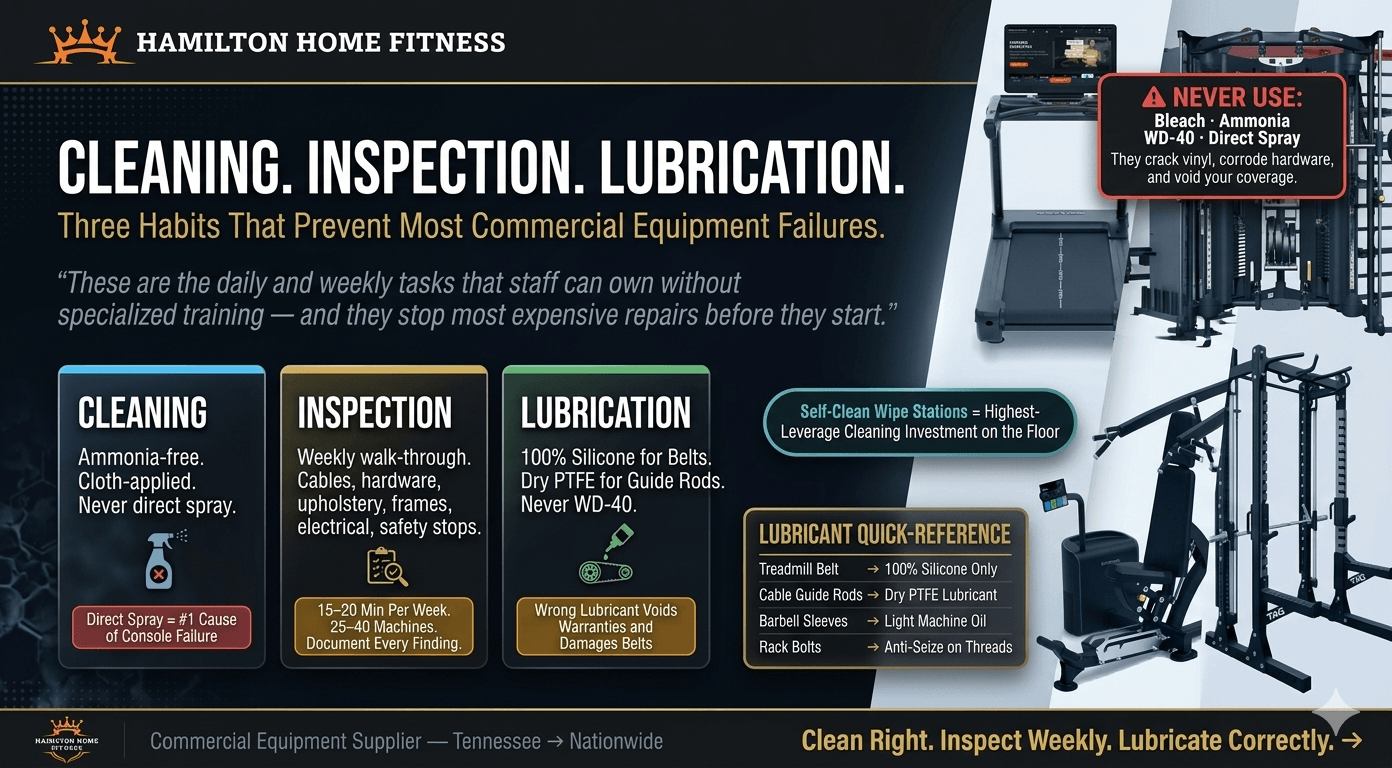
Three habits prevent most commercial gym equipment failures — consistent cleaning, structured inspection, and correct lubrication. These are the daily and weekly tasks that staff can own without specialized training, and they protect against most of the issues that turn into expensive repairs.
Cleaning Protocols
Clean commercial gym equipment with ammonia-free, non-acidic cleaners applied to a cloth—never sprayed directly onto consoles, electronics, or pulleys. Direct sprays are the single most common cause of console failure and pulley contamination on commercial floors.
Mistakes to avoid:
Don't use bleach, ammonia, or alcohol-based sprays. They crack vinyl upholstery, degrade rubber components, and corrode metal hardware over time.
Don't spray directly onto consoles or screens. Liquid migrates behind the bezel and damages electronics. Spray the cloth instead.
Don't soak upholstery. A damp wipe is enough; standing moisture rots foam through cracked seams.
Don't apply cleaner to cables, pulleys, or weight stacks. Cleaning solution attracts dust and creates friction. Use a dry cloth on these.
Don't ignore the area under and behind cardio machines. Dust ingestion into the motor compartment is a leading cause of motor failure.
For high-touch surfaces — belts, handlebars, grips, pads, and selector pins — gym-specific antibacterial wipes used between members are safe. For console screens, mix one part 91% isopropyl alcohol with one part water and apply to a lint-free cloth. Rubber flooring tolerates a pH-neutral floor cleaner; mirrors clean fine with a streak-free glass cleaner sprayed onto the cloth.
Self-clean stations with wipes at multiple points on the floor are the highest-leverage cleaning investment a facility can make. Members do most of the daily disinfection themselves when supplies are within reach.
Safety Inspection Checklist
A safe gym equipment inspection covers cables, hardware, upholstery, frames, electrical connections, and safety stops—recorded weekly in a maintenance log for liability protection. Fifteen to twenty minutes per week per 25–40 machines is a realistic time budget.
Weekly walk-through checklist:
Cables and pulleys: Inspect every cable end-to-end for fraying, kinks, or flat spots; spin every pulley by hand.
Hardware: Check rack bolts, machine frame bolts, pedal arms, and j-cup pins for tightness and seating.
Upholstery: Scan bench pads, seat pads, and back pads for tears, seam splits, or exposed foam.
Frames: Look for new dents, cracks, or paint loss at high-stress points (rack uprights, machine welds, treadmill frames).
Electrical: Confirm cardio machine power cords are intact, with no exposed wires and plugs seated firmly.
Safety features: Test every treadmill emergency stop (clip and red button), confirm cable carabiners close fully, and verify selector pins lock.
Leveling: Check that machines sit level on the floor; a rocking machine accelerates frame wear.
Console error codes: Note any persistent error codes flagged on cardio machine displays.
Document the inspection in a maintenance log—equipment ID, date, staff or technician name, findings, and follow-up actions. A documented log is your evidence of due diligence if a member is ever injured. It is also typically required by manufacturer warranty terms.
Lubrication Best Practices
Use 100% silicone lubricant for treadmill belts and dry lubricant for cable guide rods, machine pivots, and bearings—never petroleum-based sprays like WD-40, which damage belts, pulleys, and warranty coverage. Matching the lubricant to the application is the single most overlooked detail in DIY gym maintenance.
Lubricant matrix by application:
Treadmill belt and deck: 100% silicone lubricant only. Apply about 1 oz under the belt per the manufacturer's specified procedure every 3–6 months or whenever the console's "Lube" indicator triggers.
Cable machine guide rods: Dry lubricant (PTFE-based or graphite). Never grease it—it attracts dust and gums up the weight stack.
Machine pivots and bearings: Light dry lubricant or the manufacturer-specified product. Do not over-apply.
Barbell sleeves: Light oil (3-in-1 or a similar light machine oil) only if rotation is stiff; wipe off excess.
Rack hardware: Anti-seize compound on bolt threads during reassembly, not as a lubricant.
Edge cases worth knowing:
Self-lubricating treadmill belts. Some newer commercial belts are factory-treated and should not be re-lubricated. Check the manual before applying anything—adding lubricant to a self-lubricating belt causes slippage.
High-traffic facilities. 24-hour gyms, hotel fitness rooms with extended-hours access, and university recreation centers may need treadmill lubrication every 2–3 months instead of 3–6.
Humid climates. Higher humidity dries silicone lubricant faster. Inspect monthly with the finger test — rub the underside of the belt, and if it feels dry or rough, it's time to lubricate.
When in doubt, the manufacturer manual is the authoritative source for what to apply, how much, and how often.
Lifespan, Costs & Replacement Decisions
Well-maintained commercial gym equipment lasts 7–15 years depending on the category—and maintenance typically costs a small fraction of replacement value, with a clear breakeven point that signals when to upgrade. Forecasting these numbers turns maintenance from a reactive expense into a planned line item in the operating budget.

Equipment Lifespan Expectations
A well-maintained commercial treadmill typically lasts 7–12 years, ellipticals 8–12 years, strength machines 10–15 years, and racks 15+ years—but poor maintenance can cut these ranges roughly in half. The categories below give a realistic horizon for capital-expenditure planning.
Equipment Category | Lifespan With Maintenance | Lifespan Without Maintenance |
Commercial treadmills | 7–12 years | 3–5 years |
Ellipticals | 8–12 years | 4–6 years |
Bikes (upright, recumbent, spin, air) | 8–15 years | 4–7 years |
Rowing machines | 8–15 years | 4–7 years |
Selectorized strength machines | 10–15 years | 5–8 years |
Plate-loaded machines | 12–18 years | 6–10 years |
Power racks and squat cages | 15+ years | 8–12 years |
Barbells | 10+ years | 4–7 years |
Bench pads and upholstery | 3–7 years | 1–3 years |
These ranges reflect typical commercial use under good preventive maintenance discipline. Heavy-traffic facilities shorten the upper end; light-traffic facilities can exceed it. Frames and structural components almost always outlast their consumable parts—which is why replacement decisions usually hinge on belts, motors, cables, and upholstery rather than the frame itself.
Maintenance Cost Ranges
Commercial gym equipment maintenance typically costs 3–7% of equipment replacement value per year, with consumables running a few hundred to a few thousand dollars annually and professional service contracts ranging from a few hundred to several thousand dollars depending on fleet size and visit frequency. The figures below are approximate and current as of 2026; actual costs vary by region, facility size, brand, and service provider.
Typical annual maintenance budget components for a small-to-mid commercial gym (20–40 machines):
Consumables: ~$1,000–2,500/year — silicone lubricant, dry lubricant, antibacterial wipes, cleaning supplies, replacement cables, and occasional belts and pads.
Routine staff time: Internal labor for daily cleaning and weekly inspections, usually absorbed into existing staffing.
Professional service contract (quarterly visits): ~$1,500–5,000/year depending on fleet size, brand mix, and travel distance from the technician.
Per-visit emergency repair calls: ~$150–250/hour with 1–3 hour minimums, plus parts.
Major component replacement (belt, motor, cable assembly): ~$300–2,000 per incident depending on equipment class and OEM parts cost.
A larger fleet (50+ machines), a 24-hour facility, or a multi-location operator will spend at the higher end of these ranges. A small apartment or hotel gym with 5–10 machines will spend less. The cost discipline that matters most is not minimizing the maintenance line—it is keeping it predictable and avoiding the large reactive repairs that swamp a year's budget on a single failure.
Repair vs. Replace Decision Rule
Replace a commercial gym machine when a single repair exceeds about half the replacement cost, when the machine is past its expected lifespan, when OEM parts are no longer available, or when repeated breakdowns are damaging member experience. This is a defensible threshold for capital-spend decisions and aligns with how most fleet managers think about equipment economics.
Decision rule — replace the machine when any of the following is true:
The 50% rule. A single quoted repair exceeds 50% of the cost of a comparable new unit. Stacking two or three smaller repairs in 12 months on the same machine usually means the next one tips the math anyway.
End-of-life signals. The machine is at or past the upper end of its category's expected lifespan, and key components (belt, motor, cable system, upholstery, and bearings) are all showing wear simultaneously.
OEM parts unavailability. The manufacturer has discontinued the model line, parts lead times stretch past 30 days, or third-party parts would compromise warranty coverage or safety.
Member-experience damage. A machine is in and out of service often enough that members are noticing—out-of-order signs and Google reviews are early warning signals.
Safety doubt. Any concern that a frame, weld, electrical system, or load-bearing component is no longer fully reliable. Member safety is the override condition; cost analysis stops there.
When the math says replace, the next question is new versus used. New commercial equipment offers predictable conditions, a full warranty, current features, and a longer service runway. Quality used commercial equipment can reduce upfront cost meaningfully but should be inspected for belt and deck wear, cable condition, console function, parts availability, and remaining warranty.
HHF supports both paths. The Commercial Gym Equipment Buying Guide walks through specification, brand selection, and facility-fit decisions, and the full choose the best commercial gym equipment catalog covers cardio, strength, racks, free weights, and consultation support for facilities at any stage of replacement planning.
When to Call a Service Technician
Call a professional service technician for motor diagnostics, electrical work, structural welding, error-code repair, warranty-covered service, and any task the manufacturer specifies as professional-only. In-house staff can handle the cleaning, inspection, lubrication, and minor hardware tasks covered earlier, but the moment a job crosses into electrical, motor, frame structure, or warranty coverage, DIY stops being a cost-saver.
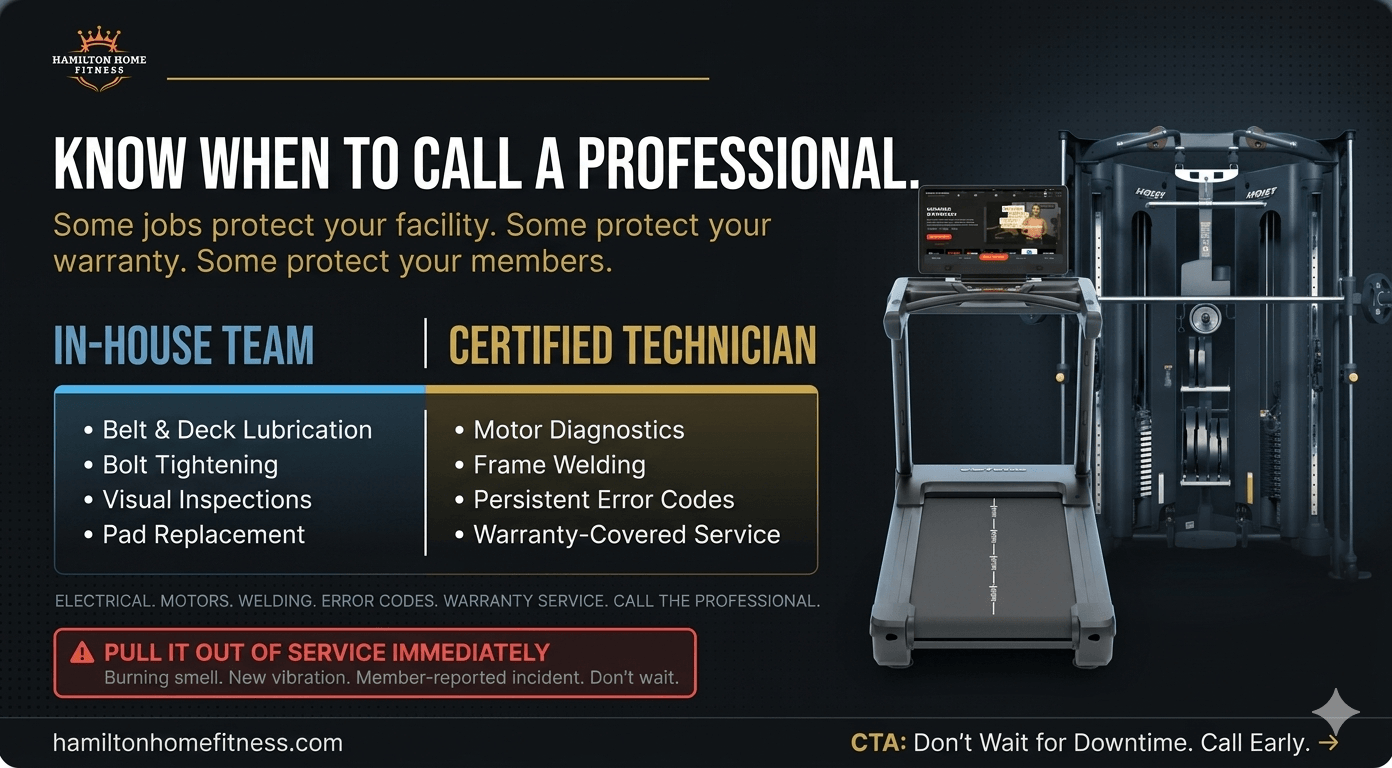
The split below covers the most common decision points.
In-house team can handle:
Daily cleaning and disinfection
Weekly visual inspection (cables, hardware, upholstery, frames)
Belt tension and alignment adjustments
Belt and deck lubrication using manufacturer-specified silicone
Monthly bolt-tightening on racks, machines, and frames
Guide rod lubrication on cable machines
Cable replacement when documented in the manual as user-serviceable
Pad and upholstery replacement using OEM parts
Console screen cleaning
Vacuuming motor compartments (with the unit unplugged)
Call a certified technician for:
Motor diagnostics, repair, or replacement
Internal electrical work or wiring issues
Persistent console error codes that survive a reset
Frame welding, cracked welds, or structural damage
Bearing replacement on flywheels, ellipticals, or cable systems
Drive belt replacement on cardio machines
Treadmill deck flipping or replacement
Cable assembly replacement on high-tension or pin-loaded systems where the manual requires professional service
Any warranty-covered service (DIY may void coverage)
Anything that doesn't behave the same after a member-reported incident
When you need a technician, vetting matters:
Manufacturer certifications. Is the technician factory-certified for the brands on your floor? Spirit Fitness, Hoist, TAG, Concept 2, Body Solid, York, Precor, and similar manufacturers each have their own service standards.
Insurance. Liability insurance and workers' comp are non-negotiable for work performed on your premises.
Brand and equipment experience. A technician who works mostly on hotel and apartment fitness rooms may not be the right fit for a high-volume commercial gym, and vice versa.
OEM parts access. The technician should source genuine manufacturer parts, not aftermarket substitutes that compromise warranty coverage.
Documentation. Every service visit should produce a written report—equipment ID, work performed, parts replaced, and next-service recommendations—
A safety note worth keeping in mind: if a member reports that a machine "felt wrong" mid-workout, if you see a new vibration or noise that wasn't there yesterday, or if any electrical issue (burning smell, sparking, intermittent power loss) appears, pull the machine out of service immediately and call a professional. Member safety overrides any cost-saving calculation, and a documented decision to pull a machine is exactly the kind of due-diligence record that protects the facility legally.
For HHF customers, equipment service coordination — routine visits, warranty support, or replacement parts — runs through the same support channel as new equipment inquiries. Reaching out early, before a small issue becomes downtime, is usually the lowest-cost path.
FAQ
What should a gym equipment maintenance log include?
A gym equipment maintenance log should include the equipment ID, date of service, task performed, name of the staff member or technician, observations (noise, wear, error codes), and any follow-up actions flagged. Keep it on a shared spreadsheet, an app, or a physical logbook that every staff member knows how to update.
Documented logs also serve as evidence of due diligence. If a member is ever injured on a piece of equipment, the log is what protects the facility against negligence claims and supports warranty-coverage decisions.
Can preventive maintenance void a gym equipment warranty?
No — proper preventive maintenance does not void warranty coverage. Most commercial manufacturers actually require documented preventive maintenance to keep the warranty valid. What voids coverage is improper maintenance: using the wrong lubricant on a treadmill belt, installing non-OEM replacement parts, performing repairs the manual specifies as professional-only, or skipping maintenance altogether.
The manufacturer's manual is the authoritative source for what is and is not user-serviceable on any specific machine. When in doubt, check the manual or contact the manufacturer or supplier before performing the work.
How do you clean upholstery on commercial gym machines?
Clean gym machine upholstery with a damp cloth and warm water, or with a gym-specific antibacterial wipe formulated for vinyl pads. Avoid bleach, ammonia, alcohol-based sprays, and abrasive cleaners—they crack vinyl, dry out seams, and accelerate foam breakdown.
Replace or reupholster pads at the first sign of tears or seam splits. Once foam is exposed to sweat and moisture through a crack, it degrades quickly and becomes a hygiene issue as well as a comfort one.
How much does commercial gym equipment maintenance cost per year?
Commercial gym equipment maintenance typically costs 3–7% of equipment replacement value per year. For a small-to-mid commercial gym (20–40 machines), that usually works out to consumables in the $1,000–2,500/year range plus a professional service contract in the $1,500–5,000/year range, with emergency repair calls extra. Figures are approximate, current as of 2026, and vary by region, fleet size, brand mix, and service provider.
The largest cost variable is whether maintenance is preventive or reactive. Reactive repairs on a single major component—motor, deck, or cable assembly—can equal a full year of preventive budget on one machine.
How do I find a qualified commercial gym equipment service technician?
Look for manufacturer certifications matching the brands on your floor, current liability insurance and workers' comp, documented brand-specific experience, OEM parts access, and a written service-report process. Ask for references from facilities of similar size and traffic, and verify the technician can handle both routine preventive visits and emergency repair calls.
Local commercial equipment suppliers are often the fastest path to a qualified technician. Hamilton Home Fitness, for example, can coordinate service support and parts sourcing for customers nationwide, which usually shortens the lead time compared to searching for a technician cold.
How do you know when to replace a gym machine belt?
Replace a treadmill belt when you see visible fraying at the edges, a glazed or shiny underside, persistent slippage after proper tensioning and lubrication, or a burning rubber smell during use. Any of these signs means the belt is past its serviceable life, and continuing to use it accelerates damage to the deck and motor.
Most commercial treadmill belts last 3–7 years under heavy daily use, depending on traffic, lubrication discipline, and belt quality. If the deck is also showing wear when the belt is due, replace both together—running a new belt on a worn deck shortens its life immediately.
Final Thought
A reliable commercial gym is built on a maintenance system, not on luck. The five layers — daily cleaning, weekly inspection, monthly servicing, quarterly equipment-specific tasks, and an annual professional review — protect member safety, extend machine lifespan, and keep the operating budget predictable.
From here, the practical next steps are short: put the schedule in front of your staff, source the consumables your fleet actually needs, and plan ahead for the machines getting close to their replacement threshold. Hamilton Home Fitness supports commercial operators on all three: replacement parts and accessories for ongoing maintenance, service coordination when professional help is needed, and a full commercial catalog when a machine is past the point of further repair. Members notice when equipment works, and operators notice when the maintenance budget stays inside the lines.