Introduction
Your racks are bolted down, and your machines are in. Commercial gym accessories are the part nobody budgets for, and six weeks from opening they're the whole list that's left: bare concrete, no mirrors, and no clock anyone can read from the far end of the room.
Still deciding on machines? What a full commercial equipment list looks like covers that. This page starts where it stops.
You'll get what has to go in before the equipment lands, roughly what each item costs, and what safely waits. The rule that sorts it is installation access, not importance.
Buy Before Opening or Add Later?
The divide isn't importance—it's installation access. Anything that goes under or behind your equipment has to be in before the equipment lands. Anything that sits on top of a finished floor can follow later, even if it feels urgent now. That one rule sorts the whole punch list.
Most opening checklists rank these items by how much members will notice them. That ordering costs money. The commercial gym equipment buying guide names the supporting setup—this is the order you buy it in.
Buy before the equipment arrives:
- Flooring, because it goes under every rack and machine
- Mirrors, because racks end up against the mirror wall
- Anything wall-mounted, while the walls are still clear
- Drop-zone and subfloor prep, which can't be retrofitted
Everything else sits on top of a finished floor. Timers, storage racks, and consumables top every opening list, and they're the easiest items to defer—a wall timer goes up in month two without moving a rack. Most of the commercial gym accessories category works that way.
Where the sequencing is tight, facility supply and installation in Tennessee covers coordination between the floor crew and the equipment installation.
What the Floor Actually Costs
Commercial rubber runs roughly $3 to $12 per square foot across the market. The two routes stocked here land at $3.75 and $4.50, so a 2,000-square-foot training floor is a four-figure line item, not the five-figure one most build-out guides imply.
That gap matters because published figures arrive as ranges nobody converts. Take the square footage from your floor layout, multiply, and you have a real number to quote against—not a bracket.
Freight is the part that moves it. Rubber is heavy, and a pallet of rolls prices differently from a boxed pallet of tiles. The Vortex 8mm rubber rolls page carries the roll dimensions the arithmetic depends on, and current shipping and freight terms are worth checking before you commit to a format.
Rolls or Tiles for a Commercial Floor
Rolls suit large open floors because they hide seams and cover ground fast. Interlocking tiles suit irregular rooms and phased installs, because you can cut, reconfigure, and replace a single square without touching the rest.
Vortex Rubber Rolls run 4 ft by 15 ft at 8 mm—$225 covers 60 square feet, in six colors, shipped free. They're heavy and awkward to cut, and a room full of corners wastes material. BodyKore Premium Rubber Interlocking Tiles cover 200 square feet for $900 at 2 ft by 2 ft. Thinner at 6mm, no free shipping, and the seams stay visible. Both sit on the rolled and interlocking rubber flooring page.
Free shipping is why the Vortex range often wins on delivered price even when the unit cost looks close.
Where Drop Zones Change the Spec
A general training floor and a barbell drop zone are two different specs. Rubber at 6 mm to 8 mm handles foot traffic and machine weight fine. Anywhere loaded bars come down needs a platform or crash pads on top of it.
Get this wrong, and the failure isn't the rubber—it's the slab underneath, cracking where a bar lands in the same spot four hundred times a week.
Body-Solid Barbell Crash Pads at $200 are the in-catalog answer for a drop zone without a built platform. They protect at the point of impact only, so a facility running several lifting stations wants platforms instead. Dumbbell drops do the same damage on a smaller footprint—worth checking against your fixed dumbbell sets and their racking.
Schema: Article and BreadcrumbList for the page. FAQPage stays valid markup but has returned no rich result since May 2026, so it earns nothing on its own here.
What Goes on the Walls
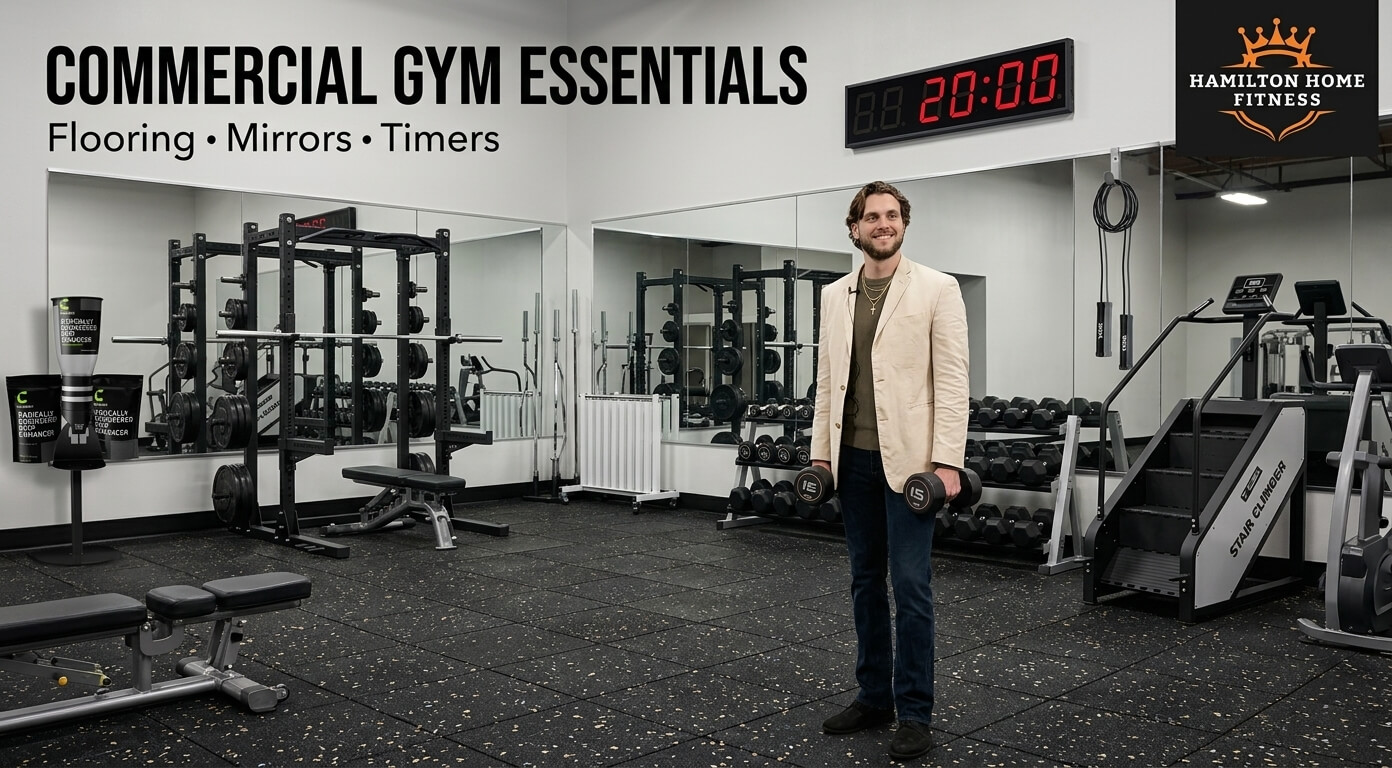
Mirrors and clocks share a section because they share a problem. Both get fixed to walls, and walls are cheapest to work on while they're clear. Both are also bought on sightline, not size.
Get either wrong, and the fix means moving equipment built for facility traffic that's already bolted down.
Mirror Height and Safety Backing
Commercial mirrors should sit with the bottom edge 12 to 18 inches above the floor wherever plates, dumbbells, or boxes live against that wall, seated on a J-channel above a low kick plate.
Mount at floor level, and the first plate leaned against the glass chips. The other mistake is spec—safety backing is a film bonded to the rear that holds the pieces together if the pane breaks.
Any room where plates come down needs it. HD Fitness Mirrors run $525. A facility wall is a multi-panel job, so panel count and fitting sit outside that price, and glass rules for commercial spaces vary by jurisdiction—check with your contractor. How installers sequence a facility build shows where the glazing slot falls.
Why Gyms Use Oversized Clocks
A gym clock is oversized because it has to be readable from the furthest working position in the room, which is what lets a coach run intervals without calling every transition out loud.
Measure from the far corner, not the front desk. One display people can read beats two small ones nobody looks at. Class formats need it too—EMOM starts a set each minute, AMRAP runs a fixed clock, and Tabata alternates 20 seconds on and 10 off.
In a studio, the same wall usually carries the timer and a vertical rack for lighter dumbbells. Plan both while it's clear.
What a Chalk Policy Really Costs
Loose chalk doesn't cost you sweeping. It costs you the air handler and the knurling. Dust settles into return air and onto every gripped surface, and both are more expensive to fix than any cleaning schedule you'd write to avoid the problem.
The documented cases come from climbing and gymnastics facilities, where one operator's air handler filled with chalk and the motor failed within months of opening. Chalk also works abrasively between moving parts, shortening service life. A strength floor carries a lighter load than a bouldering gym, so treat the scale as lower—but the mechanism is the same one, and it's why some chains ban loose chalk outright rather than managing it.
There's a second reason. Cheaper chalk is cut with drying agents, and filler content is what turns a dust problem into an air-quality one.
That leaves four positions. Loose chalk is cheapest per unit and most expensive downstream. Chalk balls contain most of the dust and cost you almost nothing to enforce. Liquid chalk removes the airborne problem entirely but needs restocking. Going chalk-free means a dispenser system and a house rule—chalk-free grip options for facilities cover what that looks like, with the Chalkless Dispenser Bundle at $459.99 as the facility-scale version. It won't suit a powerlifting room where members expect chalk and will bring their own.
For lifters who want grip without either, gloves as the other grip route solve the same problem at the hand rather than the room.
What Wears Out and What It Costs
Gym consumables are the wear items you buy once as capital and then keep buying. Collars, straps, ropes, and filters fail on traffic, not on a calendar—which is why a punch list funded in a single order runs dry around month three.
The one interval you can set on a calendar is air filtration. Monthly is the standard cadence, and a room that allows loose chalk will hit it sooner. Everything else is a judgement call, and keeping a rubber floor and mirrors clean covers what that weekly inspection looks like.
Budget these as recurring, not one-off:
- HVAC filters: monthly, sooner in a chalk room
- Weight collars: replace when the clamp slips
- Jump ropes: check the swivel, not the cord
- Lifting straps: retire at the first stitching split
- Bench upholstery: patch small tears immediately
Rating is what moves these intervals most. A residential-grade item on a facility floor becomes a consumable rather than an asset—why commercial ratings change replacement cycles explains where that line sits.
FAQ
Which accessories most affect how members perceive the room?
Floor condition and storage order. Both are visible from the door before anyone touches a machine, and a floor where every weight sits on storage racks for a commercial floor reads as a run facility rather than a rented one.
Can I use horse stall mats in a commercial gym?
They work in a garage and struggle in a facility. Thickness varies between mats, edges curl underfoot, and odor clears slowly in a closed room. Fine under a single station; wrong for a member floor.
Does taking over a former gym space save money?
Yes, meaningfully—existing flooring, mirrors, and sometimes suitable air handling can remove tens of thousands from a build-out. Check the flooring spec matches your training style before assuming it stays; a cardio-rated floor won't take barbells.
Who installs commercial gym mirrors?
A glazing or mirror contractor, not your equipment installer. The two need sequencing so wall work finishes before racks are positioned. Most quotes cover delivery and fitting together, which is why panel count drives the price more than area does.
Final Thought
Your equipment is in. What's left is short, costed, and only a question of order—what goes underneath goes down first. Book a gym design consultation to check the list against your real square footage.
Then ask for a bulk facility quote so five categories arrive as one order instead of five separate checkouts.