Introduction
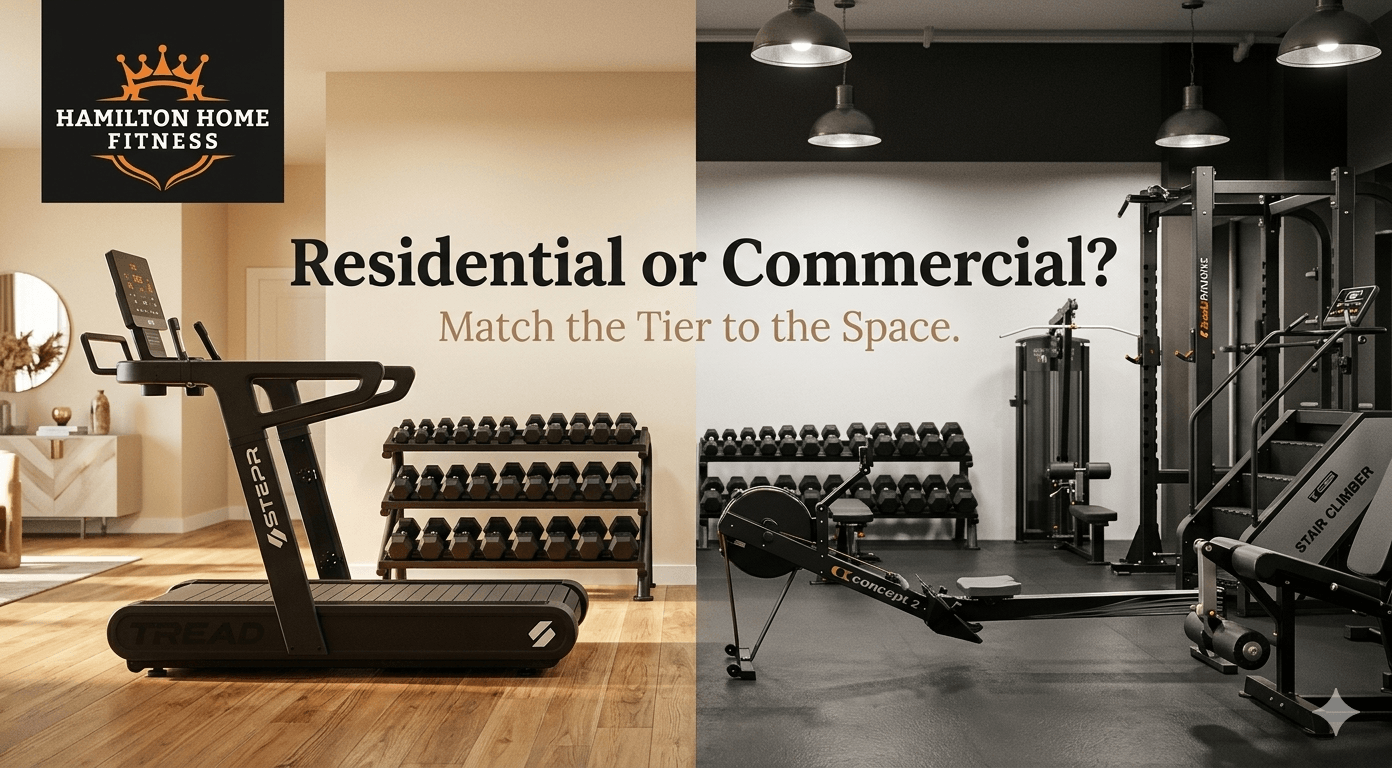
You're outfitting a small commercial space—an apartment gym, a hotel fitness room, an office wellness corner, a school weight room, or a boutique studio—and the question is whether residential equipment can do the job or whether commercial grade is the only choice.
The honest answer comes down to six things: steel frame, motor and duty cycle, weight capacity, warranty, liability exposure, and lifespan under real traffic.
This guide walks you through all six, gives you a tier-by-facility recommendation, and shows you the cost-per-use math so you can defend the decision to whoever signs the check.
The Three Tiers of Gym Equipment
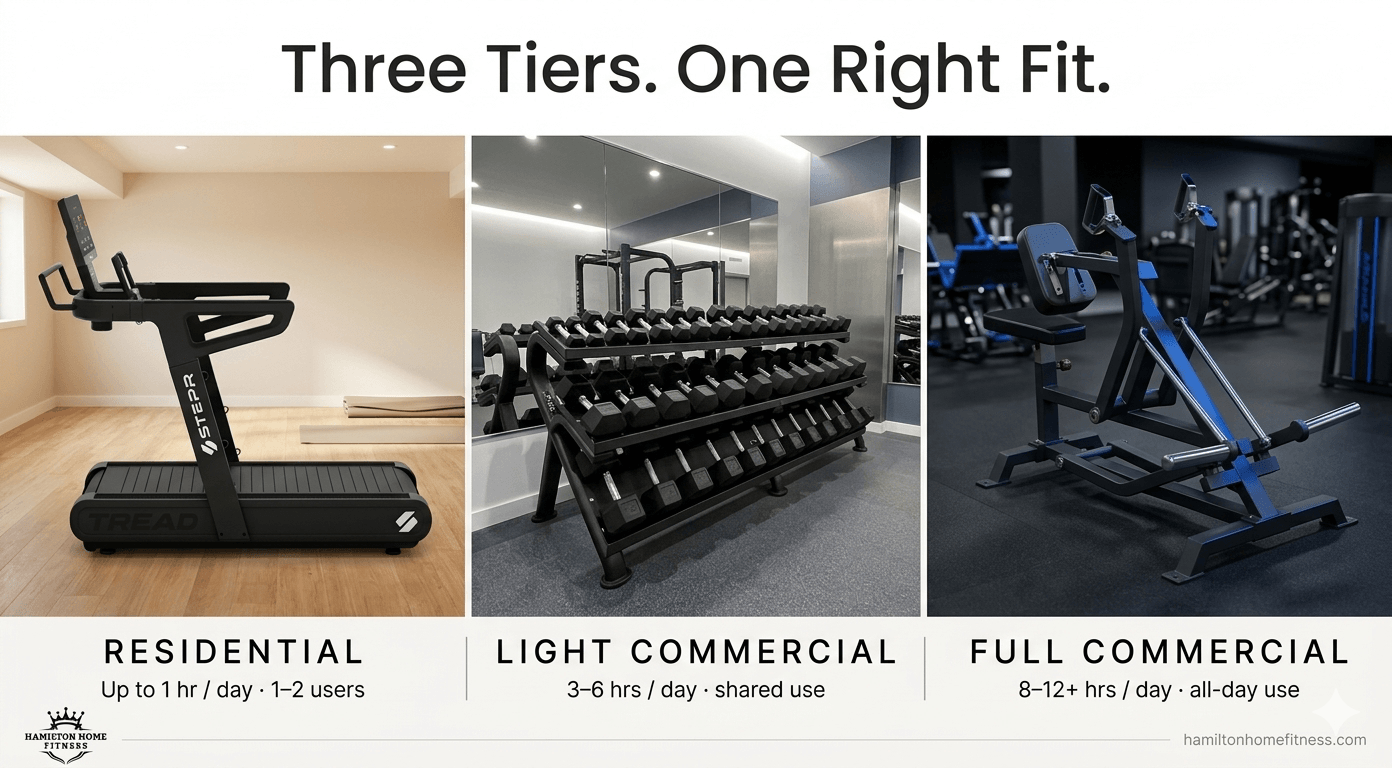
Gym equipment falls into three tiers—residential, light commercial, and full commercial—each engineered for a specific daily-use load and user count. Matching the tier to your facility is the single most important decision you'll make, because the spec gap between them is wider than the price gap suggests.
Residential Equipment
Residential gym equipment is built for one household, light daily use, and one or two users — typically under one hour of total run time per day. Frames are commonly 12- or 14-gauge steel; cardio motors are usually 1.5–3.0 HP peak-rated DC; user weight capacities sit around 250–300 lb; and dumbbells often use vinyl or coated cement rather than urethane or rubber. It's the right tier for a single-family home, garage gym, or basement setup where the equipment will see predictable, limited use. If that's your space, the home workout machines category is the right starting point.
Light Commercial Equipment
Light commercial equipment is engineered for moderate shared-use environments where 3–6 hours of daily use is expected across a known, limited user base. It fits apartment fitness rooms, boutique hotels, corporate wellness spaces, churches, and small studios with a capped membership. Construction sits between residential and full commercial—heavier frames, stronger motors, and higher user-weight ratings—and warranties typically cover the equipment for non-membership commercial placement. This is the tier most small commercial buyers actually need, and it's where residential gear most often gets miscast.
Full Commercial Equipment
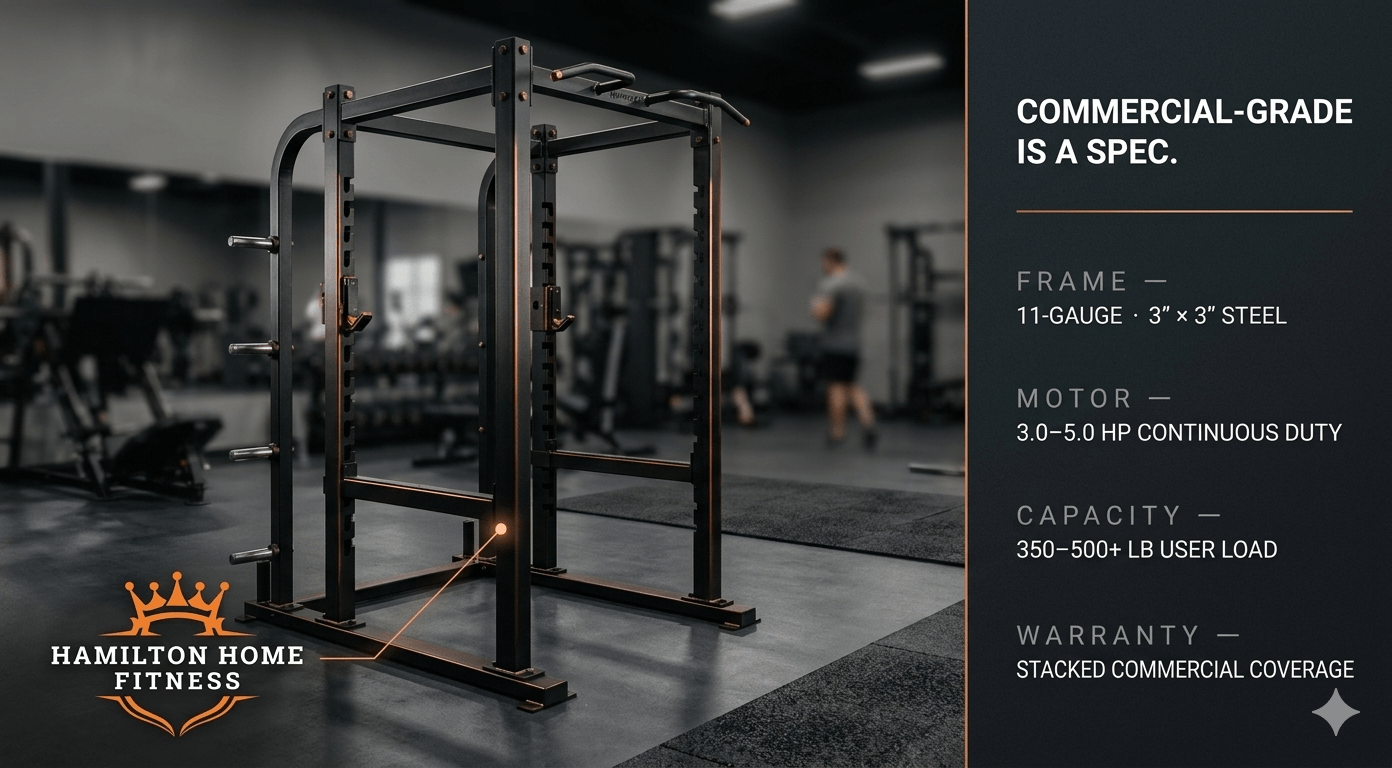
Full commercial equipment is engineered and warranted for continuous all-day use across many users—the standard for membership gyms, 24/7 facilities, schools, military, and athletic programs. Expect 11-gauge steel frames, 3.0–5.0 HP continuous-duty AC motors on cardio, user weight capacities of 350–500+ lb, and stacked warranties with explicit commercial-use coverage. This tier is non-negotiable for heavy-traffic spaces and increasingly chosen for high-end private gyms where buyers want a club-spec feel and longevity. Hamilton Home Fitness stocks the full range across cardio, strength, and free weights in its commercial fitness equipment collection.
What Makes Equipment Truly Commercial-Grade
"Commercial grade" is a spec, not a label. A machine qualifies as commercial-grade only when its frame, motor or resistance system, hardware, warranty, and user-load rating all meet commercial thresholds—and the manufacturer explicitly warrants it for commercial use. Marketing copy on a product page is not proof; the spec sheet is.
Frame and Steel Gauge
Commercial power racks are almost always built from 11-gauge, 3" × 3" steel tubing, while residential racks commonly use 12- or 14-gauge. A lower gauge number means thicker steel: 11-gauge is roughly 3 mm thick, and 14-gauge is closer to 1.9 mm. That difference shows up under load—11-gauge commercial racks routinely carry rackable capacities of 1,000–3,000+ lb, while lighter residential racks may be rated for 500–700 lb. Weld quality, powder-coat finish, and oversized hardware (1" bolts with 36 mm heads on top-tier racks) round out a real commercial frame. If a rack spec sheet does not state gauge, tubing dimension, and rackable capacity, treat it as residential until proven otherwise. Hamilton Home Fitness lists gauge and capacity on every product page in its commercial power racks category, which makes spec verification straightforward.
Motors, Resistance Systems, and Duty Cycle
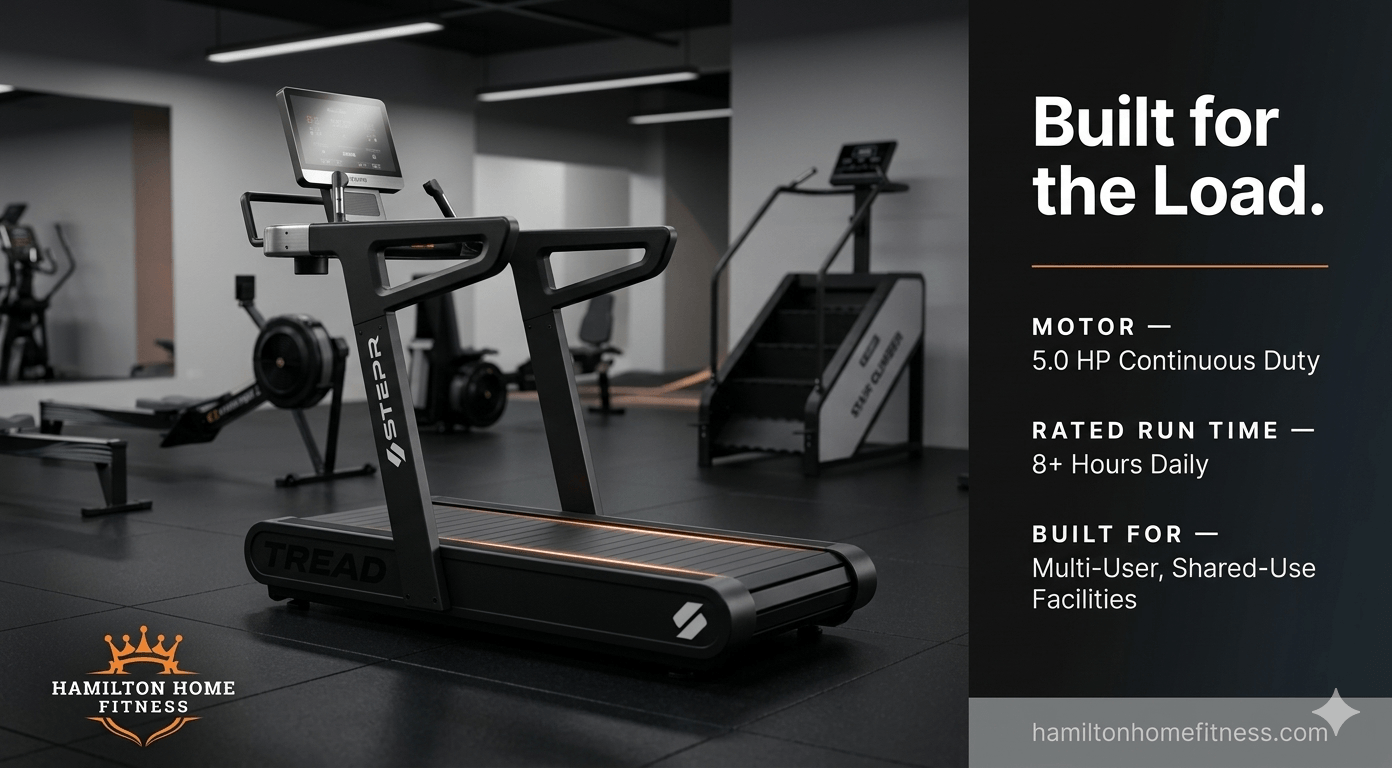
On commercial cardio, motor power is rated in continuous duty; on residential cardio, it is usually rated at peak—a higher number the machine can hit briefly but not sustain. A 2.5 HP peak residential treadmill motor is not equivalent to a 3.0 HP continuous-duty commercial motor, even though the numbers look close. Commercial treadmills commonly use 3.0–5.0 HP continuous-duty AC motors engineered for 8+ hours of daily run time, while residential treadmills typically use 1.5–3.0 HP DC peak-rated motors built for about an hour of daily use. The same logic extends to ellipticals, bikes, and rowers: heavier flywheels, sealed industrial bearings, and self-generating power systems are on commercial models versus lighter flywheels and basic bearings on residential ones. When comparing two cardio machines, always check the rating method before comparing the number.
Weight Capacity and User Load Rating
Commercial machines are rated for higher user weight—typically 350–500+ lb—because they must safely accommodate every body type and every loading scenario in a shared-use space. Residential equipment usually caps user weight at 250–300 lb. The gap is not just about the heaviest user; it's the engineering margin that handles dynamic load, repeated use, and edge cases. For benches, racks, and selectorized machines, also check rated load capacity (the working weight) separately from user weight. In any shared-use facility, you cannot screen users by size, so capacity is a safety threshold, not a preference.
Components, Hardware, and Finish
Inside the frame, commercial equipment uses industrial bearings, heavier cables, urethane or rubber-encased weights, and oversized hardware that residential builds do not. Commercial dumbbells are typically hex rubber, urethane-coated, or pro-style with knurled steel handles; residential dumbbells often use vinyl shells or coated cement that crack and chip under repeated drops. Cables on commercial functional trainers tend to be aircraft-grade steel rated for far higher cycle counts than residential equivalents. Powder-coat finishes, stainless-steel touch points, and bolt-down anchor patterns are all standard at the commercial tier and inconsistent at the residential one. These component-level differences are what justify the price gap and what keep the equipment serviceable for years. The commercial-grade free weights category is a good reference point for what commercial specs actually look like at the component level.
Duty Cycle and Why Residential Cardio Fails
A residential treadmill placed in a shared-use space typically fails within months because its motor, deck, and electronics were never engineered for back-to-back sessions across many users. "Duty cycle" isn't a marketing term—it's the engineered runtime tolerance of every moving and electrical component in the machine. Exceed it, and parts don't just wear faster; they fail in a predictable order.
The Failure Pattern
Residential cardio under commercial loads tends to fail in a predictable order: motor first, deck second, electronics third.
The motor goes first because a 2.5 HP peak-rated DC motor is engineered for roughly an hour of daily use, not 8–12. Under sustained load it overheats, the controller throttles output, and within months the motor either burns out or trips its thermal protection mid-session. The deck and belt go next. Designed for one user's stride pattern and one body weight, they delaminate, glaze, or slip when cycled through dozens of users a day. Console electronics and cooling fans round out the failure sequence; consoles that were never built for continuous operation start dropping connections, freezing, or failing outright.
For an operator, the consequence stack is what matters: unscheduled downtime, "out of order" signs in front of members or guests, voided warranty claims (because the machine was used outside its rated class), and a replacement cost that often exceeds what the commercial unit would have cost in the first place. The same failure logic applies to residential ellipticals, bikes, and rowers—lighter flywheels, basic bearings, and consumer-grade resistance systems weren't engineered for the duty cycle of a shared facility.
If the space is going to see more than two or three hours of cardio use a day across multiple users, the cardio decision is already made. Hamilton Home Fitness stocks commercial cardio equipment rated for continuous duty across treadmills, ellipticals, bikes, and rowers, which is where this tier of buyer should start.
Warranty, Liability, and Insurance Risk
Residential warranties almost always exclude commercial use, and a residential machine in a shared-use facility can void both the warranty and parts of the operator's liability coverage. This is the section most buyers skip and most operators regret.
Warranty Tiers in Plain English
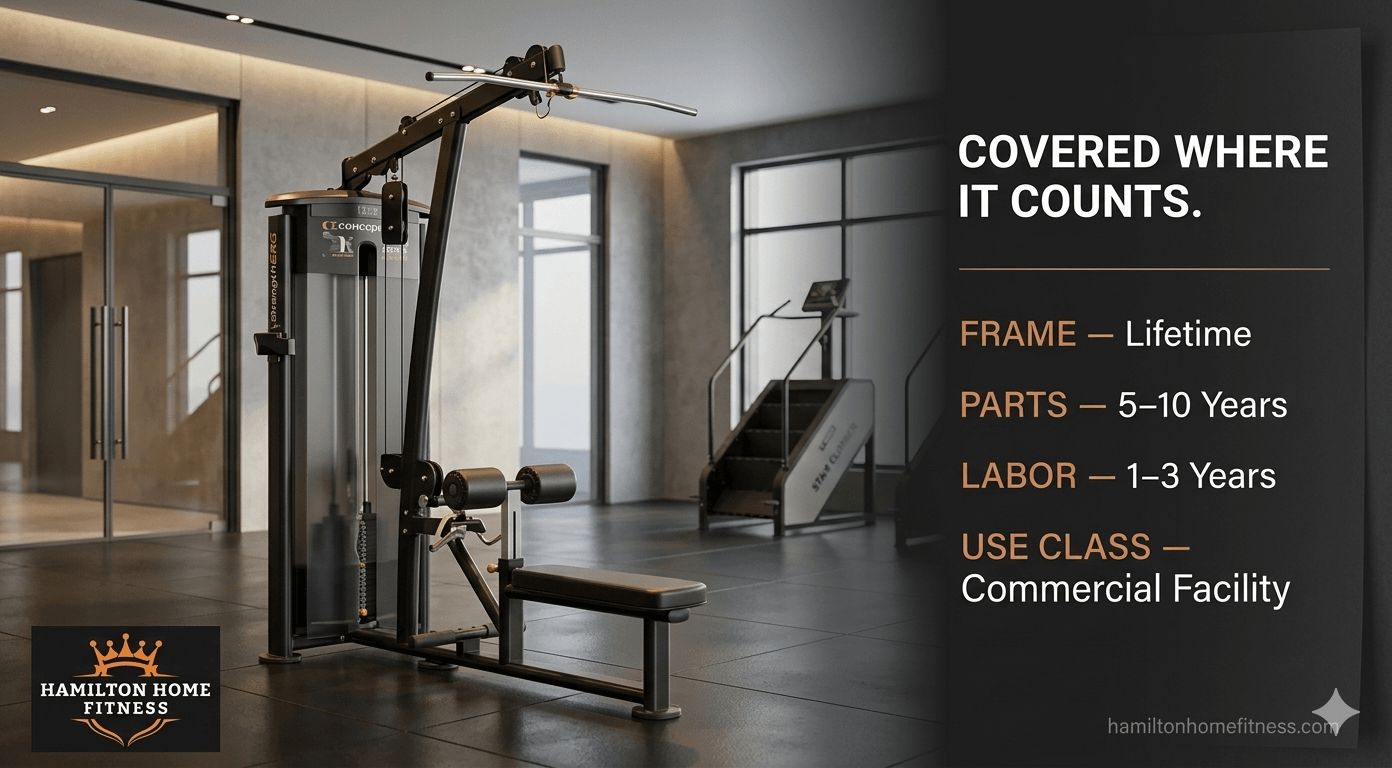
Commercial warranties are stacked — separate coverage for the frame, parts, labor, and wear items — and they explicitly cover use inside a commercial facility.
A typical commercial-strength warranty looks like a lifetime on the frame, 5–10 years on parts, 1–3 years on labor, and 90 days to a year on wear items (cables, upholstery, and grips). A typical residential warranty looks like 5–10 years on the frame, 1–3 years on parts, 90 days on labor, and explicit exclusion of any commercial, semi-public, or revenue-generating use. The numbers vary by manufacturer, but the structure is consistent: commercial warranties name the environments they cover (membership gym, hotel, apartment, school, military), and residential warranties name the environment they exclude (anything other than personal home use).
The practical test: pull the warranty document before you buy and read the usage clause. If it doesn't list your facility type as covered, the warranty does not apply to your installation — regardless of what the salesperson says.
What Voids a Residential Warranty
Most residential warranties are voided the moment the machine is placed in a commercial, semi-public, or revenue-generating environment, regardless of whether it has been used.
That includes apartment fitness rooms, HOA gyms, hotel guest gyms, church wellness rooms, office wellness corners, school weight rooms, and boutique studio floors. The void is automatic and triggered by placement, not by failure. An operator who buys residential equipment for a shared space is paying full price for a warranty that has no force from day one — and if a part fails six months in, the manufacturer's first question is where the machine is installed.
This closes the "we'll just buy the home model and save" loophole that competitor guides leave open. The saving evaporates the first time something needs warranty service.
Liability and Insurance Exposure in Shared-Use Spaces
Insurance carriers and facility operators may treat residential equipment installed in a shared-use facility as an elevated risk, and an injury claim involving such equipment can trigger coverage disputes.
The reasoning carriers' and plaintiffs' attorneys lean on is straightforward: the equipment was used outside its manufacturer-rated use class; the operator knew or should have known; and that elevates the operator's exposure under premises liability and duty-of-care standards. In practice, that can mean disputed claims, higher deductibles after an incident, or pressure to remove the equipment. It rarely shows up before something goes wrong — and that's exactly the point.
Property managers, studio owners, hotel and office facility leads, school administrators, and HR or wellness directors are the people who carry this exposure. The cost of getting the tier wrong is not just replacement equipment; it's the claim that doesn't go the way you expected.
A limitation worth stating plainly: liability and insurance outcomes are policy-specific and state-specific. Confirm the use class with the equipment manufacturer and the coverage details with your own insurance carrier before installing anything in a shared-use space. Neither this article nor any vendor's guide is a substitute for the binding answer your carrier gives you in writing.
Lifespan and Total Cost of Ownership
Commercial equipment typically lasts 2–4 times longer than residential under shared use, and once the math is run as cost-per-year-of-service, the upfront premium often disappears or reverses. The sticker price is the loudest number in the room; it is rarely the deciding one.
Lifespan Ranges by Tier
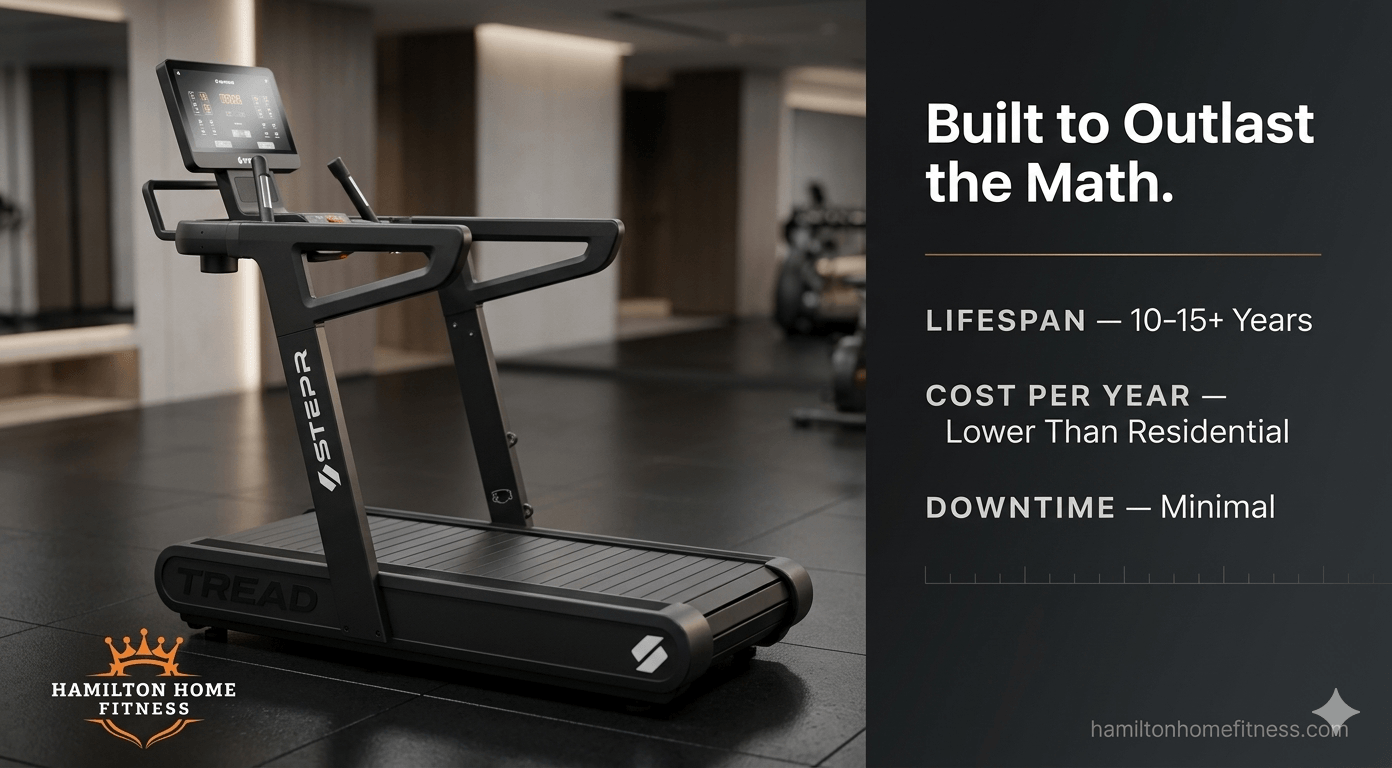
Residential equipment used residentially commonly lasts 5–10 years; the same equipment placed in a shared-use space often fails inside 2 years.
Light commercial equipment used in its intended environment — 3–6 hours of daily use in a moderate-traffic space — typically lasts 7–10 years. Full commercial equipment in heavy-traffic facilities lasts 10–15+ years with routine preventive maintenance: belt and deck service on treadmills, cable inspections on selectorized and functional trainers, bearing checks on cardio flywheels, and upholstery replacement on benches.
Lifespan is not a fixed number; it's a function of duty cycle, maintenance discipline, and tier match. The gap most buyers underestimate is the residential-in-commercial scenario—a 5–10 year machine compressed into 18 months because it was installed outside its rated class.
Cost-Per-Use Logic
Divide each option's purchase price by its realistic years of service in your facility — the higher upfront price often becomes the lower annual cost.
A simple example: a $1,200 residential treadmill replaced every 2 years in an apartment gym costs $600 per year, plus the downtime and replacement labor cost each cycle. A $4,500 commercial treadmill lasting 10 years in the same space costs $450 per year, with fewer "out of order" signs and no warranty disputes along the way. The residential option looked like a 73% discount at purchase and ended up 33% more expensive per year of service.
Run the same math on your own numbers before you decide. Pull the realistic lifespan for each tier, divide it by purchase price, and add the downtime cost (lost member satisfaction, replacement labor, and install fees) for the residential option. The math is rarely close.
Refurbished and Certified Used Commercials as a Middle Path
Certified used or remanufactured commercial equipment can deliver commercial spec at a reduced entry price — provided the seller documents what was replaced and what warranty applies.
The terms "used," "refurbished," and "remanufactured" are not standardized across the industry, so the burden is on the buyer to ask for specifics: which components were replaced (motor, belt, deck, cables, upholstery, electronics); who did the work; where the parts were sourced; what testing was completed; and what warranty the seller stands behind after the work. A well-documented remanufactured commercial treadmill can hit 10–15 years of service at a fraction of new-equipment cost; an undocumented "refurbished" machine can fail in a year with no recourse.
For budget-constrained operators who still need commercial spec and warranty coverage, Hamilton Home Fitness's certified used commercial equipment is a legitimate middle path—provided you ask the documentation questions above before purchase.
Comparison Table and Facility Fit Guide
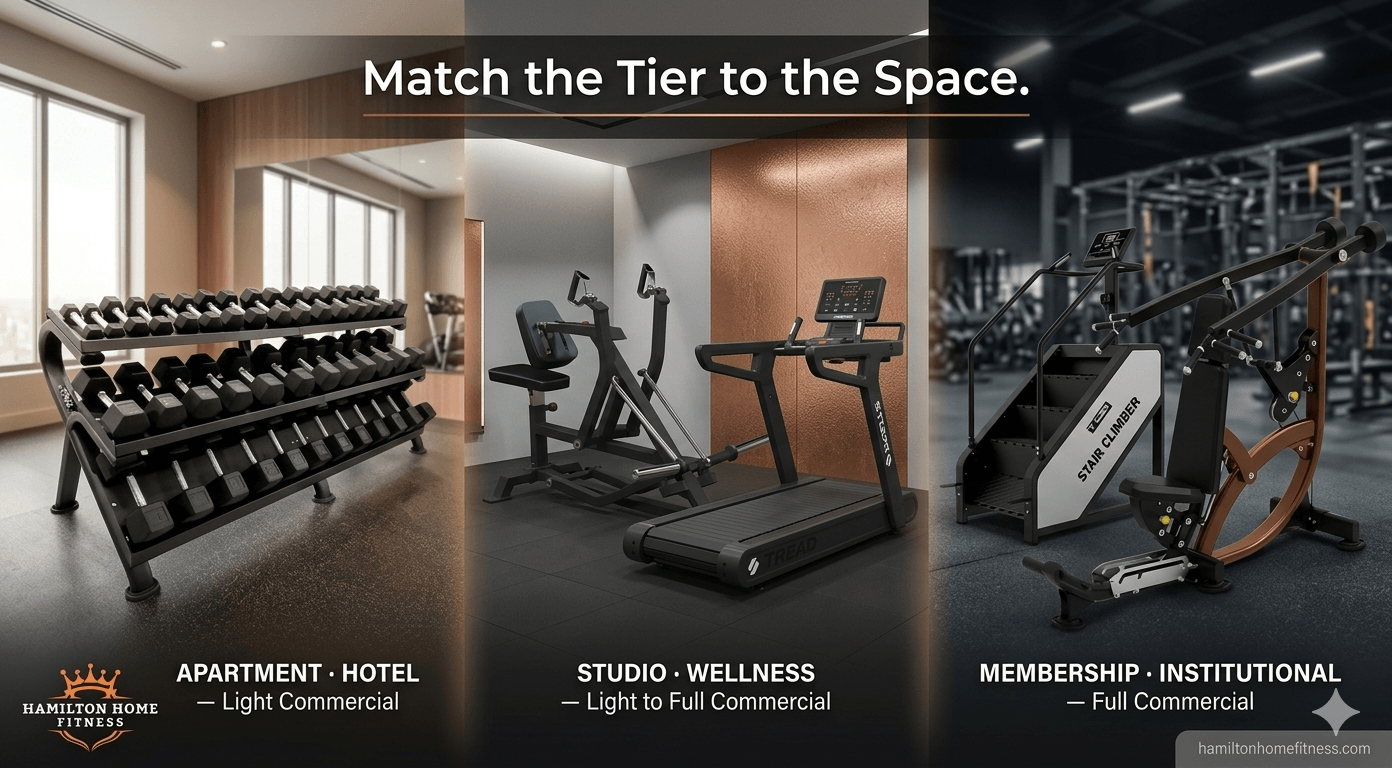
The decision usually collapses into two questions: Which tier matches my facility, and what does that tier actually look like on a spec sheet? The table answers the second; the matrix answers the first.
Side-by-Side Comparison Table
The table below summarizes how the three tiers compare on the six dimensions buyers care about most.
$–$$
Dimension | Residential | Light Commercial | Full Commercial |
Frame steel (racks) | 12–14 gauge, 2"×2" tubing | 11–12 gauge, 2"×3" or 3"×3" | 11-gauge, 3"×3" tubing |
Cardiomotor | 1.5–3.0 HP DC, peak-rated | 2.5–3.5 HP, often AC | 3.0–5.0 HP AC, continuous duty |
Rated daily use | ~1 hour | 3–6 hours | 8–12+ hours |
User weight capacity | 250–300 lb | 300–400 lb | 350–500+ lb |
Warranty structure | 5–10 yr frame, 1–3 yr parts, 90-day labor, home use only | Frame: 10 yr–lifetime, parts: 3–5 yr, labor: 1 yr, light commercial covered | Lifetime frame, parts 5–10 yr, labor 1–3 yr, full commercial covered |
Lifespan in intended environment | 5–10 years | 7–10 years | 10–15+ years |
Typical price (per machine) | $ | $$ |
Use the table as the spec-check shortcut: if a product's published numbers don't meet the column for your facility tier, it's the wrong machine for that space.
Facility-Fit Matrix
Match the tier to the facility, not to the budget — the wrong-tier installation almost always costs more over a five-year horizon.
Single-family home, garage gym, basement gym: "Residential" is the right tier for most buyers. Step up to light commercial or full commercial only if the household is multi-user, includes athletes training daily, or you want a club-spec feel and longevity.
Apartment fitness room (under 50 units, unattended): Light commercial minimum across all categories. Residential equipment in this setting voids the warranty and exposes the property manager to liability.
Larger apartment complex, HOA gym, condo amenity space: Light commercial for low-traffic spaces; full commercial for cardio and high-use strength stations once the resident count or usage hours climb.
Hotel guest gym: Light commercial as the floor; full commercial for cardio in larger or higher-occupancy properties. Guest expectations and unattended use both push the tier up.
Corporate wellness room, office gym: Light commercial for small offices with a known headcount; full commercial cardio for larger campuses or anywhere usage hours exceed a few hours per day.
Church wellness room, community center: Light commercial covers most installations; verify warranty terms cover non-membership commercial placement.
Boutique studio (under 50 active members): Light commercial may fit for some accessory and strength stations; cardio and high-traffic strength equipment should be full commercial to avoid downtime that members notice. The commercial weightlifting machines category is the right starting point for the strength floor.
Membership gym, 24/7 access facility, CrossFit box: Full commercial only. Every category, every machine.
School weight room, athletic training facility, military, and first responder: Full commercial only. User load, traffic, and institutional liability all rule out lower tiers.
If your space isn't on this list, the rule still holds: estimate daily-use hours and concurrent users, then match to the column in the table above. Tier follows traffic, not budget.
FAQ
What technically qualifies a machine as commercial-grade?
A machine qualifies as commercial-grade when its frame steel, motor or resistance system, hardware, user weight capacity, and warranty terms all meet commercial thresholds—and the manufacturer explicitly warrants it for commercial use. Marketing language on a product page is not proof; the spec sheet and the warranty's use clause are.
Does using residential equipment in a commercial space void insurance?
It can. Most residential warranties are voided by commercial placement, and some insurance carriers treat equipment used outside its manufacturer-rated use class as elevated risk after an incident. Confirm the use class with the manufacturer and the coverage details with your insurance carrier in writing before installing.
How much longer does commercial equipment last than residential?
Under its intended use, commercial equipment typically lasts 10–15+ years, and residential equipment lasts 5–10 years. Under commercial-level traffic, residential equipment often fails inside 1–2 years—a gap most buyers underestimate when running cost comparisons.
What is "light commercial" equipment, and when is it appropriate?
Light commercial sits between residential and full commercial, engineered for roughly 3–6 hours of daily use in moderate-traffic, non-membership environments. It fits apartment gyms, hotels, corporate wellness rooms, churches, and small studios with a known, limited user base—the tier most small commercial buyers actually need.
Why do commercial machines cost three to five times more than residential ones?
The price reflects heavier-frame steel, continuous-duty motors, industrial bearings, aircraft-grade cables, higher user-weight ratings, stacked warranty coverage, and engineering tolerances built for all-day multi-user loads. Residential machines carry none of those costs because they were never engineered to handle that environment.
Can a small boutique studio get away with high-end residential equipment?
Rarely as a full fit-out. A studio with limited hours and a small known client base may use high-end residential gear for some accessory stations, but cardio and high-traffic strength equipment should be light commercial at minimum to avoid warranty voids, liability exposure, and the downtime members notice immediately.
Final Thought
The tier match should be driven by daily-use hours, user count, and liability exposure — not by sticker price. Run the cost-per-use math on your own numbers, and the higher upfront price usually becomes the lower annual cost, with fewer warranty disputes and less downtime along the way.
If you already know which tier fits your facility, Hamilton Home Fitness stocks commercial cardio, power racks, free weights, and weightlifting machines across light commercial and full commercial tiers, with nationwide shipping from our Tennessee headquarters. If you're still weighing tiers against budget against facility traffic, book a gym design consultation, and we'll match the spec to the space before you commit.