Introduction
You squeezed a gripper on the couch for a month, yet your last deadlift rep still slipped from your fingers. The types of grip strength explain why: crush, pinch, and support are separate qualities. Your deadlift fails on support, and your gripper trains crush, a different job.
Below, you'll learn to spot, train, schedule, and benchmark the failing grip. Most of the fix uses the free weights you already own; the gripper keeps a smaller role.
Dealing with hand or elbow pain, arthritis, or an injury? A physical or occupational therapist sets that plan. This guide is for healthy lifters.
What Are the Three Types of Grip?
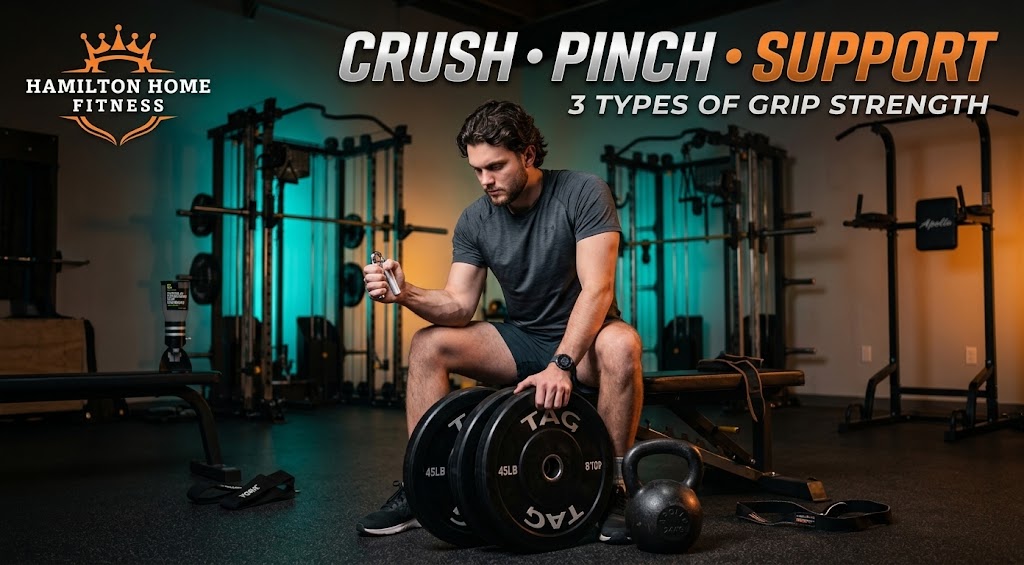
The three types of grip strength are crush, closing your hand on something; pinch, holding between thumb and fingertips without the palm; and support, keeping hold of a load over time. Each loads the hand differently, so strength in one doesn't guarantee the others.
Crush Grip: Closing the Hand
A crush grip is the force you make when you close your fingers toward your palm, as in a firm handshake or squeezing a hand gripper shut. Your forearm's finger flexors do most of the work, and a clinic grip test on a handheld dynamometer measures it.
Pinch Grip: Thumb Against Fingers
A pinch grip holds an object between your thumb and fingertips with no help from your palm, like lifting a weight plate by its rim. Without the palm, friction does the holding, so a plate pinch hold takes the lightest loads, and damp hands lose it first.
Support Grip: Holding On Over Time
Support grip is your ability to keep holding a load that is trying to pull your hand open for as long as the set lasts. How long you keep that still, isometric hold, is your support grip endurance.
Heavy grocery bags rely on it, and so do deadlifts, rows, farmer's walks, and pull-ups and hangs on a power tower.
Which Grip Is Failing on Your Deadlift?
Your grip gives out before your back because a deadlift loads support grip, and your back can hold more than your fingers can. The bar drifts toward your fingertips and peels out. The fingers decide most of the hold: in one study the thumb supplied about 17 percent of total grip force.
How the bar slips tells you what to train. It's a field check based on how grip fails, not a clinical test.
Bar rolls to your fingertips mid-set: support strength
Fine on rep one, gone by the last: support endurance
Bar slides on damp or oily skin: friction, not strength
Back rounds before your hands open: bracing, not grip
A friction slip won't improve with grip training, and a passive knurl makes it worse. Chalk or chalkless fixes it; see how chalk, liquid chalk, and chalkless differ.
If your back rounds first, that's a bracing limit, not a grip limit. The fix is how your trunk holds position, and bracing your back with a lifting belt shows where a belt helps.
Why Your Gripper Didn't Fix Your Deadlift
Hand grippers do work, but for crush grip. Six-week studies in untrained adults found roughly a quarter more closing strength. A deadlift asks for something else: keeping a closed hand from being pried open for the whole set, so the gripper gains only partly transfer.
A crush grip trainer has you close against a spring. The bar has you stay closed against a pull, and its thickness matters too: here's how bar diameter changes your grip. A gripper you can squeeze through a TV show is too light to build strength.
Your gripper still has a job: low-fatigue finger-flexor work that builds forearm muscle over months, on non-pulling days. Learn how to set and squeeze a gripper first.
What Gripper Pound Ratings Mean
A gripper's pound rating is the maker's difficulty label, not the force your hand produces, and each maker rates differently. So progress within one product line. Apollo grippers rated 100 to 350 lb ($10.08 each, October 2026) climb in 50 lb steps, a clear next rung for crush work. They won't fix a slipping deadlift or compare across brands and carry a six-month warranty.
Which Tool Trains Each Type of Grip?
Train the exact grip that fails; that's the fastest way to improve grip strength. Holding gains show within weeks as your nerves adapt; forearm training adds muscle more slowly.
Grip | Main tool | Progress by |
Support | Holds, hangs, carries | Adding weight or time |
Crush | Rated gripper | Moving up one rating |
Pinch | Plate by the rim | Adding weight or width |
Support: Holds, Hangs, and Carries
Support grip responds best to holding heavy things for time: a loaded bar held at the top, a dead hang, and carries.
Dead hangs from a pull-up bar, training it without loading your spine.
Carries build farmer's walk grip and bracing at once. Kettlebells for farmer's and suitcase carries suit lifters without dedicated handles, but a light bell won't challenge a grip that holds a heavy deadlift.
Crush and Pinch: Grippers and Plates
Hold a plate by its edge for time to train pinch, and train crush with a gripper hard enough that 8 to 12 closes is all you get.
Pinch grip training rewards dry hands. If you own plates, pinch a bumper plate by its rim; thick rubber forces a wide grip. A heavy plate slips fast, so start light and hold it over the floor, never your feet.
How to Program Grip Around Heavy Pulls
The right grip training frequency is two to three direct sessions a week, always after heavy pulling. Save hard crush and pinch sets for non-deadlift days.
Grip volume strains the elbow tendons behind the golfer's and causes tennis elbow. If pain builds, cut grip work, see a clinician, and keep training around a sore elbow, never through it.
A Sample Week for Deadlift Grip
To build grip strength for deadlifts, keep warm-ups double overhand and hold your top set's last rep a few seconds.
Heavy pull day: strapless warm-ups, hold the final rep
Upper day: dead hangs after the pulling work
Accessory day: rack-pull holds, then gripper or pinch sets
Own a rack? Rack-pull holds in a power rack load near-deadlift weights from knee height but still tax your spine, so skip them before a max attempt.
When Straps and Chalk Earn a Place
Lifting straps don't stall grip strength if warm-ups and grip work stay strapless. Use them on top and back-off sets, so your back trains when your hands quit.
York Lifting Straps ($5.00, October 2026) suit lifters whose grip ends sets early, but won't help pressing lifts.
For sweaty hands, Chalkless Grip Enhancer (from $84.99, October 2026) lifts skin oil and suits chalk-free gyms. It's low-transfer, not residue-free, and can't fix fingers pried open by load.
What Grip Strength Is Good for Your Age?
Good grip strength depends on age and sex. Grip strength standards measure crush grip on a hand dynamometer; they peak at ages 30 to 39, then decline, with US reference values for adults 18 to 85. For deadlift grip, compare your own hang and hold times.
What Grip Says About Your Health
Weaker grip is linked to earlier death: in an international study of nearly 140,000 adults, each 11 lb (5 kg) drop meant about 16 percent higher risk over about four years.
It's a marker, not a cause; bench and leg press strength predict the same way, so lift broadly.
Arthritis or a hand condition? See a physical or occupational therapist. Our rehab and mobility equipment covers balance work, not hand therapy.
Hang and Hold Tests You Can Run
A dead hang test times how long you hang from a bar with straight arms. No research norms exist, so retest yourself every four weeks.
Dead hang: seconds until your grip opens
Top-set hold: seconds holding your work weight
Carry: distance with a fixed pair of weights
No bar? A $22.99 doorway chin-up bar (October 2026) fits solid frames 24.5 to 36.5 inches wide and holds up to 220 lb; heavier lifters need a rack.
FAQ
Is there a fourth type of grip strength?
Some guides do extension, the strength to open your hand against resistance. It balances your grip rather than holding anything. The muscles behind it steady your wrist so your fingers can squeeze, and wrist-extension training has raised grip force in research.
Does the hook grip make your grip stronger?
Not much. The hook grip traps your thumb under your fingers, so it holds more through technique than training. Use it on heavy sets if you like, but keep warm-ups double overhand so your fingers still do the work.
Are wrist rollers good for grip strength?
Not on their own. They build forearm size and wrist strength but add little to holding a bar; programs that added wrist exercises to lifting found no extra crush-grip gain. Wrist curls with light dumbbells do the same job.
Final Thought
Your hands told you what to train the moment the bar left them. Name that failure, train the grip behind it, keep the gripper for crush work on off days, and strap your top sets while support grip catches up. Still unsure which failure is yours? Describe how the bar slips and ask our team which tool fits before you buy anything else.