Introduction
How does a lifting belt work? One source calls it essential; the next says it makes your core lazy. Both miss the point. A belt doesn't hold your back together—it gives your abs a firm surface to push into.
Plenty of readers will finish this page and decide their weights aren't heavy enough yet. That's the right answer, not a failure—a belt is among the cheapest lifting accessories, which is why it gets bought too early.
One boundary: this explains a training tool, not your back. If you lift through pain or manage blood pressure, a hernia, or an eye condition, get cleared individually.
What a Lifting Belt Actually Does
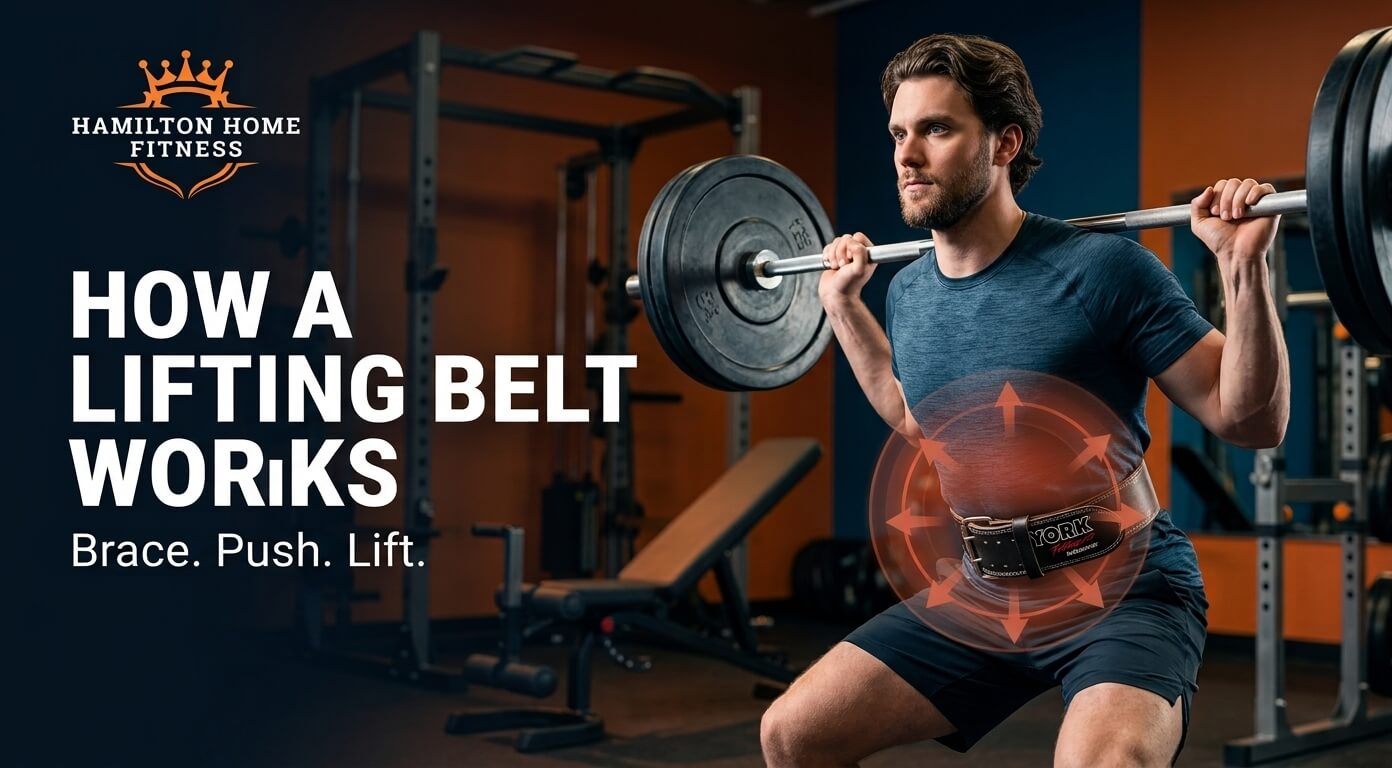
A lifting belt works by giving your abdominal muscles a rigid surface to push outward against. That raises the pressure inside your midsection, which stiffens your trunk so the spine moves less under load. The belt itself supports nothing. Your own muscles do all of it.
Picture a sealed soda can: pressurized, it holds weight; opened, it crumples. Your midsection works the same way—a point Hamilton Home Fitness makes despite selling the belts.
What Intra-Abdominal Pressure Is
Intra-abdominal pressure is the pressure inside your midsection, created when you breathe into your belly and tighten the muscles around it. Your diaphragm caps it above, your pelvic floor below, and your transverse abdominis and obliques wrap the sides—a 360-degree brace.
You build it every time you brace. On heavy compound lifts that load the spine, it holds your trunk stiff enough to transmit force.
Why the Belt Adds to Your Brace
A belt adds stiffness on top of what your own brace produces, because a muscle pushing against a firm surface generates more pressure than one pushing against nothing. The two contributions stack rather than swap.
Measured peak pressure during a braced breath-hold has run around 20% higher with a belt than without, though that difference did not reach statistical significance. Stack a weak brace and you collect little.
Does a Belt Make Your Core Lazy?
No, a belt does not weaken your core. Measured activity in the front of the trunk goes up when you wear one, not down. What changes is how the work is shared between your abs and your lower back, not how much of it gets done.
The fear behind that question is that the belt does the job instead of your muscles. Measurements point the other way. Belted squatting shows greater activation of the rectus abdominis and external obliques, strongest on the hardest reps, while excitation in the spinal erectors drops under some conditions. If you want your trunk doing more, squat variations that load the trunk differently change the demand more than dropping the belt does.
Dependency is still worth avoiding, but it comes from wearing a belt for everything, not from owning one. Keep warm-ups and lighter sets beltless, and the skill stays. And if most of your training is faster, mixed-modal training, a rigid belt spends more time in your bag than on your waist.
Which Lifts a Belt Actually Helps
A belt helps when your spine carries the load and your trunk is the path the force travels through. That points at heavy squats, deadlifts, and overhead pressing. Everywhere else it does close to nothing, because there is no meaningful spinal load for the pressure to protect against.
Apply that principle and you can rule on any lift, including ones nobody writes about. It also explains why the standing lifts need a squat rack—you can load heavy.
Lifts Where a Belt Earns Its Keep
A belt earns its place on heavy squats, deadlifts, and overhead presses because all three load the spine vertically while your trunk transmits the force. Miss the brace on any of them, and the bar tells you immediately.
Deadlifts are the clearest case. You cannot expand into the belt as fully from a hinged start, so the tension comes from squeezing hard against it rather than filling it with air.
The bench press splits the field, and the mechanism settles it: your spine is not loaded, so the belt is only stiffening your torso so leg drive reaches the bar. Useful, but for a different reason. Chasing a number there? Building a stronger press beats buying gear.
Lifts Where It Changes Nothing
A belt does nothing useful on machine work, isolation exercises, light accessory sets, or direct core training, because none of them load the spine enough for pressure to matter. Wearing one all session is the most common mistake here.
Skip the belt on:
- Machine work—the frame stabilizes you already
- Curls, extensions, raises—no spinal load
- Light or high-rep accessory sets
- Planks, carries, direct AB work—that's the point
- Every warm-up set, on every lift
One correction worth making: if the bar slips before your back complains, bracing was never the limiter. That is grip, and lifting straps for grip-limited pulls fix it for five dollars.
When the Belt Should Come On
There is no verified load threshold, and the published advice contradicts itself—buy one in your first months, or wait two years, or start at 70% of your one-rep max, or 1.5 times bodyweight. The workable test is effort: the belt starts paying when you are already holding your breath to finish the rep.
Those numbers share one thing: no evidence behind them. Each is a coaching convention stated as a rule. Your own working sets on barbells and free weights matter less than what your breathing does under them.
Here is a better signal. Once intended effort passes roughly 80% of maximum, a brief breath-hold stops being optional and starts happening on its own. That concerns hard effort generally rather than belts, so treat it as reasoning across, not a belt study. It still marks where the pressure already is.
In practice that puts most intermediate lifters at top sets only. Warm-ups stay beltless, and so does anything you could handle for ten reps. One separate point: which bar you pull with changes the deadlift more than a belt does.
How to Brace Against the Belt
Wearing a belt and bracing against one are different skills. The belt only does its job when you breathe into your belly and push outward into it. Cinch it tight like a corset, and you have removed the space you needed to fill.
That is the part most lifters get wrong on their first session with one. Position first, then the breath—and lifting belts vary enough that both are worth checking.
Where the Belt Should Sit
The belt sits roughly centered on your navel, clear of your bottom ribs and clear of your hip bones, so it can stay put while you push out against it. Too high and it catches your ribs at the bottom of a squat. Too low and it fouls the hip crease on a deadlift.
Both belts here taper to 2½ inches at the front, so back width changes what sits behind you, not the surface you brace into. The 4-inch York padded belt clears the ribs on most torsos; the 6-inch suits a longer torso and will dig on a short one. Neither is a competition belt—a platform needs uniform width.
The Breath That Makes It Work
Breathe down into your belly until you feel it press outward against the belt on all sides, tighten as though bracing for a punch, then start the rep.
- Set the belt, then stand tall
- Breathe into the belly, not the chest
- Push out into the belt, 360 degrees
- Hold, lift, and exhale at the top
Hold on only through the hard part. If you feel dizzy, stop the set. Anyone managing blood pressure, a hernia, or an eye condition should clear breath-holding individually before loading it—York Barbell sells the belt, not the medical advice.
FAQ
Should beginners use a lifting belt?
No, not while form and bracing are still being built. A belt amplifies a brace rather than creating one, so there is little there to amplify yet.
Can a lifting belt raise your blood pressure?
The belt does not, but the breath-hold it encourages does, sharply and briefly. Get individual clearance first if you have a cardiovascular condition, uncontrolled high blood pressure, glaucoma or another eye condition, an existing hernia, or you are pregnant.
Should you wear a belt for the bench press?
Optional, and for a different reason than the other lifts. Your spine is not loaded—the belt stiffens your torso so leg drive reaches a bench that holds position under load.
Will a belt help an existing lower back problem?
No. A belt is a performance tool for heavy training, not a treatment, and ongoing back pain needs individual assessment.
Is a 4-inch or 6-inch belt back better?
Torso length decides it, not strength. Both taper to the same width at the front, so the choice only changes what sits behind you—the 6-inch back version suits longer torsos.
Which size do you pick when the ranges overlap?
Size down. The belt is measured where it sits, not at your pant size, and you want holes left to tighten into—ask us which one fits your training if you are between.
Final Thought
You now know the belt is a surface, not a splint. Your own brace does the work either way, and the honest test is effort rather than a number someone published.
If your answer today is not yet, that is a result, not a failure. And if you are building the room rather than buying one accessory, plan the whole setup first.