Introduction
The sign went up last week, laminated, taped to the rack, and you have a heavy pull scheduled. So why do gyms ban chalk? Two reasons, and they get blurred together: the dust goes where cleaning cannot follow, and the complaints that trigger the ban describe the wrong problem.
The person who taped it up is reading this too, with a cleaning bill that keeps climbing and a suspicion the rule is costing them the members who do the heavy barbell work.
This page sorts the real reasons, prices what it costs a year, and names which grip options survive each kind of rule.
Why Gyms Actually Ban Chalk
Chalk bans come down to four things: dust too fine for the building to filter, residue on shared bars and pads, the cleaning hours it adds, and complaints from members who never touch a barbell. The last one triggers the rule. The first is the real problem.
Airborne dust — the finest fraction circulates rather than settling
Equipment residue — chalk in knurling holds moisture against the steel
Cleaning labor — sweeping and brushing nobody scheduled
Member complaints — the usual trigger, and the least accurate signal
Ask anyone managing commercial gym floors and the order flips. Complaints name handprints; nothing names the air, because nobody sees it. So the policy gets written from the weakest signal in the building.
Facility type shifts the arithmetic. A powerlifting gym or CrossFit box absorbs it as part of the offer. A hotel or apartment amenity room, where what a commercial floor really costs to run is measured per square foot, rarely can.
What Chalk Dust Does to a Building
Chalk damages a facility two ways, and they need different fixes. Most of the airborne fraction is too small for standard gym air handling and stays in the room. What does land is hygroscopic — it pulls moisture out of the air and holds it against steel and vinyl.
The Air and the Filters
Most chalk dust is too fine for a typical gym's filters to catch, so it circulates rather than settling where staff can sweep.
In climbing gyms, where chalk use far exceeds a weight room's, roughly 90% of it measures five microns or under — against air handlers that typically stop at ten.
That fraction is respirable — fine enough to breathe deep. Ventilation alone won't clear it, so filtration spec belongs in the brief when you plan the room around it.
Bars, Benches and Upholstery
Chalk left in knurling holds humidity against the steel, and that trapped moisture is what rusts a bar — not the chalk itself.
Same on pads and machine handles: residue and sweat, sitting.
The usual fix makes it worse. Staff reach for something stronger, and bleach, ammonia and alcohol sprays crack vinyl and break down foam faster than chalk ever would — which is why upholstery and pad care has its own rules.
What a Chalk Policy Costs a Year
There is no credible published figure for what chalk alone costs a facility per year. Anyone quoting one is guessing. The honest approach is to price the four lines chalk actually touches against your own floor, using numbers you already have.
Filter changes — count how often, then how often you'd rather
Cleaning hours — the brushing and sweeping nobody scheduled
Consumables — brushes, wipes, cloths, pad cleaner
Accelerated wear — bar refinishing and reupholstery, pulled forward
Three of those four already sit in a budget somewhere, usually unlabeled, alongside the accessories nobody budgets for. For a 20 to 40 machine floor, general maintenance runs roughly 3–7% of equipment replacement value a year, with consumables around $1,000–2,500. Those are facility-wide 2026 bands, not chalk-specific — chalk is a slice, and how big depends entirely on your traffic.
Price the replacement the same way. A grip station is capital plus refills: the 75 g bulk pack runs $84.99 and covers many applications, so the recurring line is small and predictable in a way cleaning hours never are.
One caveat before you build the case. Chalkless ships at standard rates rather than free, so add freight — see shipping and returns.
What Actually Works Instead
Grip options fall into three groups that behave very differently under a chalk rule. Only one of them creates the residue bans exist to stop.
Coatings — chalk, chalk balls, liquid chalk; add material to the hand
Oil removers — take the slick film off instead of covering it
Load bypasses — straps and hooks; remove grip from the equation
Rosin belongs nowhere on that list. It's tackier than chalk and leaves more behind, so a gym that banned powder will not welcome it.
Liquid Chalk: Cleaner, Not Clean
Liquid chalk is magnesium carbonate suspended in alcohol, so once the alcohol evaporates you are left holding chalk — just without the cloud.
That solves the air problem and only softens the residue one. Plenty of gyms allow it. Some later restrict it too, once white film shows on machine handles and cable grips.
Worth knowing before you assume a powder ban covers you.
Grip Enhancers That Remove Oil
Some grip products work by lifting the oil film off your palm rather than coating it, which is why they leave far less behind on shared equipment.
Sweat is mostly water. It's the skin oil underneath that makes a bar slip, and a coating sits on top of that oil instead of removing it.
The trade-off is real: low-transfer is not zero-transfer, and application ends with a clap or towel wipe to clear the excess. A facility expecting a spotless floor will still sweep something. For an individual, the six-bottle refill pack is the gym-bag format.
Where Straps and Gloves Fit
Straps don't replace chalk, because they solve a different problem. Chalk raises friction between hand and bar. A strap takes your grip out of the equation entirely — useful on heavy pulls, useless on presses, machine handles, or anything you might need to drop fast.
That gives you a simple rule. Lifting straps on your heaviest pulling sets, bare hands on the warm-ups, and grip work programmed on purpose if grip is a goal — farmer's walks or dead hangs, not hoping deadlifts cover it.
Gloves answer a third thing again: skin. A glove between hand and knurling protects the callus and adds a little security, but it doesn't dry a sweaty palm, and thick padding can widen your effective grip on a thick bar.
Both come from York Barbell here.
Replacing a Ban With a Grip Station
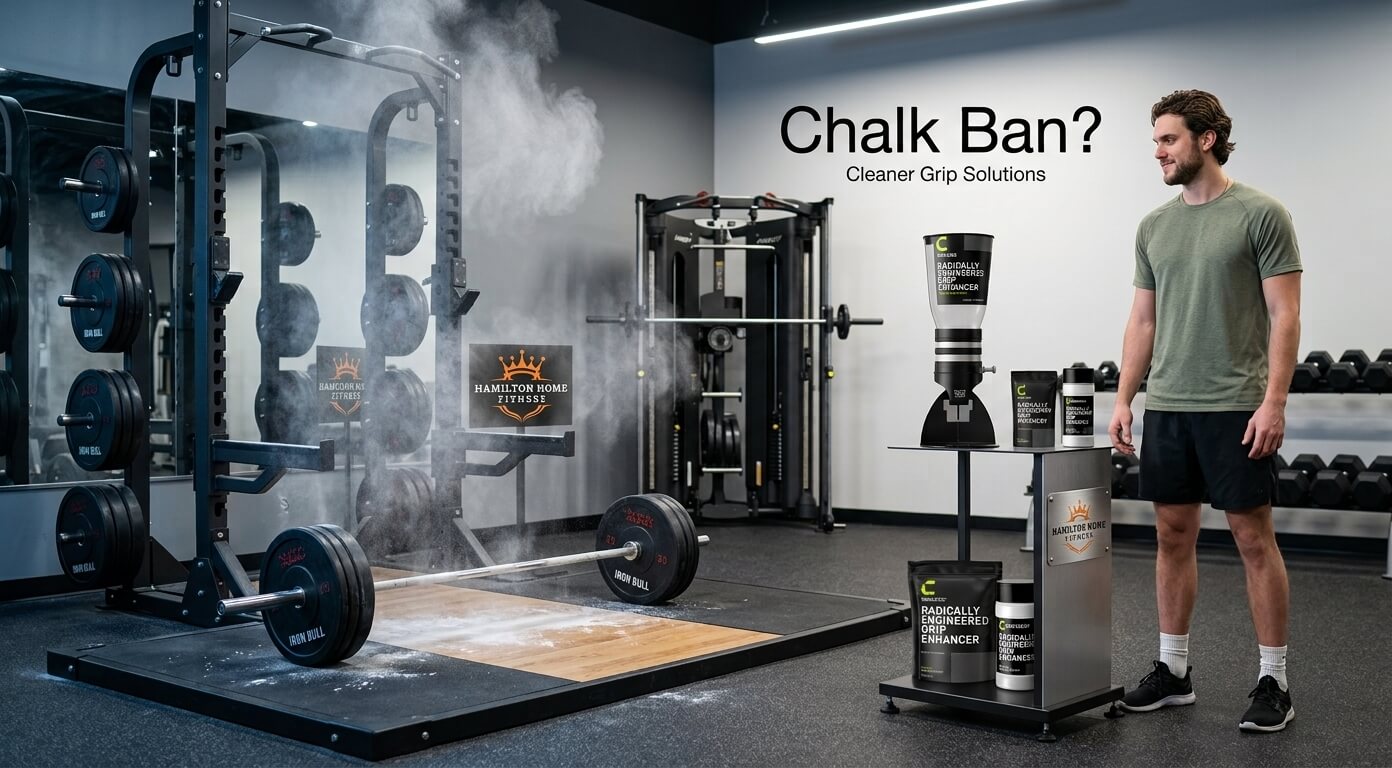
A workable chalk policy names what's allowed, not just what isn't. Put the permitted product in one supervised spot, sign it where people lift, and the rule enforces itself. A ban with no alternative gets ignored, and it costs you your heaviest members.
Pick the permitted product — one, not a category
Site the station — near the platforms, not the front desk
Post the signage — at the rack, in plain language
Brief the floor staff — so the answer is consistent
Set the refill cadence — order before it runs dry
Order matters. Signage before the product is chosen is how you end up with a laminated sheet nobody follows. The Chalkless dispenser at $389.00 handles the first two steps, dosed and wall-adjacent so nothing gets poured on the floor.
For step five, dispenser and refills as one system at $459.99 settles both in one order.
Be honest about fit: this is capital plus a recurring line. A low-traffic amenity room where two people a week pull heavy won't justify it. See the full Chalkless range — Hamilton Home Fitness is an authorized dealer shipping all 50 states from Tennessee.
FAQ
Is liquid chalk allowed in gyms that ban chalk?
Usually yes, but not always. Some facilities extend the ban after white film builds up on handles, so check the specific rule rather than assuming a powder ban is the whole policy.
Does liquid chalk work as well as regular chalk?
For most lifters, yes. It holds comparably and one application lasts longer than a powder dip. The trade-offs are a drier hand from the alcohol and a few seconds of drying time before each set.
Can I use a chalk ball if loose chalk is banned?
Often yes. The sock keeps most of the powder contained, so many gyms that ban loose chalk still allow balls. Ask first — it's a common exception, but not a universal one.
Does chalk dry out your hands?
Yes, and alcohol-based liquid chalk more so. That dryness is what turns a callus into a tear. Wash your hands after training and moisturize, particularly if you're pulling heavy several times a week.
Final Thought
Most chalk bans target the handprints, not the dust that actually costs the building money. Either way, you have better options than living with the rule as written. If your gym has one, compare grip enhancer sizes and find the format that passes.
If you wrote the rule, price the four lines first, then decide whether a station beats a ban. Talk to the team about volume pricing.