Introduction
A power tower looks like a complete home gym in one compact frame—but pull-ups, dips, knee raises, and push-ups do not train everything equally. The real value depends on whether those movements match your goals, strength level, and available space.
For beginners, the biggest questions are often practical: Can you use it before your first strict pull-up? Will it wobble during dips? Is the weight capacity high enough?
This guide explains what the main power tower exercises train, how to progress them safely, what the frame cannot replace, and which setup best fits your room and training plan.
What Exercises Does a Tower Cover?
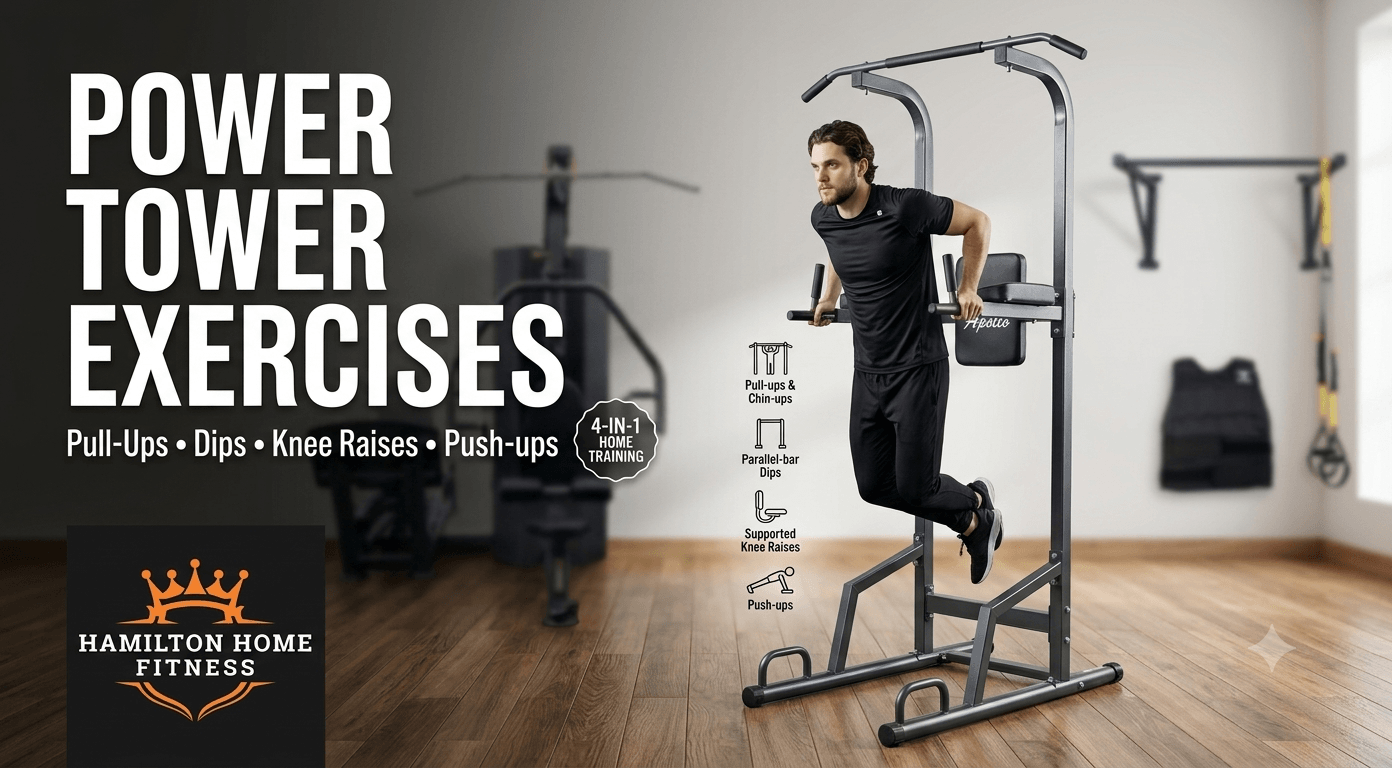
Most power tower exercises fall into four groups: vertical pulling, bodyweight pressing, supported core training, and push-ups. A standard tower combines several stations in one frame, but it is not a complete replacement for every type of strength equipment.
Four Stations and Their Muscles
Station | Main exercises | Primary muscles trained | Main limitation |
Pull-up bar | Pull-ups, chin-ups, neutral-grip pull-ups | Lats, upper back, biceps, forearms | Does not provide horizontal pulling |
Dip handles | Parallel-bar dips, assisted dips | Chest, triceps, front shoulders | Requires shoulder control and enough pressing strength |
Captain’s chair | Knee raises, straight-leg raises, oblique raises | Abs, obliques, hip flexors | Offers less grip training than hanging raises |
Push-up handles | Elevated or deeper push-ups | Chest, triceps, front shoulders | Resistance is limited by body position. |
Power Tower vs. Dip Station
A dip station is only one part of a power tower. It supports parallel-bar dips and sometimes bodyweight rows, while a full chin-dip tower also adds a pull-up station, a vertical knee-raise station, and often push-up handles.
A power tower still does not replace heavy leg training, horizontal rows, overhead pressing, or cardio equipment.
How Pull-Ups Build Strength
Pull-ups strengthen the lats, upper back, biceps, forearms, and grip while teaching the body to control its full weight. Beginners do not need to perform a strict rep on day one—a power tower can support the entire progression from assisted practice to unassisted pull-ups.
Zero-to-One Pull-Up Plan
Start with the easiest variation that lets you control both the upward and downward phases.
Build hang control: Hold the bar with active shoulders instead of relaxing completely into the joints.
Practice scapular pulls: Keep the arms straight and draw the shoulder blades down to begin the pulling motion.
Use assistance: Place a foot on stable support or use resistance bands for assisted pull-ups.
Add slow negatives: Step into the top position and lower for three to five controlled seconds.
Attempt strict reps: Pull without kicking, swinging, or craning the neck over the bar.
Reduce assistance gradually: Move to a lighter band only after your current variation feels controlled and repeatable.
There is no fixed deadline for achieving the first rep. Progress when technique improves, not simply because a certain number of weeks has passed.
Grip Changes and Muscle Bias
Grip choice changes comfort and muscular emphasis, but every variation remains a vertical pulling exercise. Chin-ups usually involve the biceps more, while standard pull-ups place greater emphasis on the lats and upper back. Neutral grips may feel more comfortable for some wrists and elbows.
Wide-grip pull-ups are not automatically better. Choose the grip that allows a controlled range without joint pain or excessive swinging.
How Dips and Push-Ups Train You
Parallel-bar dips train the triceps, chest, and front shoulders while requiring you to stabilize your full body between the handles. Push-up handles provide a more accessible pressing option, making them useful before you have enough strength and control for full dips.
Dip Form and Safe Progression
Begin from a stable top position with the elbows straight, chest lifted, and shoulders held away from the ears. Lower slowly through a range you can control, keeping the elbows from flaring excessively and the shoulders from collapsing forward.
Beginners can use a resistance band, light foot support, or partial repetitions while building strength. Increase depth only when the movement remains smooth and pain-free.
Stop the set if you feel sharp pain, pinching, or instability in the shoulder. Deep dips place the shoulder in greater extension, so more depth is not automatically better. The correct range depends on your mobility, control, and comfort.
Use the dedicated dip handles rather than assuming the padded forearm supports are designed for pressing.
What Push-Up Handles Add
Low push-up handles offer a scalable alternative to dips. Beginners can reduce difficulty by raising the body angle, while stronger users can lower the chest between the handles for a greater range of motion.
They may also provide a more neutral wrist position, but they do not guarantee pain-free training. Use a controlled depth that feels comfortable for both the wrists and shoulders.
Knee Raises vs. Hanging Leg Raises
The captain's-chair knee-raises train the abs, obliques, and hip flexors while the forearm pads and back pad support the upper body. Hanging knee raises and leg raises add grip, shoulder control, and anti-swing demands, making them harder progressions rather than automatically better ab exercises.
Supported Knee-Raise Form
Press the forearms firmly into the pads, keep the back controlled against the support, and raise the knees without kicking them forward. At the top, slightly curl the pelvis upward instead of stopping when the thighs reach hip height.
Lower slowly and prevent the legs from swinging behind the body. Fast, momentum-driven repetitions shift more work toward the hip flexors and reduce the core control the exercise is meant to develop.
The captain’s chair is especially useful for beginners who cannot yet maintain a stable hanging position or whose grip fails before their abdominal muscles are fully challenged.
From Bent Knees to an L-Sit
Progress by increasing the lever length and control before adding external weight:
Bent-knee raises
Higher knee raises with a controlled pelvic curl
Alternating or oblique knee raises
Straight-leg raises
Static straight-leg holds or an L-sit
Hanging versions require the hands, shoulders, and upper back to stabilize the body while the legs move. They are a strong next step once supported knee raises can be performed without swinging.
Add ankle weights only after straight-leg repetitions are slow, controlled, and repeatable. More resistance will not improve the exercise if momentum replaces abdominal control.
Can a Tower Build Muscle Alone?
A power tower can build upper-body and core muscle when the exercises become progressively harder over time. You can progress by adding clean repetitions, slowing the lowering phase, pausing at difficult positions, using harder variations, or adding external load.
The frame is most effective for vertical pulling, bodyweight pressing, grip strength, and core training. It is not a complete replacement for loaded leg work, horizontal pulling, overhead pressing, or cardio.
Progressive Overload Options
Add difficulty only after you can repeat the current variation with consistent form and control.
Useful progression methods include:
Adding one or two clean repetitions
Slowing each lowering phase
Pausing at the top or bottom position
Reducing band assistance
Moving to a harder exercise variation
Adding a dip belt for weighted pull-ups or dips
External load should support good technique, not replace it. If added weight causes swinging, shortened range, or unstable landings, return to the previous progression.
What It Does Not Replace
A power tower does not provide enough resistance variety for every movement pattern. Most models offer little direct support for heavy squats, hip hinges, horizontal rows, overhead presses, or structured cardio.
You can fill some gaps with resistance bands, gymnastic rings, dumbbells, or a bench. The tower can still anchor a practical bodyweight strength program, but it works best when its limitations match your goals rather than being ignored.
Why Towers Wobble or Tip
A freestanding power tower may rock because of uneven assembly, loose hardware, poor floor contact, a narrow base, or uncontrolled movement. Slight frame flex can occur, but the feet should not lift, slide, or shift across the floor during a controlled repetition.
Wobble Troubleshooting Order
Start with the frame rather than adding extra weight to the base.
Confirm that the tower is assembled on a level surface.
Loosen and retighten the bolts evenly so the frame sits square.
Check that every rubber foot contacts the floor.
Place a firm rubber mat underneath if the surface is slippery.
Perform dips and pull-ups without swinging or forceful direction changes.
Fast repetitions can make even a properly assembled tower feel unstable. Slow the movement and allow the frame to settle between reps.
When Tipping Risk Is Too High
Stop using the tower if the front or rear feet lift, the base travels across the floor, or the frame cannot settle after each repetition.
Also check your total working load, including body weight, a weighted vest, dip belt, or ankle weights. If controlled technique and correct assembly do not solve the movement, the tower may be too light, narrow, or unsuitable for your flooring and training style.
How to Choose the Right Setup
Choose a power tower by checking total working load, base dimensions, ceiling clearance, exercise coverage, and installation limits. Do not rely on the advertised weight capacity alone.
Capacity, Base, and Clearance
Your required capacity includes your body weight plus any weighted vest, dip belt, or ankle weights. Choose a model with additional margin rather than one rated exactly at your expected load.
Before buying, measure:
The full base width and depth
The tower’s assembled height
Clearance above the pull-up bar
Space for a full dead hang
Distance from walls, fans, lights, and furniture
Floor grip and mat thickness
A wider, properly supported base can improve stability, but dimensions alone do not guarantee safe performance. Assembly quality, floor contact, frame weight, and movement control also matter.
After completing these checks, compare suitable home gym equipment options.
Freestanding or Wall-Mounted
A freestanding tower provides pull-up, dip, knee-raise, and push-up stations without permanent installation. It uses more floor space but may suit renters or users who want to reposition their equipment.
A wall-mounted rack preserves floor space and usually focuses on pull-ups. It requires a suitable wall, correct hardware, and secure installation. Compare available pull-up bar options, including the Apollo Wall-Mounted Pull-Up Rack, when floor space is the main constraint.
Three Product Fit Paths
The Apollo Power Tower may suit budget-conscious home users who want the four main stations in one freestanding frame.
The BodyKore Elite Series CF2110 Chin Dip Tower is a commercial-grade option for shared facilities, trainers, or heavier-duty use.
Choose the model that fits your room, total load, exercise needs, and expected number of users—not simply the option with the largest advertised capacity.
FAQ
Are Power Towers Worth It?
A power tower is worth considering when you want pull-ups, dips, supported knee raises, and push-ups from one compact frame. It can support a practical upper-body and core program without requiring several separate stations.
Its value is lower if you already own a squat rack with a pull-up bar and dip attachments, or if your main goals require heavy leg training, horizontal pulling, or adjustable machine resistance.
How Much Ceiling Height Is Needed?
Add the tower’s assembled height, the amount your head rises above the pull-up bar, and extra clearance for safe movement. You should also check for ceiling fans, lights, beams, and other overhead obstacles.
Measure full-hang clearance as well. Your feet should not hit the floor, base, or nearby furniture when your arms and legs are fully extended.
Final Thought
A power tower is a practical choice when its pull-up, dip, knee-raise, and push-up stations match your training goals, available space, and current strength level. Its advertised capacity matters, but stable floor contact, correct assembly, overhead clearance, and controlled movement are equally important.
Complete the stability and capacity checklist before choosing between a compact freestanding tower, a commercial-grade chin dip tower, or a wall-mounted pull-up rack.