
A curved treadmill has no speed buttons. You set the pace with your body: where you stand on the deck, how hard you push and, on some models, a resistance setting. That feels odd on the first step, and it raises three fair questions. Where do you stand? How do you stop? What should your first workouts look like?
This guide answers all three with a position map, clear start and stop steps, and three starter workouts that build from walking to short sprints. If you are still choosing a machine, our treadmill range covers motorized and self-powered options.
How the Curve Sets Your Speed
On a curved treadmill, your push and your position on the deck set the belt speed. Step forward and the belt runs faster. Ease back and it slows. Resistance levels, where a model has them, add drag on top. Treat what follows as a starting guide, because every model feels a little different.
Where to Stand to Walk, Jog or Sprint
Stand toward the back of the deck to walk, in the middle to jog and farther forward to sprint. The deck rises toward the front, so the belt spins faster there.
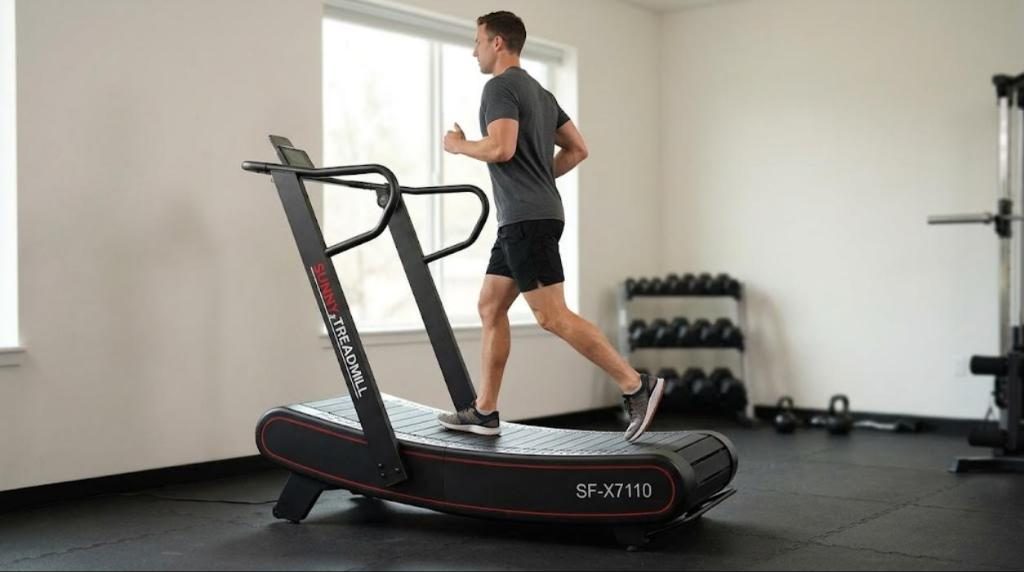
Start in the middle and try small moves. If the belt races away, step back. If it feels stuck under your feet, you may be too far back, so move forward a little and shorten your stride. Belt length, model and your height all change the feel.
Why Pace Won’t Match the Road
Display pace on a curved treadmill cannot be compared with road pace or flat-treadmill pace. Your effort drives the belt, so the same number costs more work here.
Judge each session by time, effort and the talk test. If you can speak in short sentences, you are in the right zone for an easy run. The Sunny Smart Ultra manual curved treadmill has a digital workout monitor. The APE Commercial Motorless Curved Treadmill lists no console, so use a watch. For longer runs, plan by minutes, not miles.
Start, Stop and Stay Safe
Most early stumbles come from three things: a cramped space, a rushed first step and an abrupt stop. Fix those first. Set up the space, hold on while you learn the belt, and always slow down gradually before you step off. Speed work can wait until all three feel routine.
Set Up the Space First
Clear the floor, check the ceiling above the deck and put a mat underneath before your first session. Leave open room behind and beside the machine so you can step off safely.
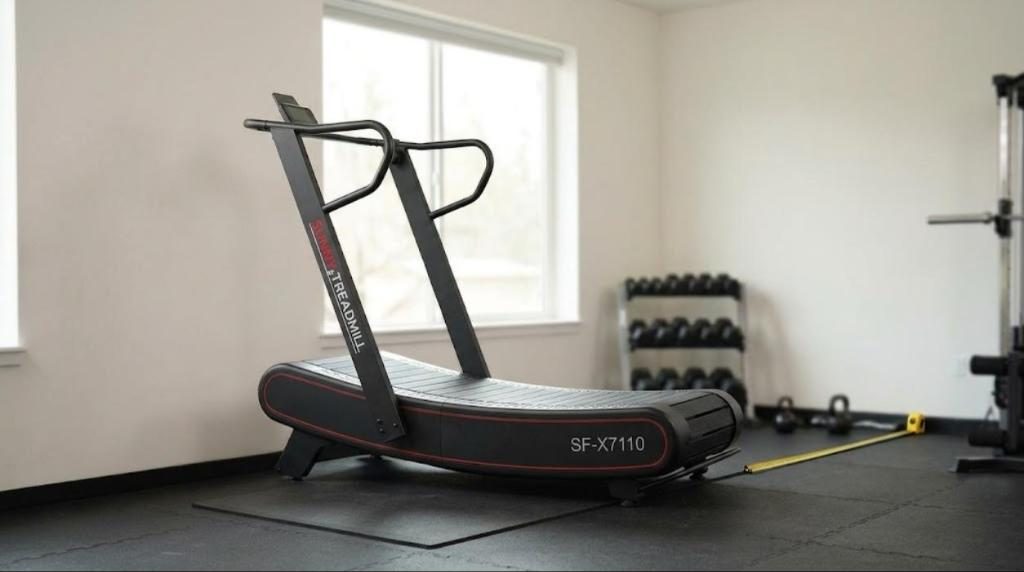
Your head rises higher while you run than while you stand, so measure with our treadmill ceiling height guide. A mat protects the floor, and our rubber flooring range includes treadmill mats.
If the treadmill will sit on carpet, Gym Space Guide explains what flooring works over carpet and when to remove it.
How to Step On and Start
Step onto the middle of the deck, hold the rails if your model has them and start with a walk. The belt follows your steps, so take short, smooth ones and let it come up to speed gradually.
Do not lean on the rails to drag the belt around. Jog only once walking feels steady.
When to Hold the Handrails
Hold the handrails while you learn, then let go as the belt feels steady. A light touch for balance is fine. Pulling on the rails changes your form and slows the belt.
Release them for sprints so your arms can drive your legs. Not every model has rails, so check the product page before you buy.
How to Slow Down and Stop Safely
Shorten your steps, ease back on the deck and let the belt slow before you step off. Never jump off a moving belt.
If your model has rails, hold them while the belt slows. A resistance or brake setting adds drag; it is not a stop button. If you have balance or joint concerns, ask a clinician before you start.
Running Form on the Curve
Run tall, land under your hips and keep your steps quick and short. The belt rewards a smooth, compact stride and punishes reaching out front. Two cues cover most of it: how you step and how you stand. Get both right and the belt works with you instead of against you.
Stride, Cadence and Foot Strike
Take short, quick steps that land under your hips. Reaching out front can slow the belt and jar your legs.
Many runners settle into a midfoot landing within a few sessions. Count quick steps rather than chasing a target number. Once your stride is smooth, the belt keeps a steady rhythm for you.
Posture and Arms
Stand tall with a slight lean from the ankles, eyes ahead and arms relaxed. Swing your arms to drive your legs, and avoid staring down at the belt.
Your First Three Workouts
Three timed sessions over about two weeks take you from walking to your first short sprints. In week one, do workouts 1 and 2 with a rest day between them. In week two, repeat both, then add workout 3. Use the talk test for effort, not the display. These are starting templates, not medical advice.
Workout 1: Walk-Jog Intervals
Walk for 5 minutes, then do six rounds of 1 minute easy jogging and 1 minute walking, and finish with a 5-minute walk. The session takes about 22 minutes.
Keep every jog easy. A gym interval timer keeps the blocks honest without a phone in your hand.
Workout 2: Steady Easy Run
Walk for 5 minutes, run easy for 10 to 15 minutes and walk for 5 more. Stay at a talking effort and take walk breaks whenever you need them.
The goal is a smooth, steady run, not a fast one. Add a minute or two to the run each time you repeat the session.
Workout 3: First Short Sprints
After a 5 to 8 minute warm-up with three short pick-ups, run six rounds of 10 seconds hard, each followed by 60 to 90 seconds of easy walking. Start near 7 out of 10 effort.
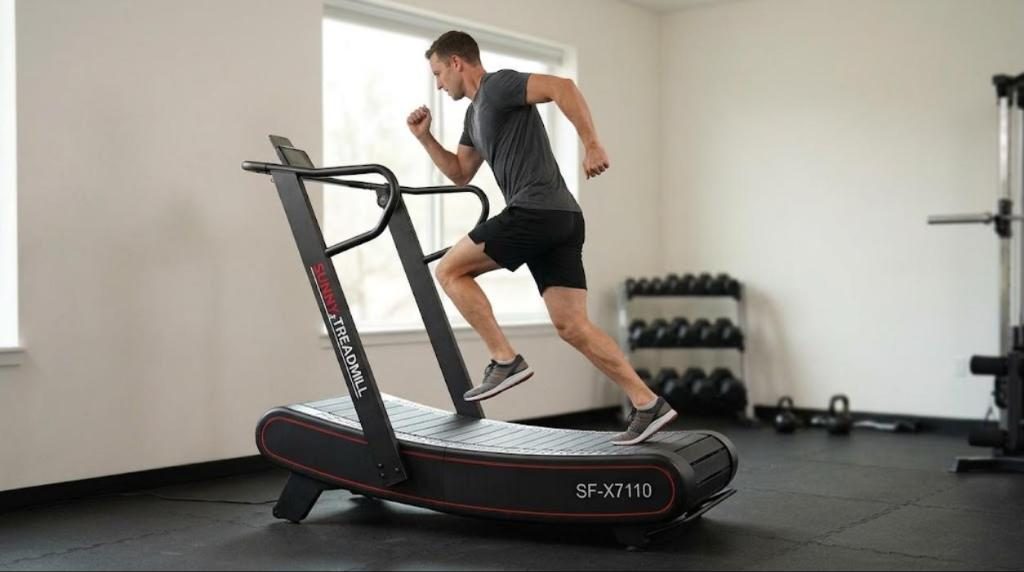
Add rounds before you add speed. If you also train with sleds, our sled push workout guide covers resisted sprint work.
FAQ
Is it harder to run on a curved treadmill?
Yes, for most people. You supply all the belt movement, so the same pace costs more effort than on a motorized belt. Start with shorter sessions and build up gradually. Our curved manual vs motorized guide compares the two in detail.
Can you walk on a curved treadmill?
Yes. Expect walking to feel harder than on a flat belt, because you still move the belt yourself. It suits walk intervals and warm-ups well, but it is less suited to long, easy walks. Start with short walks and add time.
Do curved treadmills burn more calories?
Usually more per minute at the same pace, because you do more work to move the belt. Effort decides the total, not the machine. For weight loss, sessions you can repeat every week matter most. The curved models we carry list no incline setting, so see what a treadmill with incline does if you want hill work.
How fast can you run on a curved treadmill?
As fast as you can drive the belt. Speed comes from your effort, your spot on the deck and any resistance setting, not from a motor. Plan sprints by effort rather than by a number on a screen. Keep efforts short, rest fully and warm up first.
How do resistance settings change a workout?
More resistance adds drag, so each step costs more effort. Some models have levels. The Vortex Curved Treadmill CVX2500 lists six speed and resistance levels. Start with a light setting, learn the belt, then raise it for harder intervals. Models without levels rely on stride effort alone.
Final Thought
Start mid-deck, move forward to speed up and ease back to stop. Follow the three workouts in order, and let the sessions get harder before the speed does. When you are ready to compare machines, browse our curved treadmills. Questions about freight or fit? Call or text 423-458-2453, or contact us. We ship from Tennessee to all 50 states.