
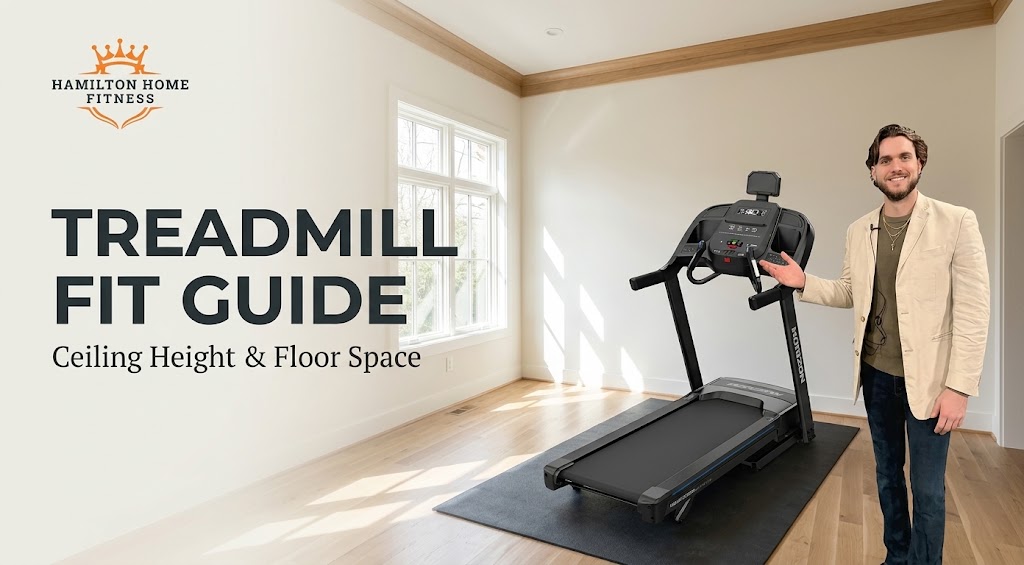
Introduction
Tape measure in hand, treadmill in your cart, you’re wondering how tall the ceiling needs to be for a treadmill when your tallest runner is over 6 feet.
The treadmill ceiling height has to clear three things stacked: that runner in shoes, the deck’s step-on height, and about 12 inches for running bounce and a safety margin. An 8-foot ceiling fits most users; a 7-foot ceiling rarely fits a runner.
Floor space sinks as many rooms as ceilings do: the zone behind the deck counts, and the math shifts for ellipticals, bikes, rowers and other home cardio machines.
The formula, floor table, checklist, and fixes follow.
What Ceiling Height Does a Treadmill Need?
The minimum ceiling height for a treadmill is your tallest user’s height in running shoes, plus the step-on height, plus about 12 inches for running bounce and a safety margin. A 6-foot runner on a deck near 9 inches needs about 7 feet 10 inches clear, so most 8-foot rooms work with little to spare.
How to Work Out Your Number
Add your tallest user’s height in shoes, the step-on height, any mat, and about 12 inches, then compare the total with the lowest point above the belt.
Measure the tallest user in running shoes
Find the step-on height (floor to belt) on the spec sheet
Add any mat or flooring thickness
Add incline lift if you use a grade
Add about 12 inches for bounce and margin
Use the maker’s rule if it’s larger
Those 12 inches cover a runner’s head rising 3 to 4 inches a stride, plus margin. Walking drops the bounce, but a maker’s rule still applies.
Take a Horizon 7.0 AT and a 6-foot-2 runner in 1-inch shoes: 75 inches, plus an 8 5/8-inch step-on height, plus Horizon’s 12 inches, totals 95.6 inches. An 8-foot ceiling clears that by under half an inch; one duct or thick mat ends the fit.
Not sure how thick your mat will be? Gym Space Guide lists garage gym flooring thickness by what you do.
Then compare treadmill specs before you shortlist; if a listing skips the step-on height, ask us for it.
How Much Does Incline Add?
Incline raises the front of the deck most. On the 7.0 AT’s 60-inch belt at its 15% top grade, the front rises about 9 inches, but the feet landing near mid-belt rise only about 4 to 5. Treat those as geometry estimates, and measure at the grade you’ll actually use, where your feet land. Decks that also decline usually start higher. If the math is tight, capping the incline is the cheapest fix.
Do Ellipticals Need More Ceiling Height?
An elliptical usually needs at least as much ceiling height as a treadmill. Its step-on height is the pedal at its lowest point, and you rise higher at the top of every stride. BowFlex asks for your height plus 20.7 inches on its Max Trainer M9, almost exactly the headroom Horizon’s rule gives its 7.0 AT treadmill.
Elliptical step-up heights on our listings run from 8 inches (Endurance E300) to 10.75 inches (Horizon 7.0 AE), the same band as treadmill decks. The top of the stride lifts you higher still, and a power incline, which the 7.0 AE has, raises the pedals further.
The BowFlex Max Trainer M9 shows the gap: an 8.5-inch step-on height, yet that 20.7-inch rule. It suits an 8-foot room, but under a 7-foot ceiling it fits users only up to about 5 feet 3 inches, the same limit as the 7.0 AT.
So compare makers’ ceiling rules, not step-on heights. No rule listed? Ask for the highest pedal height, then add your height in shoes and 4 to 6 inches. That test is how to pick an elliptical for a low ceiling as you compare our elliptical trainers.
How Much Floor Space Does Each Machine Need?
The space you need for a treadmill is its footprint plus the open floor it uses. A folding model around 76 by 35 inches needs 10 to 15 feet of length once the zone behind it counts.
Machine | Example size | Plan in use |
Folding treadmill | Horizon 7.0 AT, 76 x 35 in | 10.3 x 6.9 ft (Horizon); 14.6 x 6.2 ft (full rear zone) |
Center-drive elliptical | Endurance E100, 48 x 30 in | + 20 in on the step-off side |
Upright bike | Spirit 40U, 42.5 x 21.6 in. | + 20 in to mount |
Recumbent bike | Endurance B4RB, 64 x 26 in | + 20 in to mount |
Rower | Concept 2 RowErg | 9 x 4 ft. use area |
The 20 inches is a planning figure; follow any manual that asks for more.
Space Behind and Beside a Treadmill
Leave at least the manual’s figure behind the deck, 3 feet for Horizon, and plan the full 79 inches the voluntary treadmill safety standard sets if anyone runs or kids are around. That fall zone is where a stumble lands, so keep walls, racks, and mirrors out of it and clip on the safety key. Allow 20 to 24 inches per side.
Floor Space for Bikes and Rowers
A rower needs the most floor of the seated machines, about 9 by 4 feet, while bikes need their footprint plus about 20 inches to climb on.
Recumbent exercise bikes run longest. An air bike like the Endurance FB300B needs room around its moving arms, and riding out of the saddle lifts your head, so check headroom if you ride standing.
A rower seats you 14 to 20 inches up, so headroom matters only for upright storage, where each RowErg half stands about 54 inches. See rowing machines, sized for use and folded.
What to Measure Before You Order
Measure to the lowest thing above where the belt or pedals will sit, such as a joist, duct, light, or fan blade, not the open ceiling. Then check the floor, path, and power.
Lowest obstruction above the belt or pedals
Tallest user, standing, in running shoes
Mat thickness: check how thick your gym flooring is
Folded height under any sloped ceiling
Floor zone taped out, rear zone included
Doorways, stair turns, and carton size
Outlet within cord reach, no extension cord
Folding saves floor space, not height: the 7.0 AT stands 68 inches folded, taller than set up, which matters under a sloped ceiling. Its cord runs 80 inches, and manuals commonly warn against extension cords and say whether you need a dedicated circuit.
If your only tall spot has no outlet, consider machines that run without an outlet.
What If Your Room Comes Up Short?
When a ceiling or floor comes up short, fix the cheapest problem first: cap the incline, move the deck clear of the lowest duct, and use a thinner mat. If the maker’s rule still fails, a seated machine beats ducking on every run.
Cap the incline at the grade that passes
Shift the deck clear of beams and ducts
Swap to a thinner mat or flooring
Pick a model with a lower step-on height
Switch to a seated machine instead
Sharing the room with strength gear? Check how much room a weight bench needs before you tape out both zones.
Can a Treadmill Work Under 7 Feet?
For running, rarely: under an 84-inch ceiling, a treadmill with an 8 5/8-inch deck and a 12-inch allowance fits users only up to about 5 feet 3 inches in shoes.
Basement beams and ducts often hang below the ceiling, so measure under them. Walking drops the bounce from your own sum, but the maker’s rule still governs. The M9 elliptical hits the same limit, so it isn’t the escape. Under 7 feet, rowers and recumbent bikes are the dependable choice.
In a 7-foot basement, Gym Space Guide shows how much usable height a 7-foot ceiling leaves after a mat, and its FAQ covers whether a treadmill fits.
FAQ
What are the average treadmill dimensions?
Most full-size folding treadmills run about 70 to 77 inches long and 33 to 36 inches wide on 55- to 60-inch belts. The Horizon T101 is 70.5 by 33.5 inches; slim walking models like the Sunny SF-T722021 shrink to about 56 by 31.
What is the best treadmill for a low ceiling?
The one with the lowest step-on height whose maker’s ceiling rule your room passes at the incline you’ll use. Folding saves floor, not headroom. The same test picks the best elliptical for a low ceiling.
What ceiling height does a home gym need?
For a cardio corner, 8 feet suits most users: on a deck near 9 inches, it just fits a 6-foot-2 runner in shoes. At 7.5 feet, the same treadmill fits runners up to about 5 feet 9 inches in shoes.
Where should you put a treadmill in your house?
Under the highest clear strip of ceiling, on a level floor near an outlet, with open floor behind the deck. That usually means away from the main duct in a basement and under the peak in a bonus room.
Final Thought
Before you order, confirm three numbers: the ceiling your tallest user needs, the floor zone including the space behind, and an outlet within cord reach. And compare the maker’s ceiling rule, not the step-on height. Planning the whole room? Book a gym design and we’ll plan the layout around your ceiling and outlets.