
Introduction
Half the class can't see the phone propped on the bench, so the coach spends the session shouting the switch over the music. Or nobody's shouting, and a ninety-second rest became four minutes somewhere around the second notification.
A gym interval timer earns its place the moment more than one person, or more than one body position, has to read the clock.
That test covers coaches, small-facility owners, and solo lifters whose rest has drifted. If you're building a home gym from scratch, the clock is a late decision, but it is one. And there's a real case where a phone is enough, coming two sections down.
What a Phone Timer Actually Fails At
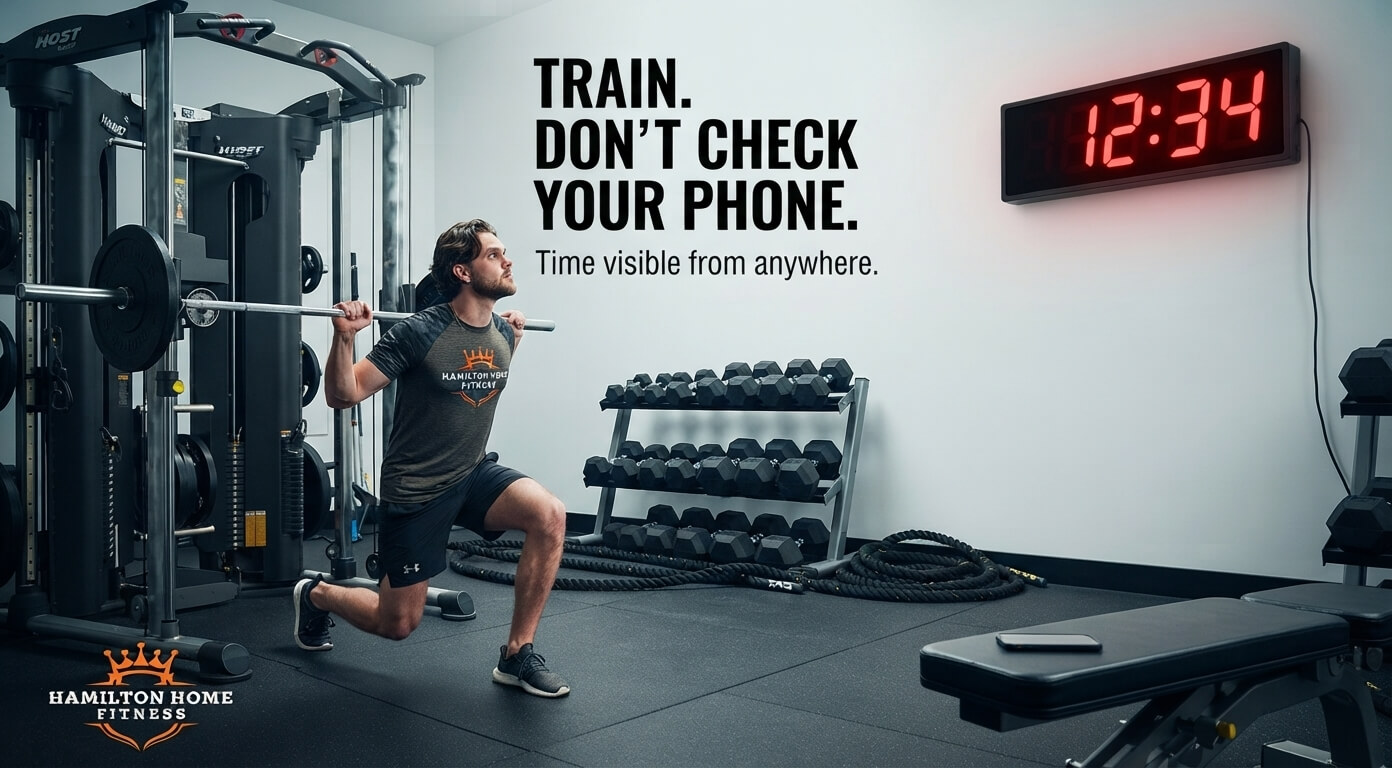
A phone does not fail at keeping time. It keeps time perfectly. It fails at being read by more than one person, from more than one position, without being touched—and those are two separate problems with two separate fixes. Hamilton Home Fitness sells the fix for both, so here is the honest version of each.
Why the Screen Is Never Where You Are
A phone screen is readable from roughly one position and one angle, which is fine until the lift moves you. Hinged over a barbell at the bottom of a Romanian deadlift, you're looking at the floor. Face down on the last burpee, same. On a rower you're facing away from wherever you set it down. Each of those is a normal position in a normal session, and none of them can see a screen lying flat on a bench. Screen size is not the variable here. Position is, and it changes every rep. In a room with stations, the problem multiplies—how a training floor gets zoned decides how many sightlines you're solving for.
The Notification Problem in Rest Time
Checking a phone timer means unlocking a phone, and the unlock is where the rest period goes. The sequence is predictable: the screen has dimmed or locked, you wake it, and the lock screen shows you three things that arrived while you were under the bar. You answer one. The set that was ninety seconds out is now four minutes out, and the drift wasn't a decision—it was the cost of looking at the clock at all. A wall timer breaks the sequence because reading it costs nothing. You glance up, you get a number, and nothing else arrives with it.
When a Phone Is Genuinely Enough
For solo strength work in a fixed position, a phone handles it. Put it in a stand at eye level, silence notifications before the first set, and it does the job a wall unit would do. The case for a dedicated home gym timer starts when a second person, or a second position, enters the room.
Run it as a two-condition test. A phone holds up when:
Nobody else needs to read the clock
One position covers the whole set
Reading distance is a few feet, not a floor
Notifications are off before you start
Fail any one of those and the phone starts costing you something. A garage gym running one lifter through squats passes easily. The same garage on a Saturday with two people alternating sets does not.
A compact timer suits exactly the first case—one user, one position, close reading distance. The Valor Compact Digital Fitness Timer is built for that room. It is the wrong buy the moment anyone reads from the far wall, and its smaller digits are the reason.
Which Timer Modes You Actually Need
Four functions cover everything: countdown, count-up, stopwatch, and programmable interval. EMOM, AMRAP, and Tabata are settings on those four, not separate hardware. A unit like the full-size wall timer with four-inch digits lists the functions rather than the format names, and it runs all of them.
AMRAP, EMOM, and Tabata Decoded
AMRAP is a countdown, for time is a count-up, EMOM is an interval with no rest, and Tabata is an interval with one. Here is the mapping:
AMRAP—as many rounds as possible, so countdown from the cap
For Time—finish the work fast, so count up to your time
EMOM—every minute on the minute, a one-minute interval
Tabata—20 on, 10 off, eight rounds, a work-rest interval
A badged Tabata preset saves you setting 20 and 10 by hand. That is convenience, not capability. Choose cross-training equipment that fits the formats you actually program, then let the timer follow.
The Mode That Apps Often Miss
A timer that only runs intervals cannot run an AMRAP or a For Time, and that gap usually shows up mid-workout. Interval mode alternates fixed blocks. It has no way to count down to a single cap or up to a finish, so the two most common conditioning formats fall outside it. Ask one question of any product page or app listing: does it count in both directions? If the spec lists interval and nothing about countdown or count-up, it will not cover your programming. Saved presets matter for the same reason—they are worth having once the modes underneath them are right. Check the full range of room-level gym accessories once you have settled the spec.
How Timed Rest Changes Your Numbers
Timing rest matters because untimed rest does not hold steady. It drifts in whichever direction your attention goes, and the drift is invisible from inside the set. The effect on strength and size is real, but smaller and less settled than the confident numbers online suggest.
The finding first. Trained lifters resting three minutes between sets gained more strength and more size over eight weeks than lifters resting one minute, with everything else held constant. The explanation is volume: longer rest lets you keep the load and the reps on later sets instead of bleeding both. The uncertainty is worth stating plainly—a later pooled analysis found the size difference real but small, with the confidence intervals overlapping enough that one to two minutes may be sufficient for most people. Strength work with heavy free weights is where the longer end earns its keep.
Here is what your body does not tell you. Breathing settles inside a minute. The energy system your next heavy set depends on takes closer to three to come back. So "I feel ready" arrives well before "I am ready," and without a clock you act on the first one. That is the drift running short—chasing the next set, cutting the rest you needed. A phone in your hand produces the opposite drift, running long. Either way the variable stops being controlled, which is the actual problem. Timing is also what makes bracing consistent, and what a lifting belt actually does under a heavy set depends on turning up to each one in the same state.
What Changes When You Coach Off a Wall
A wall clock does not make a class better timed. It makes the coach available. The coach stops being the clock, and the attention that was going into the phone goes back to the floor. It is the quietest line item in the accessories a commercial floor still needs.
Where the Coach's Attention Goes
A coach holding the timer is watching a screen instead of a squat, and the room notices. Thumb down, eyes down, calling the switch half a second late every round. A remote moves the controls to wherever the coach is standing rather than where the display hangs, and that is where it earns its place. For a solo lifter within arm's reach, it adds little, and it is one more thing to lose. The same logic runs through outfitting a commercial training floor.
Sightlines From Every Station
Check the sightline from the positions people train in, not from standing height in the doorway. Walk the room and look up from each of these:
Bottom of a squat at the furthest rack
Face down, mid-burpee, on the floor
Seated on a rower, facing away
Standing at the station behind the rig
How high to mount a home gym mirror runs on the same measurement, which is why the two decisions usually get made together.
Glass and clock often share a wall. Settle both before anyone drills, because fitness mirrors hang to the same sightline the timer does.
FAQ
What timer do CrossFit gyms use?
A large wall-mounted LED clock is the common setup in affiliate boxes, but plenty of them run a tablet or a propped-up phone near the whiteboard—the exact arrangement this page is about. Competition floors use big commercial displays readable from the stands. For a working box, size matters more than badge. HHF Commercial Fitness handles facility fit-outs.
What does a remote control actually add?
It moves the controls to wherever the coach is standing. That is essential once you work away from the display and close to being pointless within arm's reach of it.
Why do gym timers need bigger digits than road signs?
Because the reading task is different. Sign guidance assumes someone standing still whose only job is reading it. A gym clock gets read mid-effort, at an angle, in one glance, so allow far more digit height per foot of distance than sign rules suggest.
Whose position should you check sightlines from?
The athletes are at the furthest station, in the position the movement puts them in. A clock visible from the door can be invisible from the floor. If you are planning a room rather than a wall, book a gym design session.
Can a free timer app or a TV replace a wall unit?
For one person, yes. For a room with a screen already mounted, increasingly yes—but check two things: that it counts in both directions and that the display will not sleep mid-workout. Talk to our team if you are weighing that against a dedicated unit.
Final Thought
One question decides this: does anyone besides you need to read the clock? If nobody does, a phone in a stand is a reasonable answer, and you can stop here. If someone does—a class, a partner, or just you in four different positions—the question stops being whether and becomes what size. That part is a measurement, not a preference. Measure to your furthest working position, then compare digital fitness timers against the number.