Introduction
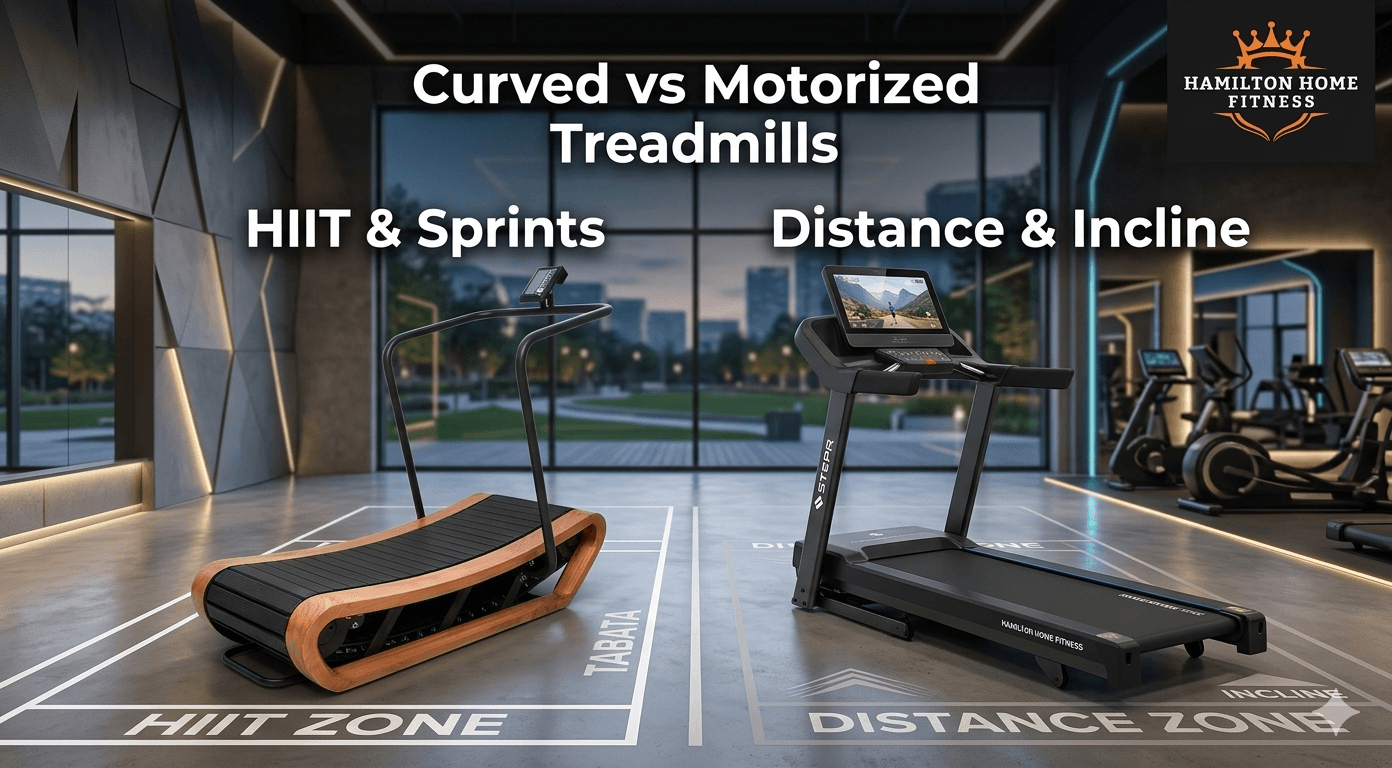
Choosing between a curved manual treadmill and a motorized treadmill comes down to one question: what does your training actually look like week to week? If you're a hybrid athlete or conditioning-focused lifter weighing a self-powered curved runner against a motorized treadmill with an incline, the right pick depends on your sprint and HIIT load, your distance and zone-two needs, your space, and your budget—not on which machine has the louder marketing.
This guide breaks down how each treadmill drives the belt, where each one wins for sprints, distance, and walking, what they do to your joints, and what long-term ownership really costs. Product-fit guidance comes at the end, after the comparison—so you can decide first and shop second.
Which treadmill type fits which athlete
Curved manual treadmills suit sprint work, HIIT, and conditioning-focused lifters who want self-paced intensity with zero motor lag. Motorized treadmills suit distance running, zone-two cardio, structured incline programs, and walkers who need a steady pace. Hybrid athletes who split between both often lean motorized with strong incline because pace control matters more day to day—unless the conditioning room is the priority, in which case a commercial-grade curved runner wins.
Curved manual treadmill | Motorized treadmill | |
Drive system | Self-powered, slatted curved belt | Electric motor, flat rubber belt |
Best use | Sprints, HIIT, Tabata, conditioning | Distance, zone-two, walking, incline work |
Speed control | Instant—your stride sets the pace | Button or program-set, with motor response time |
Typical price range | $1,700–$11,000+ | $900–$10,000+ |
How each treadmill actually works
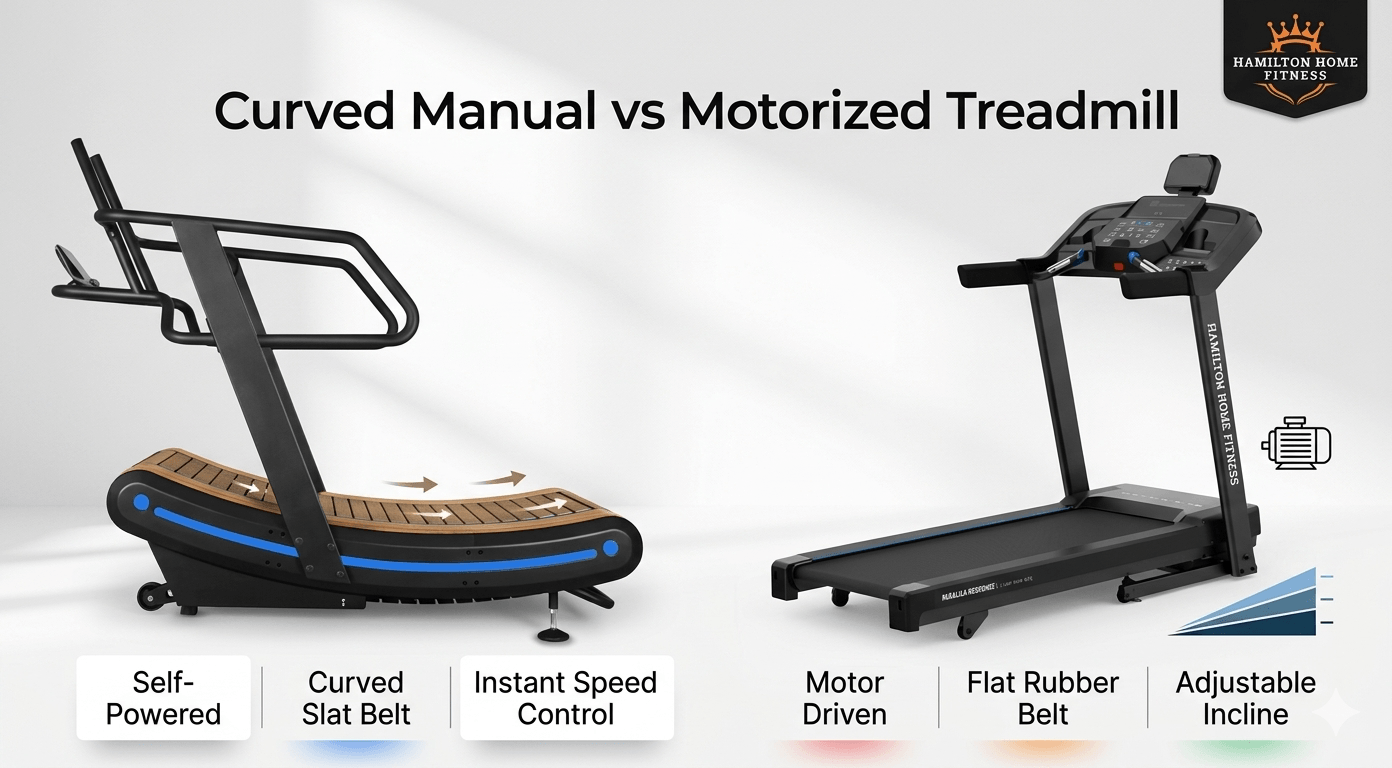
A curved manual treadmill is self-powered — the runner drives a slatted, arched belt with their stride. A motorized treadmill uses an electric motor to move a flat rubber belt at a set speed. The difference in drive system shapes everything that follows: feel, calorie cost, joint load, footprint, and price.
Curved manual treadmill mechanics
A curved manual treadmill has no motor — your stride moves a slatted, arched belt, so the deck speeds up when you run faster and slows when you ease off. There's no plug, no console-set pace, and no lag between intent and movement.
The arched deck shape is what makes self-propulsion work. Running near the front of the curve speeds the belt up; drifting toward the back slows it down. That geometry gives you a sprint-to-walk transition in one step—useful for Tabata rounds, EMOM running, and assault-runner intervals where every second of motor adjustment is a second of training quality lost.
The belt itself is built from interlocking rubber slats over bearings, not a single continuous rubber loop. Slat belts cost more to build and survive heavier impact, which is why curved manual treadmills tend to land in the commercial price tier even for home use.
Motorized treadmill mechanics
A motorized treadmill uses an electric AC or DC motor to set belt speed, so the pace stays steady regardless of your effort. Home models typically run DC motors, which are quieter and lighter. Full commercial models run AC motors, which handle continuous daily use without overheating.
The spec that matters is continuous duty horsepower (CHP) — the power the motor sustains hour after hour. Peak horsepower is a marketing number and should be ignored when comparing models. As working minimums:
2.0+ CHP — walking only
3.0+ CHP — regular running, residential use
3.5–4.0+ CHP — daily heavy use, taller or heavier runners, light commercial
4.0+ CHP AC — full commercial, multi-user gyms
A powered incline is the other defining feature. Motorized decks adjust grade in fixed percent increments (typically 0–15%, some up to 20%), which lets you train hill repeats and marathon-prep grades at exact targets—something a curved deck's fixed geometry can't replicate.
HIIT, sprints, and conditioning compared
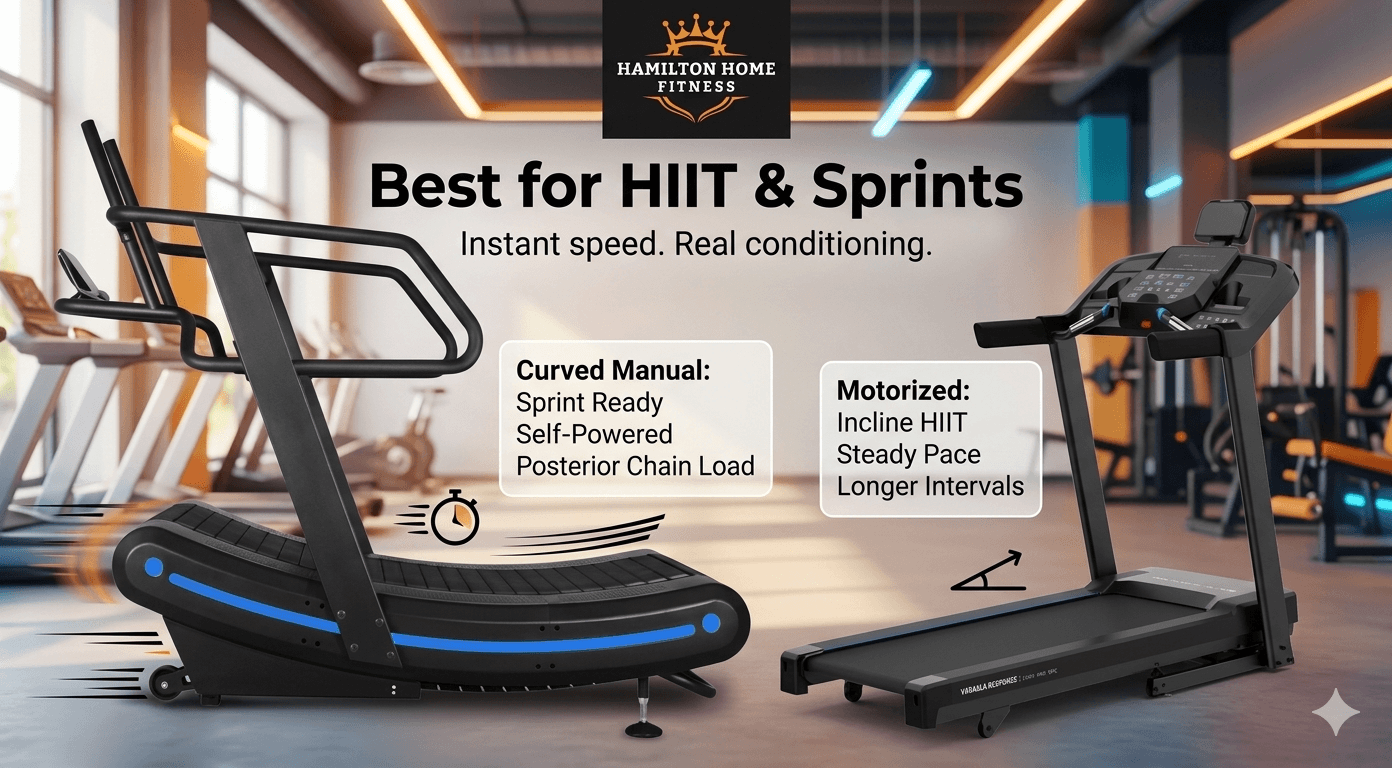
For sprint intervals, Tabata, EMOM running, and CrossFit-style conditioning, the curved manual treadmill is the stronger choice. Speed responds to the athlete instantly; there's no motor to spin up or wind down, and the harder you push, the faster the belt moves—which is exactly what interval training demands.
Why curved decks win for sprints
Curved manual treadmills respond to your stride instantly, so a sprint-to-recovery transition takes one step rather than five seconds of motor adjustment. That difference compounds across a workout. A 20-round Tabata session on a motorized treadmill loses 3–5 seconds of work or rest per round to the motor ramp; on a curved deck, every second of the 20 seconds on / 10 seconds off is real.
The self-propelled mechanic also changes which muscles do the work. Because you're driving the belt rather than chasing it, the glutes, hamstrings, and calves take on more of the load. That's why conditioning coaches, CrossFit affiliates, and combat-sport gyms reach for assault runners and commercial curved treadmills—the machine doesn't just train cardio; it loads the posterior chain.
Commercial-grade self-powered runners are also built for the abuse group conditioning creates. Slat belts, heavy steel frames, and bearing-driven decks survive back-to-back classes in a way a residential motorized treadmill cannot. For a home hybrid athlete running sprint blocks four days a week, a unit like the APE Wood Motorless Treadmill for home use brings that same self-powered mechanic into a residential footprint.
When a motorized treadmill still works for HIIT
A motorized treadmill can still deliver effective HIIT if you use incline sprints or program intervals around the motor's response time. Hill repeats at an 8–12% grade, 30-second push intervals at a fixed fast pace, and longer work-to-rest ratios (1:1 or 2:1 instead of 2:1 Tabata) all play to a motorized deck's strengths.
The decision rule is simple: if your weekly training also includes long runs, zone-two work, or daily walking, a motorized treadmill with strong incline serves the full program better than a curved deck that only excels at one slice of it. If conditioning is the priority and distance is rare, the curved deck wins.
Distance running, zone two, and walking compared
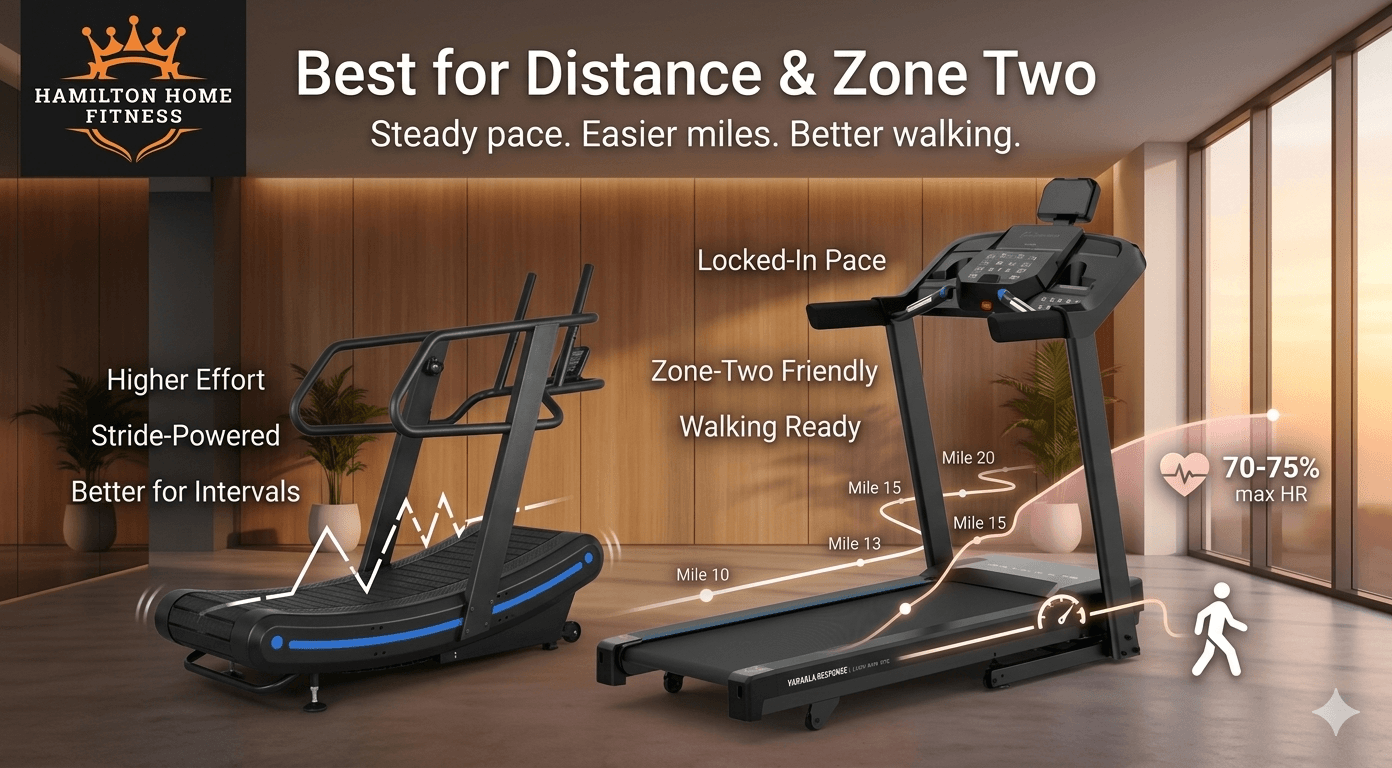
Motorized treadmills are the better tool for distance running, marathon and half-marathon training, zone-two cardio, and walking. The motor holds pace for you, so the only variable to manage is effort. Curved manual decks technically allow distance work, but the higher metabolic cost and learning curve make them inefficient for long, easy miles.
Running long on a curved treadmill
You can run distance on a curved manual treadmill, but you'll work harder than on a motorized belt at the same pace, and most users find the deck better suited to intervals than to long, steady runs. Research generally points to higher heart rate, oxygen uptake, and perceived exertion on curved decks at matched speeds, with cited differences often falling in the 10–30% range—though study designs vary and exact numbers shift by individual.
For zone-two training specifically, that's a problem. Zone two depends on holding a steady, low-to-moderate heart rate for 45–90 minutes. On a curved deck, the effort required to keep the belt moving tends to push heart rate above the zone-two ceiling, which defeats the purpose of the session.
For marathon and half-marathon prep, the issue is pace consistency. Long runs are built on locked-in splits—8:30s, 9:00s, and 10:00s. A motorized treadmill lets you set the pace and run it; a curved deck makes you negotiate the pace stride by stride, which is fine for fartleks but exhausting across 90 minutes.
Walking on a curved manual treadmill
You can walk on a curved manual treadmill, but the arched deck and self-propulsion make it noticeably harder than walking on a motorized belt. Most walkers find the curve unnatural at slow speeds and the start-up effort heavier than expected.
For under-desk walking, recovery walking, daily step counts, and senior or low-impact use, a motorized walking pad or low-speed motorized treadmill is the right tool. Curved decks are built around running mechanics—asking one to serve as a walking pad is asking the wrong machine to do the wrong job.
Joint impact, incline, and cushioning
Curved decks tend to encourage a midfoot strike, which can reduce some of the heel-strike impact common on motorized belts. But the slatted surface and self-propelled effort fatigue connective tissue faster, especially across longer sessions. Motorized treadmills with quality cushioning are generally easier on long-run joints, and powered incline opens hill-training options curved decks can't match.
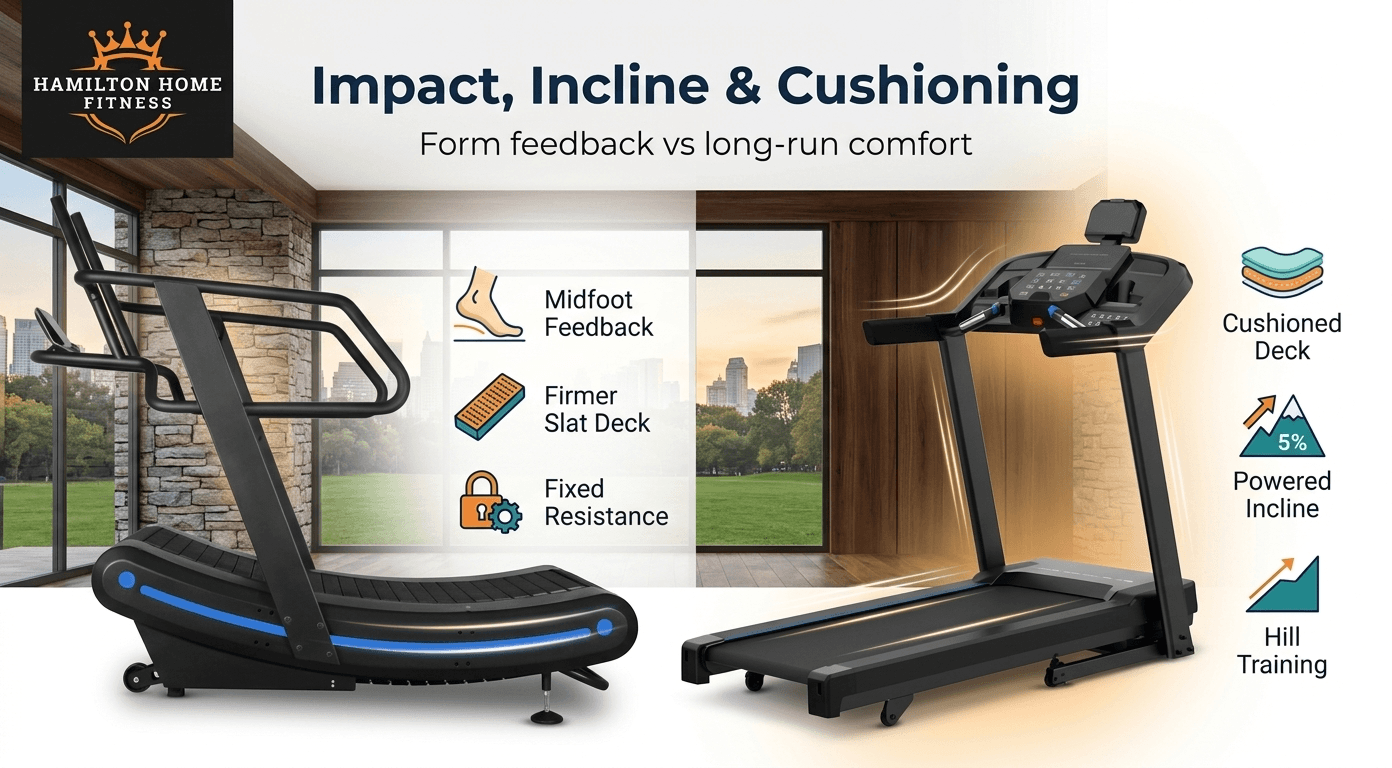
The cushioning gap is real. Premium motorized treadmills use multi-layer deck systems with elastomer or rubber cushions under the running board, which absorb landing forces and reduce load on knees, hips, and the lower back. Curved decks transfer impact through interlocking slats over bearings—durable but firmer underfoot. For runners logging 20+ weekly miles, that difference compounds.
Form correction cuts the other way. The curved geometry punishes overstriding and heel-striking, because landing too far back on the deck stalls the belt. Many runners self-correct toward a midfoot or forefoot strike within a few sessions. That mechanical feedback is something a motorized belt can't deliver — but it's a training benefit, not a joint-protection guarantee.
Powered incline vs curved geometry
A curved deck adds resistance through geometry, but only a motorized incline lets you train at specific percent-grade targets for hill repeats or marathon prep. The arc of a curved treadmill feels like running uphill because you're working against the deck's shape, not because the deck is actually angled.
The decision rule: if your program calls for a measurable grade—6% tempo climbs, 10% hill repeats, and 12% incline walks for zone-two heart rate building—you need a motorized incline. Curved decks deliver one fixed level of geometric resistance and can't dial it up or down. Motorized treadmills with 0–15% (some 0–20%) powered incline give you the full hill-training range, plus a few models offer decline for downhill mechanics and eccentric loading.
Health note: Runners with existing knee, hip, lower-back, or cardiac conditions should consult a physician or licensed physical therapist before adding sprints, high-incline work, or HIIT work to a program. Treadmill choice can change training load, but no machine prevents or treats injury on its own.
Cost, warranty, footprint, and long-term ownership
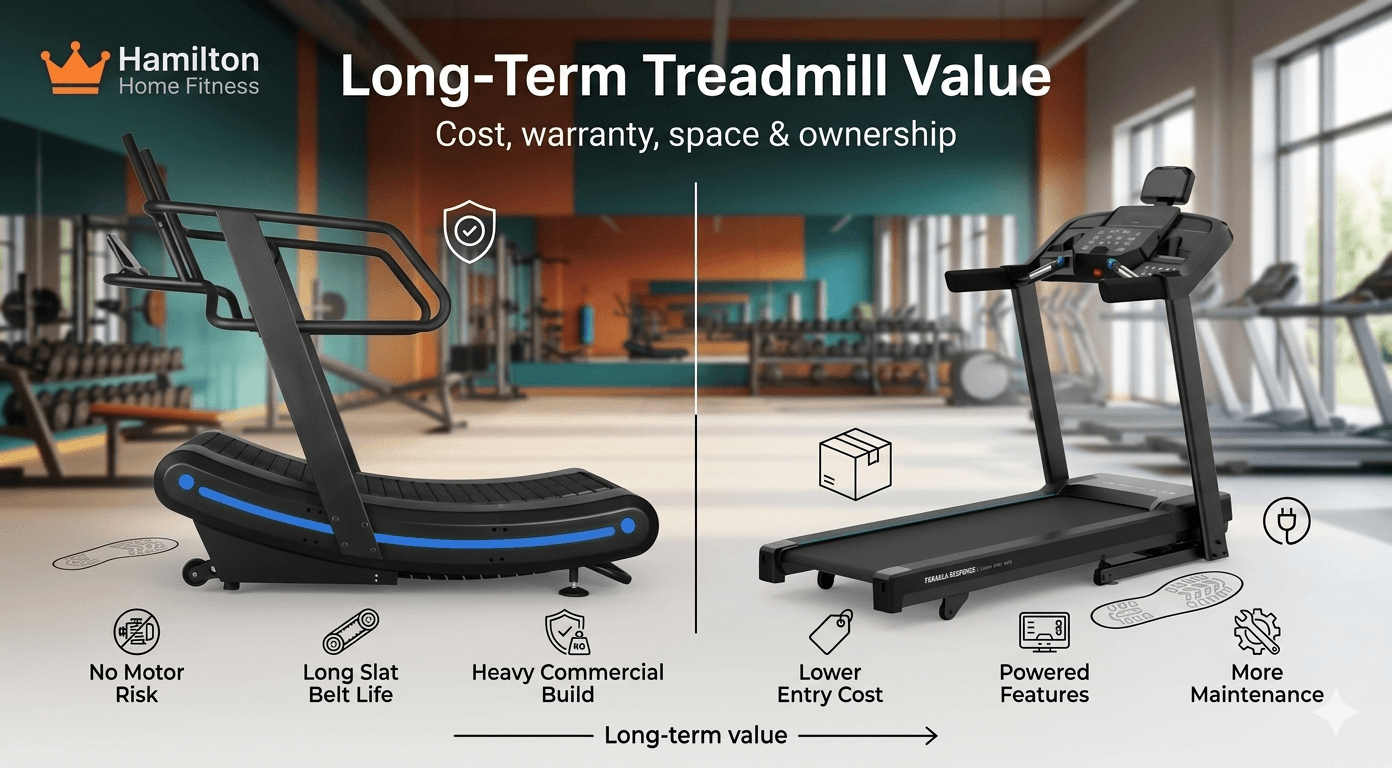
Curved manual treadmills typically cost more upfront than entry-level motorized treadmills but have no motor to replace and no electricity cost. Quality motorized treadmills are cheaper to enter but carry motor, electronics, and belt-replacement risks across a 7–15-year ownership window. The right value calculation depends on use frequency, not sticker price.
Curved manual treadmill | Motorized treadmill | |
Typical price tier | $1,700–$11,000+ | $900–$10,000+ |
Motor replacement risk | None | Real after 7–10 years of heavy use |
Belt replacement | Slat belt, long lifespan | Rubber belt, every 3–7 years with use |
Electricity cost | None | Standard outlet, modest |
Footprint | Tall, heavy, non-folding | Varies; some fold |
Maintenance | Minimal bearings, occasional service | Belt lubrication, motor brushes, electronics |
Warranty and lifespan expectations
Commercial-grade treadmills used daily generally last 7 to 12 years with proper maintenance; residential models used 3–5 hours a week often last 10+ years before a major service event. The headline warranty number alone doesn't tell the story—what matters is which components are covered for how long.
Three warranty layers to compare side by side:
Motor warranty — lifetime on premium residential, 5–10 years on commercial AC motors, 1–3 years on budget units
Parts warranty — typically 1–5 years on residential, 3–5 years on commercial
Labor warranty — usually 1–2 years; this is the one buyers often miss
Curved manual treadmills carry simpler warranty structures because there's no motor or electronics to fail. Frame and bearing warranties on commercial-grade self-powered runners often run 5–10 years, with the slat belt covered separately.
For multi-user environments—small gyms, studios, hotel fitness rooms, and corporations—match the warranty class to the use case. Residential warranties are typically void in commercial settings, which is why the commercial gym equipment range is built and warrantied differently than residential lines.
At the premium commercial tier, STEPR builds connected curved treadmill platforms designed for the daily-class loads small gyms and high-volume home users put on a machine.
Footprint, ceiling clearance, and electrical needs
Curved manual treadmills are tall and heavy, often needing 8 ft+ ceiling clearance and a freight-delivery plan; motorized treadmills need a dedicated outlet on most home installs. The install realities matter as much as the spec sheet — a treadmill that won't fit through the basement door is a return waiting to happen.
Run this checklist before buying:
Ceiling clearance—measure floor to ceiling, then add the deck height and the runner's height with hands overhead. 8 ft is the working minimum for most adults on a curved deck.
Doorway and stairway clearance—measure the narrowest path. Commercial treadmills often ship in 250–400+ lb crates.
Subfloor — confirm the floor can hold 300–500+ lb of static load plus impact. Suspended floors may need reinforcement or a treadmill mat.
Electrical—motorized treadmills need a dedicated 15–20 amp outlet; commercial models may need 20 amps on their own circuit.
Delivery method — confirm freight, curbside drop, or white-glove install before checkout.
For commercial buyers, multi-unit facilities, or anyone planning a full room rather than a single machine, booking a gym design consultation prevents the expensive mistakes that show up after delivery.
Decision framework: pick the right treadmill in 60 seconds
Use the rule that matches your training:
Sprints, HIIT, Tabata, conditioning is your priority → curved manual treadmill
Distance running, marathon prep, zone-two, daily walking → motorized treadmill with strong incline
Mixed program with both → motorized with 3.0+ CHP and 0–15% incline; add a curved deck only if conditioning volume is high
Small gym, studio, or multi-user facility → commercial-grade in both categories; residential warranties are void in commercial use
Home walking pad or under-desk use → low-speed motorized; skip curved entirely
For product fit: home-tier hybrid athletes who want self-powered mechanics in a residential footprint fit an APE-class curved manual treadmill. Conditioning-heavy small gyms and high-volume home users fit a commercial curved runner or a STEPR-connected platform. Distance runners and marathon trainees fit a motorized treadmill with 3.0+ CHP and powered incline. Multi-modality households often run one of each.
Ready to compare both side by side? Browse the full treadmill collection to see current curved and motorized options with specs, warranty, and freight details in one place.
FAQ
What is the real difference in calorie burn between a curved manual treadmill and a motorized treadmill?
Curved manual treadmills generally show higher energy expenditure than motorized treadmills at matched speeds. Studies often cite 10–30% more calories burned, with some walking-pace tests showing higher figures. Exact numbers vary by user weight, intensity, gait, and study design—treat any single percentage as a rough range, not a guarantee.
Can you actually run distance training on a curved manual treadmill?
Yes, but it costs more effort per mile than a motorized treadmill at the same pace. Most distance runners use curved decks for sprints and intervals, not long, easy miles. For marathon prep, half-marathon training, or zone-two sessions, a motorized treadmill is the more efficient tool.
Which treadmill type is easier on knees, hips, and the lower back?
Motorized treadmills with quality cushioning are generally easier on joints during long, steady running. Curved decks may reduce some heel-strike impact through forefoot encouragement, but the firmer slat surface and self-propelled effort fatigue connective tissue faster. Anyone with existing joint or cardiac issues should consult a physician or licensed physical therapist before choosing.
Do curved manual treadmills need electricity or a wall outlet?
No. Curved manual treadmills are self-powered and run with no outlet — your stride drives the belt. Some premium models include an optional plug only for the console display or app connectivity, but the treadmill itself works without it.
What motor horsepower should I look for in a home or commercial motorized treadmill?
Use continuous duty horsepower (CHP), not peak horsepower.
2.0+ CHP — walking only
3.0+ CHP — regular running, residential use
3.5–4.0+ CHP — daily heavy use, taller or heavier runners
4.0+ CHP AC motor — full commercial, multi-user gyms
Peak horsepower is a marketing number and should be ignored when comparing models.
Which treadmill is better for high-intensity interval training and Tabata-style work?
Curved manual treadmills win for short, high-power intervals because there's no motor lag—the belt speeds up the moment you push and slows the moment you ease off. Motorized treadmills can still support HIIT through incline sprints or longer work-to-rest ratios if a motorized deck better fits the rest of your program.
What is the difference between an Assault Runner and a TrueForm runner?
Both are commercial-grade curved manual treadmills, but they target different priorities. Assault Runner uses a deeper curve and is built around CrossFit-style conditioning and sprint work. TrueForm Runner uses a flatter curve and is often favored by coaches focused on running mechanics and gait training. Hamilton Home Fitness carries Assault Runner units; TrueForm is a separate brand line.
Final Thought
The right treadmill is the one that matches your actual training program, joints, space, and budget — not the one with the louder marketing. For most hybrid athletes, the choice isn't really curved vs. motorized; it's a tier decision: a commercial-grade curved runner for the conditioning room, a motorized treadmill with strong incline for daily mileage, and sometimes both in the same gym.
If you'd rather skip the spec-sheet wrestling, contact Hamilton Home Fitness for sizing, freight, and program-fit advice before you buy.