Introduction
Your rack, bar, plates, and bench get used. More barbell work isn’t the answer, yet the Cross Training page shows ropes, boxes, sleds, and towers with no hint of what you’ll still use in six months.
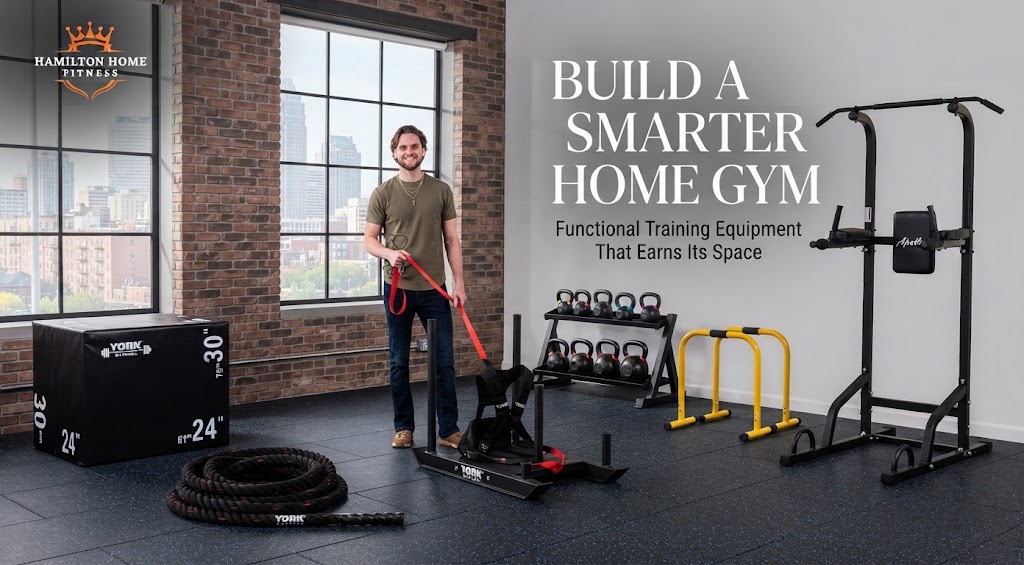
Functional training equipment for home gym owners earns its space when it covers what your rack can’t and fits your room. Usually that’s a plyo box first, a sled if you have a lane, then a battle rope. Bars and ab benches only fill gaps.
That was the first-phase build order. This second-phase purchase gets a rack audit, a four-number space test, a priced buy order, and a barbell-week plan.
Start With What Your Rack Already Covers
Before adding conditioning gear, check four things your rack and bench may already do: pull-ups, dips, decline core work, and anchoring a rope. Anything already covered is the unused gym equipment mistake waiting to happen.
Check your rack’s spec sheet, not memory. Dips are the gap you’re most likely to find, since not every rack takes dip handles, and that’s where freestanding dip stations earn a corner.
Pull-up bar on the rack: skip a doorway bar or tower
No dip handles for your uprights: dips are a real gap
Bench declines: an AB board mostly duplicates it
Rack upright free: it can anchor a battle rope
One exception: full-hang pull-ups need roughly 9 to 10 ft of ceiling. Below that, a lower-mounted bar can still earn its place. Otherwise, load the pull-up bar you already own before buying another.
The Four Numbers That Decide Floor Space
Floor area rarely decides whether a tool gets used. Four numbers do footprint, lane, ceiling, and surface plus noise. Small footprint training tools fail when even one is missing.
Tool | At rest | In use | Ceiling | Surface | Noise |
Plyo box | 18×24 in top | Approach lane | 10–13 ft | Rubber mat | Landings |
Battle rope | Shelf | Half length + 5 ft | Any | Any | Slams |
Sled | Wall | 10–20 yd | Outdoors | Turf, grass | Scraping |
Dip bars | 23×16 in each | Same | Any | Flat | Low |
Kettlebell, slam ball | Shelf | Swing room | Any | Rubber | Slams |
Ceiling and Landing Room for Jumps
Box jumps need a ceiling room for your raised arms on top of the box, plus a landing top of at least 18 by 24 in. A 6 ft lifter on a 24 in box needs about 10 ft.
Set the box on a rubber mat that keeps a box from sliding. Knee, ankle, or Achilles trouble? See a doctor or physical therapist, and start with step-ups.
Lane Length for Ropes and Sleds
A battle rope needs about half its length plus 5 ft of lane, so a 30 ft rope wants about 20 ft from a rack upright.
A sled needs 10 to 20 yards to push, but you can tow a sled with a harness in 5 to 10 yards. Measure your longest straight line first.
Before you buy, Gym Space Guide shows how to tape each piece’s footprint on the floor and live with that layout for a few days.
Garage or Driveway vs. an Apartment
A garage or driveway can host a sled and a full-length rope and box jump. An apartment usually limits you to step-ups, dip bars, and kettlebells, because landings and slams carry through a shared floor.
Outdoors, bring the rope in and wipe steel dry. Indoors, cut impact noise through a shared floor.
The Three Tools That Usually Earn a Spot
Among functional training equipment for home gym owners, three tools usually stay in use: a plyo box, a sled where there’s a lane, and an anchored battle rope. Each sets up fast for a finisher; conditioning gear needing its own setup gets parked.
Plyo Box: Most Uses per Square Foot
A 3-in-1 plyo box is usually the most versatile add-on after the rack itself: one footprint, three heights, for jumps, step-ups, and split squats.
The York 3-in-1 Plyo Box is $128.75 (October 2026); confirm its heights, which the page doesn’t list.
It suits one lifter with jump clearance. Under 10 ft of ceiling or over a neighbor, do step-ups. Wood edges punish missed jumps.
Sled: Worth It Only With a Lane
A weight sled earns its place only with a straight lane, like a driveway, so most apartments are out.
With almost no lowering phase, sled work leaves little next-day soreness and sits beside squat days.
Plate-loaded sleds run $228.80 to $550.00 (October 2026), mostly without plates. Heavy pushes on bare concrete turn loud and jerky; drag there, or compare push, drag, and push-pull sleds.
Battle Rope: Cheap Once It Has an Anchor
A battle rope is one of the cheapest hard conditioning tools, and a rack upright anchors it.
In one lab test, rope intervals hit vigorous intensity, but heart rate ran near 79% of max while oxygen use sat near 51%. Judge work, not your watch.
The low-cost York rope is $50.00 (October 2026), but its page lists no length, so confirm it. Body-Solid’s 30 ft rope is $69.50.
Gap-Fillers: Buy Only What the Rack Lacks
Dip bars, pull-up bars, ab benches, and shelf tools earn space only when they fill a gap your rack audit found. A functional fitness gear list that ignores your rack breeds duplicates.
Rack bar too close to the ceiling? Compare wall-mount and tower pull-up options.
Dip Bars, Pull-Up Bars, and Ab Benches
Dip bars are the gap-filler you’re most likely to need; racks usually bring a pull-up bar, and a declining bench covers ab-board work.
Stackable Apollo dip bars are $99.99 (October 2026), 23 by 16 in each, and suit apartments. No load rating is published, so skip weighted dips.
Ab benches start at $360.00, so buy decline boards and adjustable ab benches only if your bench won’t decline. A $275.00 power tower duplicates a rack.
Shelf Tools: Kettlebells and Slam Balls
A kettlebell or slam ball adds minimal equipment conditioning from a shelf, ideal with no lane or high ceiling.
Kettlebells from 5 lb to 48 kg fit most needs; a 16 kg bell is $63.24 (October 2026).
A 10 lb body-solid slam ball is $46.50, but skip slams over a neighbor or on bare tile.
Smallest of all: a weighted or speed jump rope, ceiling permitting.
What to Buy First on a Real Budget
What to buy after a rack depends on the gaps it leaves: usually a mat and plyo box first, then a rope, dip bars only if needed, and a sled last. Stop at the first step your space rules out. Step two is where you compare plyo boxes in foam, wood, and steel.
Run the rack audit before spending anything
Rubber mat plus a 3-in-1 plyo box
A rope, only with about 20 ft of lane
Dip bars, only if the rack has no dip handles
A sled and harness, only with a straight lane
At October 2026 prices, the three entry picks (box $128.75, rope $50.00, dip bars $99.99) total $278.74.
Under 500: add a 4/4 ft, 3/4 in rubber mat (114.99) and a 16 kg kettlebell ($63.24) for $456.97, or $356.98 without dip bars.
Under 1,000: add the Apollosled (228.80) and Body-Solid harness ($76.50), loaded with plates you own, for $762.27.
Prices exclude shipping; Body-Solid and TAG ship free, York and Apollo don’t. Match battle ropes by length and width to your lane.
Fitting Conditioning Around Barbell Days
Conditioning and barbell training mix well: across the research, adding conditioning hasn’t cut strength or muscle gains. The one cost shows up in explosive work done in the same session, so put jumps before lifting or on separate days.
That evidence comes mostly from cycling and running, not ropes or sleds, so slot each tool by its fatigue. Jumps need fresh legs, sleds cost little recovery, and ropes tax the shoulders you press with.
Squat day: jumps before lifting, sled pushes after
Press day: dips as an accessory, no rope
Deadlift day: rope intervals as a short finisher
Off day: easy sled drags or kettlebell swings
Leave about two days between hard jump sessions, and keep jump counts low at first. Slotted like this, they become tools that get used daily, not parked, and you can run EMOM and AMRAP finishers off a wall timer.
FAQ
What equipment do you need for functional training?
None to start, since bodyweight trains push, pull, squat, and hinge patterns. Equipment adds load, speed, and conditioning; with a rack, a plyo box, a rope, and, given a lane, a sled cover the rest.
Is functional training better than weight training?
Neither is better; they do different jobs. Both build strength, but functional work tends to add more agility and conditioning, while barbell training builds maximal strength more directly. Keep the barbell and add conditioning around it.
Can you do CrossFit-style workouts at home?
Yes: a rack, box, rope, and kettlebell cover many CrossFit-style workouts, so a home gym without machines works. Add a visible timer and a clear landing zone, and scale Hero WODs like Murph at home.
Is a functional trainer the same as functional training equipment?
No. A functional trainer is one cable machine with adjustable pulley columns. Functional training equipment means the wider toolset here: boxes, ropes, and sleds. Shopping for the machine? See cable functional trainers.
Final Thought
Buy what your rack can’t do and your room can actually run in that order, and skip the rest. Tonight, measure your longest straight line and your ceiling; then start with the mat and the box. Fitting several tools into one space? Plan the whole room with a gym design session.