
Introduction
You lifted the mat and found a hairline crack in the slab—or the neighbor downstairs said something. Search for how to protect the floor when dropping weights, and the usual answer is to buy thicker rubber.
It misses this. A drop zone does three jobs—spreading load, absorbing impact, and keeping vibration out of the building—and most setups do one job three times.
By the end you'll know which one. Hamilton Home Fitness ships the mats and pads nationwide—knowing which you need comes first.
One limit: load-bearing questions on wood or upper floors belong to a structural engineer, and lease or HOA terms are yours to check.
Where a Dropped Barbell's Force Goes
A dropped barbell's energy has to go somewhere. A drop zone can spread it across a wider area, absorb it by slowing the stop, or block its path into the building—three separate jobs. Most floors do one of them well and the other two barely at all, which is why thicker rubber keeps disappointing people.
Drop your phone on tile and on carpet. Same fall, different landing. The carpet doesn't make the phone lighter—it just takes longer to stop it.
Job 1: Spreading the Load
A rigid layer doesn't soften an impact—it widens it, so the load arrives across a large area instead of two plate edges.
That is what plywood is for. It doesn't cushion anything. It takes a hit concentrated on a few square inches of rubber rim and hands it to the slab spread over several square feet.
You've seen the same principle already if you've ever worried about a rack's feet on a slab. Four steel posts holding 500 pounds put more pressure per square inch on your floor than the same weight lying flat.
Job 2: Absorbing the Impact
Thin rubber fails not because it isn't hard enough, but because it isn't deep enough—it stops the bar in a fraction of an inch, and a shorter stop means a higher peak force.
Absorption is about time, not softness. A layer measured in millimeters runs out of travel almost instantly. Twelve-millimeter tiles are a fine training surface and have roughly half an inch of stopping distance.
A crash pad is five or six inches. That gap is the whole difference, and it's why buying a denser sheet of the same thickness changes nothing.
Job 3: Breaking the Vibration Path
Anything the surface doesn't absorb enters the building itself, and it travels as vibration rather than sound—which is why a neighbor can feel a deadlift they never hear.
Rubber and plywood both sit flat on the slab. They're rigidly coupled to the structure, so whatever energy survives the landing passes straight through.
This is the job nobody sells you. Lifters who already own a platform on stall mats will tell you the house still shakes.
Will Deadlifting Crack Your Slab?
A healthy garage slab handles dropped bumper plates. The hairline cracks people find under their mats are usually the ordinary kind that appears in nearly every concrete floor regardless of what happens on top of it. What genuinely marks concrete is repeated iron and heavy static loads sitting in one spot.
Start with the gap between feeling and damage. In vibration engineering, the level at which people notice a building move sits roughly an order of magnitude below the level that risks even cosmetic cracking—and "cosmetic" is defined as the superficial hairline cracking that shows up in ordinary houses anyway. Monitoring across ordinary buildings finds those thresholds crossed routinely by passing traffic. Feeling the house shake is not evidence you've damaged it.
That reasoning comes from construction vibration work, not from anyone measuring deadlifts. Treat it as context for your worry, not as clearance.
The things that actually chip a slab are less dramatic than a drop. Bare iron plates landing edge-first concentrate everything onto a rim of steel. So does a stack of plates left leaning in one corner for two years.
And a slab on grade is a different question from a wood subfloor. If you're in a basement, on an upper floor, or over joists, load-bearing capacity is a structural engineer's call—not something your choice of bar and plates can settle.
If a car also parks in the garage, Gym Space Guide's guide to floors that handle dropped weights and a parked car can help you choose.
Crash Pads or Thicker Flooring?
Crash pads win where the bar lands. Flooring wins everywhere else. If the problem is concentrated at one drop point, buy pads. If it's the whole room—footing, machine feet, general wear—buy a floor. Most people who spent money and stayed disappointed bought a floor for a pad problem.
Covers | Does | Doesn't fix | |
Crash pads | The landing spot | Absorbs the drop | Vibration into the building |
Rubber floor | Whole room | Spreads load, saves the surface | Heavy repeated drops |
Platform | One 4x8 zone | Spreads and absorbs | Vibration into the building |
Body-Solid Barbell Crash Pads run $200 a pair—dense foam in a vinyl shell, set down where the plates come to rest. They suit planned drops: deadlift singles, cleans, and a lift you bail the same way each time.
They're the wrong buy for a room where the bar lands unpredictably. A pad is a target. Miss it and the drop lands on whatever is underneath.
Protecting a whole room is a different decision, made by area and traffic rather than by impact—compare rubber flooring by format and thickness if that's the one you're making.
8mm rolls for the floor around a drop zone do that job well and won't take a loaded barbell. Not a flaw—just the wrong job for them.
What a Deadlift Platform Actually Does
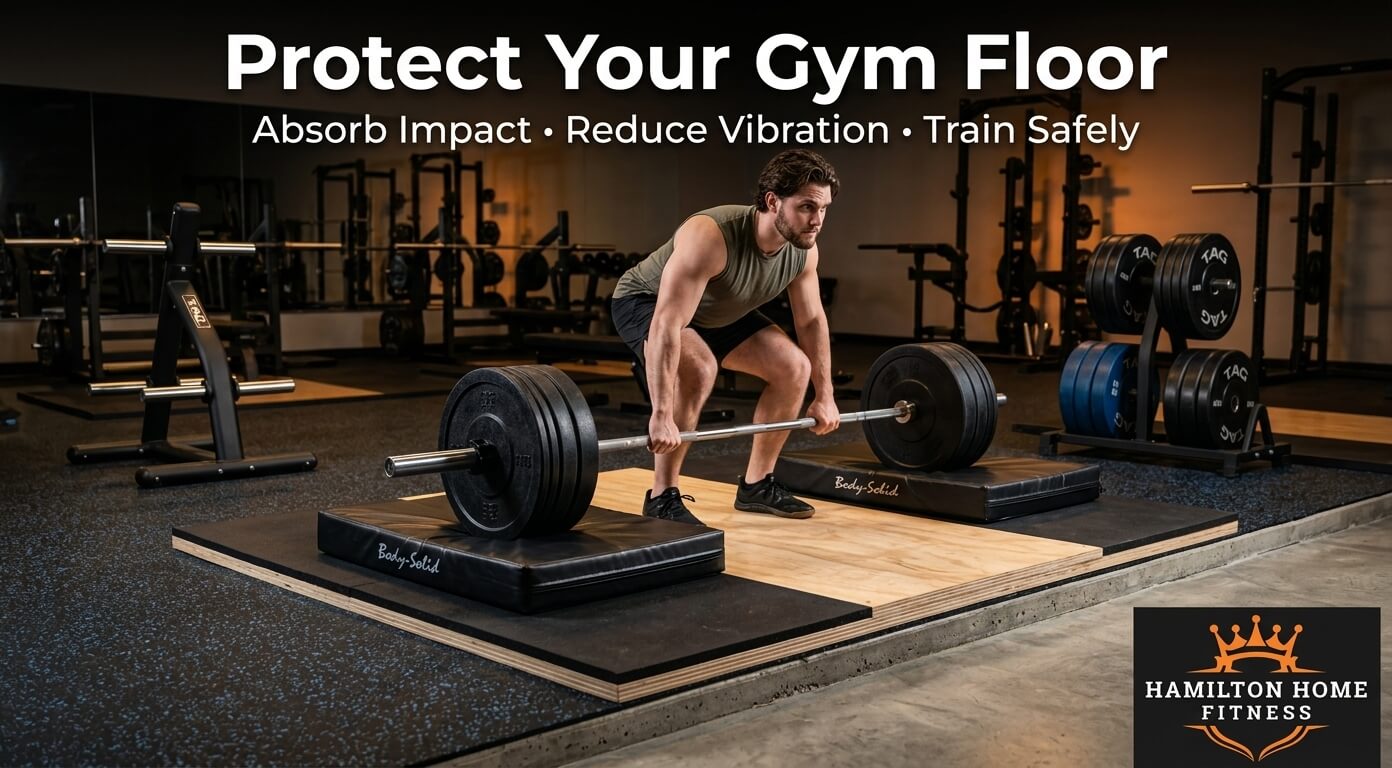
A platform is the only common setup that does two jobs at once: a rigid base spreading load across the slab and rubber wings absorbing the drop where the plates land. You need one when your drops are heavy, repeated, and always in the same spot.
The bar takes the impact too. Cheap shafts bend and sleeves loosen from repeated drops onto hard ground, which is why Olympic bars built to take drops matter as much here as the floor does.
The Layers and Why the Order Matters
A platform works bottom-up: a rigid base to spread the load, a second rigid layer for stiffness, a wood center to stand on, and rubber only where the plates land.
Base sheet—spreads the hit across the slab
Second sheet, seams offset—stops flex
Center wood surface—where you stand
Rubber wings, both sides—the landing zone
The order is doing something specific. Rubber under the lifter costs you stability; every pound you pull is fighting a surface that gives. Rubber under the plates buys absorption where it's actually needed. Same material, opposite results, decided entirely by position.
Four-by-six mats at three-quarter inch at $114.99 cut cleanly into those wings.
Budget for the height. A finished platform sits three inches up—real in a basement with an eight-foot ceiling and a bar overhead.
When to Buy One Instead of Building
Building wins on cost and loses on tolerance. If you can't cut a straight stall mat or store a full sheet of plywood, a bought platform is the honest choice.
Renting changes it again. A screwed-together platform isn't coming with you, and it isn't going back to bare slab without an argument.
For a whole room, GrytFit custom flooring and installation handle layout and fitting—quoted work, and over-specified for one drop zone in a garage.
Why Neighbors Still Hear You
A barbell drop reaches your neighbor as vibration through the structure, not as sound through the air. Surface layers reduce it. None of them stop it. The real fixes are isolating the platform from the slab, cutting how far the bar falls, or not dropping it.
Flooring gets sold on noise ratings, so check what they measure. One rating covers airborne sound—voices, music. The other covers light footfall, tested with a tapping machine. Neither measures a loaded barbell hitting the ground. "Which flooring is rated quietest" is the wrong question.
Bumper plates trade the clang for a thud. That's a real improvement, and it isn't a solution—the same mass still arrives.
Look at how facilities zone heavy lifting, and you'll notice they move it rather than muffle it: ground floor, off shared walls, on slab instead of joists.
Nothing here makes a drop quiet. In a wood-frame building with someone underneath, the honest answer may be that the dropping has to stop.
When You Should Not Drop at All
Some spaces cannot support dropped barbells. That's a fact about the building, not a verdict on your training. Lowering under control, pulling from a height, or changing the implement keeps the work intact—you lose the drop, not the lift.
Rack pulls—pull from pins, set the bar down
Block pulls—same idea, blocks instead of pins
Tempo lowering—three seconds down, every rep
Hex bar—plates land flat, not on a rim
Rack pulls are the practical swap for most people, and racks with adjustable pin heights let you set the start where your training needs it rather than where the plates happen to sit.
The controlled lowering is the underrated one. It's harder than dropping, not easier, and it builds something a drop never does.
If the answer is a redesigned space rather than a product, sequencing flooring with the rest of a build is the place to start.
FAQ
Can you drop bumper plates on horse stall mats?
For controlled deadlift drops, yes. For overhead work, a single three-quarter-inch mat is thinner than the fall deserves. Doubling the rubber adds absorption but makes the surface soft to stand on, which is the trade-off nobody mentions.
Do bumper plates solve the problem, or just change it?
They change it. The rubber face spreads the impact wider and softens the sound, but the same mass still reaches the floor. Worth having, not a fix on its own—how bumpers and iron differ on drops covers the full comparison.
Do crash pads work for overhead lifts, not just deadlifts?
Yes, and they matter more there. A bar falling from overhead arrives with far more energy than one released at the hip. The catch is that a pad is a fixed target—a bailed lift landing off it gets nothing.
Can my lease or HOA stop me from lifting at home?
Yes, and many do. Terms vary too much to generalize, so read yours before spending on a build. If the constraint is real, ask about fit before you order rather than guessing at what will pass.
Final Thought
You came here to protect a floor. The more useful question turned out to be which of the three jobs your problem actually needs—because buying for the wrong one is why the last purchase disappointed you.
Work out which it is, then buy once. And if a platform is going into a room you're still planning, book a gym design consultation before the flooring goes down rather than after.