Introduction
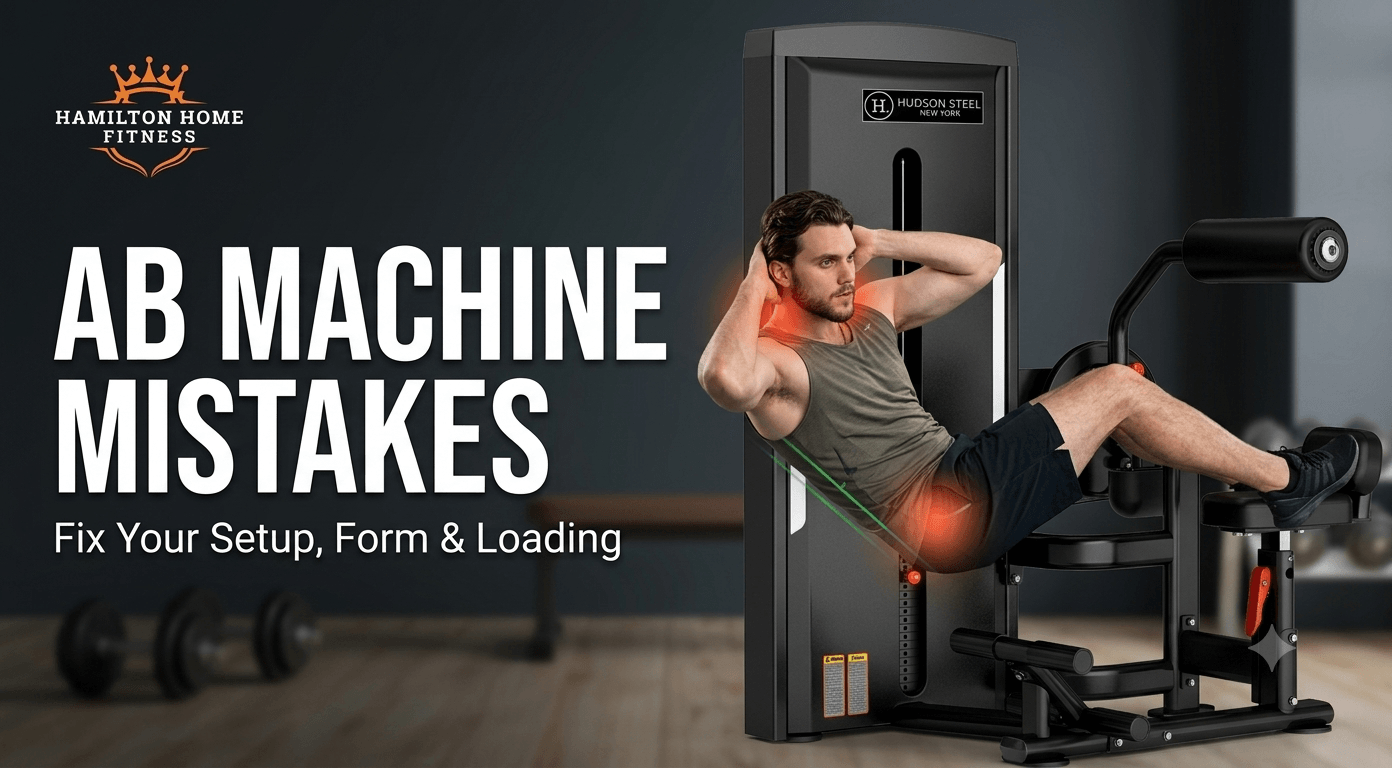
The set ends, and your neck is burning, your hips are tight, and your abs feel like they were never involved. That is not proof your abs are weak. Most AB machine mistakes are setup errors rather than effort errors, and they take one session to fix.
You paid for that machine. Before you write it off, find out which muscle is actually doing the work—then correct the pads, the angle, the tempo, and the load in that order.
Find Out Which Muscle Is Actually Working
Where you feel an AB machine set, it tells you what went wrong. A burning neck points to your head and hands. Tight hip flexors or front thighs mean hip flexion replaces trunk flexion. A sore lower back points to range or load. No ab fatigue at all usually means the pads are in the wrong place.
Find your symptom below, then go straight to the section that fixes it.
Where you feel it | What is likely happening | Where to fix it |
Neck and upper shoulders | Your head is leading the rep instead of following it | Stop Your Neck From Doing the Lifting |
Hip flexors or front of thighs | Your pelvis stayed locked while your legs or torso moved | Why Your Hip Flexors Take Over |
Lower back | Range ran past your control, or the load is too heavy | Tempo, Range and Load That Keep Tension |
Barely anywhere—abs untouched | The machine's pivot sits at your waist, not your lower ribs | Set Every Pad Before Your First Rep |
One distinction before you change anything: muscle fatigue fades in a day or two, but sharp pain, or pain that travels into an arm or leg, is a different problem and worth getting looked at.
Set Every Pad Before Your First Rep
Set the seat or back pad so the machine's pivot sits level with your lower ribs, not your waist. Set the chest or shoulder pad so it contacts you without pushing your head forward. Set the ankle pad so your knees stay bent and your hips stay quiet. Three adjustments, in that order, before a single rep.
Start with the pivot. Every seated crunch station rotates around a fixed point. Your trunk has to fold at roughly the same place. Sit down, find where the machine bends, and raise or lower the seat until that point lines up with the bottom of your ribcage. Too low and you are hinging at the hips with your abs along for the ride.
Then the chest or shoulder pad. It should meet you where the pad was designed to sit—across the upper chest or the front of the shoulders—with your back already in contact behind you. If reaching the pad pulls your head forward before you start, the pad is too far away. Bring it in.
Then the ankle pad. On knee-raise and sit-up stations, this is the one people set last and should set first. Knees bent, ankles secure, no pressing down. If you find yourself driving your feet into the pad to start a rep, your hips are lifting you and your abs are not.
Now the honest limit. Some stations have fixed pad spacing that suits an average torso and nothing else. If you are tall through the trunk or short through the legs, you can run this whole sequence and still never reach a shortened ab position. That is a fit problem, not a form problem, and it is exactly what an adjustable sit-up board solves—the pads move to you instead of the other way around.
Why Your Hip Flexors Take Over
Your hip flexors take over when your pelvis stays fixed and your legs or torso swing through space. Tilt the pelvis backward first—flattening your lower back into the pad—and the abs have to start the rep. Anchored feet make the substitution worse, not better.
Hip flexors are the muscles running from the front of your spine and pelvis down to the thigh. Their job is closing the angle at the hip. Bringing your ribs toward your pelvis is a different job, and it belongs to the abs. The problem is that both actions can produce the same-looking rep, and the hip flexors are stronger. Given the choice, your body takes the easier route every time.
Watch a knee raise and you can see it. The knees come up, the torso stays vertical, the hips swing, and the reps look fast and hard. Nothing folded. The pelvis never rotated, so the abs never shortened.
The fix comes before the rep, not during it. Tuck your pelvis under and press your lower back flat against the pad. Hold that, then move. On a knee raise, the target is your hips curling up off the pad — not your knees reaching your chest. That first inch of pelvic movement is the whole exercise.
How Steep Should a Sit-Up Board Be?
Ranking advice on decline angle openly disagrees, and that disagreement is worth knowing about before you set your board. Some sources put beginners around 15 degrees. Others call 30 to 45 degrees the working range. Both are published as standard, which tells you the number was never the answer.
Here is a test that works on any board. Set your angle, then start the rep by curling your ribs down without pressing your feet into the pads. If you can, the angle suits you today. If your feet drive down to get you moving, it is too steep—the hip flexors are pulling you up, and the steeper you go, the more they do it.
So are decline sit-ups bad for your back? The decline itself is not the problem. An angle beyond your current control is because it forces you into hip-driven reps under a longer lever. Grinding through pain is worse. If your board only offers one fixed angle and it fails the test, a folding slant board with adjustable angles lets you start where you actually are and work up.
Stop Your Neck From Doing the Lifting
Your neck hurts because your head is leading the rep instead of following it. Two faults cause it. You pull with your hands, or you let your head lag behind your torso and then snap it forward to catch up. Fix the hands first, then the head.
Hands. Lacing behind the head is not the problem—pulling is. Move them somewhere they cannot help: crossed on your chest or resting lightly on your forehead. If your elbows drive forward as you rise, your arms are working.
Head angle. This is the fault competitors skip. A chin pinned to your chest means over-curled. A chin pointing at the ceiling means undercurled. The target is a small nod, like agreeing with someone, held in that exact position for the whole set. Set it before rep one and do not chase it mid-rep.
One caveat worth taking seriously: pain that travels into your shoulder blade or down an arm is not a form problem. Stop and get it looked at.
Tempo, Range and Load That Keep Tension
Keep tension on the abs by controlling the lowering phase for two to three seconds, stopping the return before the stack or your bodyweight unloads you, and choosing a load you can move without your torso bouncing at either end.
Tempo. The lowering phase is where most people give the rep away. Let the weight drop and the abs stop working for half of every repetition. Two to three seconds down, no pause needed at the bottom, then curl again. Slower is not automatically better; controlled is.
Range. Partial range gets treated as a failure, and core work is wrong. Losing tension is the failure. On a seated crunch, the stack touching down means the abs are off; stop an inch short and they stay on. What you are protecting is continuous tension, not a longer arc.
Load. Skip the number. Pick a weight where the last two reps slow down but the path stays identical to the first two. If the path changes—torso bouncing, hips shifting, arms pulling—the load is wrong, no matter how slow you go. That test works on any station, on any day, without a calculator.
Progress from there in the smallest increment your machine allows. A stack that jumps 15 pounds at a time will outrun your control on core work long before it does on a press, which is why plate-loaded ab machines suit lifters who want to add five pounds instead of fifteen.
Rotary Torso and Cable Crunch Fixes
Two stations fail for reasons the general advice never covers, and both faults are visible from across the room.
Rotary torso. If your chest lifts off the pad or your hips shift in the seat, the load has outrun your control. Keep both in contact, rotate to a range you can pause at, and hold it for a beat. This station rewards a moderate load with a genuine pause far more than a heavy one. Among selectorized ab machines, it is the one where the pin should sit lighter than your ego suggests. If you have a diagnosed lumbar issue, clear loaded rotation with a professional before you start.
Cable crunch. The rep is a spinal curl toward your hips, not a hip hinge. The tell is your hips traveling backward as you come down—that is a hinge, and your abs are just holding on. Lock your hips in place, then round down rib by rib.
When the Machine Is the Real Problem
Form fixes solve most of these problems. Equipment is the limiting factor in three cases: a fixed angle you cannot lower, pads that will not meet your torso length, and a frame that shifts or flexes mid-rep. Everything else on this page is adjustable.
Work through the fixes first. If your reps are clean and the fault persists, here is the honest triage.
Your lower back fatigues before your abs do. Often this is a front-only routine catching up with you, not an injury. Training the lower back alongside the abs balances the trunk, and a combo station does both from one footprint. The Hudson AB/BACK CAM is designed for that in a compact space; the Hudson X Series AB/BACK is the selectorized version, which suits multi-user rooms and higher traffic. Nor is the answer if your ache is a real back problem—that needs a professional, not a purchase.
Your surface moves under you. A board that slides or a frame that flexes forces you to brace against the equipment instead of the movement. If you need nothing more than a stable flat base for crunches, a horizontal ab bench is worth considering before anything larger. It does one job, and lifters who need loaded rotation or adjustable decline should skip it.
Hamilton Home Fitness is an authorized dealer rather than a manufacturer, shipping nationwide from Tennessee — which means we can tell you when a machine is wrong for you.
FAQ
Is the captain's chair better than crunches?
Neither is better across the board — they solve different problems. A captain's chair demands more trunk control and suits lifters who can already curl the pelvis under load. A supported crunch is easier to load progressively and easier to keep strict. If your hip flexors already dominate, the crunch is the better place to rebuild the pattern.
How often should you train abs on a machine?
Two to three sessions per week, with at least a day between them. Your abs recover like any other muscle. Daily high-rep work is usually a sign the load is too light rather than a sign of dedication.
Do ab machines cause lower back pain?
Rarely the machine itself. Pain usually traces to a load beyond your control, a range that pushes past your comfortable end point, or an existing condition the movement exposes. Balanced trunk work helps—how to hinge safely on a Roman chair covers the backside of that. If pain persists, radiates, or comes with numbness or tingling, stop and see a qualified professional before continuing.
Should I train abs before or after lifting?
After, in most cases. Fatigued abs reduce the trunk stiffness that squats, deadlifts, and presses rely on, so core work at the end of the session costs you less. Training abs first is defensible only when core strength is the priority for that training block.
Fix the Setup Before You Replace It
You know which muscle is doing the work and whether pad position, angle, tempo, or load is what corrects it. Most of the time that is the whole fix—the machine was never the problem.
The exception is narrow. The angle will not drop, the pads will not reach you, or the frame moves under you. That is where adjustment runs out.
If that is you, the ab machines built for supported trunk work are where you match a station to the fault you just found.