
Introduction
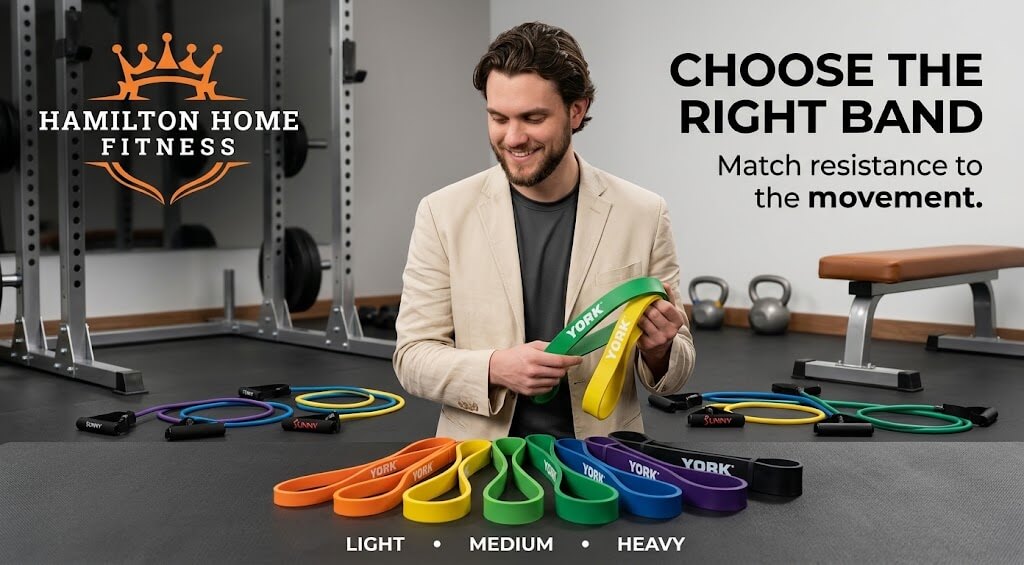
A dropdown, five-level names, and a color beside each. One chart calls purple light; the next calls it heavy. Guess wrong, and the band sits unused.
What resistance band should I use? It depends on the muscle and the move, not the color. Shoulders and arms need lighter levels than hips and back, so most people training more than one area need at least three. Still choosing between loops, tubes, and cords? Settle that first.
Below: misleading colors, mid-rep tension, a level table, set math, and when to move up. On a physical therapist's band list? Match their band; this guide compares gear, not rehab.
Why Band Colors Can't Tell You the Level
Purple can mean light or ultra-heavy, depending on the line. Band colors rank levels only within one product line, and no industry standard ties them together. So one brand's resistance band color chart says nothing about another's, even inside the Hamilton Home Fitness resistance range.
One Color, Three Levels on One Shelf
A purple band at Hamilton Home Fitness can be the second-lightest TAG Strength loop, the heaviest XERTONE cord, or a 35–80 lb York loop.
Color | TAG Strength loop | XERTONE cord | York Fitness Band |
Purple | Light (2 of 4) | Ultra Heavy (5 of 5) | 35–80 lb (4 of 8) |
Green | Xtra Light (1 of 4) | Light (2 of 5) | 40–95 lb (5 of 8) |
Green swings just as far. Width is steadier: TAG's 1¾-inch The medium matches York's 45–115 lb band in width. That's a neighborhood, not a match, since TAG prints no pounds.
How Many Pounds Is a Medium Band?
A medium band has no single pound figure. Guides put it anywhere from single digits to about 80 lb, depending on the format and the stretch it was rated at.
Labels shift inside one brand, too: York's five-tube set and its "Heavy" tube rates that tube 20–25 lb, under the 35 lb top of York's lightest loop.
TAG's level names carry no pounds at all. So compare poundage ratings only within one format.
Why Band Tension Changes Through a Rep
A band row feels easy off the start and tough at your chest. Band resistance isn't constant: tension rises as the band stretches, in a near-straight line through normal use. Lab tests on therapy bands show it only climbs steeply far past any stretch you'd use.
Stretch Percentage Sets the Pounds
A band's pull depends on how far it stretches past its resting length, so a pound rating means little without the stretch it was measured at.
A 2-foot band pulled to 4 feet is stretched 100%. A common therapy-band chart puts a green band near 4.6 lb there and 6.7 lb at triple length.
A rating is the band's tension at full stretch, not its mid-rep pull. Only a Sunny combo rated at three times its length names its stretch on this site.
Short-Stroke vs. Long-Stroke Moves
A row stretches a band further than a Pallof press, where your hands push across the band's line rather than along it. So the same band feels heavier on the row.
Pick the level for the end of the rep, where it's hardest. If the end feels right but the start goes slack, keep the level and add pre-tension: step back or widen your stance. If the end breaks your form, drop one level.
Which Level Fits Each Muscle Group?
What resistance band should I use for each move? Shoulders and arms take the lightest levels, back and chest the middle, and hips and legs the heaviest. Treat each row below as a starting point.
Move | Tier | XERTONE cord | TAG loop | York loop |
Face pulls, pull-aparts | Lightest | Extra Light | Xtra Light | 10–35 lb |
Curls, pressdowns | Light | Light–Medium | Xtra Light–Light | 10–35 or 20–50 lb |
Rows, chest press | Middle | Medium–Heavy | Light–Medium | 20–50 or 30–65 lb |
Squats, hip thrusts | Heavy | Tops out | Medium–Heavy | 35–80 to 45–115 lb |
Clamshells, monster walks | Light, short loop | — | — | — |
Pull-up, dip assist | Heaviest | Not suited | Heavy | 60–140 or 70–150 lb |
Then compare every level in Workout Bands.
Shoulders and Arms Need the Lightest
Face pulls, pull-aparts, and rotator cuff work need the lightest level you own. Small muscles tire fast, and a heavier band turns the move into a shrug.
Curls and pressdowns go a level up. XERTONE cords sold one level at a time suit both, with handles and five levels (11.98–17.98, October 2026), but top out before squats.
Glutes and Legs Take the Heaviest
Bridges, hip thrusts and squats take your heaviest loops, while clamshells and monster walks need a light short loop. TAG's 41-inch strength loops in Medium (42.00)orHeavy(54.00) anchor underfoot or over the hips.
Side-hip muscles are smaller, and those loops are too long for clamshells. On monster walks, a band at the ankles is harder than one above the knees. See why clamshell loops belong above the knee.
Which Band Helps With Pull-Ups and Dips?
For assistance, the rule flips: a heavier band gives more help. Start with one that gets every rep to the bar with a slow lowering, then step lighter as reps clean up. York bands rated from 10–35 to 70–150 lb make that plannable. Without a strict rep, begin at 60–140 or 70–150 lb; close to one, try 40–95 or 45–115 lb.
Your foot in the loop helps more than your knee, because the band stretches further. That help peaks at the bottom and fades near the bar, so the top stays your work. Need an anchor? Use a pull-up bar or station to loop it over.
Cords and tubes aren't built for body-weight help; TAG's option is its 2½-inch heavy loop. The same flip covers dips and band-assisted ab wheel rollouts. For home rows and presses, these heavy bands are overkill.
One Heavy Band or a Graded Set?
Buy one heavy band and you'll likely order twice: it suits squats and swamps shoulder work. One heavy band fits only your strongest move. Most people training upper and lower body need at least three levels, and whether a single or a set costs less depends on the line.
The four-level TAG strength band set costs $146.50; exactly its four singles added up (prices as of October 2026). Need only Xtra Light, Light, and Medium? Those three come to $92.50. XERTONE matches: its $74.50 set equals its five singles.
York's eight-band set is the exception at $87.50, about 8% under its singles' $95.33. TAG bands ship free; York and Sunny ship at standard rates.
Buy singles if you need only three TAG levels
Buy singles to fill one gap in bands you own
Buy a set if you'll use every level in the line
Buy a set to stock a studio or training room
Want the full range in one order? Browse graded resistance band kits.
When Should You Move Up a Level?
Move up a level when you beat your rep target by two on the last set, two workouts in a row, with clean form. Coaches call it the 2-for-2 rule. Before ordering, check all four:
Two extra reps on your last set
Two workouts running, not one good day
Same stance and anchor distance
Full range, no shrug or swing
Assisted moves run backward: progress means a lighter band, then none, then adding vest load to pull-ups.
How to Bridge the Gap Between Levels
When the next level is too big a jump, stack a light band onto your current one. That adds pull without stretching either band any further.
A wider stance or a step back from the anchor adds tension too, but only by stretching further, so keep each rep's end near 2.5 times resting length. Shortening or doubling a band pushes that ratio up, which is why shortening a band raises snap risk; buy the next level instead.
FAQ
What resistance band should a beginner start with?
The lightest level that makes your last two or three reps hard, usually lighter than you expect. For upper body, that means Extra Light or Light. The five-cord XERTONE set covers that start; add levels as each move earns them.
Which band level is right for rehab or seniors?
The one your physical therapist names. Without one, use the lightest level you can move slowly through full range without pain, and clear any program with your physical therapist or doctor first. Light band work after an ankle sprain shows one example.
What length resistance band should I use?
Use 41-inch loops for standing, anchored and assisted work, and 44- to 53-inch handled cords for curls, rows, and rotations. Clamshells and monster walks need short loops, like the all-latex York 5-piece loop set, though its page lists no individual ratings.
Final Thought
Color tells you nothing; the move tells you the level. Write down your three most-used exercises, find where each sits on the ladder of extra light to ultra heavy bands, and buy only those levels. Torn between two? You can ask the team to match levels to your moves before you order.