Introduction
You strapped them on, worked through ten exercises, and half of them felt like nothing. You're not imagining it.
On a squat or a lunge, the strap rides on a leg that's already holding the floor, so it adds almost nothing. On a side-lying leg raise, that same strap adds plenty. That difference decides which ankle-weight glute exercises earn your time, and the load comes right after.
Nothing here needs a cable machine. A strap from our wearable weights collection and some floor space are the whole setup.
If you're following a therapist's program, their loads beat anything here.
Which Movements Ankle Weights Load
Ankle weights load movements where your foot travels freely through the air. When your foot is planted and holding your bodyweight, the strap mostly rides along. That single test sorts every exercise list you'll ever see.
Foot-Free vs. Foot-Planted
An ankle weight only adds work when your foot is free to move through the air, because that is the only time your muscles are lifting it.
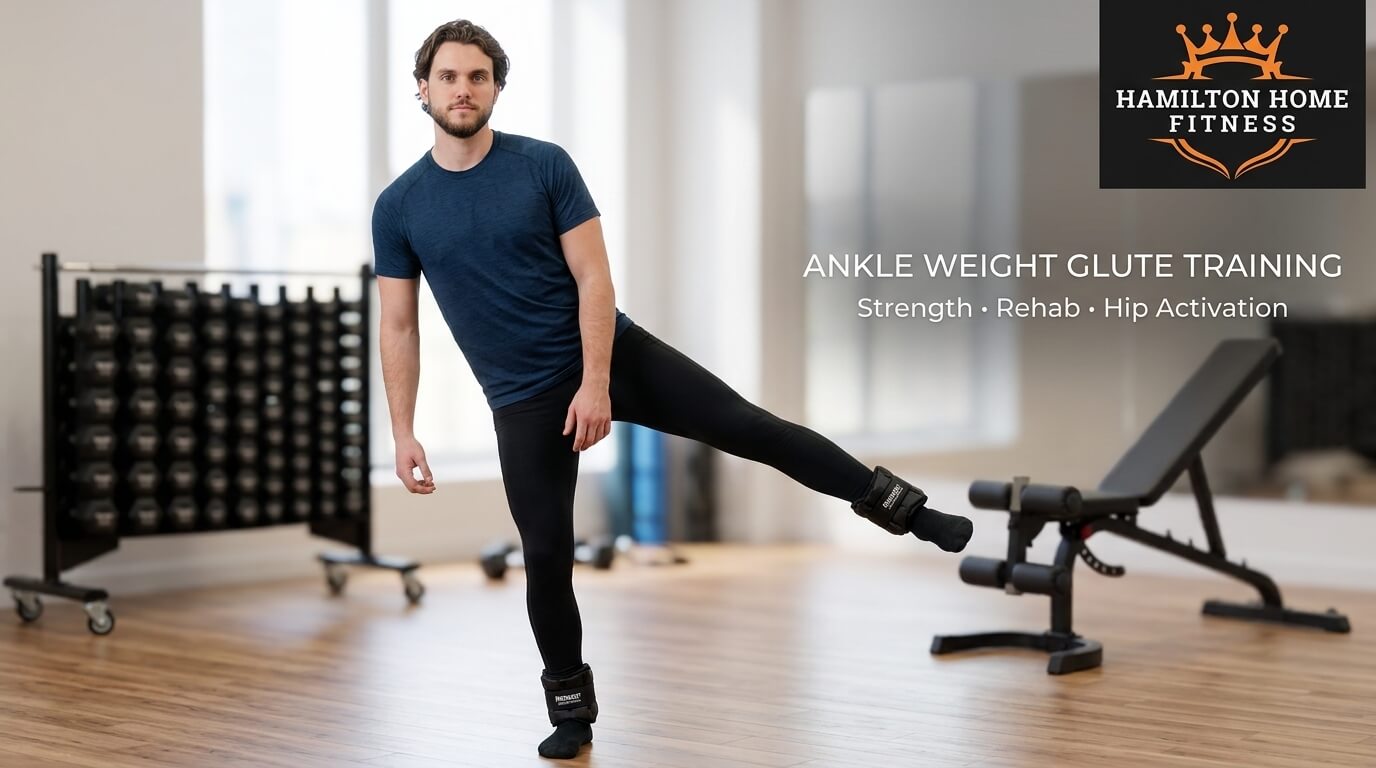
Picture a side-lying leg raise. Your top leg swings up against gravity, and the strap sits at the far end of that leg, so your hip muscles have to produce real force to move it. The further your foot sits from your hip, the harder that hip works. This is why the strap suits floor and standing isolation work best, and it's the logic behind the ankle weights we carry.
Why Squats and Lunges Waste the Strap
On a squat or lunge, your foot is planted, so the strap rides along instead of adding meaningful work to the muscle you are trying to train.
Your quads and glutes are pushing the floor away, not lifting your ankle. The strap only does a little on the way back up, as the trailing leg swings through. Two pounds against your bodyweight changes almost nothing.
If you want standing movements loaded properly, load your torso instead with a weighted vest. It suits squats, lunges, and step-ups because the weight moves with you. It's the wrong tool for a side-lying raise, where a torso load adds nothing at all.
The Glute and Hip Drills Worth Loading
The drills worth loading all share one shape. You stay stationary, lying down or standing still, while one leg swings freely through the air. Six movements cover the glutes and hips properly, and that short list is the point.
Side-lying leg raise: loads gluteus medius and minimus
Standing hip abduction: same muscles, plus balance demand
Donkey kick with ankle weights: loads gluteus maximus
Fire hydrant exercise: hits glute medius and hip rotators
Prone hip extension: loads glute maximus and hamstrings
Prone leg curl: isolates the hamstrings
Most of these start light and climb slowly, so a wide adjustable range beats a fixed pair. The adjustable wrist and ankle weights from York run from 1.3 to 11 pounds per side.
The two prone drills need a surface your hips can clear. A bed edge works, and so does a bench for prone hip and hamstring work, which keeps your pelvis flat.
One pattern sits outside this list. The clamshell keeps your ankles together, so a strap barely works there. Kits that include ankle straps give you the band version.
How Heavy Your Ankle Weights Should Be
There's no single right weight. What decides it is which joint is doing the pivoting. The same strap is conservative on a hip movement and demanding on a knee movement, which is why one number can't cover both. York Barbell straps adjust in small steps for that reason.
Loads When the Hip Is the Pivot
When your hip is doing the lifting and your knee stays straight, the leg works as one rigid lever, and the load goes to the hip muscles rather than the knee.
Side-lying raises, standing abduction, kickbacks and prone extension all work this way. Most people start between 1 and 3 pounds per side and climb from there. Going from 1 to 2 pounds doubles the load on a small muscle, so move in the smallest step your strap allows. Body-Solid pairs ship free, which matters if you end up wanting a second set.
Loads When the Knee Is the Pivot
When your knee is the joint doing the work, the strap sits at the end of a long shin and produces far more demand at that joint than the number on the label suggests.
Seated knee extension is the clearest case. Clinicians often cap this work lower than hip work for exactly that reason, and if you have a knee that flares up, start at half a pound. How much is too much varies enough between people that no article can set your number. Leg extension machines spread that load through a guided arc instead.
Do Ankle Weights Build Bigger Glutes?
Yes, but only on one condition. Light loads build muscle when your sets finish close to the point where the next rep would fail. Stop short of that, and most of the growth signal never arrives.
Here's where people go wrong. You're told fifteen reps, so you do fifteen and stop, still four reps from struggling. With heavy weights you'd have some margin there. With three pounds you have none. The set has to get genuinely hard before it counts.
That usually means higher reps than you expect. Twelve to twenty is the working range, and if twenty feels comfortable, you need more weight or slower reps, not another set.
Size and strength aren't the same thing, though. Light loads match heavy ones for muscle growth, but heavy work still wins for raw strength. If you want a stronger hip hinge, the strap won't get you there. Dumbbells for loaded hip extension will.
Leg Raises Without the Lower-Back Arch
On a straight leg raise, your hip flexors are meant to do the lifting. You can't stop them taking over, because taking over is their job. What you can control is whether your lower back arches while they work.
Here's the cue. Before the leg moves, press your lower back flat into the floor and hold it there. Bend your other knee, foot planted. If your back lifts away mid-rep, the set is over.
That flat-back version is why this movement shows up so often after knee surgery. The knee stays still while the quad holds the leg straight, so you load the muscle without moving the joint.
If your clinician's list names gear you don't own, ask us what fits your program. Their loads override anything here.
When a Band or Cable Beats a Strap
A strap loses to a band when the resistance needs to sit near your knee. It loses to a cable when the load needs to keep climbing past what any strap holds. Both cases come up fast. Start with resistance training gear if either sounds like you.
The clamshell is the clearest example. Your knees stay bent and your ankles stay together, so the strap sits close to the joint doing the rotating and produces very little. Put light loops for hip work above your knees instead, where the resistance actually has leverage.
Kickbacks and abduction are the other case. A strap works for a while, then stops. Eleven pounds per side is the practical ceiling on the range we carry, and a cable or a stack keeps going. A standing loaded abduction station covers that pattern, though it's built for facilities rather than a spare room.
FAQ
Are ankle weights good for hip strengthening?
Yes, for the side and rear hip muscles, on a stationary floor and for standing work. They do nothing useful for hip strength while you walk, since your foot is planted for most of every step.
Can seniors use ankle weights safely?
Usually yes on hip work, starting lighter and staying at each weight longer. Check with your doctor first if you've had a hip or knee replacement or if sensation in your feet is reduced.
Which movements do physical therapists commonly load with ankle weights?
Straight leg raises, side-lying abduction, and prone hip extension and knee extension work. If a therapist assigned yours, their prescribed load and progression override anything in this article.
How do I progress once the heaviest strap is easy?
Slide the strap further down your leg before buying heavier. Then slow the lowering phase. Then change the movement. Only after that do you need free weights.
Are ankle weights bad for your knees?
Not on hip-driven movements where your knee stays straight. On seated knee extension the demand at the knee is real, so start lighter there than you would for hip work.
Final Thought
One test decides everything here: if your foot is free to swing, the strap works. If it's planted, it doesn't. Six movements pass that test, and the right load depends on whether your hip or your knee is doing the pivoting.
Pick a strap with enough range to grow into. Hamilton Home Fitness ships nationwide from Tennessee.