
Introduction
Your straps are unboxed, and your only option is a hollow bedroom door. If it gives, you fall backward onto a hard floor. The straps are rated. The door isn’t.
How to anchor a TRX safely: use a solid door that swings away from you, a joist or stud mount, a rated rack crossmember, or a sound beam. Set it 7 to 9 ft up, then test in stages. Still choosing? Compare TRX suspension trainers.
Inside: the rating chain, room options, mount steps, and a staged test. Unsure of your framing? Hire a qualified installer; a failed anchor means a fall. Hamilton Home Fitness ships nationwide from Tennessee.
Where Can You Safely Anchor a TRX?
A suspension trainer anchor is safe only when every link holds bodyweight: a solid door that swings away from you, a joist or stud plate, a rack crossmember within its rating, or a beam or exposed joist wrapped with a strap anchor. On a bedroom door, the chain runs straps, carabiners, door anchors, and latches, and nobody rated the latch.
What Does the Weight Rating Cover?
TRX’s warning label lists a 350 lb maximum suggested user weight. That rates the straps, not the door or joist holding them. It’s static, too: jumps and slips add load no maker quantifies.
Our TRX Club 4 System Suspension Trainer ($300.00 as of October 2026) is pitched at shared use, but its listing names no anchor or rating, so confirm both first.
Can You Anchor to a Rack or Beam?
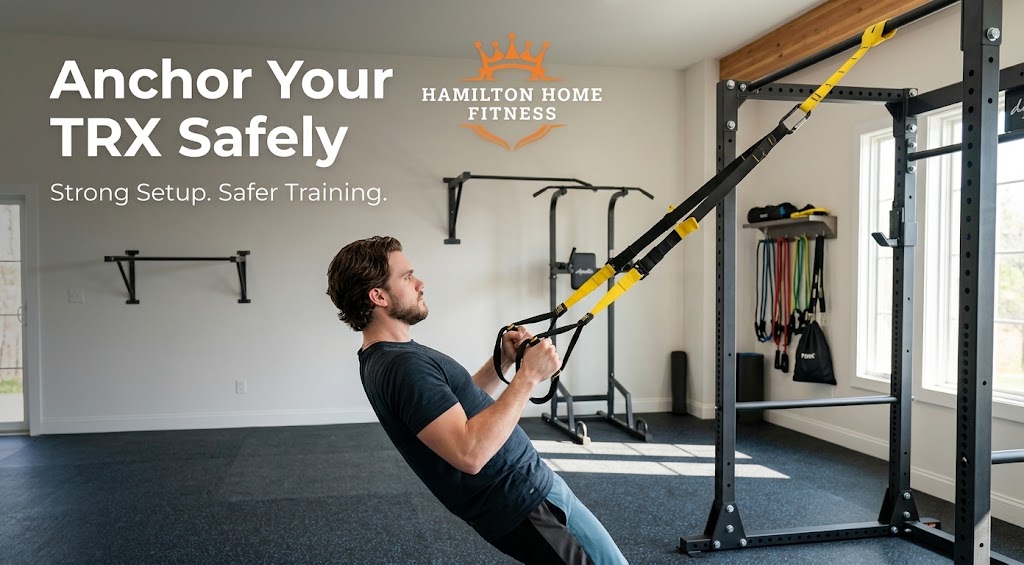
A power rack works as a suspension anchor if its rated capacity covers you, it doesn’t rock under an angled pull, and the strap wraps the crossmember at least twice. Compare power racks with listed load capacities.
Exposed beams and joists work the same way. TRX flags some overhead metal beams as sharp-edged, so pad or skip them; see how sharp edges wear through bands.
Which Fixtures Only Look Strong?
Household fixtures fail as TRX anchors because they’re built for light downward loads, not bodyweight pulled at an angle.
Towel bars: made for towels, not a lean
Curtain rods: brackets bend outward
Light fixtures: the box holds a lamp
Drywall anchors: they tear out of gypsum
Doorway pull-up bars: built for straight-down loads
Traveling? See hotel-room anchoring and travel kits.
Is a TRX Door Anchor Safe?
A TRX door anchor is safe only on a solid door that swings away from you, closed with the latch fully engaged and locked. Each pull then drives the door into its frame instead of prying it open. Quick check: push the closed door from your side. If it opens, it opens mid-rep too.
Which Doors Should Never Hold You?
Skip any hollow-core door, any door that swings toward you, and any door you can’t lock. Each turns your bodyweight against the door’s weakest part.
Hollow-core: owners report cracked doors
Swings toward you: every pull pries the latch
No lock: a sign alone won’t stop someone
Sliding or glass-paneled: no solid edge
Worn latch or loose strike plate
Loose hinge screws
Pull-up bars share these limits; compare fixed and freestanding pull-up stations.
Will a Door Anchor Damage Your Door?
TRX says its padded door anchor won’t damage paint or wood. The real wear is structural: months of loading can loosen hinge screws and the strike plate.
Watch the latch side. If a gap there grows between sessions, stop and repair the door before you train again.
Can You Use a TRX Without Drilling?
Yes, if one no-drill point passes the checks above. For apartment anchoring without drilling, that means a solid door swinging away from you, a hinge-pin anchor on an interior door, or a power rack you already own. If none passes, a suspension trainer is the wrong tool for your home.
Over-the-door anchor: only on a door that passed the push test
Hinge-pin anchor: interior doors with 3½ in or 4½ in pins
Your own power rack: rated for you and steady when you lean
Renting? Check your lease before fitting any hardware, even a hinge-pin anchor. If nothing qualifies, switch tools and compare band formats that need no overhead anchor.
Straps still sealed? Check our return terms before you open the box.
How High Should a TRX Anchor Be?
Mount or wrap the anchor 7 to 9 ft off the floor, then set the strap height above the floor so its anchor loop hangs about 6 ft up. Above 9 ft, add an extension strap.
Setting | Height |
Overhead anchor point | 7 to 9 ft off the floor |
Strap anchor loop | About 6 ft off the floor |
Extension strap | 9 ft or higher, or thick objects; one strap if under 25 in around |
An 8 ft basement ceiling fits; a 10 ft great room needs the extension.
How Much Clearance Do You Need?
Mount an overhead anchor at least 3 ft from the nearest wall so you can turn a full circle beneath it, and keep the floor clear to the end of your deepest lean.
On garage or basement concrete, rubber flooring for the training zone adds grip; Vortex 8 mm rolls cost $225.00 for 4 x 15 ft as of October 2026. Rubber won’t make a fall safe, and over carpet it’s a trip edge.
How Do You Mount a TRX Into a Joist?
A ceiling mount for a suspension trainer goes into the center of a wood joist or stud with two 3/8 in x 3 in lag bolts and washers, never drywall or plaster. Unsure of your framing? Hire a qualified installer.
Ceiling Joist or Wall Stud?
A ceiling joist lets you train facing any direction. A wall anchor plate on a stud works, but most move then face the wall or away from it.
For 16 in on-center studs or concrete, Apollo makes a stud-mounted steel pull-up rack ($125.00 as of October 2026), rated to 400 lb installed and 36 in deep. Hardware is extra, and it’s rated as a pull-up rack, so confirm suspension use with us. Renters should skip it.
If you choose a wall stud, Gym Space Guide explains why to confirm stud spacing across at least three studs before you drill.
What Hardware Does a Joist Mount Need?
Beyond the bolts, you need a drill with a 1/4 in. bit, a stud finder, a ratchet, and a pencil. Those are TRX’s plate specs; follow your own plate’s instructions.
Find the joist’s center
Mark it, keeping the anchor 7 to 9 ft up
Drill two 1/4 in pilot holes
Drive the bolts and washers snug, not stripped
Run the staged load test below
What About Concrete or Unknown Walls?
Poured concrete can take a ceiling plate with 3/8 in x 3 in concrete lag shields. TRX doesn’t recommend brick or cinder block.
Steel studs and hollow blocks need a contractor, since wood lag bolts can’t grip them. See how wall-mounted racks bolt to studs and concrete.
How Do You Load-Test an Anchor?
The last step in how to anchor a TRX is proving it. Test the anchor before use in four stages, each heavier than the last. This builds on TRX’s pull-hard check; it isn’t a manufacturer protocol.
Pull hard with both hands, standing
Lean back slightly, arms straight
Lean further, body closer to horizontal
Hang briefly in a low row, hips near the floor
Stop at any creak, movement, falling dust, or widening gap.
What Should You Inspect Each Session?
Before every session, check the straps and hardware, and replace any worn part rather than train on it.
Webbing: no fraying or cuts
Stitching: no pulled threads
Carabiner gate: snaps fully shut
Bolts or screws: still snug
Door latch: no new gap
Carabiners are rated in kilonewtons; 1 kN is about 224.8 lb of force, so read your own gate’s stamp.
Retire worn straps. A $144.99 replacement strap set is listed as of October 2026, but its page shows no specs, so confirm the rating first.
What Changes in Studios and Clinics?
Studios, rehab clinics and shared gyms should use professional installation for commercial gyms and a written inspection log, because many users of different sizes load the same point every day.
Rehab clients should train under a qualified professional’s supervision. Adding several stations? Plan a multi-station layout before drilling.
FAQ
What is the TRX suspension anchor for?
It’s the wrap-style strap for beams, bars, poles, and trees. Wrap it until its bottom loop hangs about 6 ft up, adding or removing wraps to adjust the strap length, then clip the trainer to that bottom loop only.
How do you anchor a TRX to a tree or pole?
Outdoors, wrap the strap around a sound, living tree branch or a smooth pole, cinch it tight, and clip in. On a vertical pole or trunk, set the loop about 6 ft up. A thick trunk needs an extension strap.
Final Thought
Your straps are only as safe as the weakest point holding them. Pick a point rated for your bodyweight, set it 7 to 9 ft high, and prove it in stages before your first full rep.
Not sure your door, ceiling or rack qualifies? Describe it when you ask our team about anchor compatibility before ordering.