Introduction
You want a squat rack, but a full power cage swallows half your garage — or it won't fit at all in your basement, apartment, or military housing. A wall-mounted squat rack solves the floor-space problem, but only if the wall behind it can hold what you're about to bolt to it.
Studs, anchors, ceiling height, and the right rack spec all have to line up. Get any one of them wrong, and the rack rocks, the bolts pull out, or a loaded barbell ends up on the floor—or on you.
This guide walks you through how to pick the right wall-mounted squat rack for your space and how to anchor it safely, with the exact specs, wall types, anchors, and clearance numbers that matter.
What Is a Wall Mounted Squat Rack?
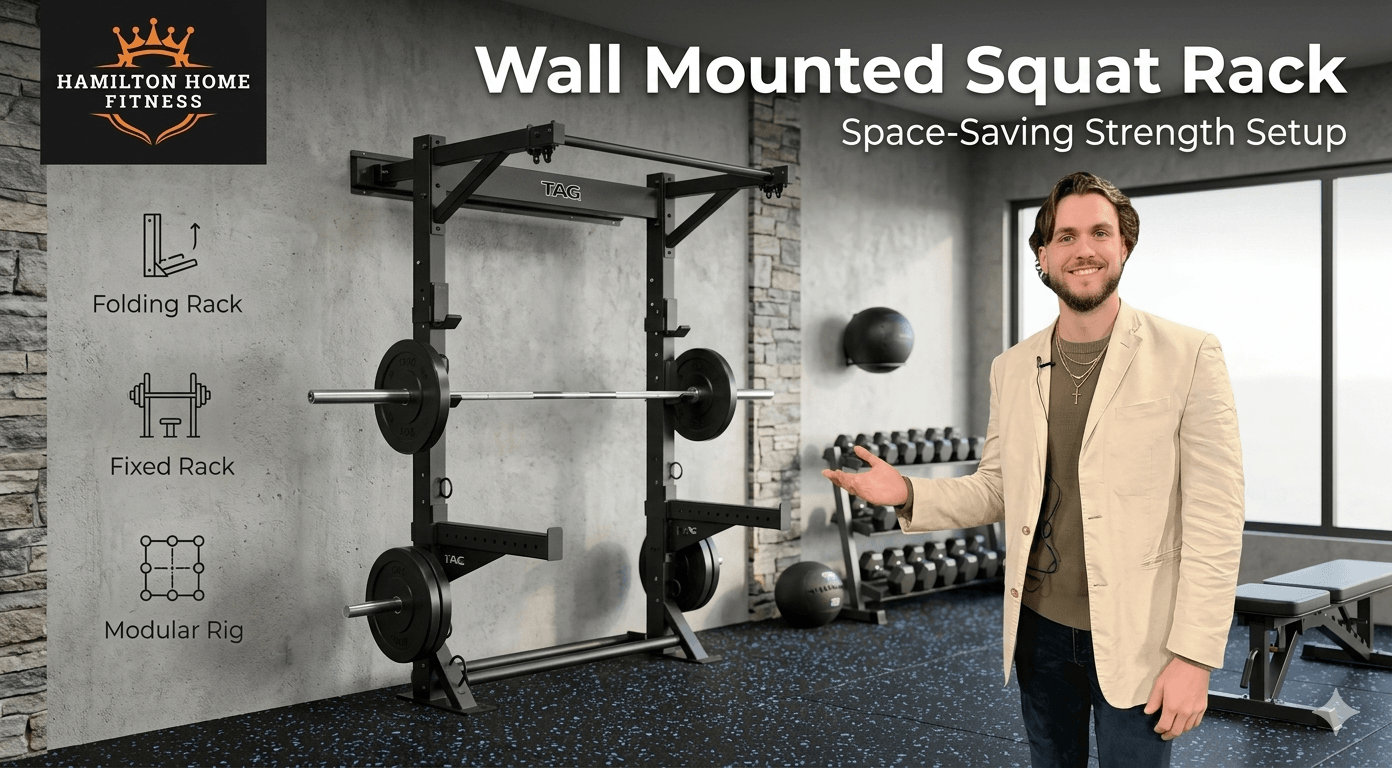
A wall-mounted squat rack is a squat rack with uprights bolted directly into a wall, sometimes with floor contact at the base, sometimes not. It comes in three real form factors: fold-flat racks that hinge against the wall, fixed wall mounts that stay extended, and modular wall mount rigs that build out laterally across a wider section of wall.
Folding vs Fixed vs Modular Wall Mount Rig
Wall-mounted squat racks come in three real forms: fold-flat racks that hinge against the wall, fixed wall mounts that stay extended, and modular wall-mount rigs that build out laterally.
A fold-flat squat rack uses a pin or hinge system at the base. Extended, it gives you a full squat and bench station typically 21" to 41" deep from the wall. Folded, it collapses to roughly 5"–6" of depth so you can park a car or use the room for anything else. This is the form factor most garage and basement lifters end up choosing.
A fixed wall-mount power rack stays extended at all times. There is no folding mechanism to wear out, the frame is usually more rigid, and setup between sessions is faster. The trade-off is a permanent floor footprint, so it suits dedicated gym rooms more than shared spaces.
A modular wall-mount rig is a multi-bay setup that runs along a longer wall—two, three, or more stations side by side. Studios, small commercial spaces, and home gyms with one long uninterrupted wall use these to train multiple lifters at once or to add specialty stations like pull-up bars and dip handles without buying a second rack.
How to Choose the Right Wall-Mounted Rack
Five specs decide whether a wall-mounted squat rack will serve you for years or feel undersized within months: upright size, steel gauge, hole spacing, weight capacity, and attachment compatibility. Get these right and the rack scales with your training. Get them wrong, and you replace them.
Upright Size — 2x3" vs 3x3"
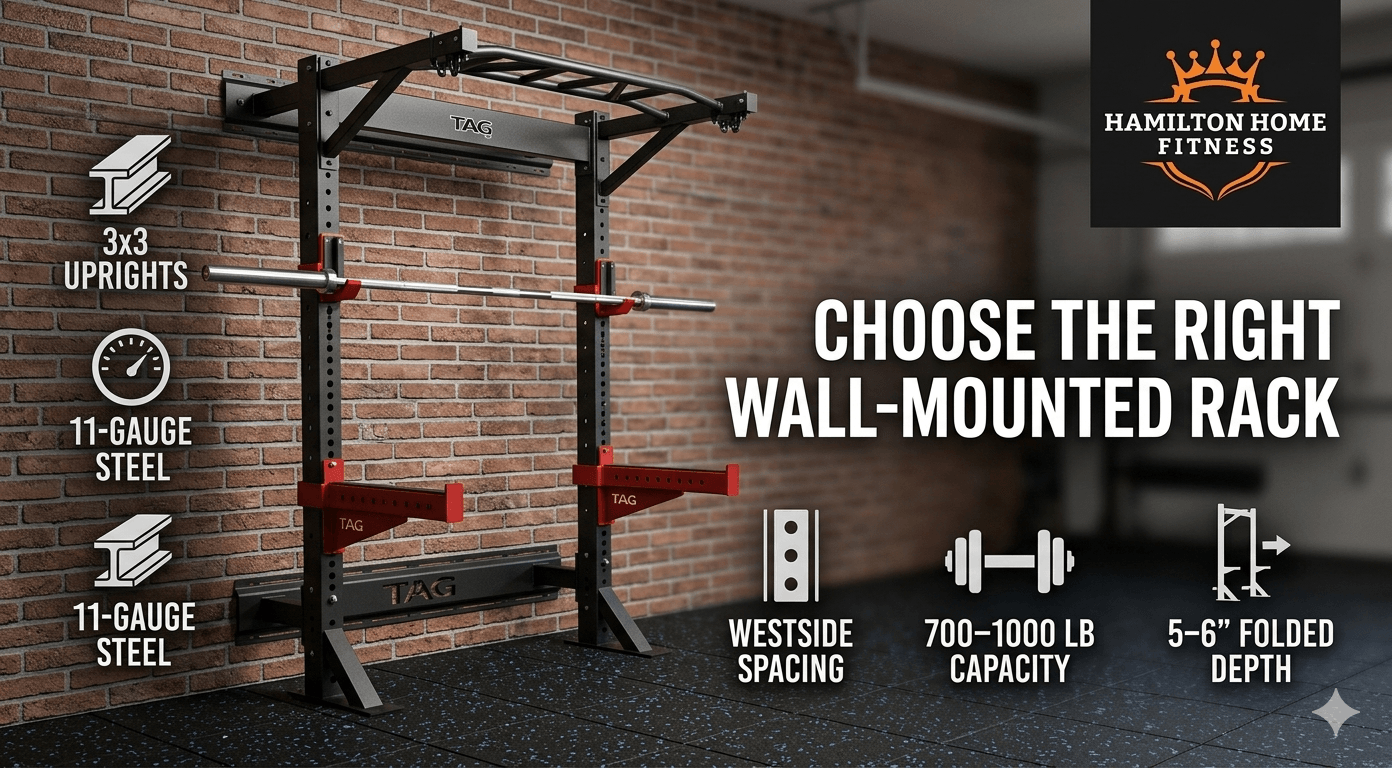
Choose 3x3" uprights for heavy training and broader accessory compatibility; 2x3" works for lighter loads and tighter budgets.
3"x3" uprights are the home gym standard for serious lifters. The thicker tube is stiffer under load, accepts most aftermarket attachments, and gives you room to grow into heavier squats, deadlifts off the rack, and rack pulls. A 2"x3" is lighter, cheaper, and fine for lifters squatting in the 200–400 lb range, but the accessory market shrinks and the rack feels less planted as the loads climb. If you're choosing once and keeping it, 3x3" is the safer call.
Steel Gauge — Why 11 Gauge Is the Common Standard
11-gauge steel is the standard for serious home gym wall mounts because it holds heavy loads without warping at a price most lifters can justify.
12-gauge is thinner and shows up on budget racks; it's workable for light to moderate training but flexes more under load and can dent at the J-cup contact points. 7-gauge is commercial heavy-duty — overbuilt for almost every home gym, more expensive, and rarely needed unless you're pulling well into the 600+ lb range. For most garage and basement setups, 11-gauge 3x3" is the sweet spot.
Hole Spacing — Westside vs 1" vs 2"
Westside hole spacing puts holes 1" apart through the bench press range and 2" apart elsewhere, which lets you fine-tune J-cup height for benching.
Standard 2" spacing is fine for squats, but a single 2" jump in J-cup height can mean the difference between a clean lift-off and a press-out on the bench. Racks with 1" spacing throughout cost more and add weight. Westside spacing—1" through the press zone and 2" up the rest of the upright—is the practical compromise most lifters land on.
Weight Capacity and Frame Stability
Most quality wall-mounted squat racks are rated between 700 and 1,000 lbs, but the real-world capacity is whatever the wall, studs, and anchors can actually transfer to the structure.
A 1,000 lb-rated rack bolted into a single drywall stud is not a 1,000 lb rack. Capacity is a chain—the lowest-rated link sets the ceiling, and on a wall mount, the wall and anchors usually are that link. Treat the manufacturer rating as the upper limit of the frame, then check what your wall and anchors actually support before you assume the full number applies.
J-Cups, Pull-Up Bar, and Spotter Arms
Look for sandwich or UHMW J-cups that protect the bar; a pull-up bar set roughly 8 ft from the floor and deep enough from the wall for kipping; and flip-down or pin-pipe spotter arms if you train alone.
J-cups with UHMW plastic inserts or sandwich-style construction protect your barbell knurl from metal-on-metal wear during re-rack. Pull-up bars built into the rack work for most lifters, but check the bar's distance from the wall—anything under about 18" makes kipping pull-ups and muscle-ups impossible. Spotter arms matter most for solo lifters. Flip-down arms stay attached, pin-pipe safeties give the highest catch rating, and strap safeties save the barbell from impact damage on a missed lift. Verify the rack accepts compatible J-cups and spotter arm options in your upright size before you buy—attachment compatibility is the spec most lifters discover too late.
Folding Depth and Footprint
A fold-flat, wall-mounted rack folds to roughly 5–6" from the wall and extends to 21–41", which is the spec that decides whether you can still park your car or use the room.
Shallow-fold racks (around 5" folded) hinge in on themselves and keep the most floor space free. Deeper extended depths (around 41") fold sideways instead of inward and give you more pull-up clearance from the wall but eat more space when folded. Measure your room twice: the folded depth tells you what the space looks like when you're not training; the extended depth tells you whether the rack actually fits during a session. For garage and basement footprints where every inch matters, shop wall mount rigs built for tight garage and basement footprints to see how folded and extended depths vary across models.
Ceiling Height and Floor Clearance Math
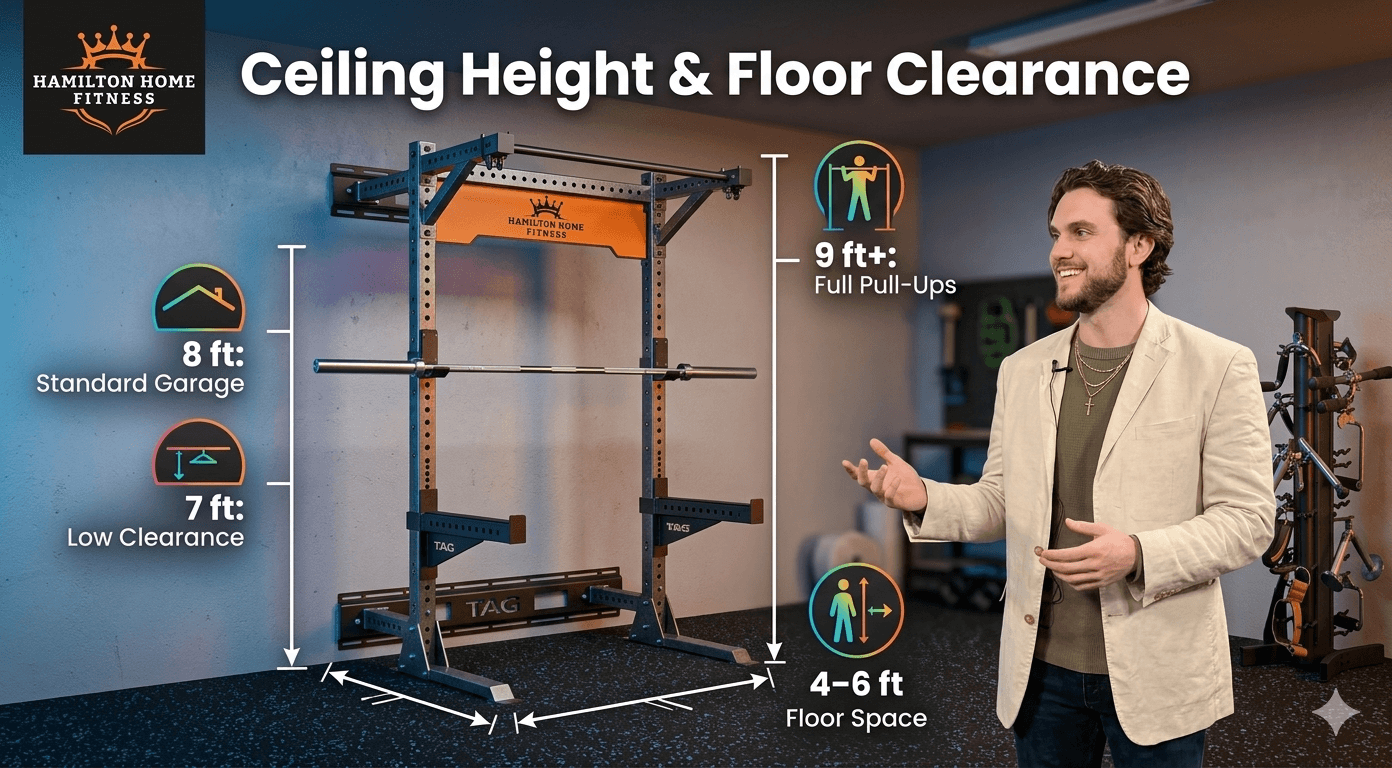
Most wall-mounted squat racks need at least a 7' ceiling for squats and 8'–9' for pull-ups, depending on the lifter's height and the bar position. The numbers below tell you what works at each ceiling height and how much floor space to leave in front of the rack.
7-Foot Ceilings
At a 7' ceiling, choose a low-profile wall rack and plan to do pull-ups from a kneeling or hanging position rather than a full hang.
A 7' ceiling is the tightest spec a wall-mounted rack realistically works under. Standing squats clear for most lifters because the bar sits below ceiling height during the lift, but the pull-up bar will land close enough to the ceiling that a full hang means brushing the rafters. Most lifters at this ceiling either skip the pull-up bar entirely or use a kneeling chin-up from the bar. The overhead press is usually off the table unless you're under 5'8".
8-Foot Ceilings
An 8' ceiling is the most common garage spec and works for full pull-ups for most lifters under about 6'2", as long as the pull-up bar sits within a few inches of the ceiling.
This is the height most wall-mounted squat racks are designed around. Pull-up bars typically mount at roughly 7' from the floor, giving about a foot of head clearance for a strict pull-up. The overhead press is workable for most lifters. Kipping pull-ups get tight—the swing brings your head close to the ceiling on the back half of the kip—but strict pull-ups work fine.
9-Foot and Taller Ceilings
A 9' or taller ceiling clears overhead presses, kipping pull-ups, and most muscle-up attempts on a wall-mounted bar.
At 9' you stop thinking about clearance and start thinking about training. Standing presses, push presses, jerks, kipping pull-ups, and muscle-ups all become practical. The pull-up bar can sit higher off the ceiling for cleaner swing room, and taller lifters (6'2" or taller) get the head clearance they need for full overhead lockouts.
Floor Clearance for Loading and Bailing
Leave at least 4 ft of clear floor in front of the rack so you can load plates, step back to squat, and bail forward without hitting anything.
4 ft is the working minimum — enough to slide a 45 lb plate onto the sleeve, step back two paces to clear the J-cups, and bail forward off a failed squat without crashing into a bench, wall, or car. For deadlifts pulled from the floor near the rack, plan closer to 6 ft so the bar has room to land cleanly. Pair that clearance with rubber gym flooring built for heavy lifting under a rack to protect the subfloor, deaden noise, and absorb the impact when a loaded barbell does come down.
Wall Type, Framing, and Anchors That Actually Hold
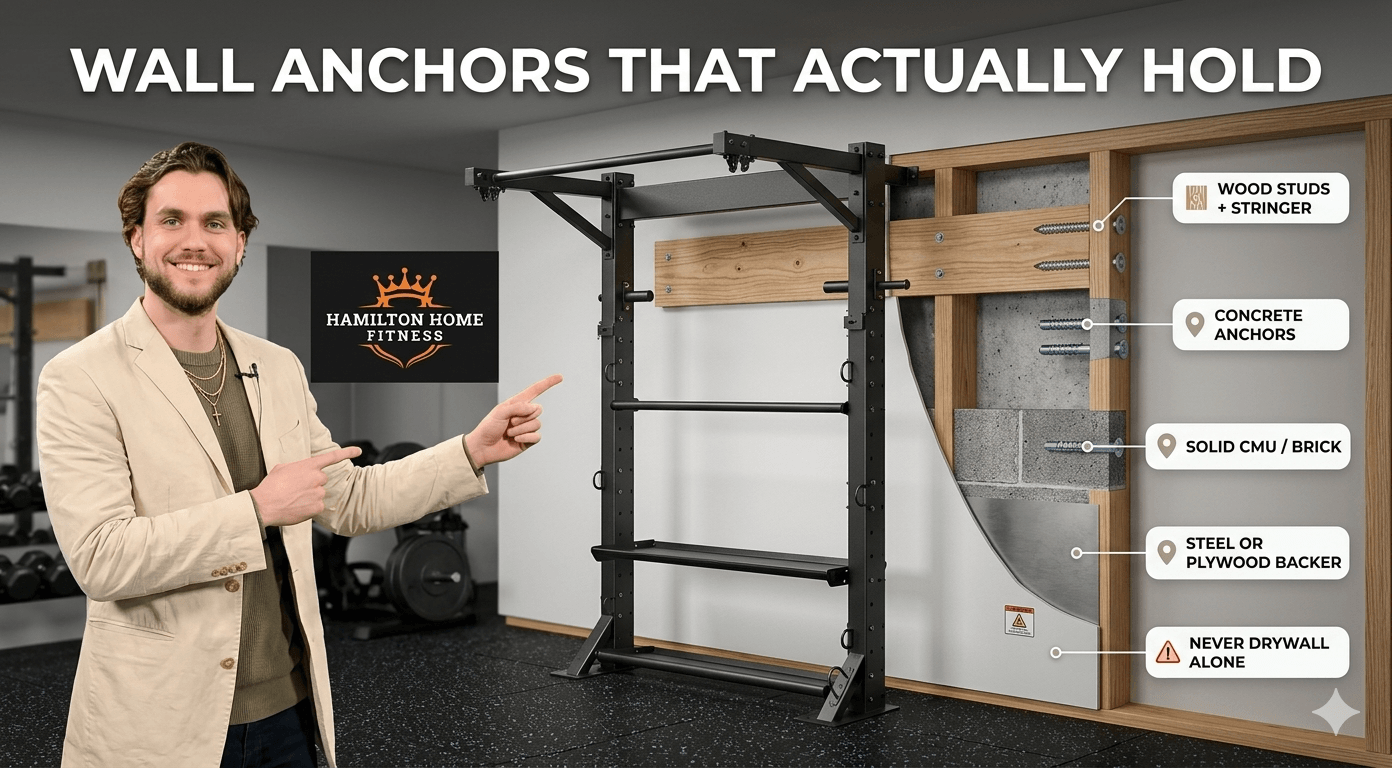
Mount only into wood studs, solid concrete, solid-cell CMU, or a steel or plywood backer plate that spans multiple studs—never into drywall alone. The wall type decides the anchor, and the anchor decides whether the rack stays put under load.
Wood-Framed Walls (2x4 and 2x6, 16" or 24" OC)
On wood framing, bolt the rack into a 2x6 or 2x10 stringer that spans at least three studs, using 3/8" x 5" lag screws driven into the studs.
A stringer is a horizontal board you lag-bolt across the studs first. The rack then bolts into the stringer. This does two things: it spreads load across more framing than the rack alone would catch, and it solves non-standard stud spacing so the rack's mounting holes don't have to line up perfectly with what's behind your drywall. Use a stud finder to confirm stud locations before drilling, and verify spacing with a small pilot hole—16" on center is standard, but older homes and garages sometimes run 24" on center or irregular. GRK structural screws are an alternative to lag bolts when codes or load requirements call for them.
Concrete Walls
On poured concrete, use 1/2" or 5/8" wedge anchors set with a hammer drill or epoxy anchors when the pull-out rating needs to be higher.
Wedge anchors expand inside the drilled hole and grip the concrete mechanically—they are fast to install and rated for the loads a wall-mounted rack produces. Drill with a masonry bit sized to the anchor spec (the anchor packaging tells you the exact bit diameter), blow the dust out of the hole, and torque to the manufacturer's spec. Epoxy anchors take longer to set but deliver higher pull-out ratings and work better in older concrete that may have hairline cracks near the anchor zone.
CMU (Cinder Block) and Brick Walls
CMU and brick can hold a wall-mounted rack only when the anchors land in solid cell blocks or solid mortar joints—never in hollow voids.
CMU walls have hollow cells. An anchor set in a hollow cell has almost nothing to grip and can pull out under a fraction of the load. Identify solid-cell rows or filled cells before drilling—sometimes the top course is grout-filled; sometimes specific cells are filled with rebar and grout for structural reasons. Epoxy anchors work well in solid CMU because the epoxy bonds to the block walls of the cell. Brick walls follow the same logic: anchor into the brick itself or into solid mortar joints, never into the soft mortar that crumbles under stress. When in doubt, add a steel backer plate that distributes load across a wider area.
Steel-Stud and Drywall-Only Walls
Drywall alone cannot hold a loaded wall-mounted squat rack—the screws will pull out under load, often during a failed rep.
Drywall anchors, toggle bolts, butterfly anchors, and Molly bolts are all rated for picture frames and shelving, not for the dynamic pull-out forces a loaded barbell generates. Steel-stud walls are similarly unsafe for a direct mount because the thin metal won't hold a lag-style fastener under repeated heavy load. The solution for steel-stud walls is engineered: a Unistrut frame anchored back to floor and ceiling structure or a full reframe of that wall section with wood backing. If your only available wall is drywall over steel studs and you can't reframe, a wall-mounted rack isn't the right form factor—a free-standing power rack is.
When to Add a Steel Backer Plate or Plywood Backer
Add a steel backer plate or 3/4" plywood backer when stud spacing doesn't line up with the rack's mounting holes or when you need to distribute load across more than two studs.
A backer plate sits between the rack and the wall, lag-bolted into multiple studs across its length. The rack then bolts into the backer plate rather than directly into the studs. This solves three common problems: rack mounting holes that fall between studs, walls where only two studs are within reach of the rack's footprint, and installs where you want extra load distribution as a margin of safety. Steel backer plates are stiffer and thinner; 3/4" plywood is cheaper, easier to cut to fit, and works for most home gym loads when properly lagged into framing.
How to Install a Wall-Mounted Squat Rack
Install in seven steps: confirm wall type, locate and mark studs, position the stringer or rack template, drill pilot holes, drive anchors, torque to spec, and then load-test before training.
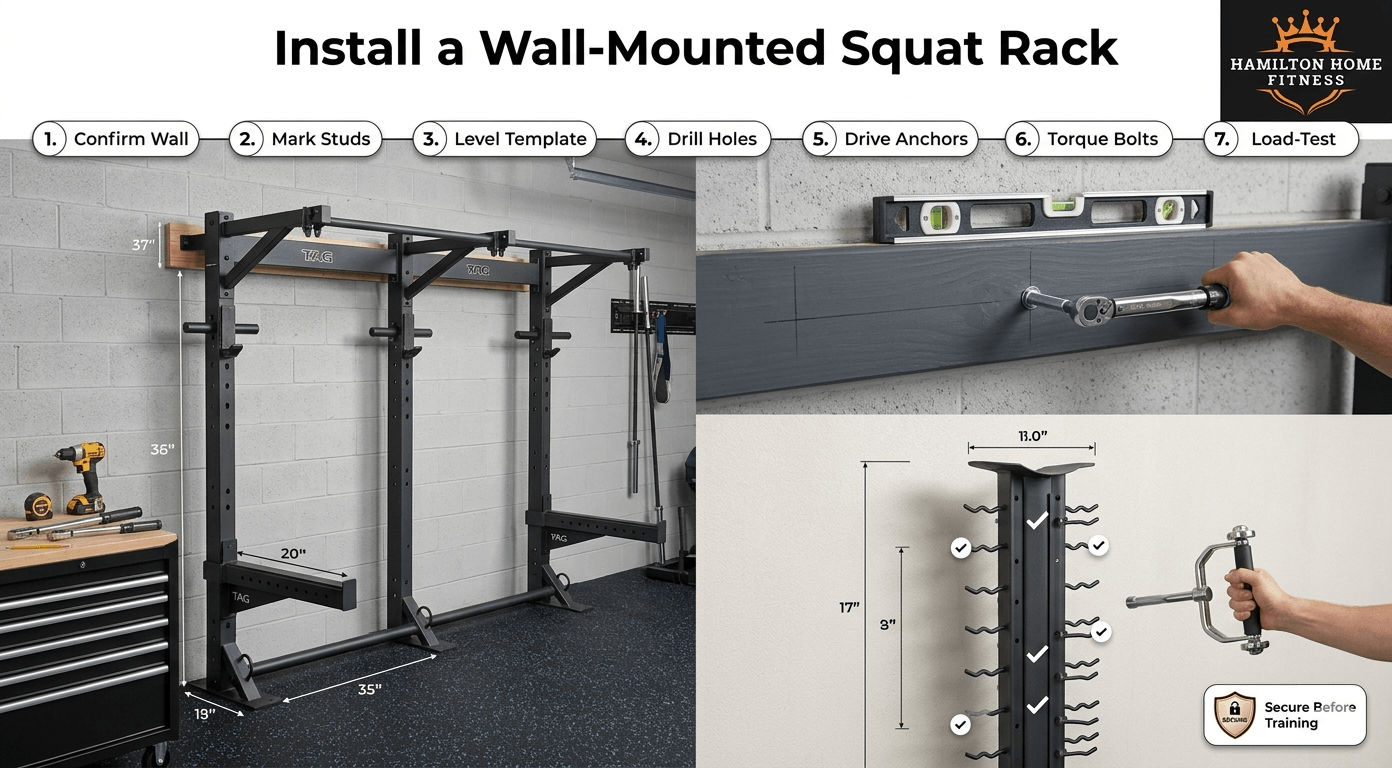
Confirm the wall type. Wood frame, concrete, CMU, or backer plate — match the anchor before you drill anything.
Locate and mark studs or solid material. Use a stud finder on wood walls; tap-test or check building plans for solid-cell CMU. Mark every anchor point in pencil.
Position the stringer or rack template against the wall. Level it. Re-check that the marks line up with framing.
Drill pilot holes to the correct depth and diameter for your anchor spec. Clear masonry dust from concrete or CMU holes.
Drive the anchors or lag screws. Start them by hand to confirm alignment, then drive with an impact driver or wrench.
Torque to the manufacturer's spec with a torque wrench—not by feel. Under-torque pulls out; over-torque strips the anchor or splits the wood.
Load-test before training. Hang body weight from the pull-up bar. Re-rack an empty bar onto the J-cups and check for movement. Then load progressively—never jump from an empty bar to a working set.
Tools You Actually Need
You need a stud finder, level, impact driver or socket wrench, torque wrench, and a hammer drill with masonry bits if any anchor goes into concrete or a block.
Add a tape measure, marking pencil, safety glasses, and a step ladder. For wood stud installs, a 3/8" drill bit set is needed for pilot holes. For masonry, match the bit diameter to the anchor packaging spec exactly—wedge anchors require a specific bit size to seat correctly. A second person makes positioning the stringer or rack template far easier, especially on taller installs.
When to Hire a Professional
Hire a contractor if your wall has steel studs, hollow CMU, or unknown framing or is on a second floor—the failure cost outweighs the install cost.
A failed wall mount install doesn't just damage the rack. It pulls drywall, framing, or block out of the wall and drops a loaded barbell on the floor or the lifter. If you can't confirm what's behind the wall, if the wall is steel-stud or unreinforced hollow CMU, or if the rack is going on a second floor where vibration travels through joists, a structural contractor is the right call. A few hundred dollars for a proper install is cheaper than the rack, the wall repair, and the injury combined. For lifters who want a deeper look at the install logic before deciding DIY versus professional, the step-by-step home gym rack install reference covers the full setup process.
Wall Mount vs Free-Standing Power Rack
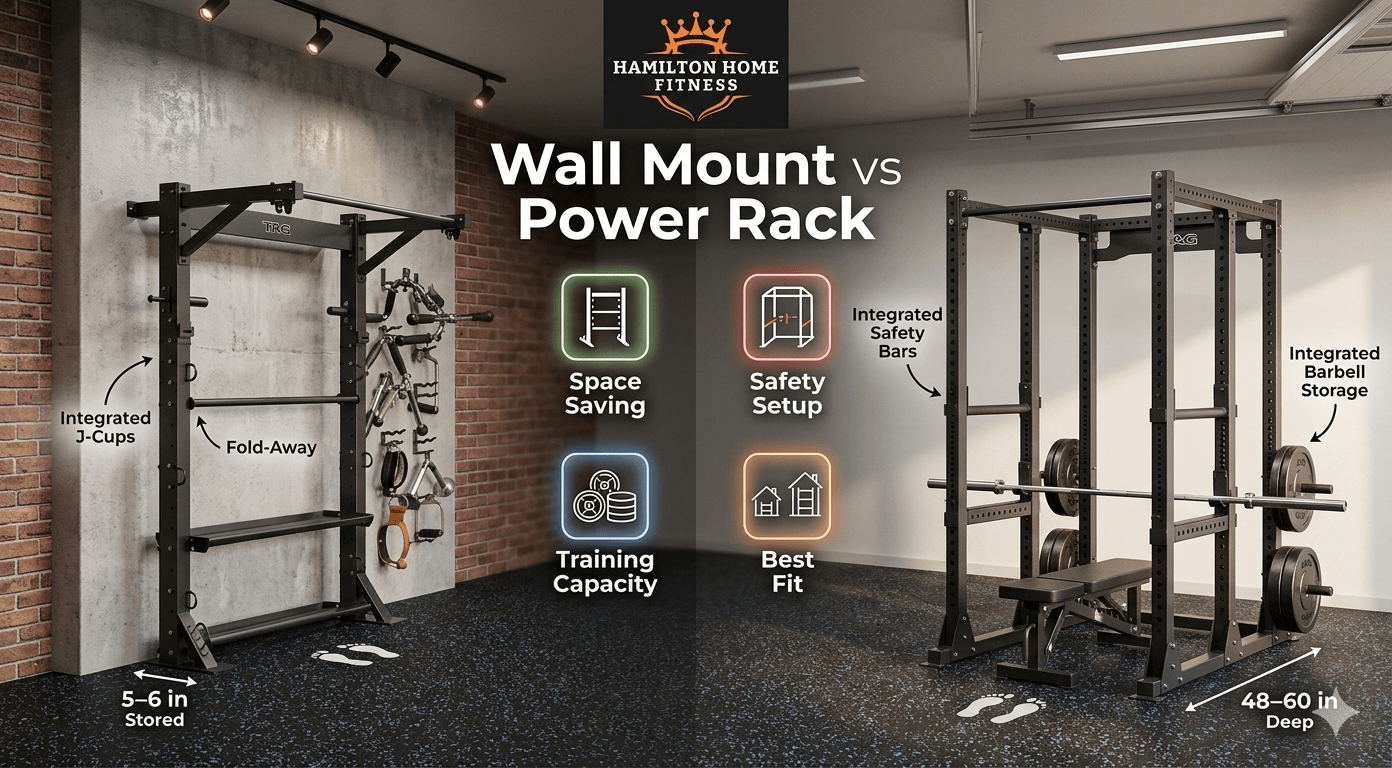
Choose a wall mount when floor space is the constraint and you can anchor into solid framing; choose a free-standing power rack when you have the room and want enclosed safety bars on every rep.
$–$$
Spec | Wall Mounted Squat Rack | Half Rack | Full Power Rack | Squat Stand |
Footprint (extended) | 21"–41" deep | ~48" deep | ~48"–60" deep | ~24"–30" deep |
Footprint (folded/stored) | 5"–6" deep | Fixed | Fixed | Movable |
Install requirements | Bolted to wall studs or masonry | Floor-mount optional | Floor-mount optional | None |
Safety on failed lift | Flip-down spotter arms (limited) | Spotter arms (limited) | Enclosed safety bars or straps (highest) | Spotter arms or none |
Typical max load | 700–1,000 lbs | 1,000 lbs | 1,000–1,500 lbs | 500–1,000 lbs |
Attachment range | Moderate | Wide | Widest | Narrow |
Typical price range | $$ | $$$ | $ | |
Best fit | Garage, basement, apartment, military housing | Mid-size home gym with limited depth | Dedicated gym room with full ceiling height | Tightest budgets, lightest loads |
The decision rule is short. If your floor space disappears every time the rack stays out, go with wall mounting and accept the install work. If you have a dedicated room and you train near max alone, a full power rack with enclosed safety bars gives you the highest margin on a failed rep—and the full power rack setup guide for squats, the bench, and pull-ups walks through how that form factor sets up. Half racks and squat stands sit in between; they are more stable than a wall mount and less enclosed than a full cage and worth considering when the wall isn't an option but a full cage is too much rack.
Common Install Mistakes and Failure Modes
The four most common wall mount failures are drywall-only mounting, wrong anchor for wall type, skipped torque checks, and uneven floor contact that causes rocking.
Drywall-only mounting. Anchors set into drywall without hitting studs or a backer plate will pull out under load — often on the first heavy set, sometimes weeks later when the drywall fatigues. This is the single most common catastrophic failure.
Wrong anchor for the wall type. Wedge anchors in hollow CMU cells, lag bolts driven into mortar joints, or drywall Toggles used on a wood-stud wall all share the same outcome: a rack that feels solid empty and pulls out loaded. Match the anchor to the wall before drilling.
Skipped torque checks. Hand-tightened lag bolts or anchors set "until it feels snug" either strip the threading or sit loose enough to work themselves out over months of training. Use a torque wrench to manufacturer spec on every anchor, and recheck torque after the first week and again at one month.
Uneven floor contact causing rocking. When the rack's base contacts a sloped garage floor or sits proud of the wall by an inch in one spot, the rack rocks on every rep. That rocking transfers load cyclically into the anchors and accelerates pull-out. Shim the base with steel or hardwood shims before final torque so the rack sits flush against the wall and floor at every contact point.
FAQ
What stud spacing and wall framing do wall-mounted squat racks require?
Standard 16" on-center 2x4 or 2x6 wood framing works for most wall-mounted squat racks. If your spacing is 24" on-center or non-standard, add a 2x6 or 2x10 stringer or a steel backer plate that spans at least three studs. Always verify stud locations with a stud finder before drilling.
Which concrete and wood anchor types are rated for heavy squat and bench loads?
For wood studs, use 3/8" x 5" lag screws driven into a stringer that spans multiple studs. For poured concrete, use 1/2" or 5/8" wedge anchors or epoxy (chemical) anchors. For solid-cell CMU, epoxy anchors hold best. Drywall anchors, toggle bolts, Molly bolts, and butterfly anchors are never rated for the dynamic pull-out forces a loaded barbell produces.
Can a wall-mounted rack safely catch a failed back squat with spotter arms?
Yes, when the rack is properly anchored, the spotter arms are rated for the load, and the arms are set at the correct height for the lift. Flip-down spotter arms on a wall-mounted rack catch a failed back squat with less margin than the enclosed safety bars of a full power cage. Lifters training near max alone should consider strap safeties, pin-pipe safeties, or a full power rack for the extra catch margin.
How much floor space and ceiling clearance does a folding wall rack need fully extended?
Folded depth runs about 5"–6" from the wall; extended depth runs about 21"–41" depending on the model. Leave at least 4 ft of clear floor in front of the rack for loading and bailing and at least 7 ft of ceiling for squats. An 8 ft or taller ceiling is preferred for full-hang pull-ups.
Can you do pull-ups and muscle-ups on a wall-mounted squat rack?
Yes. Most wall-mounted racks include a pull-up bar that supports strict and kipping pull-ups when ceiling clearance allows. Muscle-ups need at least 9 ft of ceiling and a pull-up bar mounted deep enough from the wall to clear the swing—usually 20 inches or more.
Should I install the rack into a load-bearing wall or use a backer plate?
Both are safe when the anchors are rated for the load. Mounting directly into a load-bearing wall with solid studs is the cleanest install when the rack's mounting holes line up with framing. A steel or plywood backer plate is the right solution when stud spacing doesn't match the rack or when you want to distribute load across more studs as a margin of safety.
Final Thought
A wall-mounted squat rack works when the rack spec matches the wall, the ceiling, and the loads you actually lift. The right form factor, the right anchors, and honest clearance math are what separate a safe install from a failure under load.
If you know your wall type and ceiling height, browse wall mount rigs sized for your space. If you're unsure what your framing can hold or whether your ceiling clears the bar you train with, book a free gym design consultation for your space and ceiling with the Hamilton Home Fitness team and get a wall mount setup matched to your room before you drill the first hole.