Introduction
The rack is bolted down, the flooring is in, and the mirror is the last item on the build. Home gym mirror size is the one decision you cannot undo.
Everything else in how to build a home gym from scratch can be sold or swapped. Glass bonded to a wall cannot.
Three numbers settle it: panel size, bottom-edge height, and distance from where weights land. The field agrees on the first two and gets the third, plus the glass spec, wrong.
A caution first: full-size panels are heavy and hang above where you train. Past one small mirror, hire an installer.
What Size Mirror Shows Your Whole Body
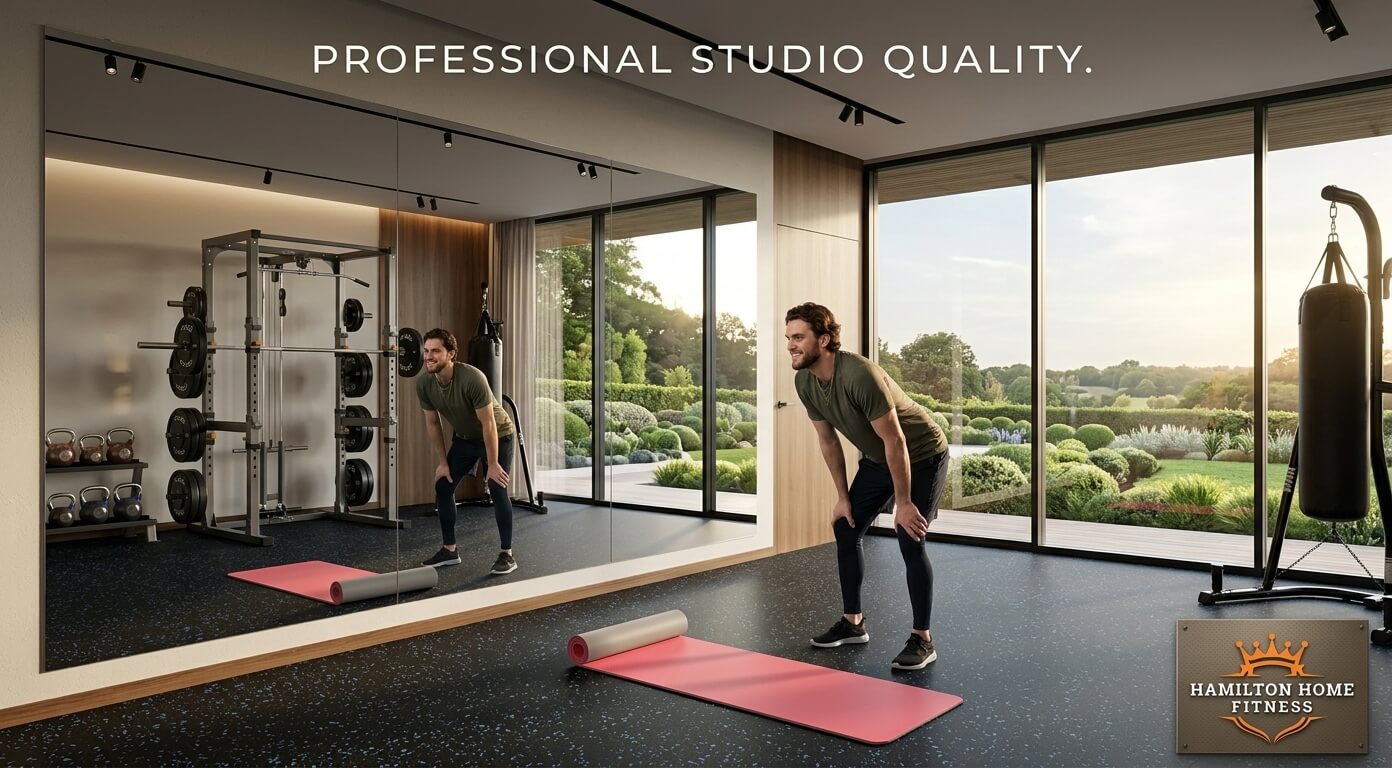
The working minimum for a home gym is a 24 by 48 inch panel. A 48 by 72 inch panel is the reliable single-station size, capturing a standing adult with arms overhead. Room depth changes the answer: the closer you stand, the less a given panel returns.
That last point gets skipped everywhere. A shallow basement bay needs more glass than a deep garage, not less.
Check the spec sheet on any mirror wall for the home gym build against your own wall run before ordering.
Minimum, ideal, and full-wall sizes
A 24 by 48 inch panel is the smallest that shows a full body once it is mounted correctly, and a 48 by 72 inch panel is the size that reliably captures a standing adult with arms overhead.
Take a 5'10" lifter squatting eight feet back. A 36 by 60 panel shows depth and knee tracking. Step in to five feet, and the same panel clips the head on a press.
24 x 48: single station, tight budget
36 x 60: form checks, most garage gyms
36 x 72: overhead work, taller lifters
48 x 72: one full station, arms raised
48 x 84: full-wall runs, studio feel
Sizes pair with a bottom-edge height, and the table below sets both together.
The stocked 48 by 72 inch mirror kit with safety backing is that single-station size at $525. One panel covers one station. A wall wider than about four feet needs a second panel or a different plan.
One panel or several side by side
Two 48-inch panels set side by side give an eight-foot reflective run, which is the standard way to cover a wide wall without moving a single oversized sheet through a doorway.
That doorway is the real constraint. A 48 by 84 sheet has to turn a basement stairwell, and glass does not flex.
Panels bring a seam and an alignment job. Polished edges butt tight, but each panel has to sit on the same plane, which an uneven wall fights. One sheet gives a clean reflection and a harder delivery. Two give an easier install, and a line down the middle you will stop noticing by week two.
How High to Mount the Bottom Edge
For standing and lifting work, the bottom edge sits 12 to 18 inches off the floor. For yoga, Pilates, and floor rehab, it runs close to floor level instead. Measure from the finished floor, not the subfloor.
That last word does real work. Lay rubber flooring for the finished floor height after the mirror goes up and every measurement moves.
Test it yourself. Stand where you actually train, and check you can see your feet.
Lifting and standing: 12 to 18 inches
For standing and lifting work, the bottom edge of a gym mirror sits 12 to 18 inches off the finished floor, which keeps the vulnerable bottom edge clear of rolling weights while still showing the feet.
The elevation buys you edge protection. A dumbbell that rolls does not reach the glass.
Then there is the constraint most people meet too late. Electrical outlets are conventionally installed with their tops around 24 inches, so in a finished room your panel either starts above them or needs cutouts. Cutouts are fabricated before delivery. Discover the outlet after the glass is cut and you have bought the wrong panel.
Yoga and floor work sit much lower.
For yoga, Pilates, and floor rehabilitation work, the mirror runs close to floor level, because your eyes are near the ground, and a panel mounted at lifting height shows you nothing useful.
Lying supine, a bottom edge at 18 inches reflects the ceiling back at you.
One room cannot serve both well. A squat rack wants the glass up and protected. Mat work wants it down where the edge is exposed to heels. Pick which use wins, and accept the compromise on the other. If floor work is the priority, yoga and studio gear are the sides to build around.
How Far the Mirror Sits From the Rack
Two different distances matter here, and most guides collapse them into one. Viewing distance decides whether the reflection is useful, and around six to eight feet lets you read knee tracking without clipping your head overhead. Impact clearance decides whether the glass survives the year.
Commercial floors lose mirrors often enough that operators treat replacement as routine maintenance. The usual cause is not a thrown weight. It is a dumbbell that lands, bounces, and travels. Position the power racks and cages so the mirror is beside your working position rather than directly behind where loads come down.
What the weight is made of changes the risk more than a few feet of floor does. Steel plates on a hard surface skip. Bumper plates absorb and settle.
So does what they land on. Thin matting lets a dropped dumbbell rebound; 3/4-inch rubber mats for drop zones kill most of that energy at the point of contact.
Work through these before you fix a position:
Nothing lands between you and the glass
Bumpers and thick matting in the drop zone
Bottom edge raised above rolling weight
Weight and bar storage on another wall
Side wall for the mirror where possible
Tempered, Annealed, or Safety-Backed?
Safety backing, not tempering, is the specification that matters for a gym mirror. Backing holds fragments in place if the panel breaks. For gym mirror thickness, 6 mm is the working floor, and panels above 48 by 72 want 8 mm to stop edge flex.
Home rooms and shared facilities sit at different tiers, and the difference is real—see residential and commercial equipment tiers before over-speccing a one-user space.
Ask a supplier for these:
Safety backing stated in writing
6 mm minimum, 8 mm on large panels
Low-iron glass for true color
Polished or finished edges
Cutouts fabricated before delivery
Final sizes confirmed before cutting
Why tempering can bend the reflection
Tempering makes glass stronger by heating and rapidly cooling it, but that process leaves stress in the panel that bows it slightly—and a reflective coating magnifies any bow into a visibly distorted reflection.
The glass trade has held this position on mirrors for a long time. Strength and flatness pull against each other, and a mirror is bought for flatness.
There is a second cost. Tempered glass cannot be cut after treatment, so every panel is ordered at final size with no margin for a measuring error.
Tempering still earns its place where bodies hit walls. Martial arts rooms are the clear case.
What safety backing actually does
Safety backing is a film bonded to the rear of the mirror that holds broken pieces in place instead of letting them fall, which is the specification that matters most in a room where weights move.
A bathroom or closet mirror almost never has it. That is the honest answer to whether a regular mirror will do: it will reflect you fine, right up until it doesn't.
The stocked panel lists safety backing explicitly, and that phrasing is the tell. A listing that does not mention backing does not have it. Backing reduces what happens when a panel breaks. It does not stop one breaking, and no mirror is shatterproof. Browse the wider gym accessories range once the glass is specified.
Mounting It Without Ruining the View
Standard gym mirror installation puts the weight on a channel anchored into structure, with adhesive as a secondary bond. Adhesive alone is not a mounting system for a panel this size, whatever the product page suggests.
Glass moves as fragile freight on a scheduled delivery, so read shipping and returns before you commit to a date.
A flat wall matters more than the glass.
A warped, funhouse reflection is almost always the wall rather than the glass, because a mirror bonded to drywall takes on every bow, seam, ridge, and patch behind it.
Panels ship flat. Walls are not. Drywall bows between studs, joint compound builds at the seams, and old patches sit proud of the surface.
Basements are the worst case and the most likely room. Settling, access panels cut into a wall and later filled, a decade of small repairs.
Then adhesive makes it permanent. The panel cures to whatever shape it was pressed against, and there is no adjusting it afterward. Run a straight edge across the wall first. Shimming happens during installation or not at all—worth raising when you book a gym design consultation.
Drywall, block, and rented walls
On drywall, the weight is carried by a channel screwed into studs with adhesive as a secondary bond; on block or concrete, adhesive is unreliable, and mechanical anchors do the work alone.
Drywall: J-channel into studs, plus mastic
Block or concrete: top and bottom tracks
Renting: lean panel, anti-tip strap, no drilling
Renters should settle the mounting question before ordering, not after the pallet arrives. Freight for glass is scheduled and hard to send back. If access or the wall is uncertain, contact us about freight first.
One line worth taking seriously. A 48 by 72 panel is a two-person lift, mounted above where you train, and it fails badly. Anything beyond a single small mirror is a professional installation.
FAQ
How much does a home gym mirror cost?
A ready-made frameless panel runs roughly $135 to $350. Installed mirror walls typically land between $1,000 and $4,500. The stocked 48 by 72 kit is $525, and free shipping covers Vortex fitness equipment.
Do I need cutouts for outlets and switches?
If an outlet or switch falls inside the panel's footprint, yes. Cutouts are fabricated before delivery and cannot be added once the glass is cut, so measure their positions before you order anything.
How do I clean a gym mirror without damaging it?
Avoid ammonia cleaners and never spray the glass directly. Liquid running into the edges degrades the backing and causes dark spots. Apply cleaner to a microfibre cloth instead, and wipe inward from the edges.
Can one person install a 48 by 72 inch panel?
No. A panel that size is a two-person lift at minimum, and a full wall is a professional job. For studio and facility installs, commercial fitness equipment is specified and fitted rather than self-installed.
Final Thought
Three numbers finish the job. A 48 by 72 panel for one station. A bottom edge at 12 to 18 inches, measured off the finished floor. Enough distance that nothing lands between you and the glass.
Insist on safety backing, and check the wall is flat before anything is ordered. Hamilton Home Fitness ships nationwide from Tennessee.