Introduction
Three tabs open, three products, none of them expensive. Behind the decision sits a half-remembered warning about ankle weights and your knees.
Weighted vest vs. ankle weights is not a question about how much weight. It is a question about where the weight sits. A vest rides near your center of mass. Ankle and wrist cuffs hang off the end of a swinging limb, and that distance decides what you train and what you risk.
This page compares tools, not people. If a joint already hurts, start with your doctor or physical therapist. If you would rather browse first, the wider body weight range is one click away.
Where Each Weight Sits on Your Body
A weighted vest sits on your torso, close to your center of mass. Ankle and wrist weights sit at the far end of a limb that swings through every step. That gap between the weight and the joint above it is what multiplies the work, and it multiplies the strain by exactly the same amount.
Think of it as a lever. The further the weight sits from the joint doing the moving, the more that weight is worth.
Why Weight on Your Feet Costs More
A pound strapped to your ankle costs your body several times more energy than the same pound sitting on your chest, because your leg has to accelerate it forward and stop it again on every single step.
Load-carriage research has produced a consistent ordering. Weight carried on the torso is the cheapest per pound. Weight in the hands costs more. Weight on the feet costs the most by a wide margin—several times the torso figure.
The honest limit: those measurements come from loads far heavier than a typical ankle cuff, so the ranking holds while the exact multiple at one or two pounds does not.
That cost is the whole appeal. Two pounds on each ankle makes a familiar walk feel harder, and harder feels like progress. It is also the reason people keep buying them for exactly the wrong activity.
The load you hold works differently again. A dumbbell sits at the end of your arm too, but you set it down between sets.
Why the Same Lever Loads Your Knee
The extra cost and the extra joint load are the same thing. The distance between the weight and the joint above it is what multiplies both, which is why you cannot buy one without the other.
Here the evidence is messier than the warnings suggest. Light ankle loading has been associated with better knee position sense, not worse, and one of the gait studies most often cited as proof of harm concluded that varied loading may actually improve walking measures.
What is well supported: added weight at the ankle changes stride length, cadence, and walking speed, and it shifts work toward the muscles at the front of the thigh.
What is contested: whether that translates into injury over time.
What nobody has measured well: the loads people actually buy. Most cuffs sold start at 2.5 pounds a side, which sits above almost everything that has been studied.
So the warning is not wrong. It is just stated as a rule when it is really a question about how much and on what activity. If a knee, hip, or ankle is already a problem, that question belongs with a clinician before it belongs in a cart—the rehab range is where that conversation usually ends up.
The One Rule That Picks Between Them
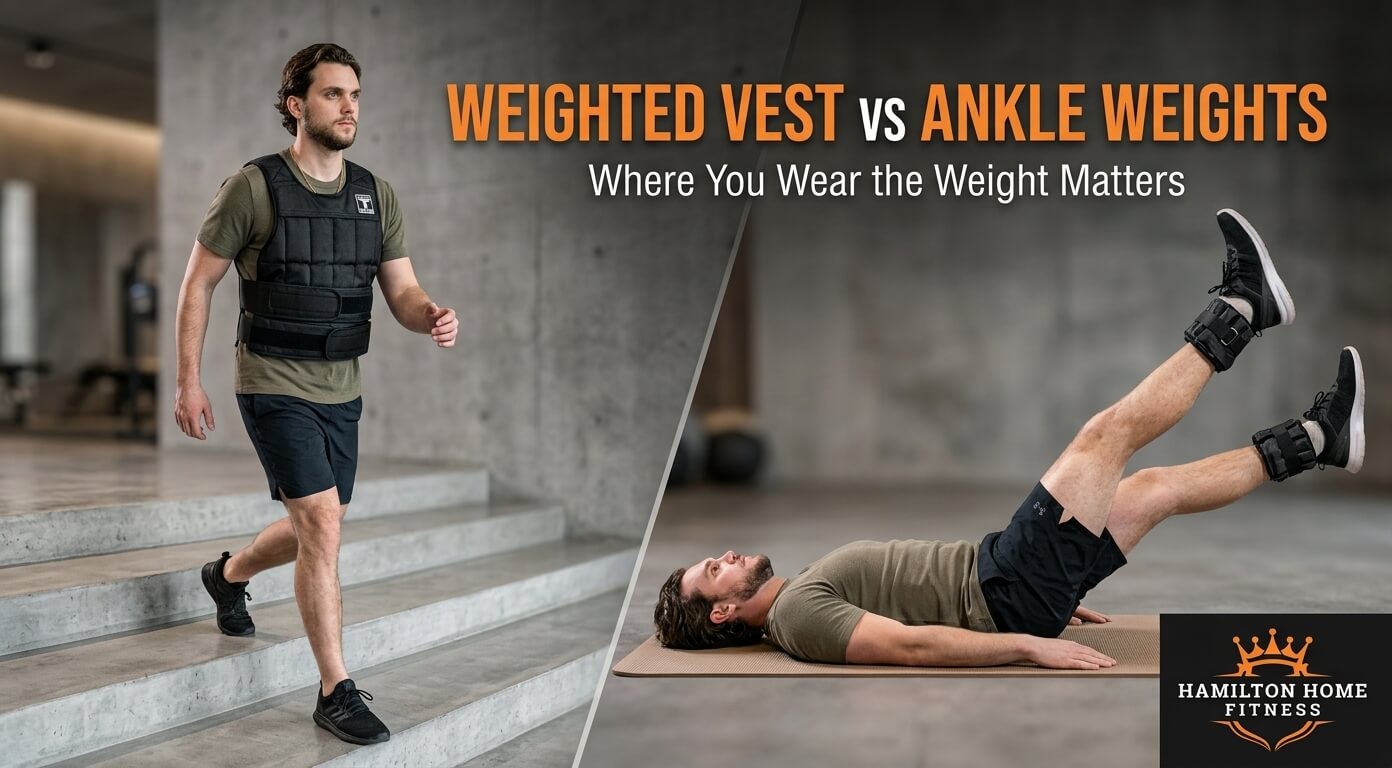
Wear the load on your torso for anything you do on your feet. Save limb load for work you do in one place. Walking is a swinging movement, and swinging is where the lever bites—a vest rides through it, and cuffs fight it.
A neighborhood walk is the clearest case. Your legs already swing, and your balance is already working. A vest adds resistance without changing your gait, which is why a weighted vest is the only one of the three that suits the activity.
A side-lying leg lift is the opposite case. Nothing swings, the hip does one job, and the long lever that unsettles your balance on a walk is exactly what makes the exercise harder. Adjustable ankle and wrist cuffs belong here.
The rule travels. Stairs, hiking, errands, a bodyweight circuit—feet moving, load on the torso. Mat work, seated exercises, and standing hip work—one position, load on the limb.
So weighted vests vs. ankle weights is not really the question. Name the activity first, and the tool names itself.
What Each One Actually Trains
A vest raises the cost of movement you already do. Ankle weights load one muscle group at a time. Wrist weights add a little upper-body demand to an arm swing. None of the three build meaningful size on their own, and none of them will decide where your body changes shape.
Here is the split, tool by tool:
Weighted vest—makes a walk, a hill, or a set of push-ups harder without changing how you move
Ankle weights—add resistance to one hip or knee movement at a time, on a mat or in a chair
Wrist weights—add modest demand to an arm swing, most useful when gripping something is the problem
One correction worth making, because the field gets it backwards. Plenty of pages claim a vest trains your upper body while ankle weights train the lower. Walk in a vest and your arms do almost nothing. The work lands on your legs, your hips, and the muscles holding your torso upright—the same places the load would land if you had simply gained the weight.
The bone-density claim needs the same honesty. Walking produces ground reaction forces near your own bodyweight. Running is closer to two and a half times that. Adding five or ten percent in a vest raises the number a little, and the evidence on whether that is enough to build new bone is genuinely mixed. Treat it as possible, not promised.
What none of them train is a movement your body cannot already do. A vest cannot give you a pulling motion. Cuffs cannot give you a press. If that is the gap you were trying to fill, resistance bands will do more for you than any wearable weight will, and a dual-purpose adjustable cuff is the wrong purchase for it.
The Risks and How to Avoid Them
Almost every problem with wearable weights traces back to two variables, and neither one is the product. Too much load at once, or too long spent carrying it. Both announce themselves as a change in how you move, well before they arrive as pain.
So use one test, and it covers all three tools. If the load changes your stride, your posture, your breathing, or your joint comfort, it is too heavy for that activity today. Soreness the next morning is ordinary. Sharp pain mid-session, or joint pain that turns up at the same moment every time, is not—stop rather than train through it.
Adding weight too fast is the common version. Move up in small steps and stay at each one for a few weeks; a 3.5 lb add-on plate progresses a vest without doubling it.
Duration is the quieter failure. A vest worn all day is not a longer workout—it is postural fatigue. Once your trunk tires, your lower back takes over, and you spend hours rehearsing a compensation instead of training. Twenty to sixty minutes is the useful window, and then it comes off.
Fit ends more vests than load does. One that bounces or rides up gets worn twice and lives in a closet after that, so talk to the team about fit if you are between sizes.
Which One Fits You, and What It Costs
The activity picks the tool, not the buyer. Train on your feet, and you want a vest, whatever your age or experience. Train on a mat or in a chair, and you want cuffs. Grip trouble is the one case where wrist weights are the right answer rather than a smaller version of a better one.
For most people walking, that means starting with something like Body-Solid's 20 lb premium vest and loading it well under capacity. It is the wrong buy if you already know you will never go past ten pounds—a lighter vest costs less and does the same job.
Rehab, Seniors, and Grip Problems
Light ankle and wrist cuffs are the sensible pick for anyone training in a chair, on a mat, or through a set of prescribed exercises, because the load stays on one muscle group and never has to survive a stride.
Two cases make this concrete. Someone working through a physical therapy sheet needs a pound or two that can sit on the ankle through a clamshell or a standing hip abduction. Someone whose hands give out before the muscle does—arthritis, a wrist injury, reduced grip—needs the weight attached rather than held, which is the one job a wrist cuff does better than a dumbbell.
Your provider sets the load and the movements here, not this page.
Body-Solid's ankle cuffs at $100 suit a routine you will run several times a week for months. For occasional floor work, they are more than the job needs.
Which Gives You the Most Per Dollar
The most load per dollar and the most training per dollar are not the same purchase. A single adjustable cuff set covers both wrists and ankles across a wide range for under forty dollars, but it cannot do the one thing a walker actually needs.
The York adjustable cuffs run $39.50 and adjust from 1.3 to 11 pounds per piece, up to 22 pounds for the pair. Nothing else on the site covers that much range, in two places on the body, for that money.
Vests start around $50 and run to just under $200. Body-Solid vests ship free, which York, Hudson, and Apollo do not—worth a few dollars on a small order.
So the cheapest useful answer depends on the rule, not the price tag. Floor and rehab work: the cuffs win outright. Walking: the York vest at $70 is the low-commitment way in, though anyone certain they will progress should buy adjustable and add plates instead of replacing the vest later.
FAQ
Which wearable weight is best for beginners?
A vest if you train on your feet, and light cuffs if you train on a mat. Experience isn't the variable—activity is. York Barbell covers both at the low end.
Can I use ankle weights if my knees already hurt?
Ask your doctor or physical therapist first. That is a clinical question, not a product one. Adding load at the end of a long lever is the wrong first experiment on a painful knee.
Are ankle weights good for Pilates and floor work?
Yes. These are exactly the stationary movements the rule permits—nothing swings, so the lever works for you rather than against you. Stay light enough that your control and range don't slip.
Can I wear a vest and ankle weights at the same time?
Not for anything on your feet. The two loads behave differently, and the ankle load is the one that changes your gait. If you want more resistance, add it to the vest—the 40 lb version exists for that.
Will ankle weights make my legs bigger?
No. They build strength and muscular endurance, not size—that takes heavier loading. And you can't choose where your body changes shape. Conditioning gear does more for how legs look.
Final Thought
Load on the torso for anything you do on your feet. Load on the limb for work you do in one place. That single rule outlasts any product comparison, and it answers activities this page never mentioned.
Pick the tool that matches what you already do, start lighter than feels impressive, and let the load follow the habit rather than the other way round. Hamilton Home Fitness ships to all 50 states from Tennessee, and shipping and returns are straightforward if the first load turns out to be the wrong one.