
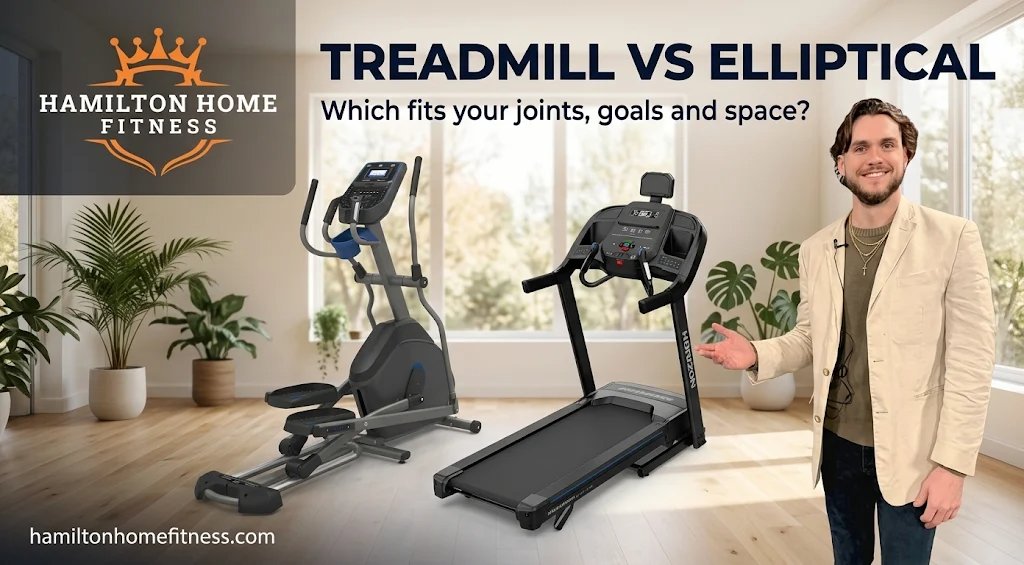
You have room for one cardio machine, knees that grumble after a jog, and guides that each crown a different calorie winner. The honest treadmill vs elliptical answer turns on three checks: joints, goal and room.
The treadmill leads for running, incline walking and fold-away rooms; the elliptical leads for achy knees, shared floors and arm work. A wrong pick can be a 277-lb mistake, so we check each point against two same-price Horizon Fitness machines.
Coming back from injury or surgery? Clear the motion with your doctor or physical therapist first.
Joint Impact: Knees, Bones and Balance
For your joints, the elliptical is the lower-impact machine because your feet never leave the pedals. Running on a treadmill lands at roughly two to three times body weight per stride, and walking at about one to one and a half. Elliptical pedal forces stay at or below walking levels.
Bad Knees: Which Machine to Try First
For most achy knees, start on the elliptical and let next-day soreness decide. One catch: its deeper knee bend under load can flare kneecap (front-of-knee) pain. If it does, switch to flat treadmill walking.
After surgery or injury, let your doctor or physical therapist choose. If both machines hurt, recumbent bikes with back support are the lowest-impact option.
Bone Density: Do Both Machines Count?
Yes, both count as weight-bearing exercise, because your legs carry your body weight on either machine. Bone-health groups list elliptical training and fast treadmill walking as low-impact ways to keep bones strong, while jogging's higher impact helps build bone. With osteoporosis or a past fracture, ask your doctor first.
Seniors: Why Balance Comes Before Impact
For older adults, steadiness matters more than impact. A treadmill belt keeps moving, so it suits steady walkers who use the rails and safety key; the 7.0 AT starts at 0.5 mph. An elliptical has no belt, but the 7.0 AE's pedals sit 10.75 inches up, so grip the handles. Mount and dismount only at a full stop.
Weight Loss: Effort Beats the Machine
Weighing treadmill vs elliptical for weight loss? Neither machine burns more by itself. Calories follow effort and minutes, so pick the one you'll use hardest and most often each week, and stick with it.
30 Minutes: Elliptical or Brisk Walk?
Thirty minutes on an elliptical beats a treadmill walk only when you push harder. Energy tables score a brisk 3.5 to 3.9 mph walk at 4.8 METs (multiples of your resting burn) and moderate elliptical work at 5.0. For a 180-lb adult, estimated calories in 30 minutes:
Brisk treadmill walk: about 205
Moderate elliptical: about 215
Hard elliptical: about 385
Console calorie readouts are estimates too.
Incline Walking vs the Elliptical
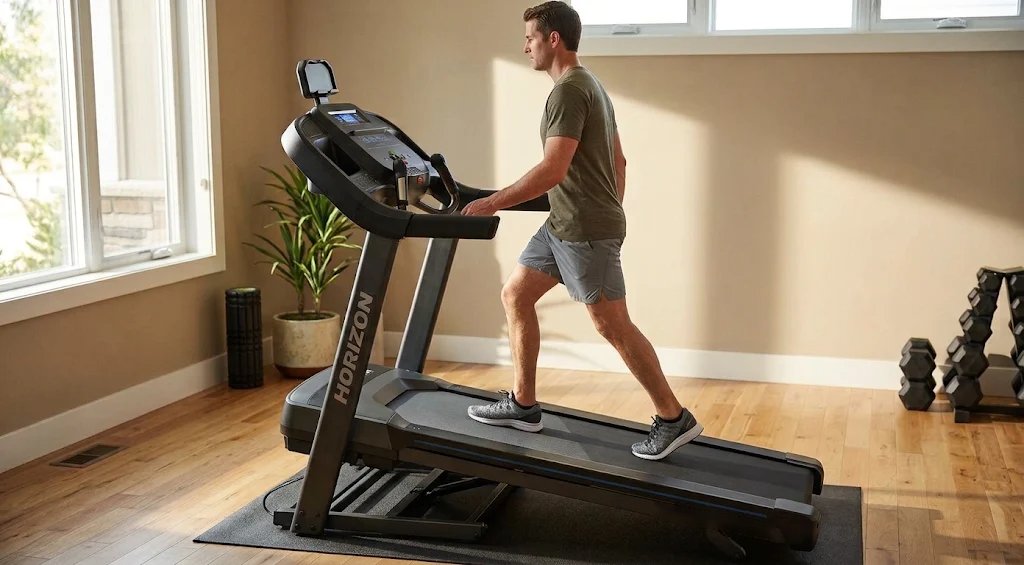
An incline walk lets a treadmill outwork a moderate elliptical session without running impact. Brisk uphill walking at a 6 to 10% grade rates about 7 METs, roughly 40% more than moderate elliptical work, or about 300 calories in 30 minutes at 180 lb. That extra work is what incline does to a treadmill walk. Build grade slowly to spare your calves and Achilles.
Elliptical Miles, Steps and Minutes
No, five elliptical miles aren't five treadmill miles: consoles estimate distance from pedal turns and an assumed stride, while a treadmill measures belt travel. For steps, 10,000 taken at a moderate 100 a minute is about 100 minutes of walking near 3 METs. An estimated 60 minutes of moderate elliptical work, near 5 METs, covers the same effort.
Home Gym Fit: Floor, Folding and Power
For a home gym, the room decides: a folding treadmill suits a space with another job, while an elliptical suits a corner that stays set up. Check four things first:
In-use footprint plus the clear zone behind a belt
Stored footprint, if the room has other uses
Headroom: tallest user plus step-on height
A grounded outlet on its own circuit
Tight room? Get a free 3D layout of your room.
Floor Space and Which One Folds
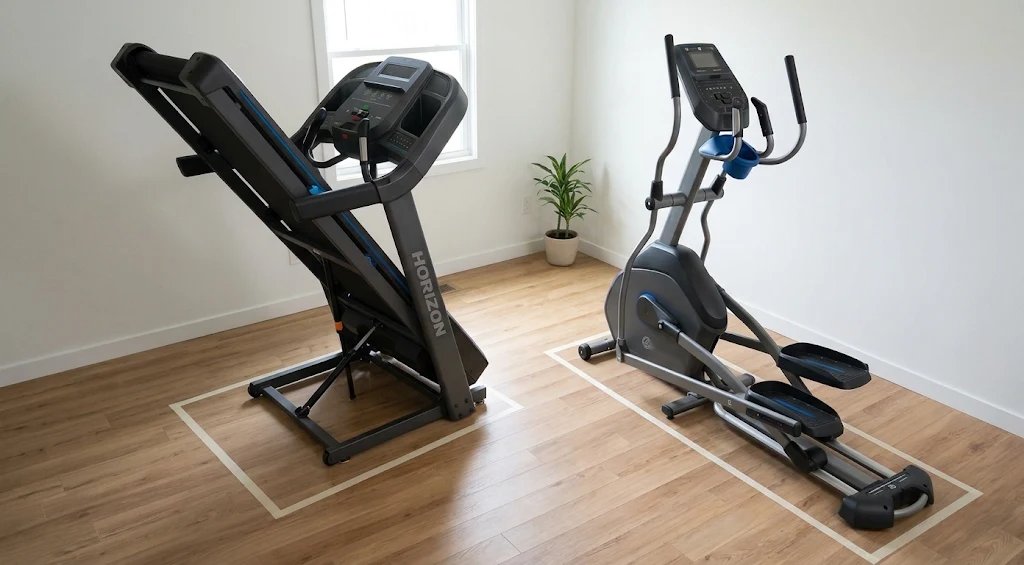
Only the treadmill folds in this pair, and folded it takes less floor: about 10.7 square feet, standing 68 inches tall. In use, the 7.0 AT needs about 18.5 square feet plus a clear zone, which our ceiling height and floor space guide measures. The non-folding 7.0 AE takes about 12.7 square feet, though it runs 11 inches narrower than the treadmill.
Do Ellipticals Need an Outlet Too?
A powered elliptical usually does. Horizon's manual asks for a grounded outlet on a dedicated circuit of 15 amps or more for the 7.0 AE, as for the 7.0 AT. Dedicated means nothing else shares that breaker.
The treadmill also isn't GFCI-compatible, a snag in many basements, and Horizon's support terms rule out rooms without temperature control, such as garages. With no usable outlet, the self-powered Endurance E5000 needs none, though it lists at $2,860 as of November 11, 2026.
Same Price Test: Horizon 7.0 AT vs 7.0 AE
When the elliptical vs treadmill price is equal, compare motion, footprint, user limit, warranty and power. Horizon's home-use 7.0 AT and 7.0 AE both list at $999 on our site as of November 11, 2026.
Spec | 7.0 AT treadmill | 7.0 AE elliptical |
Price | $999 | $999 |
Motion | 0.5–12 mph, 0–15% incline | 20" stride, 20 magnetic levels, power incline |
Footprint | 76" x 35" in use; folds to 44" x 35" | 76" x 24"; does not fold |
Max user | 325 lb | 325 lb |
Warranty | Lifetime frame/motor, 3-yr parts, 1-yr labor | Lifetime frame/brake, 3-yr parts, 1-yr flywheel/labor |
Power | Grounded, dedicated 15+ amp circuit; no GFCI | Grounded, dedicated 15+ amp circuit |
When the 7.0 AT Treadmill Fits
The 7.0 AT suits walkers and runners up to 325 lb who need the floor back after each workout. On the Horizon 7.0 AT folding treadmill, a one-step hydraulic fold clears the room after a morning walk. Skip it if a user tops 325 lb, you want a 22-inch deck, or impact bothers your knees.
When the 7.0 AE Elliptical Fits
The 7.0 AE suits achy-kneed users up to 325 lb who want arm work and can give it a permanent spot. The 7.0 AE's full spec sheet shows moving and fixed handles plus power incline on a 24-inch-wide frame. Pass if it must fold away or deep knee bend bothers your kneecaps.
Its 10.75-inch step-on height rises with the incline, so check your ceiling; taller users can confirm a 20-inch stride with our elliptical stride length by height guide.
Which Should You Buy? Pick by Situation
An elliptical is better than a treadmill when sore joints, a shared floor or upper-body work top your list. A treadmill is better when you run, walk hills or need the floor back after workouts. Boiled down, the pros and cons give one pick per situation:
Achy knees or hips: start on the elliptical
Training for a race: the treadmill
Brisk or incline walking: the treadmill
Upstairs room or shared wall: the elliptical
Room that doubles as an office: a folding treadmill
Want your arms working too: the elliptical
If you lean treadmill, compare home treadmills by deck size and incline range.
Leaning elliptical? Browse home ellipticals by stride and drive to match your height and room.
FAQ
Which is better for losing belly fat, a treadmill or an elliptical?
Neither targets belly fat, because your body doesn't burn fat from the spot you exercise. Fat comes off everywhere through total activity and diet, so choose the machine you'll use longer and harder.
Which works more muscles, a treadmill or an elliptical?
The elliptical, if you push and pull its moving handles: arms, chest and upper back join in, and glutes tend to work harder than in walking. A treadmill works mainly your legs; incline walking adds glutes, hamstrings and calves.
Can elliptical sessions replace runs when I'm training for a race?
Some, but not all. Elliptical work holds aerobic fitness, yet trained runners who replaced every run with it for five weeks still ran slower time trials. Keep your key runs and use the elliptical for easy extra volume.
Which machine is quieter in an upstairs room or apartment?
Usually the elliptical: no foot strike, no belt motor. A treadmill is quieter at a walk than at a run. Under either machine, rubber flooring or an equipment mat softens what travels to the room below.
Final Thought
Choose by your hardest limit: knees and shared floors point to the elliptical, while running, incline walking and a room that must fold point to the treadmill. Horizon is a private-invoice brand here, so if the pair fits, call 423-458-2453 to confirm stock, delivery cost and delivery date. Read our return terms first, since returns carry a 25% restocking fee.