
Introduction
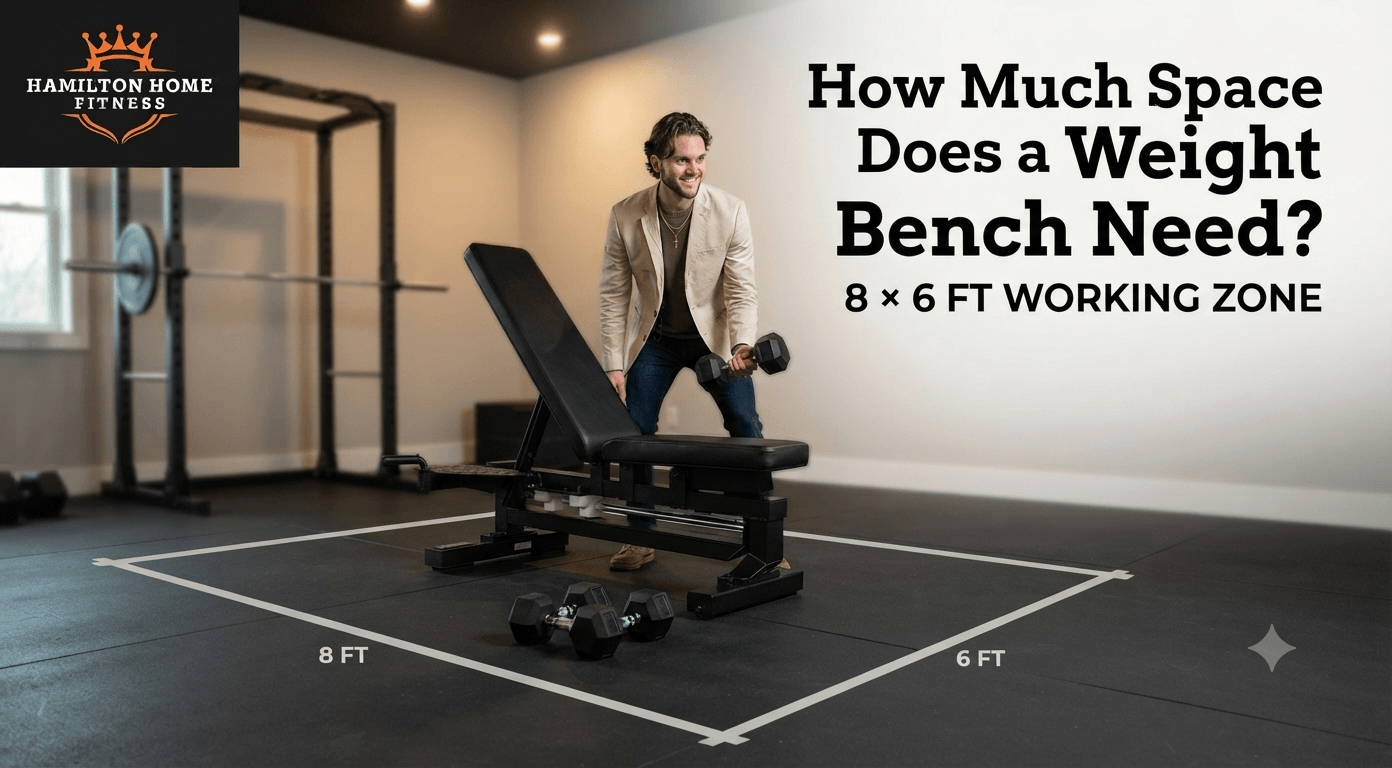
A weight bench needs about 6 square feet of floor. To actually train on one with dumbbells beside it, plan on closer to 48—a working rectangle near 8 by 6 feet.
That's the trap. A 48-inch bench does not need 48 inches of room. Product pages list the bench at rest, never in use.
If you're measuring a garage bay, spare bedroom, or basement corner, that gap decides whether the bench fits—or ships back on a freight truck. Here's the real rectangle, the ceiling number, the rack clearance, and when folding is the honest answer.
Weight Bench Dimensions and Footprint
Most flat benches run 45–50 inches long and 15–19 inches wide. Adjustable and FID benches run longer, near 50–55 inches, and are taller through the backrest. A bare bench takes roughly 6 square feet. That figure is accurate—and it is not what you reserved.
Bench Type | Typical Length | Typical Width | Pad Height | Space Note |
Flat | 45–50 in | 15–19 in | 17–18 in | Smallest footprint |
Adjustable / FID | 50–55 in | 15–20 in | 17–19 in | A backrest adds length |
Olympic | 50–55 in | Up to 50 in | 17–18 in | Built-in rack widens base |
Folding | 45–55 in | 15–20 in | 15–19 in | Stores flat or upright |
Flat vs Adjustable Bench Dimensions
A flat bench is shorter and simpler. An adjustable bench trades a few inches of length for every angle you'll ever need.
Those four inches on paper become two feet in the room—an FID needs standing space behind the backrest to change angles. Note base width and leg spacing too; they decide rack fit later. Pull up flat bench dimensions to compare against the FID you're weighing.
Why 17 Inches Is the Standard Height
Most benches sit 17 to 18 inches from floor to pad—close to IPF competition specs, which land near 17 inches.
The reason is leg drive: pushing through your feet to stay stable. Feet flat on the floor, or you lose it. A taller pad also lifts your seated head, which tightens the ceiling math coming up next.
Some strong benches sit near 18½ inches. That's a trade-off, not a defect—know it before you buy.
How Much Clearance a Weight Bench Needs
Bench length + 2 feet at the head + 2 feet at the foot = your working length. Bench width + arm sweep + a loading lane on each side = your working width. A 4-foot bench lands near an 8 × 6-foot rectangle for dumbbell work alone.
Side, Head, and Foot Clearance
Leave 2 to 3 feet on each side of the bench and 3 feet of walkway anywhere you pass behind it. That's elbow room, dumbbell room, and spotting room.
Head and foot each need about 2 feet—dumbbells go down behind your head, and legs swing off the end. Both need floors.
How far from the wall? Two feet minimum; three is better. Park a bench 8 inches off the wall, and you'll learn why: on that side there's nowhere to rack a dumbbell and no clean way to bail a rep.
Barbell Loading Space
A 7-foot Olympic bar is longer than most benches are wide. Plan around 10 feet so you can stand at each end and load plates.
Size the room to the bar, not the bench. A 4-foot bench in a 7-foot room reads fine—until you slide a 45 on and your knuckles find drywall.
Plate storage eats more. A weight tree needs its own footprint and can't sit in the bar's path. Budget Olympic barbells and weight plates as one zone.
Ceiling Height for Seated Pressing
Measure it, don't guess. Sit at your steepest incline, press your arms overhead, and mark the ceiling above your knuckles. Add 9 inches — the radius of a 45-pound plate, the part that hits first.
Clears? Press seated. Doesn't? Three options: smaller plates, a lower incline, or dumbbells.
This is where pad height returns. Every extra inch of bench puts your knuckles an inch nearer the joists—which is why, in a 7-foot basement, a small spec difference becomes a real one.
Will a Bench Fit Inside a Power Rack?
Most adjustable benches fit inside a standard power rack, but fitting between the uprights isn't the same as fitting well. Base design decides it. A wide or long base can collide with rack feet or safety arms, pushing the bench off-center and shifting your pressing groove.
Measure two things first: the rack's inside width between uprights and the bench's widest point at the base—usually the feet, not the pad. Then check the safety arms. A bench can clear the uprights and still fight the arms you need low for pressing.
The feature worth looking for is a passive rack lock. The bench's rear seats are into the rack's stringer—the crossbar low on the frame. Nothing clamps. It drops in, so the bench can't creep or twist mid-set.
Compare inside widths across power racks and cages before you commit to either piece.
Folding Benches and Upright Storage
A well-built folding bench is stable enough for most home lifters. But a hinge is a compromise, and it shows in the numbers: folding frames typically carry lower load ratings than fixed ones. Cheap folding benches lose the most—that's where the wobble comes from, not from folding itself.
Now the part nobody tells you: upright storage is not free.
A bench stored on end still occupies wall space and needs ceiling height above it. Worse, some folding benches can't stand on end at all — the wheels won't let them balance — and plenty don't fold flat enough to slide under a bed. Read the stored dimensions before you plan the corner they'll live in.
Wheels change the math entirely. A bench you can roll away needs clearance only while you're using it, not permanently. The ST Multi-Function Bench with transport wheels is worth considering if that's your constraint: it stores at 48 × 24 × 19 inches, rolls on two wheels, and its rear seats into a compatible rack.
Total Floor Space by Room Type
Reserve roughly 40–50 square feet for a bench and dumbbells. Add a rack and a barbell, and you're closer to 70. A 10 × 10 room handles all three comfortably. A 6 × 8 corner handles a bench and dumbbells—and nothing else.
Space | Typical Size | What Fits | What Doesn't |
Apartment corner | 6 × 8 ft | Folding bench, adjustable dumbbells | Barbell, rack |
Spare bedroom | 10 × 10 ft | Bench, dumbbells, rack | Cardio too |
Basement corner | 8 × 10 ft | Bench, dumbbells, short rack | Overhead pressing |
Single garage bay | 10 × 20 ft | Bench, rack, bar, plates | Car, once loaded |
Bench Plus Dumbbells: The Real Total
Dumbbells don't live on the bench. They live on the floor beside it—and that floor is part of your footprint.
A rack of hex dumbbells is 3 to 7 feet long. Adjustable pairs shrink that to a corner. Either way, you lean over to pick them up, so leave 2 feet in front to reach without clipping the pad.
Garage, Spare Room, or Apartment
Yes—a bench fits in most apartments, provided it stores away and you accept that dumbbells do the work. No barbell. No rack.
A spare bedroom is the sweet spot, but measure honestly: door swing and closet clearance can eat 12 square feet before you set anything down.
A basement corner works until you press overhead—check your ceiling first. A single garage bay fits everything, but not with the car still in it.
Start with adjustable weight benches built for tight spaces and filter by stored footprint.
Measure Before You Buy: A Quick Check
Tape the working rectangle onto your floor. Lie down inside it. Sweep your arms as if pressing dumbbells. If that motion hits a wall, a shelf, or a car, the bench is too big for the room—not the other way around.
Then run these four:
Mark the rectangle. Bench length plus 2 feet at each end. Bench width plus a loading lane on each side.
Check the ceiling. Sit at your steepest incline, press up, and add 9 inches for the plate.
Measure the doorway and the delivery path. Most benches ship fully assembled. A stair turn can stop a 55-inch frame that clears the door with room to spare.
Confirm the stored spot. If it folds, measure where it will actually stand.
Laying out the whole room, not just the bench? Book a gym design consultation, and the team can spec it before you order.
FAQ
Do I need rubber flooring under a weight bench?
Usually, yes — and the reason is load concentration, not scratches. A bench puts your bodyweight plus loaded dumbbells onto four small feet. That's a far higher load per square inch than a treadmill. Rubber matting spreads it and protects concrete, tile, or hardwood. On carpet, a mat also stops the bench rocking as the pile compresses.
How heavy is a weight bench, and can one person move it?
Most home benches run 50 to 90 pounds. With transport wheels, one person can tilt and roll a bench without help. A fixed-frame bench with no wheels is a two-person lift for most people—and genuinely awkward on stairs.
Will a weight bench fit through a standard doorway?
Usually. A standard interior door is 30 to 32 inches wide, and most benches are under 26 inches, so the width is clear. The real risk is length on stair turns. Fully assembled benches ship ready to use and can't be narrowed to get around a corner.
Final Thought
The bench's listed footprint was never the number that mattered. The working rectangle is—and you can measure yours tonight.
Roughly 8 by 6 feet for a bench and dumbbells. More once a barbell joins them. The ceiling was checked, and the doorway was checked.
With those numbers in hand, choosing a bench stops being a guess. Compare weight benches by type and filter by the footprint your room can actually hold.