
Introduction
Your cardio corner is a detached garage, basement wall, or barn stall, and the nearest outlet sits across the room or yard. Non-electric cardio machines let you train there without an extension cord taped across the floor, which is a trip hazard, not a plan.
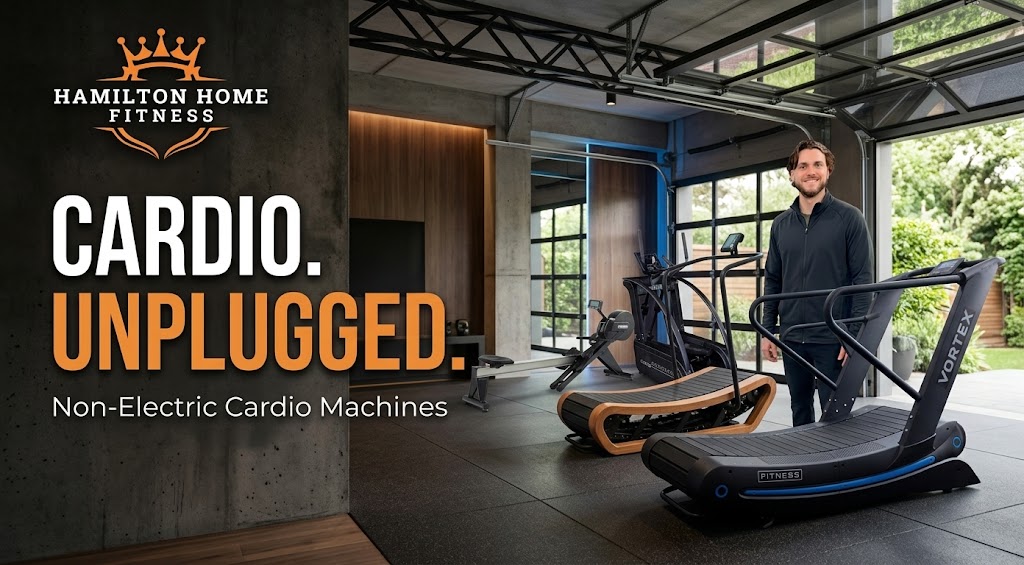
Four types in our full range of home cardio machines need no outlet: curved or manual motorless treadmills, air bikes, and self-generating rowers and ellipticals. They differ in what powers the screen, how hard the effort feels, and how much floor they take.
The decision table below sorts them first, and real models follow, each with its limits.
Which No-Outlet Machine Fits Your Space?
Choose a motorless treadmill to walk or run, an air bike for short, hard intervals in a small footprint, or a self-generating rower or elliptical for low-impact work with a full console. None of these non-electric cardio machines needs a wall outlet.
Machine | What moves it | What powers the screen? | How it feels | Best for | Skip it if |
Motorless treadmill | Your stride turns the belt. | Varies by model | More effort than a motor belt | Walking, jogging, and sprints | You need a held speed or incline. |
Air bike | Pedals and handles spin a fan | Usually batteries (AA or D cells) | Resistance rises with effort. | Hard intervals, small rooms | Fan noise and wind bother you. |
Self-generating rower | Your stroke spins a flywheel. | A built-in generator | Seated, smooth, and full-body | Low-impact work, full console | Getting down to the floor is hard. |
Self-generating elliptical | Your stride spins a flywheel. | An internal generator | Standing and gliding, low impact | Joint-friendly cardio with programs | You want to run. |
No-outlet machines compared by drive, screen power, and fit.
The table picks the type; each product page settles on console, size, and user limit.
Do Non-Electric Machines Need Any Power?
Most exercise equipment that doesn’t need electricity still has a screen, and the screen is where power hides. Motorless treadmills can need none, air bikes use batteries, and self-generating machines make their own.
Check each listing’s power line, not its category: the Spirit XS895 HIIT Trainer sits in our elliptical range but requires power.
Motorless Treadmills: No Power at All
A non-electric treadmill uses no electricity: your stride turns the belt, so it runs without a cord.
Resistance doesn’t change that. The Vortex CVX2500 offers six levels on an all-mechanical drive, and the Sunny Smart Ultra adds eight magnetic levels with no power required. Our self-powered curved treadmills all run on user power.
Air Bikes: Do They Need Electricity?
AirBikes don’t need an outlet: your legs and arms spin the fan that makes the resistance, and most consoles run on batteries.
The Schwinn Airdyne AD6 takes two AA batteries; Concept2’s PM5 uses two D cells, topped up by the flywheel. Pack spares, not a cord, when you compare air bikes for home and commercial floors, and check the listing on any bike with electronic resistance.
Self-Generating: How the Screen Gets Power
A self-generating elliptical or rower has a small generator on its flywheel, so your stride or stroke makes the power that lights the display and sets resistance.
The Endurance E5000 Self-Generating Elliptical runs 20 levels, programs, and wireless heart rate this way, and the Spirit Fitness CRW800 rower needs no plug either. Most displays fade soon after you stop. Home machines keep the power for their own console; only a few commercial systems feed it back into a building.
Will You Lose Your Workout Data?
No. Most non-electric exercise machines still record time, distance, or calories, and generator-powered models add programs and heart rate. What you give up are the motor features: a held speed, powered incline, and streaming classes.
Here is what each power tier typically records, though consoles vary by model:
Zero-power treadmills: a digital monitor on some, nothing on others
Battery consoles: time, distance, calories, and watts on Concept2 ergs with the PM5 monitor
Generator consoles: programs, heart rate, and resistance levels
Every tier: no held speed, powered incline, or streaming
The Spirit Fitness CRW800 magnetic rower shows what a generator console adds. Its built-in generator runs a 5.5-inch LCD, and controls on the handle change resistance mid-stroke. A 15-inch frame height makes it easier to get on and off. If you only want basic numbers, a simpler rower costs less than its $1,799.99 listing (October 2026).
Are Self-Powered Machines Harder to Use?
Yes, for treadmills: at the same pace, a self-powered treadmill takes more effort because you move the belt as well as yourself. Air bikes and air rowers only resist as hard as you push, and self-generating ellipticals offer low levels, so easy sessions stay easy.
Can You Walk Easily on a Manual Treadmill?
Yes, you can walk on a manual treadmill, but every step does the belt’s work, so a slow walk feels heavier than on a motor deck, and starting takes a push.
If steady daily walking at one held pace is your main use, a plug-in deck may suit you better. If walks mix with jogs and intervals, a self-powered deck works well. Walk your first few sessions, start on the lowest resistance, and hold the rails lightly until your stride settles.
If you have a heart, joint, or balance condition, check with a physician or physical therapist first.
How Do They Handle Sprints and Intervals?
For sprints and intervals, a self-powered machine responds at once: push harder and it speeds up, ease off and it slows, with no motor ramp in between.
Try 30 seconds hard and 90 seconds easy on a curved deck. Drive forward to speed up and drift back to slow down. You never touch a button. On an air bike, resistance climbs with effort, so a beginner and a trained athlete can share one machine.
Where Can a No-Outlet Machine Go?
Gym equipment that doesn’t need electricity can go anywhere with a level, covered floor: a detached garage, basement, barn, covered porch, or off-grid cabin. A plug-in treadmill needs an outlet, and some need a dedicated 20-amp circuit, like Spirit’s CT850 and CT900.
Garage, Basement, or Spare Room Corner
In a garage or basement, check the footprint, clearance, and max user weight before anything else.
APE Wood Motorless: 56.3 x 33 in, 265 lb max user
Sunny Smart Ultra curved: 67.7 x 29.9 in., 330 lb max. user
Schwinn Airdyne AD6: about 50 x 26 in., 300 lb max. user
Concept2 RowErg: 9 x 4 ft of floor, clearance included
The hardwood-frame APE motorless treadmill suits walkers and joggers under 265 lb, but it is rated residential only, with no incline setting.
Rowing instead? Compare the self-powered rowing machines in our range.
A garage corner also has to cope with heat, cold and damp; Gym Space Guide shows what to fix first in a garage gym's climate.
Barn, Porch, or Off-Grid Cabin
In a barn, porch, or off-grid cabin, a no-outlet machine keeps running through outages, but it still needs a roof, a level floor, and a clean belt.
Keep it off bare dirt and out of rain, check the manual’s temperature and humidity guidance, and plan the freight route from truck to floor.
The Vortex CVX2500 curved treadmill suits this job: an all-mechanical drive with six levels, listed to run through power interruptions. At 74 x 34 in and $2,799 (October 2026), it’s a poor pick for tight rooms or slow daily walks.
FAQ
Are non-electric treadmills better than electric ones?
Neither wins outright. A non-electric deck drops the motor, cord, and power bill, and it responds instantly in intervals. An electric deck holds a set speed and changes incline for you, which suits long, steady sessions. Our curved manual vs motorized treadmill comparison goes deeper.
Do exercise bikes need electricity?
Many don’t. Air bikes and bikes with a manual tension knob run on pedal power, with battery or generator consoles. Bikes with electronic resistance, touchscreens, or streaming classes need an outlet. The Spirit Fitness self-generating line includes the 4.0U upright bike, which needs no wall power.
What routine care do motorless treadmills, air bikes, and self-generating machines need?
Less than motor machines. Keep belts, slats, and rails free of grit, check and tighten bolts, wipe sweat off frames, and replace console batteries when the display fades. Follow the owner’s manual for any lubrication or service schedule.
Final Thought
Non-electric workout equipment comes down to three calls: power, space, then effort. Walk or run on a motorless treadmill, sprint on an air bike, or go low impact on a self-generating rower or elliptical.
Check the max user weight and footprint on the product page, then call 423.458.2453 for a freight quote. Spirit Fitness, Vortex, and Body-Solid machines ship free; our freight and return terms cover the rest.