
Introduction
Three flooring products, the same recycled rubber in all of them, and a price per square foot running from under a dollar to nearly six. Nothing explains the gap.
The short version: format decides how the floor installs, how easily you can change it later, and how finished the room looks. Thickness and density decide the price. Most comparisons blur those into one.
So whether you're doing a garage yourself, renting and needing the floor to leave with you, or covering a pillared room, rubber rolls vs. tiles gym flooring is a question of shape and tenure. Every price below comes from stock at Hamilton Home Fitness.
Rolls, Tiles, or Mats: The Short Answer
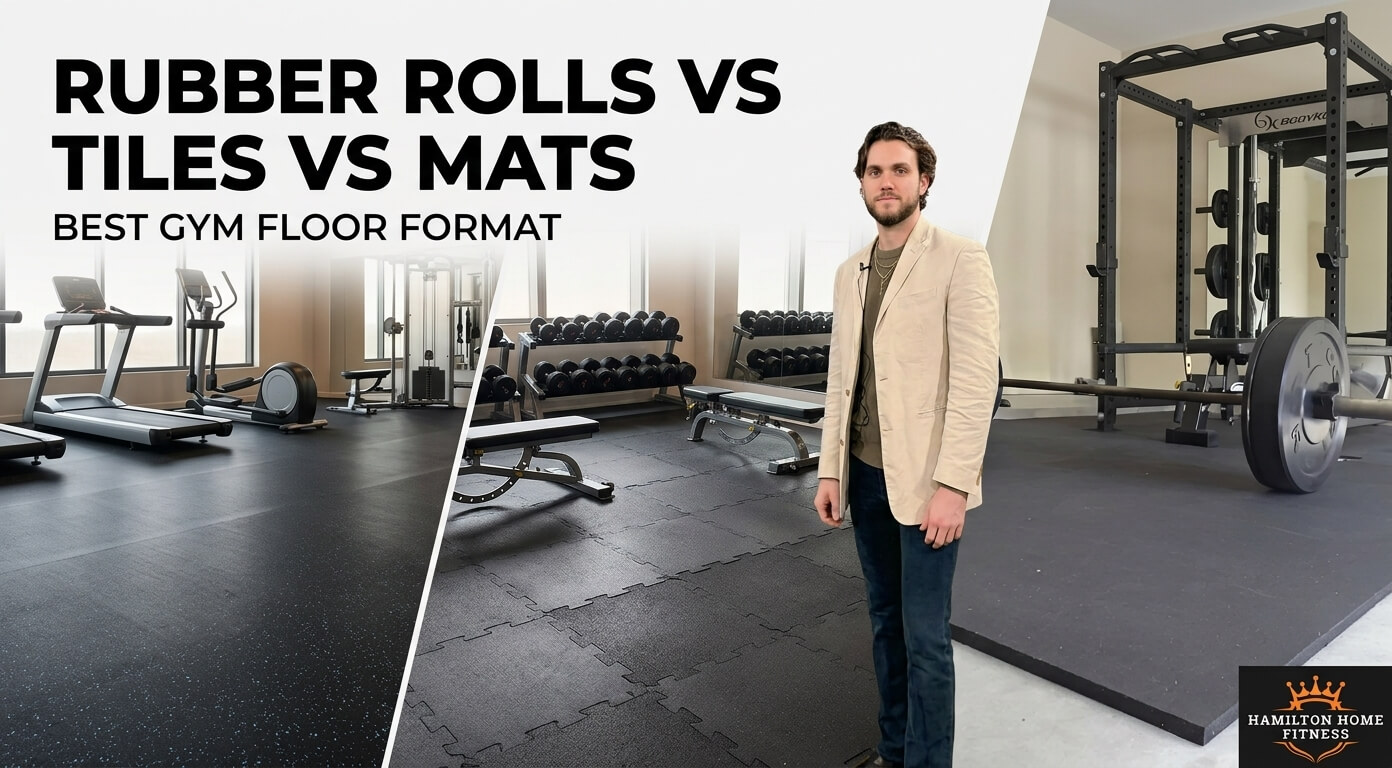
No format wins outright. Rubber rolls suit large rectangular rooms because fewer pieces mean fewer seams and a continuous finish. Interlocking tiles suit odd shapes and solo installs because every cut wastes one tile, not a four-foot width. Rubber mats suit drop zones because thickness beats coverage where weight lands.
Rolls earn their place on the open floor. A room with straight walls and no obstacles takes two or three runs of the Vortex 8 mm rubber rolls, leaving a couple of seams instead of a grid. Cut that same roll into a pillared space, and it wastes material across its full four-foot width.
Tiles trade that finish for control. You lay them alone, work around a doorway without a straight edge, and lift one out later. The gym mats versus rolls question barely gets asked, because most comparisons drop mats. A straight-edge mat is not cheap flooring—it is spot armor, laid where a bar lands and nowhere else.
What Each Format Really Costs
The format does not set the price. Thickness, density, and brand do. On stocked flooring, the cheapest option and the most expensive option are both interlocking tiles, which is the opposite of how nearly every cost comparison frames it.
That matters because buyers rule out a whole format on price when the real spread sits inside each one. Before you compare formats, compare specs—and price the install separately, since the commercial gym equipment buying guide treats those as two line items for good reason.
Price Per Square Foot, Ranked
On stocked gym flooring, the price per square foot runs from under a dollar to roughly six—and both ends of that range are interlocking tiles, not rolls.
Format | Coverage per unit | Price per sq ft |
12 mm tiles, 4-pack | 16 sq ft | ~$0.94 |
8 mm rolls, 4×15 ft | 60 sq ft | ~$3.75 |
6 mm tiles, bulk | 200 sq ft | ~$4.50 |
3/4" mats, 4×6 ft | 24 sq ft | ~$4.79 |
7/16" puzzle pack | ~10.8 sq ft | ~$5.81 |
Prices are verified for August 2026 and are subject to change.
York Floorguard tiles with edging anchor the bottom. Cheap per square foot, sold in small packs—fine under cardio or a stretching corner, not the choice under a loaded rack.
Small body-solid puzzle-mat packs sit at the top. Per square foot they are the dearest way to cover a room, so buy them for a corner and nothing larger.
What the Install Itself Costs
Tiles are almost always the cheapest to install because they need no adhesive, no crew, and no specialist cut—but that saving shrinks fast in a large open room where rolls go down in a fraction of the time.
Fifty tiles is fifty alignments. Two roll runs is two. For roughly 400 square feet of open floor, professional gym equipment installation often costs less in labor than the hours a DIY tile grid takes.
Branded inlays and logos change the maths again, since custom and branded floor installs are quoted as a finished job rather than materials plus your weekend.
Which Rooms Break Which Format
Every obstacle in a room is a cut. Every cut in a roll wastes material across its full four-foot width. Every cut in a tile wastes one tile. That single difference is why pillared and irregular rooms favor tiles no matter what the per-square-foot figure says.
Picture a two-car garage with a support column near the middle and a step down to a side door. Trimming a roll around that column means cutting into a four-foot run and losing the offcut. Twelve tiles touch the same column, and only the four that meet it get trimmed. BodyKore 2×2 interlocking tiles handle that geometry without a waste calculation.
Edges and doorways behave the same way. A wall that runs out of square, a threshold that has to stay clear, an alcove holding the water heater—each is another cut, and each costs a roll more than it costs a tile. Zoning the room first helps here, which is what planning a commercial gym layout is for.
Then there is later. A tiled floor grows by adding pieces at the edge. A rolled floor grows by ordering a matching run and living with a fresh seam. If the room is likely to change, book a gym design session before you order rather than after.
For a garage slab, Gym Space Guide compares seven garage gym floor types against dropped weights, a parked car and a damp slab.
How Hard Each Format Is to Install
Tiles are a one-person job at any room size. Mats are a two-person job per piece, every piece. Rolls depend entirely on roll length—not on rolls being inherently unmanageable, which is what most guides imply.
That distinction matters on delivery day more than on install day. Anything heavy arrives by freight, so check how freight delivery works before you plan who is helping you carry it.
Roll Weight and Two-Person Reality
A rubber roll's weight comes from its length, not from being a roll—an 8 mm roll runs roughly two pounds per square foot, so a shorter roll is a manageable one-person carry, while a fifty-foot run is not.
Do the arithmetic on the size you are actually buying rather than the size the internet quotes. Cutting is the easier half: a sharp utility knife, a straight edge, several shallow passes instead of one deep one, and a scrap piece underneath.
Shorter stocked lengths across the Vortex range are what make a roll workable solo. The limit is honest—one long continuous run in a big open room still wants a second pair of hands to keep the edge true.
Why Tiles Shift and How to Stop It
Interlocking tiles shift when the floor is too small to hold itself together, when the perimeter is left loose against a wall, or when equipment drags rather than sits. Each has a different fix.
Work through these before blaming the tiles:
Cover wall to wall so edges compress
Tape the perimeter on partial-room layouts
Lift equipment into place; never drag it
Add border pieces where edges stay exposed
A small floating island of eight tiles will always creep. Larger York Barbell tile layouts hold themselves once the perimeter has something to push against.
Damage, Repairs, and Moving Out
Tiles are the only format where damage costs one piece instead of a whole run. They are also the only format a renter can lift, stack, and reinstall somewhere else without losing the floor they paid for.
Think about what one dropped plate actually costs you. A torn tile is replaced by pulling it and clicking in a spare. A tear in the middle of a fifteen-foot roll run leaves you patching a visible seam or pulling the entire run—and if that run was glued down, removal is its own bill. Spot armor avoids the question entirely, which is why 4×6 mats at three-quarter-inch thickness sit where the bar lands rather than across the room.
Tenure is the same argument with a moving van attached. A renter or a short-lease studio should stay modular, because loose-laid tiles come up in an afternoon. Density is what makes them worth moving, so check the rating before you buy twice—the distinction between commercial versus residential gym equipment applies to flooring as much as to racks.
One honest note on wear: most floor damage is a plate problem, not a flooring problem. Switching to bumper plates that soften the drop protects any of the three formats better than buying thicker rubber does.
FAQ
Do you need glue for rubber gym flooring?
Not for most home installs. Tiles and mats hold by weight and interlock alone. Rolls can be loose-laid or taped at the perimeter, and adhesive is reserved for high-abuse commercial zones where zero movement is the requirement.
Are horse stall mats good for a home gym?
Yes, for a lifting platform, with three caveats. It is near-identical dense rubber, but each 4×6 mat runs close to 100 pounds, the initial odor is strong in an enclosed room, and shipping can rival the mat price—so it is a collect-in-person buy.
Can I mix rolls, tiles, and mats in one room?
Yes, and most working gyms do. Rolls across open cardio and machine zones, tiles where the room turns awkward, and thick mats under the rack. One catch: formats at different thicknesses need a transition at the join.
Do rubber mats alone protect against dropped barbells?
Mostly, at three-quarter-inch thickness with controlled lowering. For repeated loaded drops, add body-solid barbell crash pads rather than more flooring—a pad absorbs the impact, while a floor only spreads it.
How do I order flooring for a whole facility?
By quote, not by cart. Large-area orders ship freight, some brands run on private invoices, and delivery access affects the cost, so request a freight quote rather than estimating.
Final Thought
Two decisions, not one. Room shape and how long you'll be there—pick the format. Thickness and density set the price. Treating those as a single question is what sends buyers to the wrong product.
You have both answers now. Measure length by width, add a margin for cuts, and browse the rubber flooring collection with your format already settled.