
Introduction
Bumper plates absorb dropped Olympic lifts and protect your floor. Iron plates load heavier in less space at a lower cost per pound. Most serious garage and basement gyms end up running both.
If you deadlift past 405, snatch, clean, or program metcons that finish overhead, the wrong plate type costs you a cracked floor, a bent bar sleeve, or a setup that physically can't hold the weight you're chasing.
This guide compares both plate types across drop tolerance, bounce, sound, dimensions, and discipline-specific use cases for powerlifting, Olympic lifting, and CrossFit—then shows how to mix them safely and what to pair them with.
Bumper Plates vs Iron Plates at a Glance
Bumper plates absorb dropped Olympic lifts and protect floors, while iron plates load heavier in less space at a lower cost per pound—most serious home gyms benefit from a hybrid set of both.
Feature | Bumper Plates | Iron Plates |
Drop tolerance | Built for overhead drops | Not designed to be dropped |
Bounce | Low to dead bounce (durometer 80–90) | Hard, unpredictable rebound |
Sound | Muted thump | Sharp metallic clang |
Diameter | Standard 450 mm across all weights | Varies by weight |
Thickness (45 lb) | ~75–85 mm | ~25–45 mm |
Cost per pound | Higher | Lower |
Best for | Olympic lifting, CrossFit, dropped deadlifts | Powerlifting, controlled lifts, max sleeve loading |
What Each Plate Type Actually Is
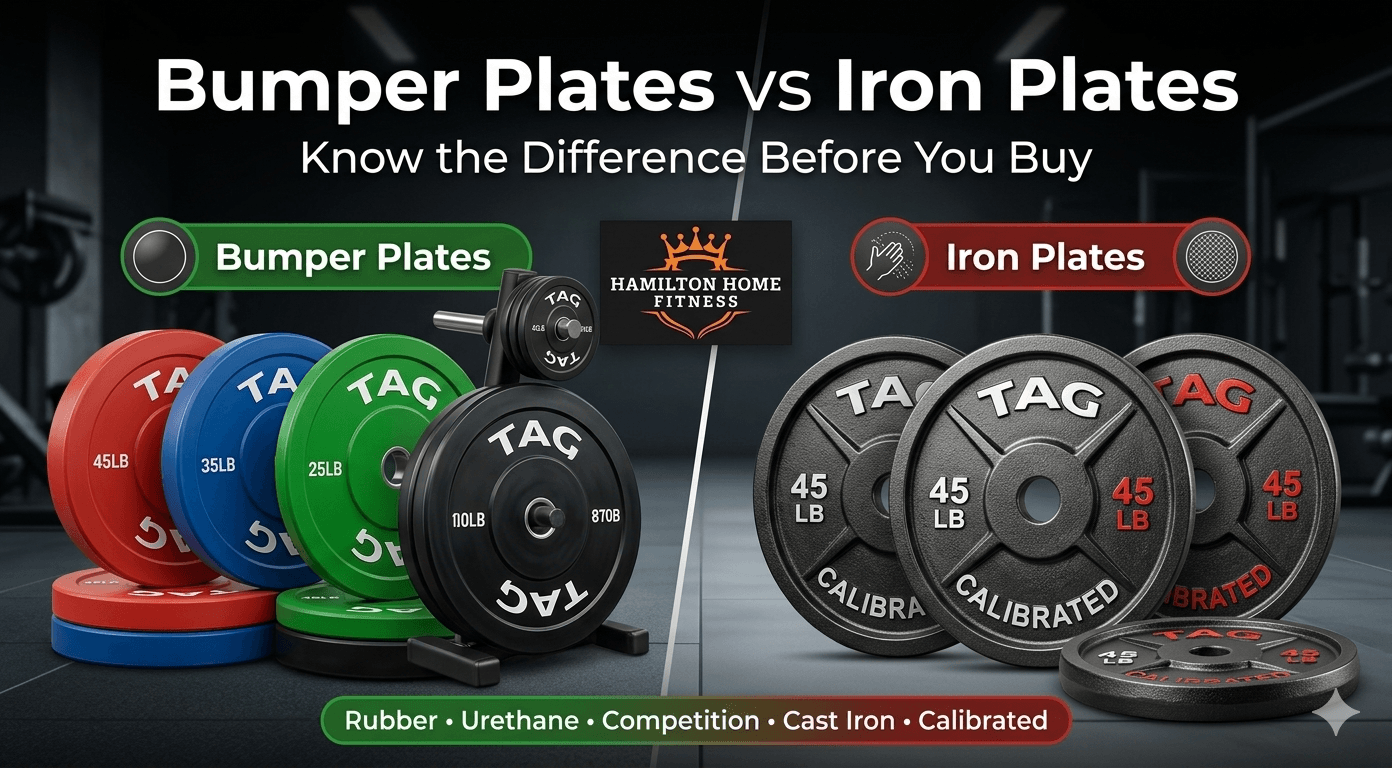
Bumper plates are steel-hub plates wrapped in rubber or urethane built to be dropped; iron plates are bare cast iron or machined steel built to be loaded but not dropped.
Bumper Plate Types: Rubber, Urethane, Hi-Temp, Crumb, Competition
Bumper plates split into four practical categories — virgin rubber training, urethane, hi-temp, and crumb rubber — plus competition plates as a precision tier above all of them.
Virgin rubber training bumpers use fresh, unrecycled rubber with a durometer around 80. They give a moderate bounce, smell less than recycled rubber, and handle daily home-gym use well.
Urethane bumpers use a denser man-made polymer with a higher durometer (around 90). They bounce less, resist scuffing, hold color coding sharply, and survive heavier abuse — at a noticeably higher price.
Hi-temp bumpers are made from heat-cured recycled rubber with a thicker profile. They take outdoor heat well and are common in CrossFit affiliates, but they're wider per pound than virgin rubber, eating sleeve space faster.
Crumb rubber bumpers use ground recycled rubber pressed into a plate. They're the budget tier, with a softer feel, more bounce, and often a stronger rubber odor when new.
Competition bumper plates sit above all four. They meet IWF specifications: ±1% weight tolerance, exact 450 mm diameter, chrome or stainless steel hub, IWF color coding (red 25 kg, blue 20 kg, yellow 15 kg, green 10 kg, white 5 kg), and a tested dead bounce designed to keep the bar near where it landed.
Iron Plate Types: Cast Iron, Machined, Calibrated
Iron plates range from rough-cast economy plates (±3% tolerance) to machined plates with a tighter fit to calibrated steel plates built to IPF specifications (±10 g tolerance).
Cast iron plates are poured into a mold, finished with enamel or hammertone paint, and sold by weight in pounds or kilograms. They're the cheapest per pound, but tolerances are loose and edges vary.
Machined plates start as cast iron, then get machined to truer dimensions and a tighter collar fit. They cost more, sit flatter on the bar, and load more cleanly side by side.
Calibrated powerlifting plates are the precision tier. Built to IPF color coding and dimensions, they hold ±10 g tolerance through calibration plugs on the back of the plate, use a precise 50 mm collar opening, and run thin enough to load 700 lb on a standard Olympic bar. They're the standard for IPF and USA Powerlifting meet platforms. For a closer look at the competition tier, see Hamilton Home Fitness's calibrated competition plates.
Drop Tolerance, Bounce, and Sound
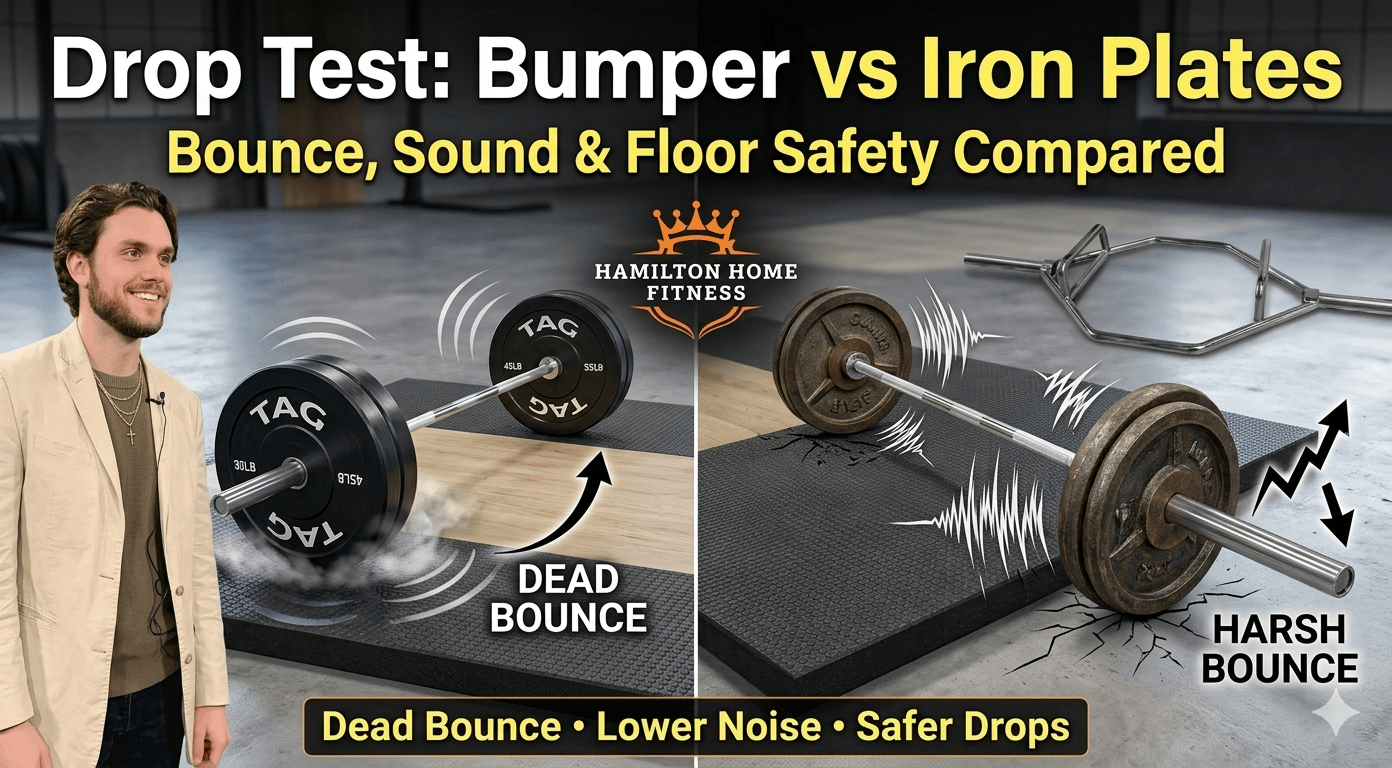
Bumper plates are designed to be dropped from overhead; iron plates are not—dropping iron cracks plates, dents bars, and damages floors.
Drop Tolerance: What Each Plate Can Survive
Quality bumpers are tested for thousands of overhead drops; iron plates can chip or shatter on the first hard drop and will damage barbell sleeves on impact.
Bumpers absorb impact through the rubber or urethane that wraps the steel hub. The hub keeps the plate centered on the bar while the rubber dissipates force into the floor—ideally a lifting platform, deadlift platform, or three-quarter-inch rubber mat over concrete.
Iron is brittle on impact. A dropped 45 lb cast iron plate can crack at the hub, chip on the edge, or bend the bar sleeve it lands on. Repeated drops also break apart concrete subfloors and crack horse stall mats faster than bumpers do.
The safest rule: if the bar might leave your hands above the waist, the plates touching the floor need to be bumpers.
Bounce and Dead Bounce Explained
Bounce is measured on the Shore durometer scale—softer rubber (around 80) bounces more; harder urethane and competition rubber (around 90) give a dead bounce that keeps the bar from skipping back at the lifter.
A bouncy plate sends the bar traveling after it lands. On a snatch bailout or a missed jerk, that means the bar can rebound into your shins, the rack, or the wall behind you. Dead bounce keeps the bar near the drop point, which matters for safety and for resetting between reps.
Training bumpers in the 80-durometer range bounce noticeably—fine for deadlifts and CrossFit metcons, less ideal for repeated overhead drops. Competition plates and urethane bumpers in the 88–90 range are the closer-to-dead-bounce tier built for Olympic lifting.
Sound: How Loud Each Plate Type Really Is
Iron plates ring sharply on contact; rubber and urethane bumpers thump and absorb—bumpers are the better choice for shared walls, basement gyms, and early-morning sessions.
A loaded bar of iron plates clangs every time the plates slide against each other on the sleeve, and the ring carries through floors and walls. In a basement under a bedroom or a garage that shares a wall with a neighbor, that noise is the difference between a sustainable training time and complaints.
Bumpers don't eliminate sound, but they replace the clang with a duller thump. Pairing bumpers with rubber flooring or a lifting platform compounds the effect. If you train before sunrise or after kids' bedtime, this single difference often decides the purchase.
Diameter, Width, and Sleeve Space
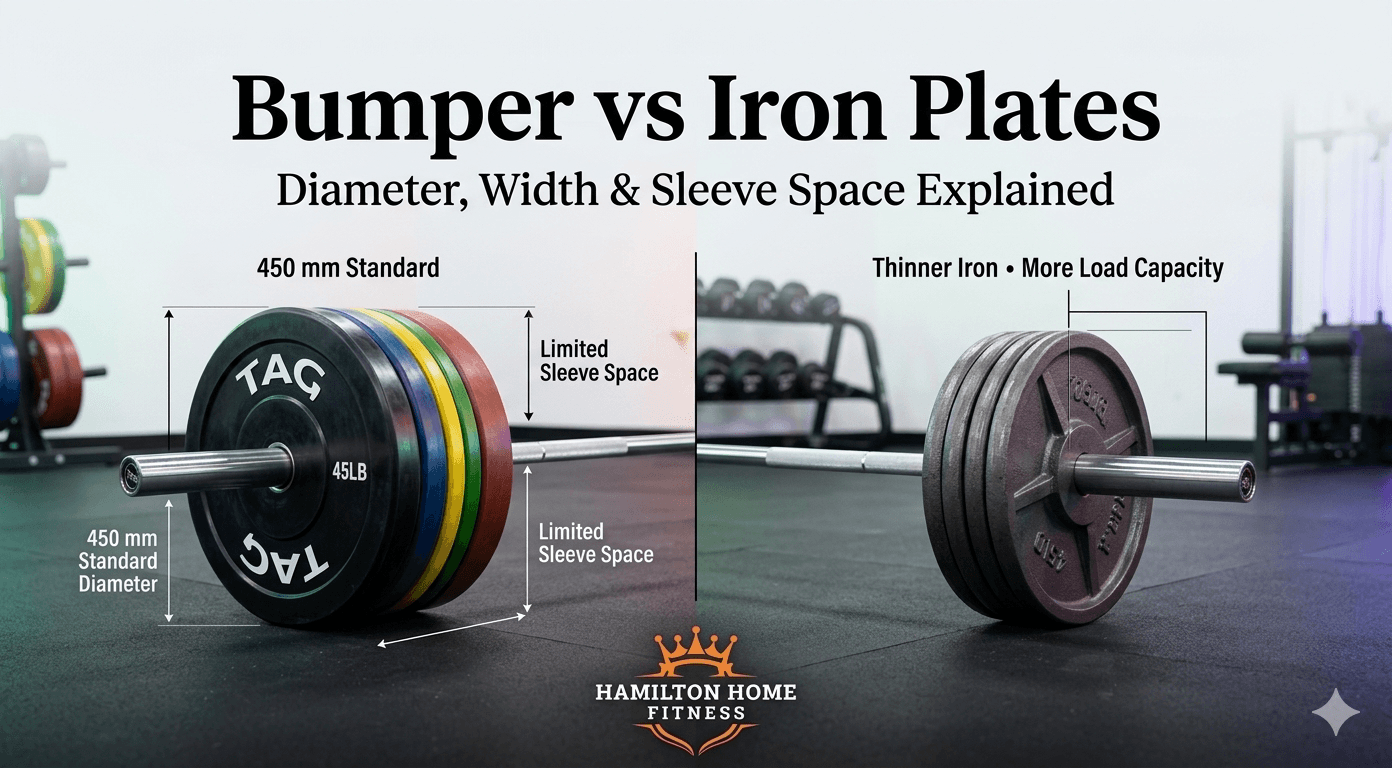
Bumper plates standardize at a 450 mm diameter regardless of weight; iron plates vary by weight and are much thinner, letting more total weight fit on the same bar sleeve.
Diameter Standards: 450 mm and Why It Matters
Bumpers are 450 mm, so the bar starts at a consistent 8.75 inches off the floor for every Olympic lift, regardless of the weight on the bar.
That consistency matters more than it looks. A snatch pulled from a 450 mm plate teaches the same start position whether the bar is loaded to 95 lb or 225 lb. Mixed-diameter plates change the pull height every set, which breaks the groove on Olympic lifts and shifts deadlift mechanics at lighter loads.
Two exceptions are common. Change plates (0.5–2.5 kg) are small steel discs added to fine-tune competition lifts without affecting bar height because they sit between larger bumpers. Technique plates (often 5 or 10 lb) are sometimes sold at the full 450 mm diameter so beginners can practice from the correct height—useful for learning the snatch and clean before pulling heavy.
Plate Width and the 500 lb Question
A 45 lb bumper is roughly 75–85 mm thick, while a 45 lb calibrated steel plate is roughly 25–30 mm thick—a standard 16.5-inch sleeve fits about four to five 45 lb bumpers per side, capping a bumper-only loadout near 450–500 lb.
The math is straightforward. A 16.5-inch sleeve gives you about 419 mm of loadable space per side after the collar. Five 45 lb bumpers per side at 80 mm each is 400 mm—tight but possible. Add a 5 lb collar, and you've reached 455 lb on the bar with no room for change plates or warm-up adjustments.
If you pull above 500, you have three real options: switch the outer pairs to iron 45s, move to thinner calibrated steel for the inside loaders, or run a hybrid setup from the start. Most lifters chasing 600+ lb deadlifts at home go hybrid.
Collar Opening: 50 mm and 2-Inch Fit
Olympic plates use a 50 mm (1.96-inch) collar opening—calibrated plates run tighter for a precise fit, while budget cast iron may run looser and rattle on the sleeve.
The difference is small in millimeters but real in feel. Calibrated plates with a 50.4 mm opening grip the sleeve so tightly that a cheap bar with an oversized sleeve simply won't accept them. Budget cast iron at 51–52 mm slides on easily but clatters during squats and cleans, and the wobble shows up on the bar path.
Before ordering plates, check the sleeve diameter on your bar. A precision-spec bar (typically 49.5–50 mm sleeve) pairs cleanly with calibrated plates; a generic Olympic bar usually pairs better with bumpers or standard cast iron. To match your plates to a bar built for the right tolerance, browse Hamilton Home Fitness's Olympic and powerlifting bars.
Use Cases by Discipline
Powerlifters get more from calibrated iron, Olympic lifters need bumpers, CrossFit programming demands bumpers, and most hybrid lifters end up running both.
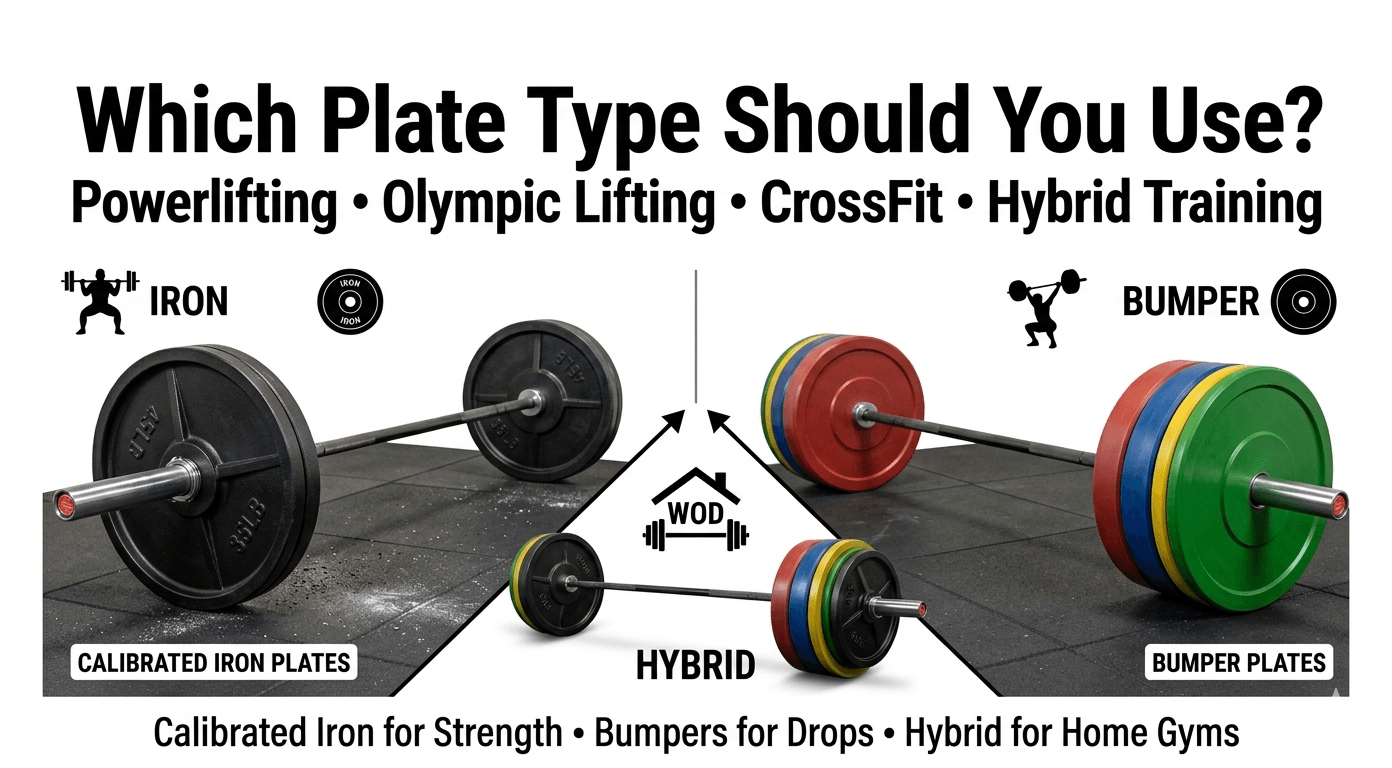
Powerlifting: When Calibrated Iron Wins
For powerlifters, calibrated steel plates win on accuracy (±10 g), thin profile for stacking heavy deadlifts, and the bar feel that matches IPF and USA Powerlifting meet platforms.
Accuracy compounds at heavy loads. A 1–3% tolerance on a 500 lb deadlift is 5–15 lb of unknown weight—enough to invalidate a training PR or sandbag a meet attempt. Calibrated plates hold ±10 g across the set, so the bar feels identical from session to session.
The thin profile matters as much as the accuracy. Stacking six or seven calibrated 25 kg plates per side is realistic on a standard sleeve; stacking the same in bumpers is not. For conventional and sumo deadlifts above 500 lb, that loadable space is the deciding factor.
Casual powerlifters and intermediate hybrid lifters under 500 lb can train productively on machined cast iron. The calibrated upgrade earns its price once meet prep starts or once attempts cluster within 5 lb of a true max.
Olympic Lifting: Why Bumpers Are Non-Negotiable
Olympic lifts end overhead—and Olympic lifters miss lifts—so the bar must be droppable without destroying plates, the bar, or the floor, which only bumpers allow.
A missed snatch lands a loaded bar from above your head. A failed jerk does the same. A clean catch in a bad position gets dumped forward. None of these are mistakes you'll stop making—they're a built-in cost of training the lifts at intensity.
Bumpers absorb that drop. Iron does not. Beyond safety, the consistent 450 mm diameter gives you the same pull height on every set, which is how the snatch and clean groove gets built in the first place. Training bumpers (durometer 80) work for most home Olympic lifters; competition-spec or urethane plates with dead bounce are the upgrade once attempts get heavy or floor space tightens.
CrossFit: Bumpers Plus a Few Iron Plates
CrossFit programming drops the bar from overhead between rounds, so bumpers are required — iron only enters the picture for occasional heavy strength work above the practical bumper ceiling.
A typical metcon—thrusters, push presses, power cleans, and snatches—finishes with the bar dropped from the top. Doing that on iron destroys equipment within weeks. Bumpers absorb the impact, reset quickly between rounds, and let you train at pace without watching the floor.
Iron earns a spot for heavy strength days outside the metcon: a 500 lb deadlift, a max-effort back squat above what bumpers can stack, or accessory work where you're not dropping the bar. For most CrossFit-style home gyms, a complete bumper set covers 90% of training, and a pair of iron 45s handles the rest. Hamilton Home Fitness's Bumper Plates collection covers training, crumb rubber, and competition tiers in one place.
Hybrid Training: The Setup Most Home Lifters Actually Need
Most serious garage gyms end up with a pair of 45 lb bumpers per side for drops plus 45 lb irons for stacking—a hybrid setup that covers deadlifts, cleans, squats, and metcons without compromising any of them.
The pattern is simple: bumpers handle anything that gets dropped, and iron handles anything stacked above the bumper ceiling. A starter hybrid might be two pairs of 45 lb bumpers, two pairs of 45 lb irons, and a full progression of smaller plates from 25 down to 2.5. From there, you add bumpers as your Olympic work scales and iron as your deadlift climbs.
This isn't a compromise — it's the setup most experienced lifters build over time. Buying it from the start saves the cost of replacing a single-type set later.
Building Your Plate Set
A complete home set means a base bumper pair, mid-weight bumpers or iron for warm-ups, and change or fractional plates for progression—totaling 230 to 500 lb depending on your training ceiling.
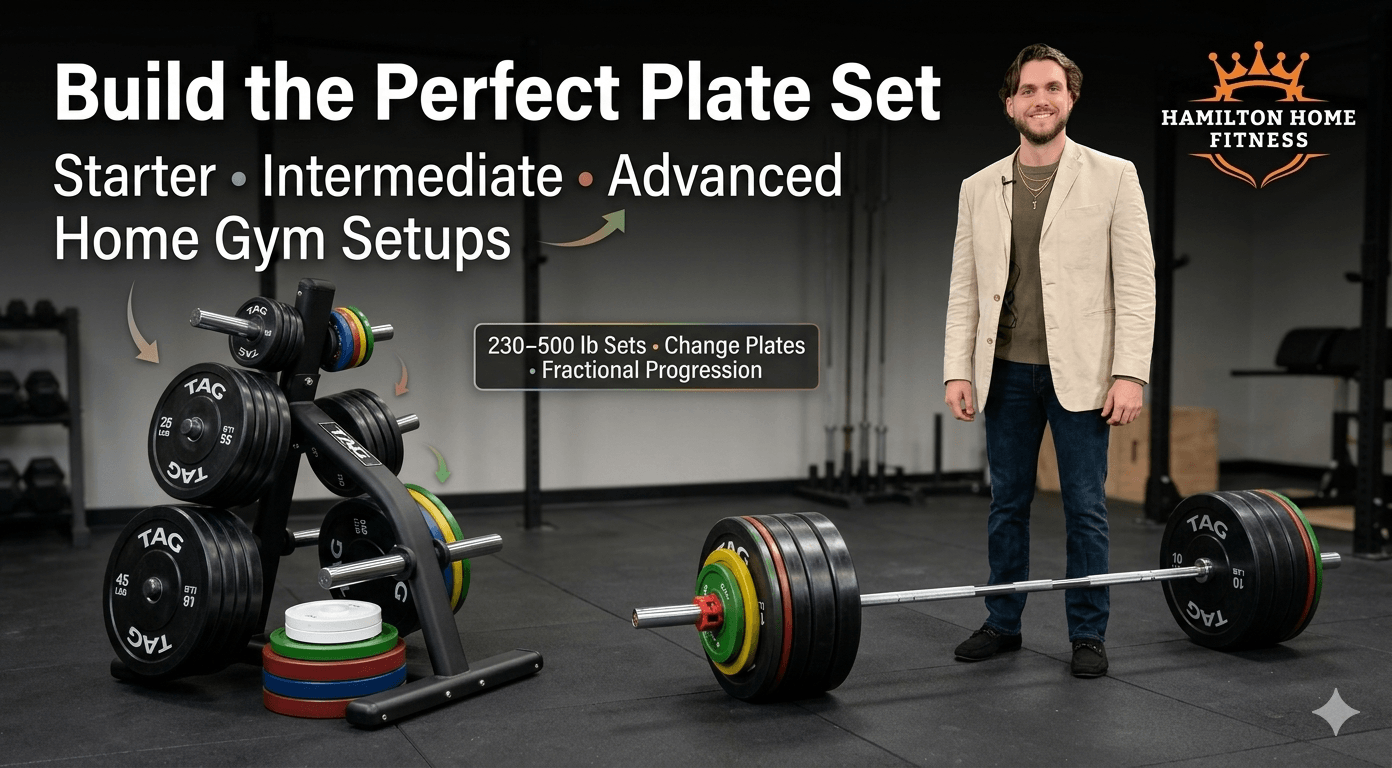
Starter, Intermediate, and Advanced Set Sizes
Starter sets run 230–260 lb (one pair each of 45, 25, 10, 5, and 2.5 lb), intermediate sets push to 300–370 lb, and advanced setups reach 500 lb or more with multiple 45 lb pairs.
A 230 lb starter set typically covers one pair of 45, 25, 10, 5, and 2.5 lb plates. With a 45 lb bar and collars, that puts your working ceiling near 235–240 lb—enough for most lifters in the first year of serious training.
A 260–300 lb intermediate set adds a second pair of 45s or a pair of 35s. Working ceiling climbs to 305–355 lb, which covers the squat and deadlift progression of most home lifters through years two and three.
A 370–500 lb advanced set runs three to five pairs of 45s plus the smaller progression plates. This is the tier where the bumper-versus-iron decision starts to bite, since five pairs of 45 lb bumpers fill the sleeve and leave no room for warm-ups. Most lifters at this tier go hybrid: bumper 45s on the outside, iron 45s inside.
For lifters pulling 500+ lb regularly, a 500 lb hybrid set with calibrated steel for the inside loaders is the cleanest build. To compare full configurations side by side, browse Hamilton Home Fitness's complete plate sets.
Change Plates and Fractional Plates
Change plates (0.5–2.5 kg) and fractional plates (0.25–2 lb) make small jumps possible for snatch progression, bench press grinding, and meet-specific attempts.
Change plates sit at competition kilogram increments: 0.5 kg, 1 kg, 1.5 kg, 2 kg, and 2.5 kg. Olympic lifters use them to add 1 kg total (0.5 per side) for slow snatch progression. Powerlifters prepping in kilograms use them to hit exact meet attempts.
Fractional plates are the pound equivalents: 0.25, 0.5, 0.75, 1, and 2 lb. They matter most on the bench press, where a 5 lb jump can stall a working set, but a 1 lb jump moves the bar forward. They also matter on the strict press and on accessory lifts where the gap between dumbbells is too wide.
Skipping them is one of the most common reasons trained lifters plateau on lifts that should still be progressing. A full fractional pair set is small money for the training mileage it returns.
Mixing Bumpers and Iron Safely
You can mix bumpers and iron on the same bar—load bumpers closest to the collar so they absorb the drop, place iron between the bumpers and the inside collar, and avoid dropping any bar loaded with iron from overhead.
Load Order: What Goes Where on the Bar
Place bumper plates on the outside of the sleeve so they hit the floor first; smaller iron plates go between the bumpers and the inside collar to protect the steel hub of the bumper from damage.
The reason is geometric. Bumpers are 450 mm; iron 45s are smaller. If iron sits outside the bumper, the smaller iron plate touches the floor first on a drop, transferring the full bar load into a plate not built to absorb it. The bumper hub also takes a hit from the iron plate's edge driving into it sideways.
Loaded correctly, the bumper is the only plate that touches the floor. The iron plates ride above ground level, the bumper absorbs the impact, and the bar sleeve stays straight. This is the same order most CrossFit affiliates and Olympic gyms use when they mix plates.
When Mixing Is a Bad Idea
Never drop a bar from overhead if iron plates are on the outside of the sleeve or if a smaller-diameter iron plate is the only plate touching the floor.
A few other situations call for stopping the lift instead of dropping it:
All-iron loadouts. No bumper means no drop. Lower the bar under control or use the safety pins.
Single-bumper-pair setups where the bumper is paired with a much larger iron plate that lands first.
Mismatched bumper diameters. Some 10 lb training bumpers run smaller than 450 mm; if those are the outermost plates on a heavy drop, the larger plates inside take the impact instead.
When in doubt, treat the bar as undroppable. A controlled lower onto safety arms or pins protects every plate, every sleeve, and every floor in the room.
What to Pair With Your Plates
Plates only perform as well as the bar that holds them, the floor they land on, and the rack that stores them—budget for all three before ordering the heaviest set.
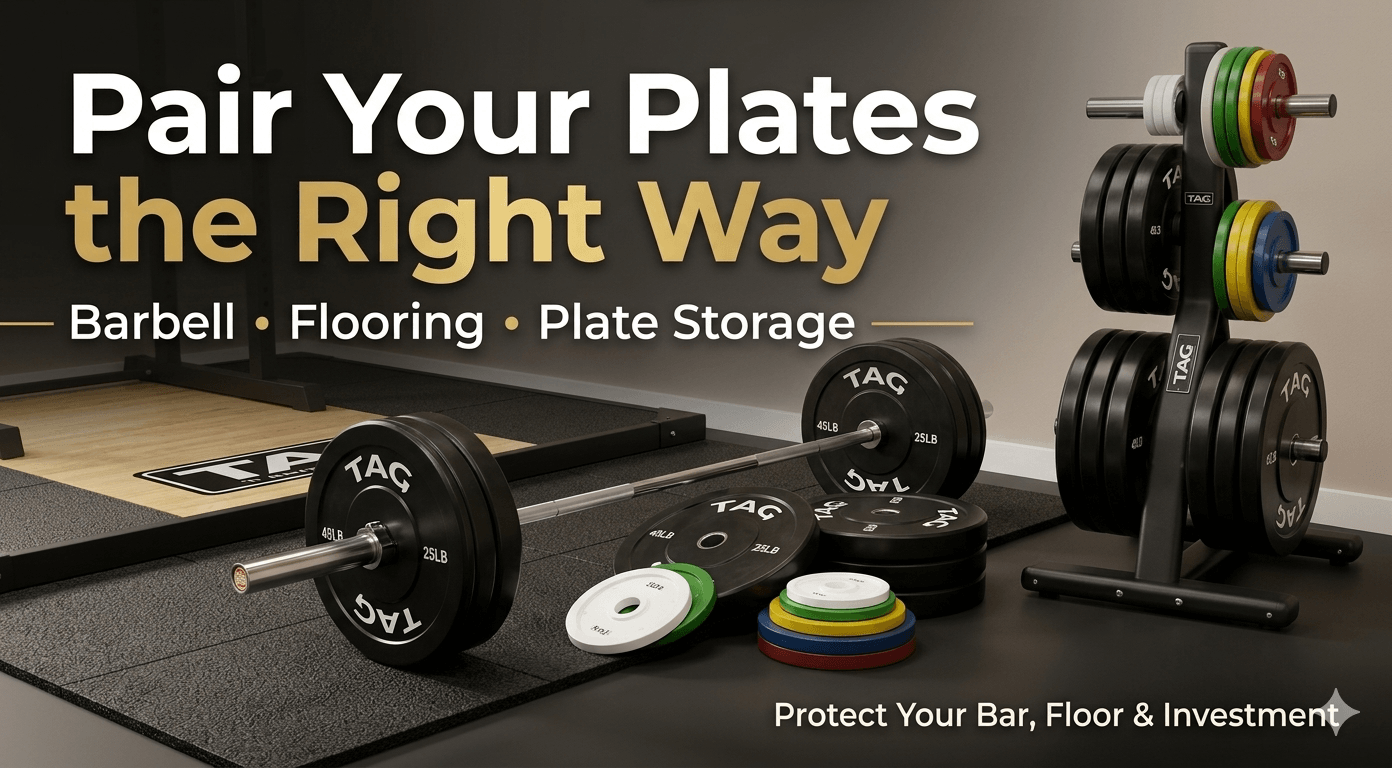
The Right Olympic Barbell
Match plate type to bar: a 28–29 mm men's bar or 25 mm women's bar with a 16.5-inch sleeve handles most home setups, while deadlift bars and squat bars solve discipline-specific problems.
A multi-purpose Olympic bar (28.5 mm shaft, dual knurl markings) handles squats, presses, cleans, and deadlifts without favoring any one lift. It's the right starting bar for hybrid setups.
A deadlift bar runs 27 mm with a longer shaft and more whip, letting the bar bend before the plates leave the floor—useful for max-effort pulls but wrong for cleans.
A squat bar runs stiffer (29 mm) with an aggressive center knurl and a longer shaft, built to sit stably on the back under heavy load.
A women's Olympic bar runs 25 mm with a shorter shaft and lighter weight (15 kg / 33 lb), built for lifters with smaller hands or for any lifter doing high-volume Olympic work.
Calibrated plates need a precision-spec sleeve. Budget cast iron and bumpers fit most quality Olympic bars without issue.
Flooring and Platform
Bumpers on three-quarter-inch rubber mats or a dedicated lifting platform protect concrete; iron plates demand mats or a deadlift platform even though they aren't meant to be dropped.
Three-quarter-inch horse stall mats are the budget standard for garage gyms. They handle bumper drops on concrete, dampen sound, and last years. Two mats butted together cover the lifting zone for most home setups.
Dedicated lifting platforms add a wood subfloor between rubber landing pads, which spreads the impact across a wider area and protects the concrete below. This is the right upgrade once drops become daily.
Deadlift platforms target the bar's landing zone with thicker rubber, useful even for controlled lowering of iron plates—repeated controlled drops still wear concrete over time.
A bare concrete floor with bumpers is workable in the short term but cracks plates and the slab faster than the savings justify.
Plate Storage
Vertical plate trees and horn-style storage keep plates off the floor, off the bar, and out of the walking path—a small purchase that protects a heavy investment.
A vertical plate tree holds plates by diameter on steel posts, keeps the floor clear, and stops bumper hubs from sitting flat on concrete (which slowly deforms cheaper rubber over time). Horns mounted to a power rack work the same way for lifters short on floor space.
For a dedicated vertical option built for a full Olympic plate progression, the Tag Fitness Olympic Plate Tree holds bumpers and iron together on one footprint.
FAQ
When do you actually need bumper plates instead of iron?
You need bumpers any time the bar will leave your hands above the hips—Olympic lifts, jerks, snatches, dropped deadlifts, and metcon transitions. Pure powerlifters who never drop the bar can train with iron alone.
What is the diameter and width difference between bumper plates, calibrated plates, and standard iron plates?
All quality bumpers are 450 mm in diameter regardless of weight. Calibrated steel plates and standard iron plates vary by weight. A 45 lb bumper is roughly 75–85 mm thick, a 45 lb calibrated steel plate is roughly 25–30 mm thick, and a standard cast iron 45 falls in between.
How much do bumper plates bounce, and is dead bounce worth the extra cost?
Training bumpers (durometer 80) bounce noticeably. Competition and urethane bumpers (durometer 88–90) give a dead bounce that keeps the bar near the drop spot. Dead bounce is worth the upgrade for Olympic lifters and CrossFit boxes; it's optional for casual home lifters.
Are urethane bumper plates worth the price over rubber or hi-temp bumpers?
Urethane is more durable, denser, lower-bouncing, and odorless—but typically costs 30–60% more than virgin rubber bumpers. It earns the premium in heavy-use commercial settings and outdoor garage gyms. For a typical home setup, quality virgin rubber bumpers are usually enough.
How many bumper plates do I need to deadlift 500 lb without iron?
On a 45 lb bar with two collars (~5 lb), you need 450 lb of plates—roughly five pairs of 45 lb bumpers, which fills most 16.5-inch sleeves. Many lifters add a pair of iron 45s on the inside to free up space and reduce sleeve bow.
Can you mix bumper plates and iron plates on the same bar safely?
Yes. Load bumpers on the outside (closest to the collar) so they hit the floor first, and place iron plates between the bumpers and the inside collar. Never drop the bar if a smaller-diameter iron plate is the outermost plate.
Why are competition bumper plates so expensive?
Competition bumpers meet IWF specifications: ±1% weight tolerance, strict 450 mm diameter, chrome or stainless steel hub, color coding, and a tested dead bounce. Those tolerances require denser materials, tighter manufacturing, and certification—costs that scale to the price.
Do bumper plates damage barbells?
Quality bumpers used as intended do not damage a quality barbell. Damage shows up when bumpers are dropped on bare concrete, when iron plates are mixed in the wrong load order, or when a budget bar's sleeve flexes under repeated drops.
Final Thought
Bumpers handle anything you drop. Iron handles anything you stack above the bumper ceiling. A hybrid set covers both—and matches how most serious home lifters actually train across powerlifting, Olympic lifting, and CrossFit.
The next step is to compare the bumper, crumb rubber, and competition tiers against the iron and calibrated options side by side, then add a plate tree so the heaviest line item on your invoice stays off the concrete. If your build needs a hybrid configuration tailored to your lifts, ceiling height, and floor, talk to the Hamilton Home Fitness team about a hybrid plate setup—we ship nationwide from Tennessee and can match the plates to the bar, rack, and platform you already own.