
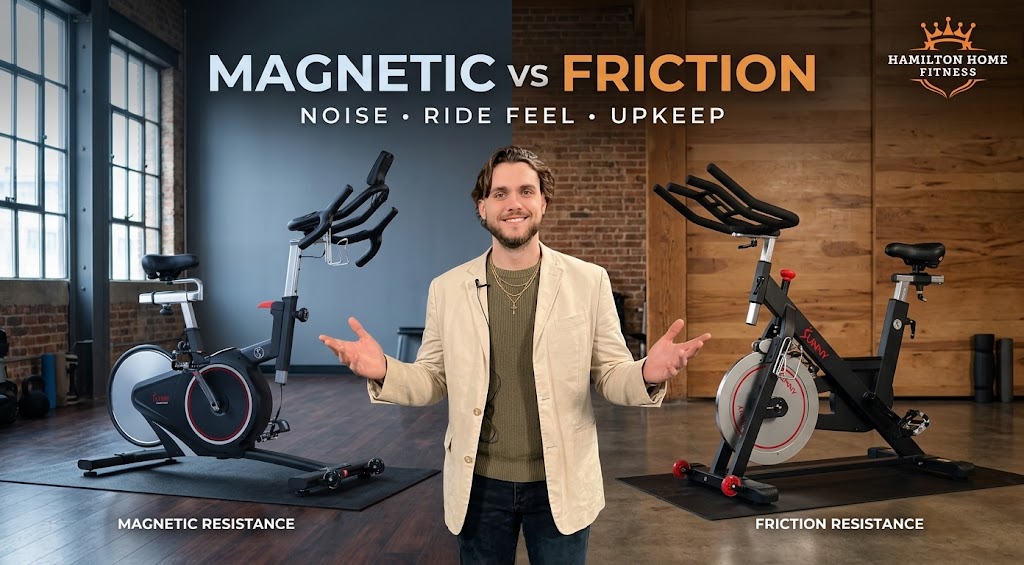
You've narrowed it to two or three spin bikes. One spec sheet says friction, another says magnetic, and someone at home is still asleep when you ride at 6 a.m. In the magnetic vs. friction spin bike choice, magnetic is quieter and has no pad to wear, while friction keeps firm drag at any pedal speed and needs a new pad now and then. Below: why they feel different, what neighbors hear, and how to read flywheel specs. Room Fit has its own ceiling height and floor space guide.
Which Spin Bike Resistance Is Better?
For most shared homes, magnetic resistance is the better choice. It is near-silent at the flywheel and has no pad to wear out. Friction still suits riders who want firm drag at slow pedal speeds and cheap, simple repairs.
Price doesn't have to decide it. At Hamilton Home Fitness, the friction Sunny SF-B1002 and the magnetic SF-B1877 at the same price are both listed at $329.99 (as of October 31, 2026). At that level, you're choosing upkeep and feel, not budget.
Choose magnetic for early or late rides in a shared home.
Choose magnetic for numbered levels you can repeat.
Choose friction if slow, heavy seated climbs matter most.
Choose friction if you'd rather replace a cheap pad than a magnet unit.
How Does Each System Slow the Flywheel?
The difference between a friction and magnetic spin bike is contact. A friction bike presses a felt or leather pad onto the flywheel as you turn the knob. A magnetic bike moves permanent magnets toward the spinning metal wheel, creating eddy currents (small swirling electric currents) that push back. Nothing touches.
Why Magnetic Drag Rises With Speed
Magnetic drag only exists while the flywheel moves. The faster the metal passes the magnets, the harder it pushes back, and a stopped wheel feels no drag at all.
That's why magnetic bikes gear the flywheel to spin fast, why slow seated climbs can feel lighter on some models, and why many keep a small pad as the emergency brake.
Is a belt drive the same as a magnetic one?
No. Belt drive is how your pedaling reaches the flywheel, while magnetic or friction is how the flywheel gets slowed, so a belt-drive bike can still use a pad.
The Sunny SF-B1002 belt-drive bike shows it: a belt turns a 49 lb flywheel while a leather pad supplies the drag. A chain, by contrast, needs oil and adds hum.
Which Is Quieter in an Apartment?
Is a magnetic spin bike quieter than a friction one? At the flywheel, yes. Magnets make almost no sound, while a pad whooshes softly and can squeal once it dries or glazes. Through a floor, the bigger noise comes from the frame.
That's why a magnetic vs. friction bike swap alone may not stop complaints. Neighbors usually hear thumps from a frame rocking during standing sprints, not pad hissing.
How to Stop Floor Vibration
Most floor noise from a spin bike comes from movement, so the fix is a steady bike on a dense mat. See how thick flooring needs to be under a bike.
Level the feet so the frame can't rock.
Lay a dense rubber mat under the whole bike.
Retighten frame bolts once a month.
Stay seated for early and late sessions.
How Do the Rides Feel Different?
Both types can feel smooth, because the flywheel does most of that work. The differences show at the edges: friction holds heavy drag even at slow pedal speeds, while magnetic gives clean steps that land in the same place every ride.
On a magnetic vs. friction resistance bike, you notice it when a class cue says "add a quarter turn." The micro-adjustable magnetic SF-B1805 makes those steps fine, with a 44 lb flywheel and a 300 lb max user weight, though at $599.99 it costs nearly double the entry pair.
Which Holds Interval Levels Better?
Magnetic resistance repeats better. Each knob position sets the magnets at the same distance from the flywheel, so a level feels the same next month, while a pad's bite changes as it wears.
Many friction bikes show no numbered levels at all. There, a quarter turn means whatever your pad allows today.
What Upkeep Does Each Type Need?
A magnetic bike needs almost nothing at the resistance: wipe off sweat and keep the belt and bolts in shape. A friction bike adds pad care. When parts fail, though, a magnet assembly costs more to fix than a pad.
When to Check or Replace a Pad
Check a friction pad about once a month, and replace it once it's worn thin, hardened, or still squealing after treatment. Some makers plan on a new pad every 6 to 12 months of regular riding; heavy use shortens that, and your manual comes first.
Back the knob off after each ride so sweat can dry.
Look for thin, hard, or shiny spots each month.
Treat the pad only as the manual says.
Replace it when it's worn thin or still squeals.
Felt pads usually take silicone spray; leather pads, like the SF-B1002s, take whatever the manual names.
What Flywheel Weight Should You Get?
Most spin bikes we list with a stated flywheel weight carry 40 to 49 lb. Within one design, heavier means a smoother, steadier stroke, but compare weights only between bikes built the same way.
Sunny's magnetic bike with a 7.36 lb aluminum flywheel costs the same $599.99 as the 44 lb SF-B1805. A light wheel geared to spin fast still carries real momentum. With clip-in-compatible pedals, it suits riders in cycling shoes, not tight budgets.
Does Weight Matter More on Friction?
Yes, the number tells you more on a friction bike. The pad's drag ignores speed, so weight mainly sets how smoothly the wheel carries you through each stroke. On a magnetic bike, speed shapes momentum and drag alike, so gearing matters as much as pounds.
Front or Rear Flywheel?
A front flywheel sits under your dripping sweat, which corrodes the wheel and soaks a friction pad. A rear flywheel stays out of that drip zone and needs less cleaning.
The front-flywheel Vortex VSB1200 shields its 20 kg (about 44 lb) flywheel with an anti-sweat cover for $795, shipped free, but its page doesn't state the resistance type.
The rear flywheel spin bike from Vortex, the VSB1225, keeps its magnets and belt out of the drip zone for $849.99, but it's on backorder for 2026.
Which Bike Fits Which Home?
Settle on the magnetic vs. friction spin bike choice by how and when you ride. Thin floors and early sessions point to magnetic, while heavy seated climbs on a tight budget can point to friction. Every pick must also clear your body weight.
Your home | Resistance to favor | Example to check |
Thin floors, early rides | Magnetic, belt drive | Sunny SF-B1877 |
Tight budget, heavy climbs | Friction | Sunny SF-B1002 |
Several riders, one bike | Magnetic, fine steps | Sunny SF-B1805 |
Rides in cycling shoes | Magnetic, clip-in pedals | Sunny 7.36 lb flywheel model |
Sweaty garage or basement | Rear or covered flywheel | Vortex VSB1225 or VSB1200 |
For a bike that lives in a garage or basement, Gym Space Guide explains why gym equipment rusts in a garage and how to stop it.
To widen the search, compare every exercise bike we carry and filter by brand.
The Schwinn IC4 magnetic bike lists a 330 lb max user weight and is sold by private invoice, so call 423.458.2453 or request a quote.
Before ordering, check max user weight: the SF-B1877 lists 265 lb and the SF-B1002 275 lb. Neither Vortex page lists one, so ask our team for the missing specs.
FAQ
Do spin bikes need electricity?
No, not friction bikes or manual-knob magnetic bikes. Your pedaling drives the resistance, and the console usually runs on batteries. Motorized resistance or a built-in screen needs an outlet. For outlet-free rooms, see other cardio machines that run without an outlet.
Is a spin bike good for knees?
For most people, yes, because cycling has no landing shock. Knee strain usually comes from a saddle set too low or from grinding heavy resistance at a slow cadence. With knee pain or a recent injury, check with a doctor or physical therapist first.
Can a friction spin bike work with cycling apps?
Yes, for apps you follow along with: add a Bluetooth cadence sensor and a chest-strap heart rate monitor. It can't send accurate watts, though, because nothing measures the pad's drag. Power-based apps such as Zwift need power pedals or a smart bike.
Final Thought
Magnetic suits quiet shared homes and repeatable levels; friction suits riders who want firm, slow-speed drag and don't mind pad care. Choose the resistance, read the flywheel number in context, and confirm max user weight. Then call 423.458.2453 with the model number for anything a page leaves out.